All topics: trading questions and answers
Understand trading products, orders, currency markets, company information and bonds. Each short answer links to its written explanation.
1. How an exchange operates
Exchange vs broker
How is an exchange different from a broker?
An exchange organises trading between participants. A broker provides a client with access to markets and handles orders. They perform different roles.
Market participants
Who trades on financial markets?
Participants include individuals, banks and investment funds. Brokers, market makers and clearing organisations help provide access, liquidity and settlement.
Company shares
What is a share?
A share represents part ownership of a company. Its voting and payment rights depend on the share class and issue terms. Neither owning a share nor its class guarantees a dividend.
Exchange-traded assets
What can be traded on an exchange?
Different exchanges list different products, including company shares, bonds and futures on currencies, commodities or indices. Check the exact product: ownership of an asset and a contract position give different rights.
Last traded price
What does the price on an exchange mean?
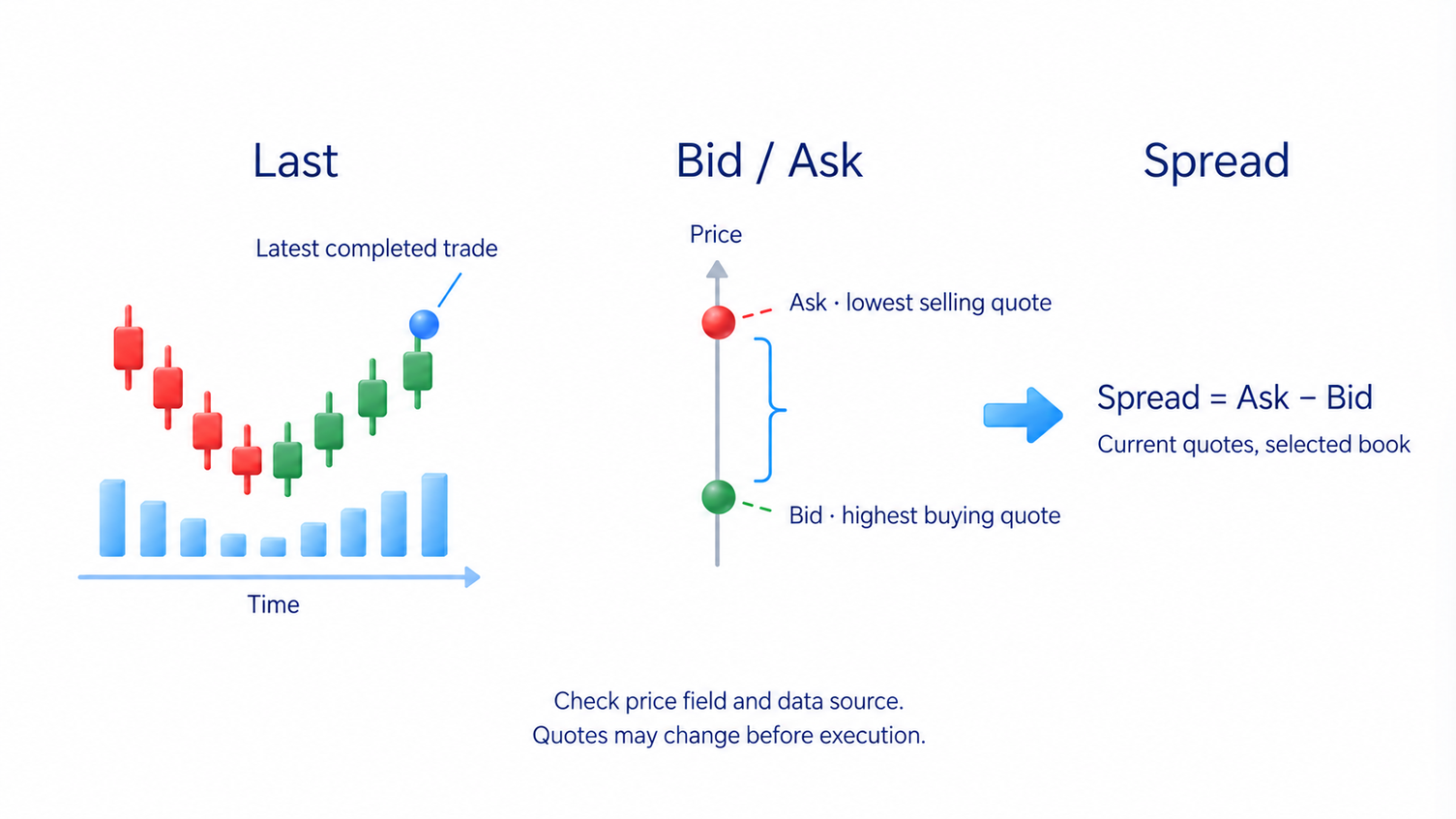
A trading screen may show Last, Bid or Ask. Last is the latest completed trade price; Bid and Ask are buying and selling quotes. Check which price field and data source the screen uses.
Order book basics
What is an order book?
It lists available buy and sell orders at different prices. Orders waiting at a price can be matched with orders seeking immediate execution.
Trade clearing
What is clearing?
Clearing organises the obligations created by a trade and helps manage the risk that a participant fails to pay or deliver. It is part of how an exchange market operates.
Busy trading hours
When does Arapov prefer to trade?
In his session lesson, Arapov highlights the European-US overlap and advises beginners to distinguish active hours rather than watch the screen all day. Check the chosen instrument’s schedule and actual trading conditions; this is not a universal session rule.
Share dilution
What is share dilution?
If additional shares of the same class are issued, a holder keeping the same number can own a smaller percentage of that class. Buying enough additional shares can maintain the percentage. The change does not by itself show that the company’s total value fell.
Common vs preferred shares
How are common and preferred shares different?
Common shares generally provide voting rights. Preferred shares may have priority for dividends or other rights defined by their terms; the label alone does not guarantee payments.
2. How trades move prices
Supply and demand
Why do market prices move?
Later trades can occur at higher prices when buyers accept higher offers after lower-priced quantity has traded or been withdrawn. Selling can similarly reach lower bids. Every completed trade has both a buyer and a seller.
Bid, ask and spread
What are bid, ask and spread?
Bid is the highest available buying quote and ask the lowest available selling quote in the selected book. Their difference is the spread. They can change before your order executes.
Spread costs
Why does the spread matter for small trades?
The spread is a cost relative to the price move you seek. It can take a large share of a small target price move even when it seems minor for a longer trade.
Liquidity and slippage
What happens when a market has low liquidity?
It may be harder to trade the desired size without moving price. Spreads can widen and the execution price can differ from the price expected.
Market volatility
What is volatility?
Volatility describes the size of price fluctuations, not their direction. Average True Range (ATR) measures recent price ranges, including gaps. It does not predict the direction of the next move.
Market maker
What does a market maker do?
A market maker provides buy and sell quotes and helps other participants trade. Its role is to provide liquidity, not necessarily to target an individual trader's stop.
3. Placing and managing orders
Types of orders
What types of trading orders are there?
The basic types include market, limit and stop orders. They differ in how they balance execution speed, price control and activation conditions.
Market order
What is a market order?
A market order seeks a trade at available opposing prices without a limit price chosen by the trader. The final price can differ from the quote, and available quantity or venue restrictions can prevent immediate completion.
Limit order
What is a limit order?
A limit order sets the highest purchase price or lowest sale price you will accept. It may fill immediately, partly or not at all; touching the limit on a chart does not guarantee execution.
Buy stop vs sell stop
How do buy stop and sell stop orders work?
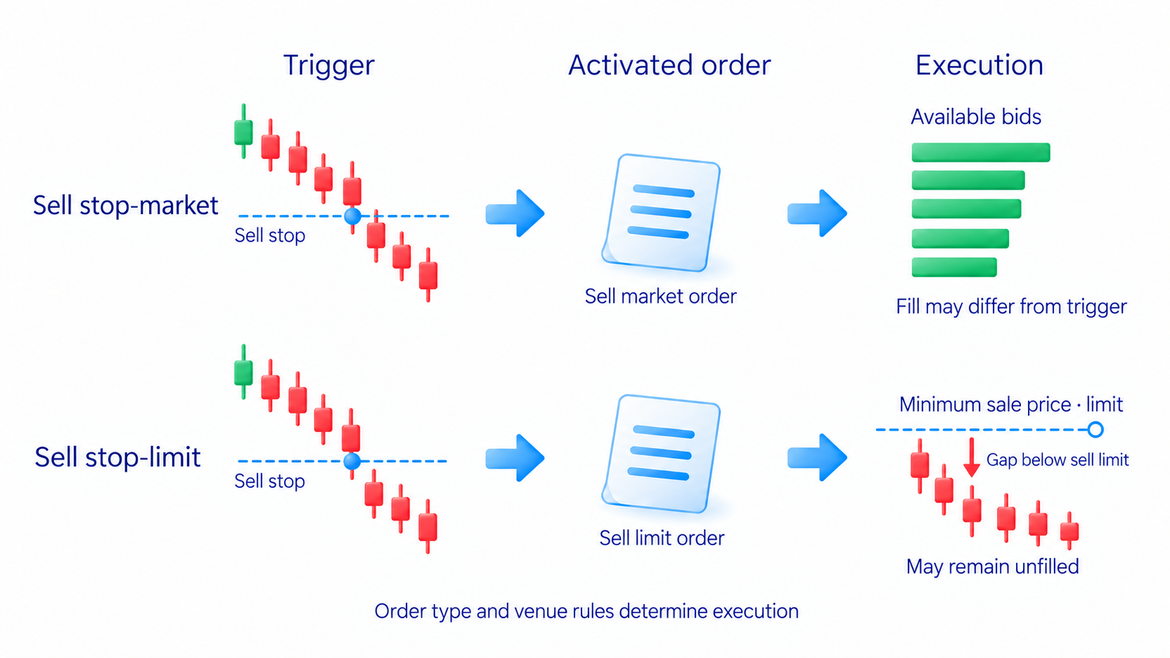
A buy stop activates above the current price; a sell stop activates below it. After the trigger, execution follows the order type and venue rules.
Stop-limit vs stop-market
How is a stop-limit different from a stop-market?
A stop-limit activates a limit order, which may remain unfilled. A stop-market seeks execution at available prices, so its final price can differ from the trigger.
Protective stop-loss
Where does Arapov place a stop-loss?
In the course’s buying example, Arapov puts the protective exit below the low of the completed pullback, a temporary decline after a rise, used to justify the entry. He calculates quantity from the chosen loss budget and stop distance. The stop does not guarantee an exact exit price.
Stop hunting
Why can price move through obvious stop levels?
Many traders may place protective orders around visible highs and lows. When stop-market orders activate, their buying or selling can accelerate a move if opposing quantity is limited. A move through a level does not prove that someone deliberately targeted the stops.
Trailing protection
How does a trailing stop work?
A trailing stop adjusts its trigger as price moves in the trade’s favour, using a specified distance. For a purchase, it moves up with the reference price and does not move down when that price falls. Platform rules and available prices determine execution; profit is not guaranteed.
Iceberg order
What is an iceberg order?
An iceberg order displays only part of its total quantity. Hidden quantity replenishes the displayed portion under the venue’s rules. Repeated trading at a price can suggest replenishment, but a normal chart does not identify the owner or prove the total hidden size.
Order splitting vs spoofing
How is splitting an order different from spoofing?
Splitting divides a genuine trade into smaller orders. Spoofing uses orders placed without a genuine intention to execute them to mislead other participants. Cancelling an ordinary order does not by itself prove spoofing.
Order duration
What do Day, GTC, IOC and FOK mean?
Day expires after the specified session. GTC means good till cancelled, subject to the broker’s expiry rules. IOC means immediate or cancel: fill available quantity now and cancel the rest. FOK means fill or kill: complete the whole order immediately or cancel it.
OCO orders
What is an OCO order?
OCO means one cancels the other: it links two orders so that filling one causes the other to be cancelled. A profit target and protective exit are a common pair. Check partial-fill and cancellation rules; the setting does not remove every execution or technical risk.
4. Trading currencies
Forex basics
What is Forex?
Forex is the market for exchanging currencies. Prices are quoted in pairs, such as EUR/USD, showing one currency's value in another.
Forex participants
Who are the main participants in Forex?
Central banks, commercial banks, other institutions and individual traders participate. Their roles and trading sizes differ, so retail activity is only part of the market.
Forex vs stocks
How is Forex different from stock trading?
A share represents ownership in a company; a currency pair expresses one currency’s price in another. Shares can trade on or off an exchange, while currency products can be over-the-counter or exchange-traded. Compare the actual product, venue and trading hours.
Long and short positions
How do long and short positions make money?
Buying a currency pair benefits when its first currency rises against the second; selling benefits when it falls. Quantity, actual entry and exit prices, fees and financing determine the account result.
Forex swap
What is a Forex swap charge?
It is an overnight financing adjustment that can be a charge or credit. The terms depend on the pair and broker and can affect trades held for several days.
Leverage and margin call
What are leverage, a margin call and a stop-out?
Leverage lets a trade be larger than the funds put up to support it. Taking a larger trade increases the cash effect of a currency move. A margin call concerns insufficient supporting funds; a stop-out is forced closure under the account rules.
Currency risk
What is currency risk?
Currency risk is the possibility of a loss from an exchange-rate move. Several open currency pairs can depend on the same currency movement, so their risks may overlap.
Carry trade
What is a carry trade?
A carry trade seeks income by funding in a lower-interest currency and holding an investment in a higher-interest one. An unfavourable exchange-rate move can outweigh the income. The product’s actual financing terms determine any charge or credit.
Forex trading sessions
Which Forex sessions does Arapov focus on?
In his session lesson, Arapov highlights European-US activity and recommends separating working hours rather than watching the screen all day. The useful window still depends on the pair and actual trading conditions.
US Dollar Index
What is DXY used for?
DXY shows the dollar’s movement against a basket of six currencies. It gives broad currency context, but does not supply a trade entry. EUR/USD materially influences the index, so comparing them is not an entirely independent confirmation.
Pips in Forex
What is a pip?
A pip is a conventional price-change unit, usually 0.0001 or 0.01 when yen is the quote currency. It is not always the smallest displayed price step. Its cash value depends on quantity, the pair and the account currency.
Major, cross and exotic pairs
What types of currency pairs are there?
Major pairs include the US dollar; cross pairs do not. Exotic pairs include less widely traded currencies. These categories do not guarantee predictable price behaviour.
5. Understanding economic events
Fundamental analysis
What is fundamental analysis?
It examines a business and its economic environment to assess an asset’s value and factors that could change it. The evidence depends on the asset; an assessment does not promise an exact future price or trade entry.
Economic market drivers
What economic events can move markets?
Company results, central-bank decisions, inflation and employment releases can change expectations of income, costs and financing. Their effect depends on the asset and what participants already expected.
Economic data surprises
Why does the same economic report cause different reactions?
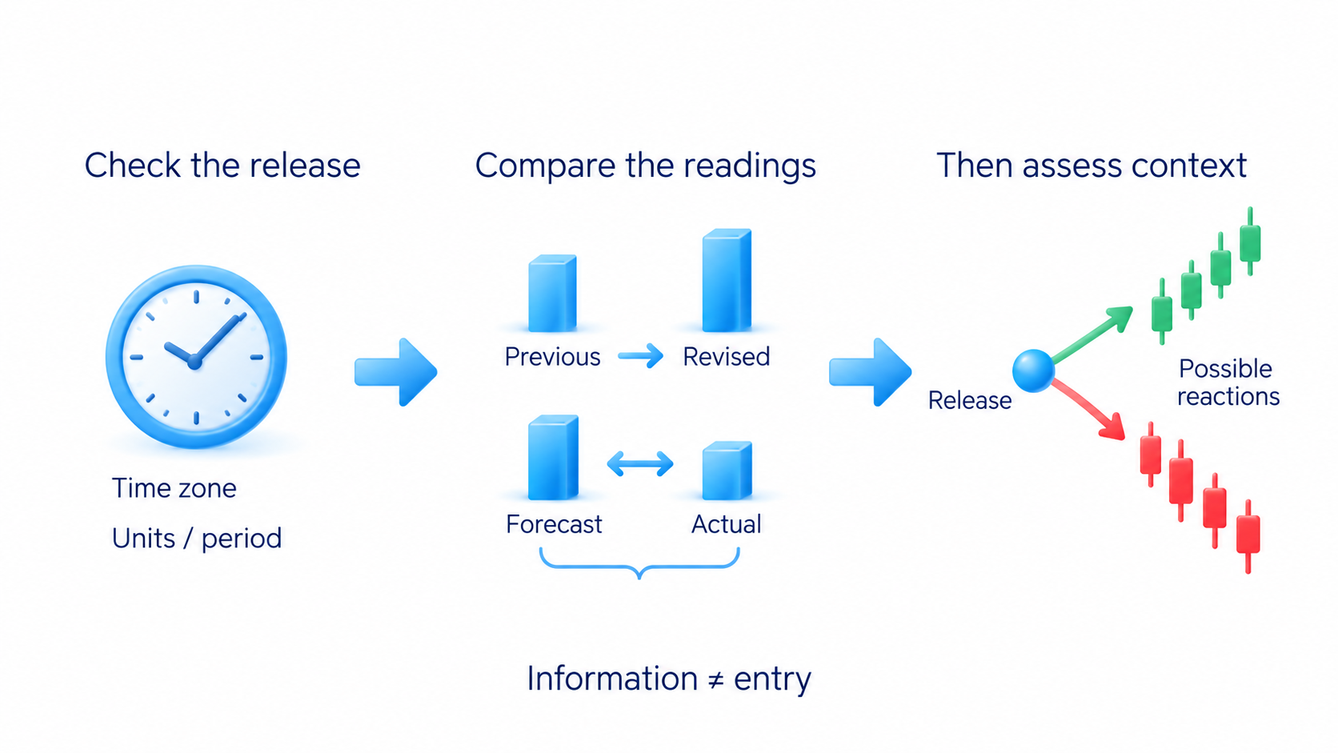
Markets compare the release with what was expected. A strong-looking number can still disappoint if participants had expected more.
Central-bank interest rates
How can interest rates affect markets?
Rates affect borrowing costs and assessments of future earnings. Relative conditions matter for currencies, and bond payments must be compared with the return buyers require. A rate change alone does not determine the direction of every asset.
Risk-on vs risk-off
What do risk-on and risk-off mean?
Risk-on describes greater willingness to hold risky assets. Risk-off describes a shift towards perceived safety. These are broad market conditions, not individual trade signals.
Economic calendar
What is an economic calendar?
It lists scheduled releases, previous readings, forecasts and publication times. Verify the time zone and units, compare the actual result with the forecast and check any revised previous value. It supplies information, not a buy or sell instruction.
Market expectations
Why do prices move before news is announced?
Participants trade on expectations as well as published facts. By the time news arrives, part of its possible effect may already be reflected in price.
Trading around news
Why does Arapov wait after major news?
The available course explanation does not establish a personal rule of waiting after major news. It recommends learning chart structure and trading activity before relying on economic forecasts. A release can change price and execution conditions rapidly, so the report alone does not establish an entry.
COT report
What does the COT report show?
It reports holdings on specified futures markets by participant category. Tuesday’s data are generally released on Friday. Categories do not disclose every trader’s intention, and the delayed figures do not determine a trade entry.
6. Gold, oil and stock indices
Gold trading
What is XAU/USD?
XAU/USD quotes gold in US dollars, usually per troy ounce. The label does not identify the product: check whether it is physical metal, a fund, a future or a CFD.
WTI vs Brent
How are WTI and Brent different?
Brent and WTI are different crude-oil benchmarks with different delivery markets and contracts. Supply, demand, production decisions, transport and inventories can affect their prices and the gap between them. Compare suitable contract months and sources.
Stock indices
What is a stock index?
A stock index is a calculated measure of a selected group of shares. It is not itself a security. Funds and futures provide different ways to follow it, with different ownership, costs and contract requirements.
Trading different assets
Can the same chart-reading approach be used on gold, oil and indices?
Levels, volume and price reactions can be examined on different charts. Applying the course’s tools to another market still requires checking that market’s data, contract size, costs and trading hours.
Oil inventory reports
Why do traders watch oil inventories?
Inventory data adds information about available supply. The EIA report covers the US oil balance, not the entire world market. Compare the figures with expectations and the rest of the report rather than treating one change as a trade signal.
7. Buying assets and trading contracts
Derivative contracts
What is a derivative?
A derivative is a financial contract whose value and payments depend on an asset or another reference, such as an interest rate. Its terms determine the rights and obligations you take on.
Futures contract
What is a futures contract?
A futures contract is a standardised agreement to buy or sell an asset at a price agreed now, for delivery or settlement at a future date. Some contracts settle in cash rather than by delivering the asset.
Spot vs futures
How is spot trading different from futures?
Spot involves buying or selling the asset itself. Futures involve a contract linked to it, with funds pledged to support the contract and settlement rules that can add leverage and forced-closure risk.
Futures margin risk
Does a small margin mean a small risk?
No. Margin is funds or eligible assets pledged to support a position, not its maximum loss. Price changes affect the full quantity traded. A small initial amount can therefore accompany a much larger percentage loss on those supporting funds.
Learning spot first
Why is a fully paid spot purchase simpler to understand than futures?
A fully paid spot purchase buys the asset using your own funds. Futures add contract quantity, funds pledged to support the contract and settlement rules. Borrowed spot trading can also require supporting funds, so check the exact product rather than relying on the spot label.
Swap contracts
What is a swap contract?
A swap contract exchanges payments under agreed rules, for example fixed-interest payments for payments based on a changing rate. It is different from the overnight charge or credit called swap in a retail Forex account.
Options vs futures
How is an option different from a future?
An option buyer pays for a right they do not have to exercise. A futures contract creates obligations under its terms, so the risks and settlement work differently.
Forward vs futures
How is a forward different from a future?
A forward has individually negotiated terms. Exchange-traded futures have standard specifications and exchange-based settlement arrangements.
Margin shortfall
What happens when a futures account runs short of margin?
The account may need more funds or eligible assets to support its positions, or a reduction in trade size. The broker or platform can close positions under its rules; a warning in time to respond is not guaranteed.
8. Understanding debt investments
Bonds vs shares
How is a bond different from a share?
A bond represents a debt owed by whoever issued it under specified payment terms. A share gives ownership in a company. The holder’s payment rights and risks differ.
Bond prices and rates
Why can bond prices fall when interest rates rise?
For a simple fixed-payment bond, other things equal, new bonds offering more attractive returns can make an existing lower-paying bond less valuable. Its price and yield therefore tend to move in opposite directions.
Coupon vs bond yield
How is a coupon different from yield?
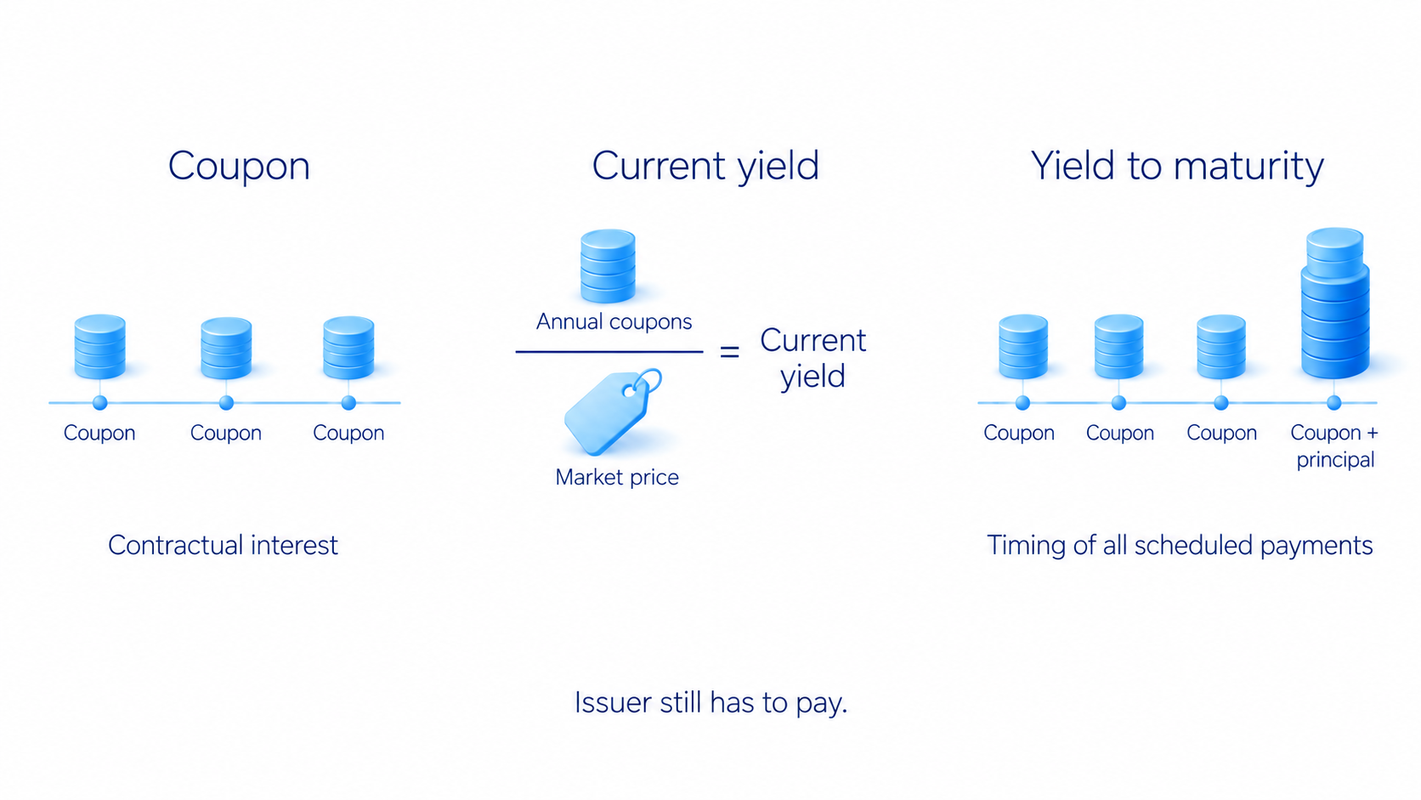
The coupon is the bond’s contractual interest payment. Current yield compares annual coupons with the market price; yield to maturity also considers when scheduled payments and repayment arrive. The borrower still has to make those payments.
Bond risks
Can I lose money on a bond?
Yes. The borrower may fail to pay, a sale before maturity can occur below the purchase price, and inflation can reduce the purchasing power of payments. Currency, limited trading activity and early repayment create additional risks.
Bond yields and markets
Why do traders watch bond yields?
Yields describe the returns buyers require for future debt payments. They provide context about rates, expectations and credit conditions, but do not by themselves determine a trade entry.
Bond duration
What does bond duration measure?
Modified duration estimates a bond’s price sensitivity to a small yield change. Other things equal, a higher value means a larger price response. It does not measure or remove every bond risk.
Inverted yield curve
What is an inverted yield curve?
An inverted yield curve has higher short-maturity yields than longer-maturity yields for comparable debt. It can reflect expectations of lower future rates or weaker conditions, but does not establish a recession date or trade entry.
Corporate bond spread
What is a corporate bond yield spread?
A corporate bond yield spread is the yield gap between the corporate bond and a suitable government reference. Compare similar currency, maturity or duration, and repayment rights. A wider gap can reflect credit or trading risk rather than a bargain.
About these learning materials
This section draws on the ArapovTrade library and Igor Arapov’s educational videos. It offers definitions, instrument comparisons, explanations of market mechanics and the author’s trading approach.
The library’s author is Igor Arapov, a practising trader since 2013. The detailed lessons explain each subject in context; these short answers provide a starting point.




