All topics: trading questions and answers
Understand crypto assets, transfers, storage, service arrangements and common loss mechanisms. Each short answer links to its written explanation.
1. Getting started with crypto
Cryptocurrency basics
What is cryptocurrency?
It is a digital asset whose transfers are recorded under a computer network’s rules. Its purpose, supply and holder rights depend on the particular asset. Buying it does not guarantee income.
Blockchain transactions
What is a blockchain?
It is a shared record maintained across a network of computers. Check transfer details carefully: a mistaken crypto transfer is generally not reversed like a bank payment.
Bitcoin, altcoins and stablecoins
How are the main types of cryptocurrency different?
Bitcoin has a limited supply; Ethereum supports applications. Other cryptocurrencies are commonly called altcoins, while stablecoins aim to track a reference such as a currency.
Crypto market risks
How is crypto trading different from other markets?
Many crypto markets trade around the clock on separate platforms, but service and withdrawals can still be interrupted. Check the exact product, the company serving the account and how the assets are stored; market access and custody are different questions.
Choosing a crypto exchange
What should I check before choosing a crypto exchange?
Check the company, country and service scope, purchase/sale/withdrawal charges, minimums and supported networks. Buying availability does not establish withdrawal availability. Exchange storage depends on the company; self-custody requires protecting and recovering your own access.
First crypto trade
What should I plan before buying crypto?
Choose the product and pair, quantity, entry condition, permitted money loss and exit instruction before ordering. Protective stops do not guarantee an exact sale price; a stop-limit can remain unfilled. Check actual fills rather than treating the intended price as the result.
Crypto chart analysis
How does Arapov analyse a crypto market?
The available course material does not establish a compulsory private crypto routine using issuance, halvings and Bitcoin dominance. Standard written checks here identify the exchange, product, chart interval and volume units, compare price with activity, and distinguish a capitalisation ratio from direct money flows.
Crypto demo trading
Why practise crypto trading on a demo account?
A demo account helps practise order entry and rules without losing real trading funds. The course treats unprepared movement to real money as a mistake. Demo execution and emotions can differ from live trading, and practice does not verify a platform’s ability to safeguard funds.
KYC checks
What does KYC mean?
KYC means Know Your Customer: a service checks a customer's identity. Passing identity checks does not, by itself, prove that an exchange is reliable.
2. Keeping keys and funds secure
Hot vs cold wallet
How are hot, cold and exchange wallets different?
A hot wallet uses keys in an online environment; cold storage keeps signing keys offline. A hardware wallet can keep keys inside a device. With an exchange account, the service generally controls the keys. These arrangements create different access and recovery responsibilities.
Hardware wallet
What does a hardware wallet protect?
A hardware wallet keeps its private key, the secret used to authorise transactions, inside the device while signing. It cannot make a harmful action safe. Check the transaction details and protect the recovery words that restore access.
Seed phrase
Why should I keep my seed phrase offline?
A seed phrase is a set of recovery words that can restore access to wallet accounts. Someone obtaining it may control the assets. Photos, cloud copies and entering it into an unsolicited site can expose it; use the wallet’s official recovery procedure.
Wallet backup
How should I prepare a wallet backup?
Record the recovery words accurately and keep separate protected copies. Use the wallet’s official backup-check procedure before relying on them, and verify any passphrase and compatibility requirements.
Exchange vs personal wallet
Should I keep all my crypto on an exchange?
An exchange controls its keys and withdrawal process, so a failure or suspension can affect your holdings. With a self-custodial wallet, you control the keys and must protect the access needed to recover them. Check the arrangement and its risks before depositing.
Multisignature wallet
What is a multisignature wallet?
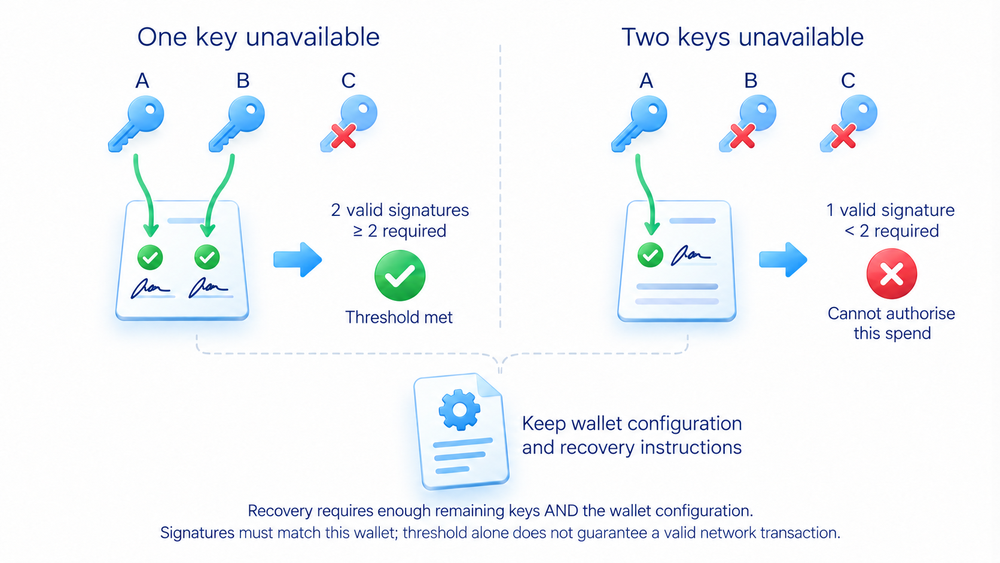
A multisignature wallet uses multiple signing keys and a chosen number of required signatures, for example two out of three. Access can remain available after a lost key if enough other keys and the wallet’s configuration remain available.
3. Tokens linked to a reference price
Stablecoin peg
How does a stablecoin keep its price stable?
Different designs use reserves and redemption arrangements, assets committed to back issued tokens under program rules, or changes in supply and exchanges for a related asset. These mechanisms aim at a reference price, often one US dollar, but do not guarantee that it will hold.
USDT vs USDC vs DAI
How are USDT, USDC and DAI different?
USDT and USDC depend on their issuers and reserve arrangements. DAI uses software rules and assets committed to support those rules, which can include outside assets and issuers. Compare backing, redemption access and control rights rather than treating all three as interchangeable dollars.
Tether reserves
Why do USDT reserves matter?
Reserve assets help support the ability to redeem, but the report and redemption terms answer different questions. Check the reporting date, asset categories, scope, eligibility and possible suspension conditions. The available course evidence does not establish a personal USDT-reserve examination routine.
Stablecoin control risks
How do centralised and decentralised stablecoin risks differ?
A centralised design depends on its issuer’s backing and control rights. A protocol-based design depends on software rules and assets committed to support them, and may still rely on outside issuers. Neither removes all risk.
UST collapse
What did the UST collapse show?
UST lost its dollar-price link in 2022. Its failure shows that a stated reference price is not a guaranteed sale or redemption value. The relevant question is how that particular design is supported; it does not establish that every stablecoin has the same mechanism or that Arapov personally analysed that episode.
Frozen stablecoins
Can a stablecoin issuer freeze my tokens?
Some centralised tokens allow an issuer to freeze transfers at particular addresses. The possibility depends on the contract and the issuer's control rights.
USDT transfer network
Why must I choose the correct network when sending USDT?
The same token name can be used on different blockchains. The sender and receiving service must support the selected network, or funds may become inaccessible.
4. Crypto contracts and leverage
Perpetual futures
How is a perpetual contract different from a regular future?
A perpetual contract has no scheduled expiry date. A regular future has contract expiry terms. Neither contract gives you ownership of the underlying cryptocurrency.
Funding rate
What is a funding payment?
Funding is a payment between trades opened for a rise and trades opened for a fall, rather than simply an exchange fee. Who pays, the rate and timing depend on the contract. The payment direction can change.
Crypto leverage
How does leverage change gains and losses?
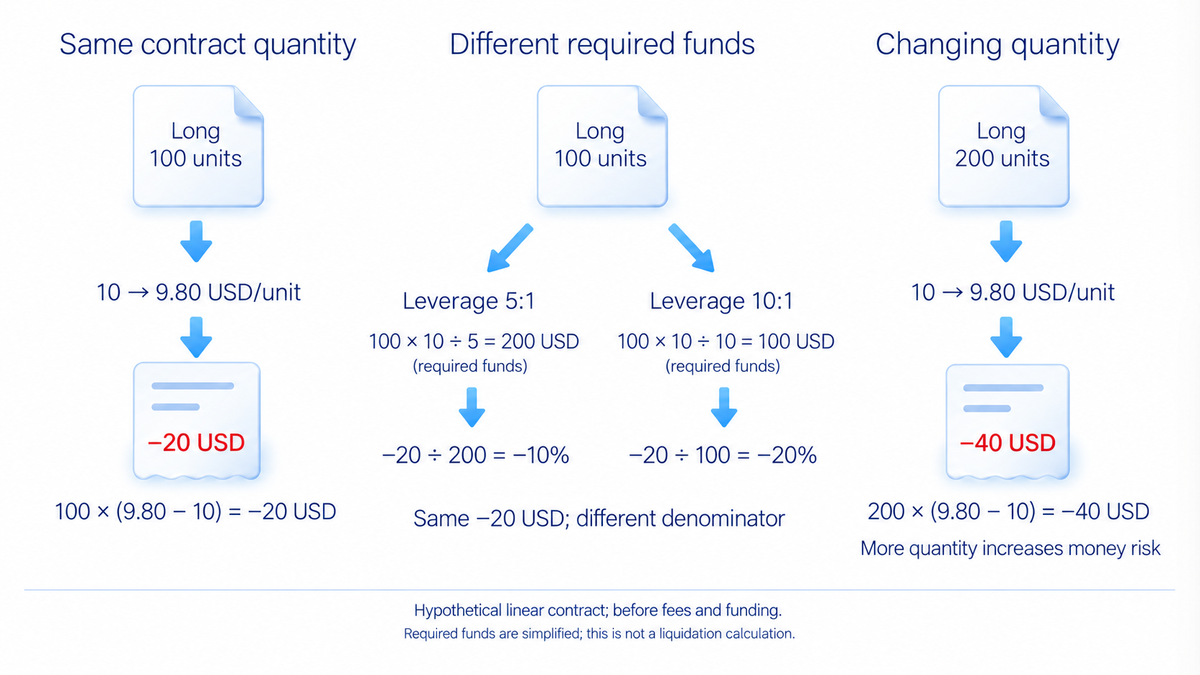
For the same contract quantity, leverage does not change the money gained or lost from the same price move. It reduces the funds required to open the position, so the result can be larger relative to those funds. Increasing the quantity increases monetary risk.
Liquidation price
Why does higher leverage bring liquidation closer?
If higher leverage lets you open the same position with fewer funds and you commit only that smaller amount, the same position has less room for an adverse move, other things being equal. The actual liquidation threshold also depends on maintenance and account rules; leverage alone does not fix it.
Liquidation cascade
What is a liquidation cascade?
Forced closures add orders to a moving market. Those orders can push price further and trigger more closures, amplifying the move.
5. Financial services on a blockchain
DeFi basics
What is DeFi?
DeFi provides financial operations through programs on a blockchain, a shared record of network transactions. You sign actions with a crypto wallet. Before committing funds, establish where the assets go and what conditions govern getting them back.
CeFi vs DeFi
How is CeFi different from DeFi?
CeFi relies on a company to manage the service and custody. DeFi uses blockchain applications and wallet interaction, changing who controls access and which risks you face.
DeFi building blocks
What services make up DeFi?
They include token exchanges, lending, stablecoins and data feeds called oracles. Connected services can pass a problem from one component to another.
DeFi swaps and pools
What can I do in DeFi?
Applications can offer token swaps, borrowing, lending and adding assets to pools used for other users’ swaps. High promised returns can involve high risks rather than a guaranteed income.
Smart-contract risk
Can an audited DeFi app still lose funds?
Yes. A code audit examines a particular version and can find weaknesses without guaranteeing their absence. Price data, linked assets, spending permissions and later changes can still cause losses. The available course explanation does not establish a private DeFi-app rule.
6. Supporting a Proof of Stake network
Crypto staking
What is staking?
Staking commits coins under a network’s rules to help confirm transactions in a Proof of Stake system. Rewards come with network, asset and service risks. It is not a guaranteed bank deposit.
Bitcoin vs Proof of Stake
Can Bitcoin be staked like Ethereum?
Bitcoin adds blocks through computational work, called Proof of Work, rather than native staking. Products advertised as Bitcoin staking use separate service or network arrangements; read what happens to the coins instead of assuming they participate in Bitcoin’s own block confirmation.
Validator vs delegation
How is running a validator different from delegating?
Running a validator means operating equipment and software that check network blocks. Delegation assigns coins to a validator without operating it yourself. A custodial service adds dependence on the company holding and managing the coins; the arrangements have different duties and risks.
Unbonding and slashing
What are unbonding and slashing?
Unbonding is leaving staking and can involve a wait or withdrawal queue. Slashing reduces committed funds for specified validator violations. An ordinary missed-duty penalty is not always slashing; both exit and penalty rules depend on the network.
Staking risks
Can staking rewards be outweighed by losses?
Yes. The coin's price can fall more than the rewards earned. A positive reward amount therefore does not by itself mean a positive total result.
7. Understanding token supply
Tokenomics
What is tokenomics?
It is a token’s economic design: issuance, distribution, uses and incentives. It helps explain which units are available, who may receive more and what a holder can do with the token. Those rules do not predict a future price by themselves.
Token supply and distribution
What should I check in a token's supply design?
Check the token’s purpose and holder rights, supply date and source, the supply figure used in fully diluted valuation (FDV), which applies the price to the provider’s broader supply figure, the next available portion and its recipient, and who can change the rules. Reconcile the documents with network records and the provider’s method before using the figures.
Token unlocks
What are vesting, cliffs and token unlocks?
Vesting is a schedule for releasing tokens; an unlock makes restricted tokens available. A cliff is an initial waiting period before tokens become available under the schedule. A first release may occur when that period ends.
Token design examples
Why compare Bitcoin, ETH and LUNA tokenomics?
They show different issuance mechanisms. Bitcoin’s scheduled new issuance declines toward a cap; ETH is issued as rewards while some fees destroy it. In the original Terra system, converting UST into LUNA destroyed UST and created LUNA. These rules explain supply differences, not a guaranteed price or a ranking.
Tokenomics warning signs
What tokenomics warning signs does Arapov watch for?
The available course does not establish a separate personal tokenomics filter. Unexplained issuance, unclear team releases, unknown powers to change rules and rewards without a stated source need investigation. They are unresolved risks, not automatic proof of fraud.
8. Trading price differences
Crypto arbitrage
What is crypto arbitrage?
It tries to profit from price differences across linked cryptocurrency trades. A gain exists only after the required trades finish and their costs are deducted.
Exchange vs triangular arbitrage
How is triangular arbitrage different from exchange arbitrage?
Exchange arbitrage compares prices across venues. Triangular arbitrage moves through three trading pairs, usually without transferring funds to another exchange.
Other arbitrage strategies
Are there types of arbitrage besides exchange price gaps?
A spot purchase paired with a futures trade opened for a fall can reduce directional price risk. Its result still depends on contract terms, changing periodic contract payments, price differences and costs. These conditions differ from a simple pair of spot trades.
P2P arbitrage
What risks come with P2P arbitrage?
It trades price differences in person-to-person markets. Problems with the other party, payment reversals or restrictions and account checks can outweigh the apparent gain.
Arbitrage costs
Why is arbitrage not risk-free profit?
The available quantity can disappear, orders can fill partly and separate exchanges do not execute their orders as one indivisible transaction. Fees and restoring balances reduce the result. Plan what to do if only one side fills before relying on the displayed difference.
Delta-neutral position
What does delta-neutral mean?
A delta-neutral combination aims to offset changes caused by a small move in the asset’s price, for example a coin purchase matched with a contract trade opened for a fall. Their prices, contract payments and execution can still differ, so it is not a fixed or risk-free return.
9. Recognising risks and scams
Types of crypto risk
What risks should a crypto beginner understand?
Price changes, service failures, loss of wallet access and fraud require different checks. Before committing funds, identify what you buy, who controls it and what permissions you grant.
Crypto drawdowns
Can a cryptocurrency lose most of its value?
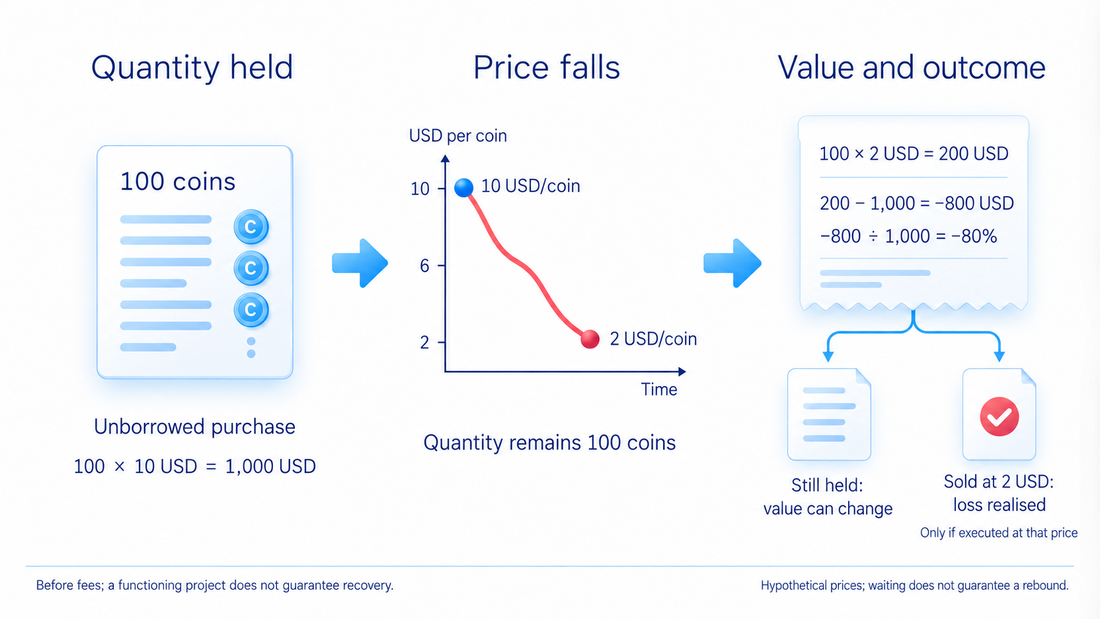
Yes. A functioning project does not guarantee a profitable purchase. In the hypothetical unborrowed purchase, 100 coins bought for USD10 each are worth USD200 at USD2 per coin, an 80% decline before fees. Waiting does not guarantee recovery.
Crypto scams
What types of crypto scams should I recognise?
Examples include fake investment platforms, phishing messages that steal recovery access, recruitment-funded schemes and creators removing trading assets. Check verifiable actions, payment sources and permissions; a falling price alone does not prove fraud.
Pump and dump
How does a pump-and-dump scheme work?
Early holders build a position, promotion draws in buyers and the holders sell into that demand. Late buyers can be left with a falling price and few available buyers.
Scam warning signs
What should make me stop before sending funds?
Pressure to act, an unverified recipient, unclear withdrawal terms or requests for excessive wallet permissions are reasons to stop. Check the genuine site, legal entity, payment purpose and access before transferring.
10. Tokens driven by public attention
Memecoin basics
What is a memecoin in Arapov's approach?
A memecoin is a cryptocurrency associated with jokes, characters or online communities. Attention can increase demand but also fade. Issuance, creator powers and the ability to sell depend on the project; the name does not establish safety.
Memecoin liquidity
Why can a memecoin's price change so sharply?
With few available buyers or few assets available for trading in a pool, even a modest sale can receive much lower prices. Large holders can also sell; token-specific creator powers may change supply or restrict selling.
Memecoin supply and hype
How can supply and attention affect a memecoin?
A large supply does not ensure buying demand. If the reason for purchasing is simply that new buyers will arrive, the result depends on future interest rather than an established source of income.
Memecoin speculation
Do stories of huge memecoin profits show what most buyers earn?
No. Selected success stories do not describe all buyers or a complete sample. Costs and the prices actually available when selling matter; a displayed price is not proof that every holder could sell at that price.
Memecoin launchpad
What does a memecoin launchpad do?
A launchpad can automate token issuance and initial trading. That does not establish safety or future value. Check its distribution, fees, program-change and transition rules.
Bonding curve
What is a bonding curve?
It links a token's price with purchase or issuance parameters. In the model discussed, later purchases face a higher price, giving early and late buyers different entry conditions.
About these learning materials
This section draws on the ArapovTrade library and Igor Arapov’s educational videos. It offers definitions, instrument comparisons, explanations of market mechanics and the author’s trading approach.
The library’s author is Igor Arapov, a practising trader since 2013. The detailed lessons explain each subject in context; these short answers provide a starting point.




