Trading means buying and selling a financial instrument to try to profit from changes in its price. The instrument might be a company’s shares, a currency pair or a futures contract. A correct prediction can produce a profit, but costs and the way an order is executed also affect the result. Trading can lose money, including money a beginner expected to keep.
You can learn the first steps without depositing real money. Start by understanding the instrument, learning to use a trading platform and writing down the conditions for a practice trade. A trading platform is the software used to view prices, send orders and manage positions, the trades you currently have open. Opening it is the beginning of practice, not evidence that you are ready to trade with savings.
In my teaching, I start with price levels and trading volume on one selected market. The aim is to turn an observation into a decision you can explain: why enter, what would make the idea wrong, how much to trade and how to exit. This article sets out that learning route. Detailed methods belong in the linked lessons.
Is Trading Suitable for You?
Trading requires time to learn, attention while carrying out the chosen method and the ability to accept a loss without abandoning the rules. It does not provide a dependable wage simply because you spend hours at a screen. Before choosing it, consider when you can study and whether money used for trading can be lost without affecting essential expenses.
Do not use rent money, emergency savings or borrowed funds as a learning account. Someone who urgently needs income may feel compelled to take a trade even when its conditions are absent. Begin with simulated practice so that learning to operate the platform does not also put essential money at risk.
What Do Long and Short Mean?
A long position benefits from a rise in price, before costs. Buying shares and later selling them is a straightforward example. A short position benefits from a fall in price, before costs. In a conventional share short sale, shares are borrowed and sold, then bought back to return them to the lender.
The risks depend on the product and how the position is financed. If you buy shares in full without borrowing, their price falling to zero can destroy the money invested in them. A share short sale can suffer much larger losses because the price at which the shares must be bought back has no fixed upper limit. Borrowing fees and other expenses also matter.
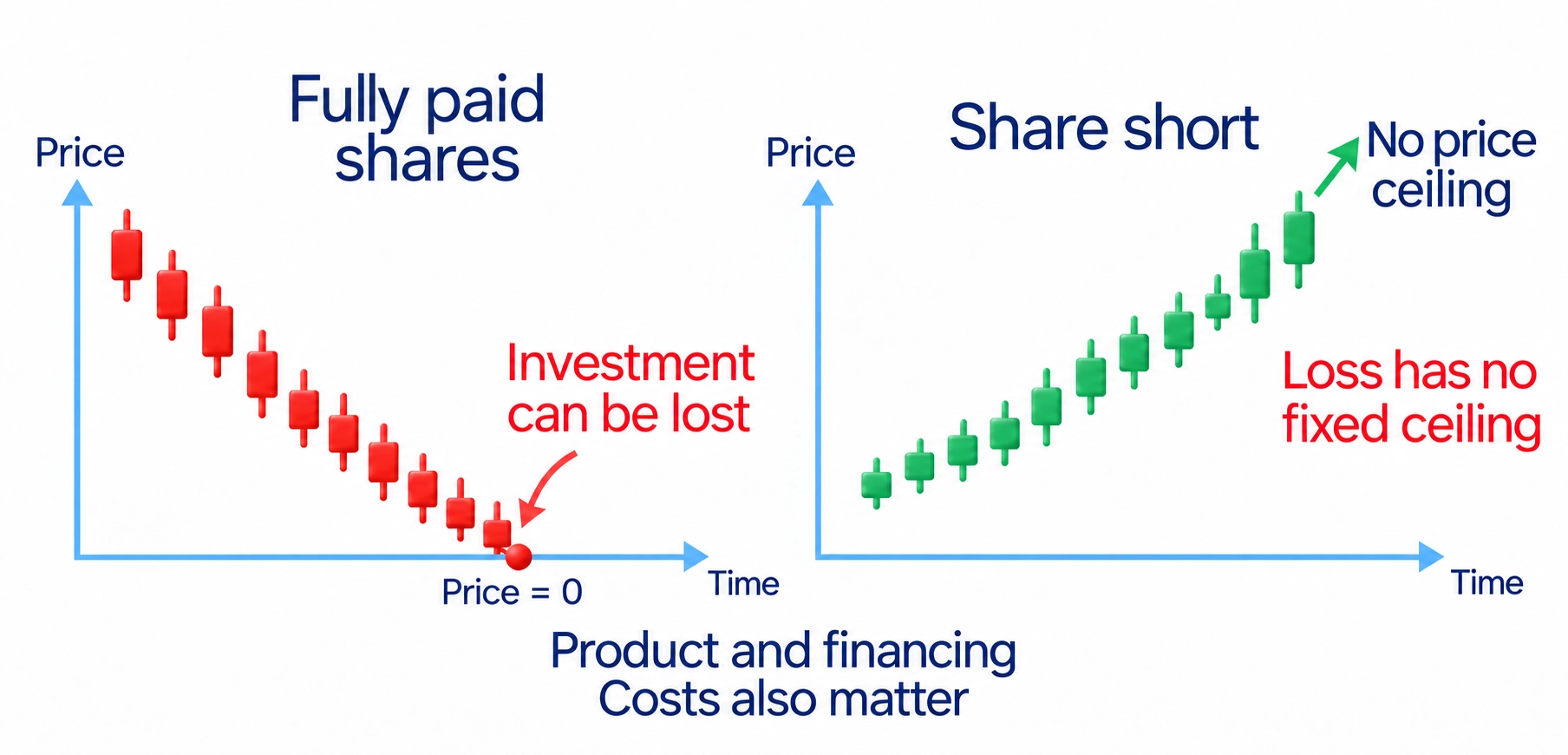
Futures and other contracts can provide rising-price or falling-price positions through different arrangements. Do not assume that every sell order borrows shares or that every purchase limits the loss to the amount you deposited. Identify the exact product before applying a rule learned from another market.
What Should a Beginner Learn First?
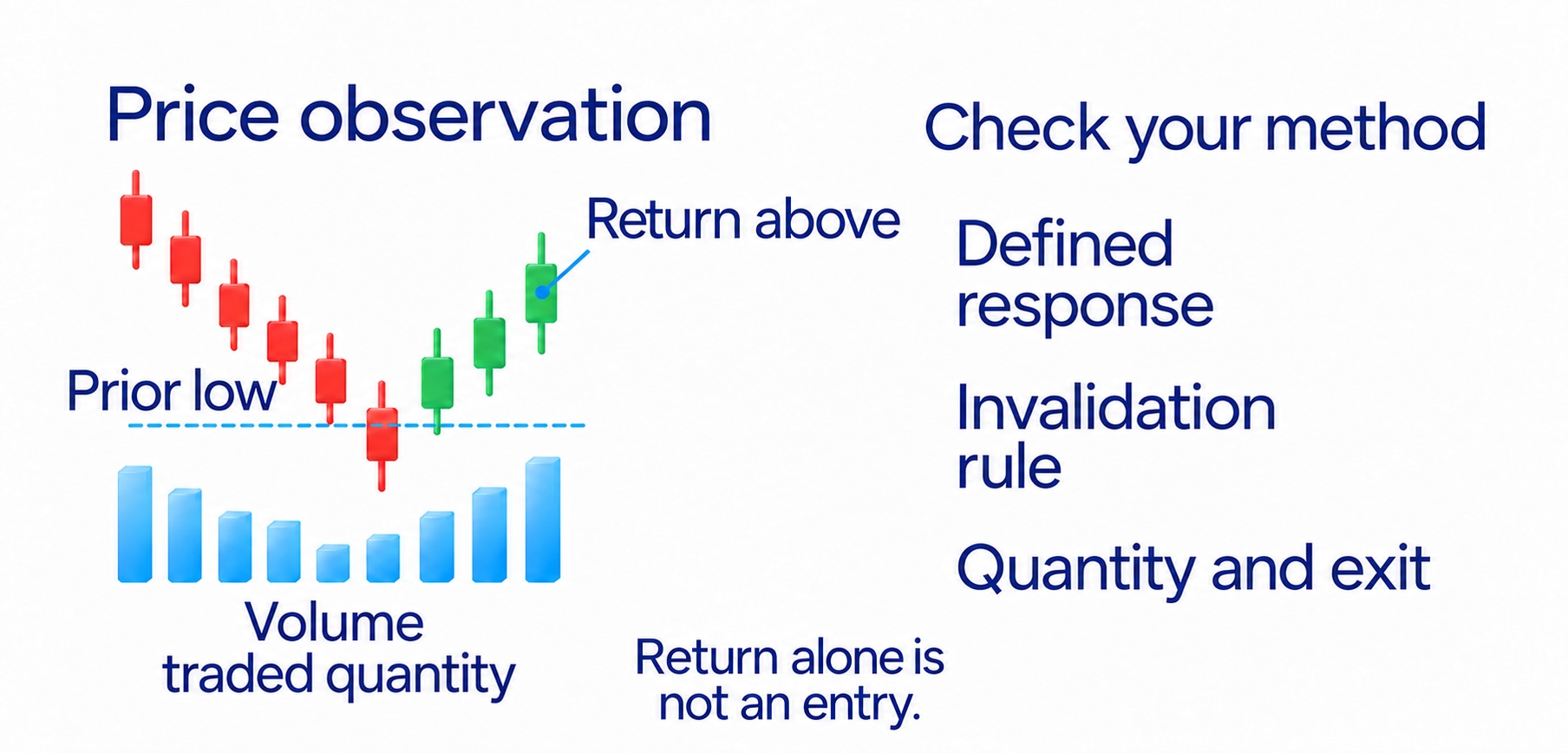
Learn to read what the chart actually shows: prices over time, the highs and lows of price moves and periods when movement slows. A price level is a price or zone used as a reference because the market previously reacted there. It is a reference for checking what happens next, rather than a promise that the next reaction will repeat.
Volume measures the quantity traded in the selected data source, such as shares or futures contracts. It can help compare trading activity during different price moves. It does not reveal the identity or intention of every participant. If you use a different type of volume data, check what it measures before interpreting it.
For example, price moving below an earlier low and then returning above it can be an observation to investigate. The return alone does not establish a profitable entry. The method must state what further response is required, where the idea becomes invalid and how the position will be managed. Learn those conditions together instead of treating a recognisable shape as a complete trade.
Start with one actively traded instrument and a small, consistent set of observations. An indicator can be useful when you understand what it calculates and where its interpretation can fail. Adding several indicators before deciding what information you need makes the decision harder to explain. The article on building a trading system explains how entry, exit and risk rules fit together.
How to Start Learning Trading
First learn the mechanics: how an order opens or closes a position, which quantity you are trading and how a change in price changes the result. Then learn the observations and conditions of one method. Practise placing and managing its orders on a demo account before considering a real-money account.
My free trading course connects the theory with practice and a review of recorded trades. Use the library to clarify a particular topic, then return to the platform to practise that action. Reading more articles is useful when it resolves a specific question; it does not replace carrying out and checking the task.
Keep a working set of rules that identifies the instrument, entry conditions, planned exits and position-size calculation. If you change the rules, record the change and keep the new results distinguishable from the old ones. Otherwise a collection of trades made under different methods can look like a test of one method when it is not.
How Much Money Do You Need, and How Do You Choose a Broker?
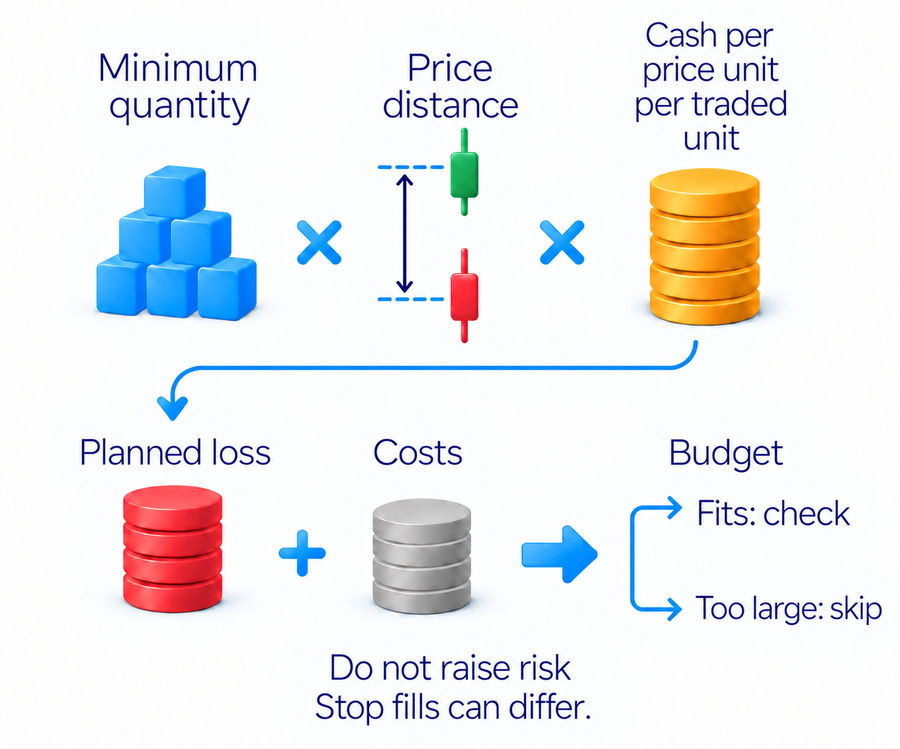
You do not need a real deposit to begin simulated practice. For real trading, there is no single starting amount that suits every instrument and every person. The minimum trade quantity, price-movement value, costs and loss you can afford all affect whether an account can support the intended trade.
If the smallest permitted position would already exceed your planned loss budget, skip that trade. Increasing the budget simply to fit the product changes the risk decision. A broker allowing an order is not confirmation that its possible loss is acceptable for you.
Before transferring money, check the firm’s legal name and current status in the relevant regulator’s register. Read the agreement, transaction and account fees, withdrawal procedure, available instruments and rules for closing positions. Registration does not guarantee profits or remove market risk. Advertising “zero commission” does not establish that there are no other costs. The guide to brokers and trading platforms explains these checks in more detail.
What Should You Prepare Before Your First Trade?
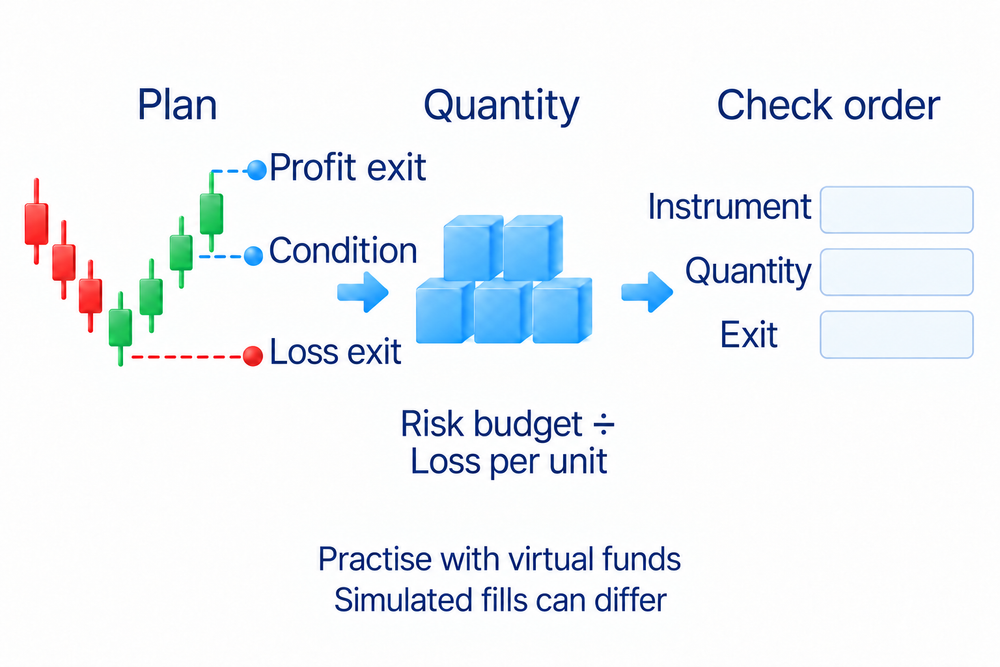
Write down four decisions before entering: the observation and conditions that justify the trade, the price behaviour that would invalidate it, the money you are prepared to lose and the planned way to take a profit. These decisions must agree with the actual instrument and the method you are practising.
A stop-loss is an order intended to exit a position when price moves against it to a specified level. Choose the exit condition and acceptable money loss before calculating the quantity to trade. A stop does not guarantee an exact sale or purchase price: rapid movement, a trading halt or other execution conditions can change the result. The full calculation is explained in stop placement and position sizing.
Once the position is open, compare your actions with that plan. Moving the planned loss exit farther away, adding quantity without recalculating risk or abandoning the intended exit can turn it into a different trade. Managing an open trade covers decisions after entry.
How to Practise on a Demo Account
A demo account uses virtual money. It lets you practise sending orders, checking quantities and closing positions without losing real funds. The demonstration of opening a TradingView demo account is an optional practical aid. You can understand and follow the learning process described here without watching it.
Set the simulated balance and quantities to values relevant to the account you might actually use. Include realistic costs where the simulator permits it, and understand its execution assumptions. Simulated fills, available data and product handling can differ from live trading. The pressure of losing your own money is also absent.
Save the losing trades instead of resetting the account to hide them. In my learning programme, completing a recorded series of practice trades is an exercise in applying the rules. A specified number of demo trades is not proof that the method will be profitable with real money. Take a practice entry only when the written conditions appear, rather than forcing trades to finish an assignment.
Beginner Mistakes and Your Trading Journal
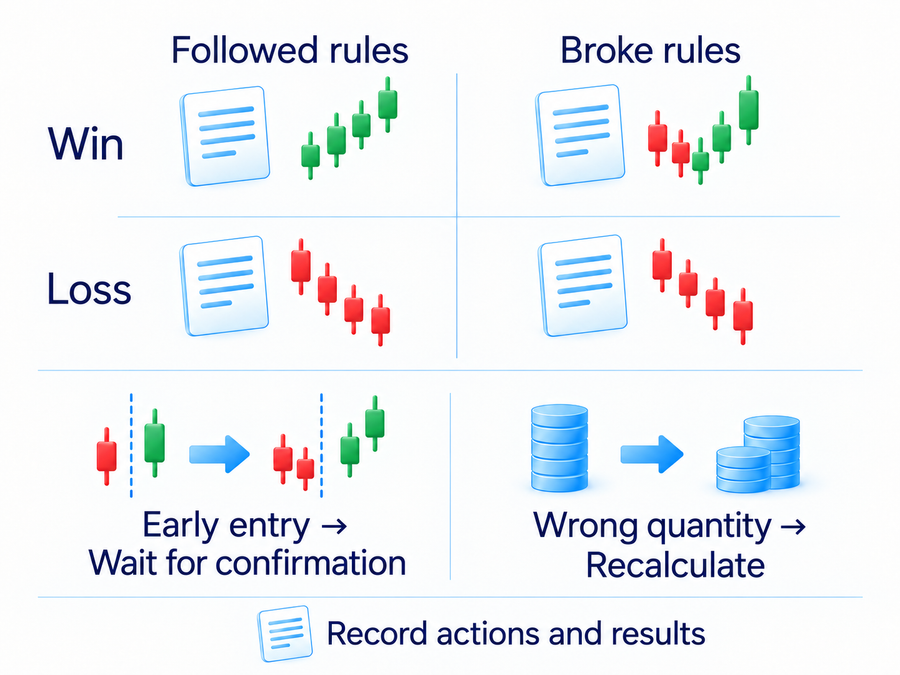
Common mistakes include entering without conditions, taking a quantity the account cannot support, moving the loss exit to avoid accepting a loss and immediately trying to win back money. The useful distinction is between a loss from following the plan and a result caused by breaking it. A planned trade can lose; an unplanned trade can happen to win.
For each practice trade, record the entry reason, entry price, quantity, exit, result after costs and any departure from the rules. Keep the chart used for the decision when possible. This makes it easier to identify whether the difficulty was understanding the conditions, calculating the quantity or carrying out the intended action.
Choose a concrete correction from the record. If you repeatedly enter before confirmation, practise waiting for that condition. If you enter the wrong quantity, practise the calculation and order-ticket check. Changing the entire method after each loss prevents you from learning whether you can apply one set of rules consistently.
When Should You Consider Real-Money Trading?
Before considering a real-money trade, be able to explain its entry, invalidation, quantity and exit without relying on a signal you do not understand. Keep an unedited practice record and know the account’s costs and execution rules. These are preparation checks, not a guarantee that switching to real money will succeed.
There is no fixed number of weeks after which every beginner becomes ready. Review the quality of the decisions and records rather than treating time spent learning as permission to take a larger risk. If the possible loss is unacceptable, continuing simulated practice or choosing not to trade is a valid decision.
Once the basic actions are understood, compare trading styles with the time you can actually give the process. Copy trading and prop trading have their own arrangements and risks. Neither is a compulsory next step or a substitute for understanding an open position.
Frequently asked questions
Trading is buying and selling a financial instrument to try to profit from price changes. The result depends on the price movement, quantity, costs and execution. Losses are possible.
Learn the instrument and basic orders, write down the conditions of one method, then practise placing and managing those trades on a demo account using virtual money. Keep records so you can check what you understood and what you actually did.
Simulated practice does not require a real deposit. Real trading depends on the product’s minimum quantity, costs and the loss you can afford. If the smallest position exceeds your budget, skip the trade rather than increasing the risk to fit it.
It lets you practise sending orders, choosing trade quantity and exiting trades with virtual money. Use realistic settings and retain losing trades. A demo result is not a guarantee of the same fills, emotions or profits with real money.
Know why you would enter, what would invalidate the idea, how much you are prepared to lose and how you plan to exit. Calculate the quantity from those decisions and check the order details before submitting it.
Learn to read prices and the chosen volume data, explain entry and exit conditions, calculate quantity and carry out the plan. A record of decisions and rule violations helps distinguish understanding a method from merely recognising a chart shape.
About the author
Igor Arapov, a practising trader since 2013 and author of the ArapovTrade library. ORCID: 0009-0003-0430-778X.




