Risk management is the set of rules you use to control potential trading losses. Before opening a trade, decide how much you are willing to lose and calculate a trade quantity that fits that limit.
In my approach, this calculation comes before the order. Confidence in a trade, or a wish to recover an earlier loss, is not a reason to increase its risk. If you are preparing for your first trades, trading for beginners explains the starting steps.
How Much Should You Risk Per Trade?
Risk per trade is the amount you plan to lose if the trade reaches its protective exit. You can set it as a dollar amount or a percentage of your account. It is different from the amount you spend to open the position.
Position sizing is often called money management. It determines how much to trade, while risk management sets the loss limits that quantity must respect. These labels can overlap; changing the name does not change the calculation or make the position safe.
Use current account equity: the value of the account including the profit or loss on positions that are still open. For example, if the account's value falls from $10,000 to $9,500 because of a $500 open loss, calculate risk from $9,500. Risking 1% of that equity gives a $95 loss budget.
Money risk = current account equity × risk percentage / 100.
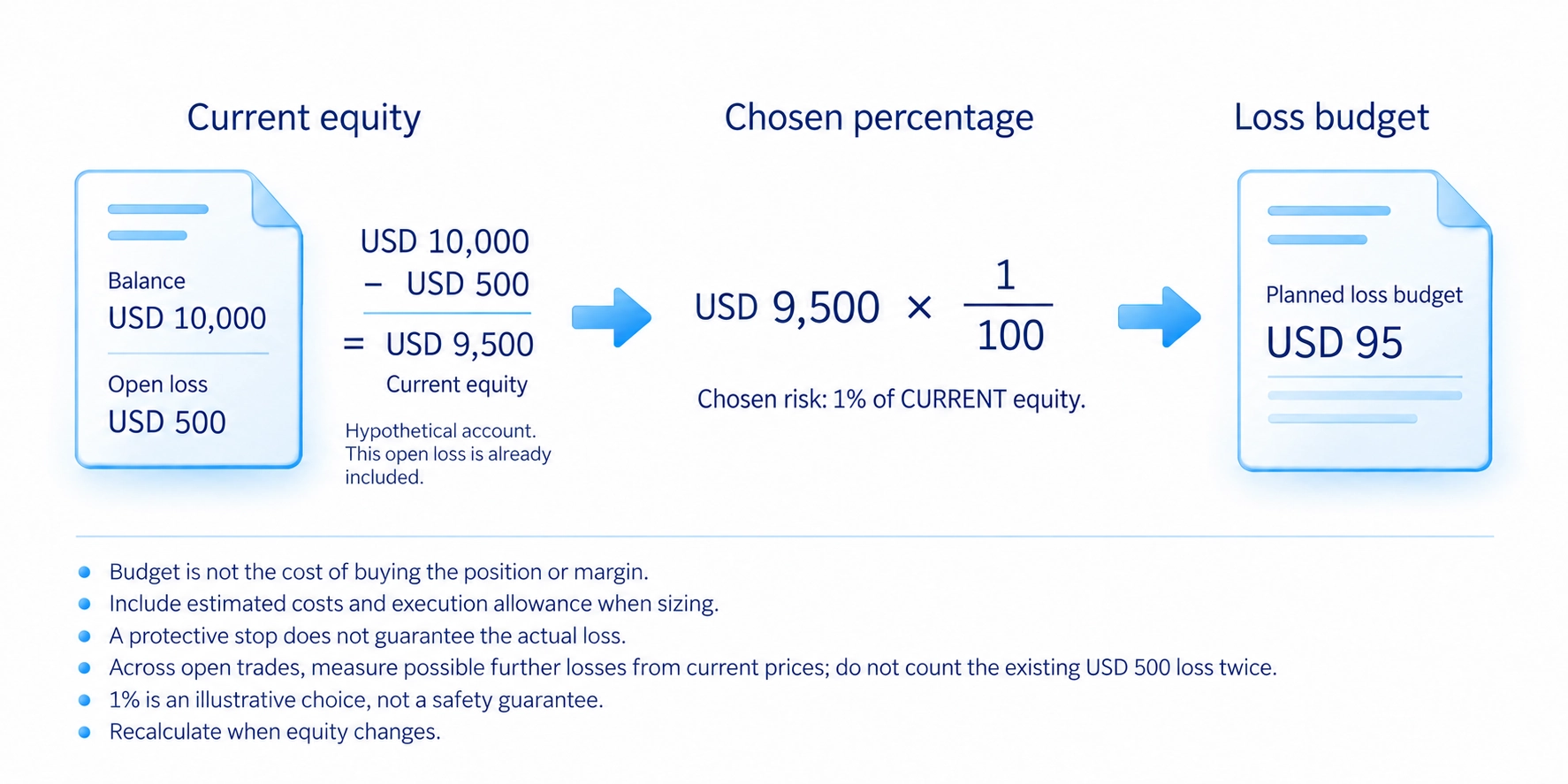
The often-used 1% or 2% guideline is a choice, not a safety guarantee. Choose a limit by considering how much account decline you can tolerate, what a series of losses would do, and how much risk you already have in open trades. While learning, a smaller percentage may be appropriate; the aim is to follow the limit consistently.
How to Set a Stop-Loss and Calculate Position Size
A stop-loss is an instruction to close a position if the market reaches a specified trigger. Choose the exit level before calculating quantity. Starting with a large position and then squeezing the stop closer can leave it inside ordinary price fluctuations, even though your reason for entering has not changed.
In my system, the stop is tied to the point where the reason for the entry no longer holds. In the course's buying example, a temporary decline after a rise is called a pullback. The stop is below the low of the completed pullback used to justify the entry. A move below that low breaks the condition on which that purchase was based.
Consider a hypothetical stock trade with $10,000 of account equity and a 1% risk limit, giving a $100 loss budget. The planned entry is $50 per share and the stop is $48. If both orders execute at those prices, the price loss is $2 per share.
For this example, reserve $10 of the budget for trading costs and possible worse execution. That leaves $90 for the price movement:
Number of shares = (loss budget − estimated costs and execution allowance) / loss per share to the stop.
The quantity is ($100 − $10) / $2 = 45 shares. Check it: 45 × $2 + $10 = $100. Buying the shares costs $2,250, while the planned loss under these assumptions is $100.
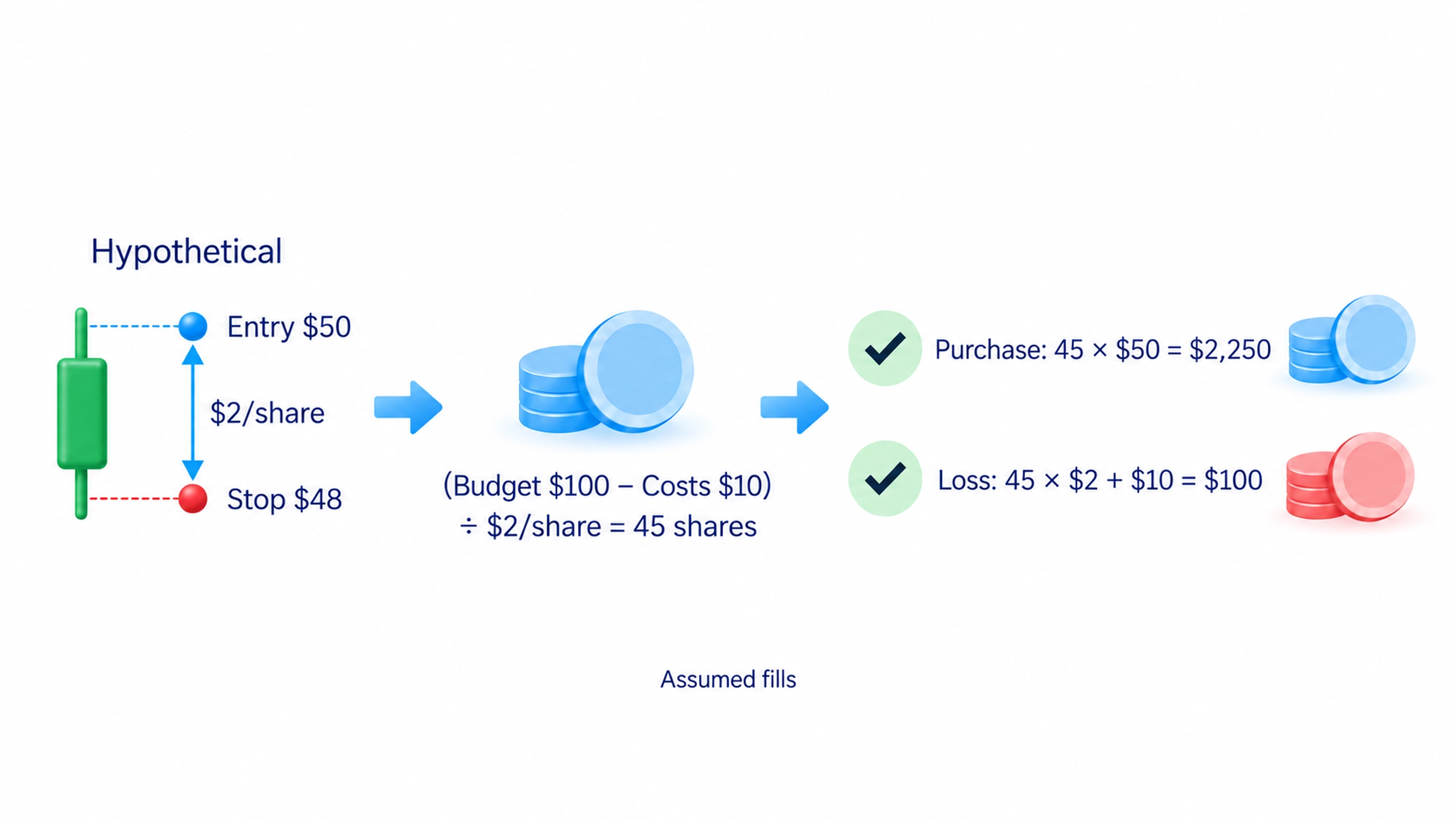
The $10 allowance is an illustrative estimate, not a standard fee or a guaranteed maximum. In practice, allow for entry and exit charges, any holding costs, and possible differences between planned and actual execution. The spread is the difference between the buying and selling prices. If it is already reflected in your entry and exit prices, do not add it again.
A stop does not guarantee the exit price. A stop-market order becomes a market order when triggered, so a fast move or a shortage of available buyers or sellers can produce a worse fill. A stop-limit order sets a price condition but may remain unfilled. Order types explains this execution trade-off in more detail.
If the entry changes, recalculate before placing the order. A wider stop requires fewer units for the same loss budget. Round the quantity down to an allowed size; if even the minimum position exceeds your budget, skip the trade rather than raise the risk to fit it.
For an instrument traded in lots or contracts, calculate the loss on one lot or contract first. A lot is a specified quantity of the instrument. A point, pip or tick measures a price change; these units are not interchangeable, so check the product specification and its money value for the size you are trading.
Position size in lots or contracts = remaining loss budget / (distance to the stop in price units × money value of one price unit for one lot or contract).
The loss budget and unit value must use the same currency. Check the permitted quantity step too: a result below one contract does not authorize a fractional contract where only whole contracts are allowed. Forex trading explains lot and pip values and conversion into your account currency.
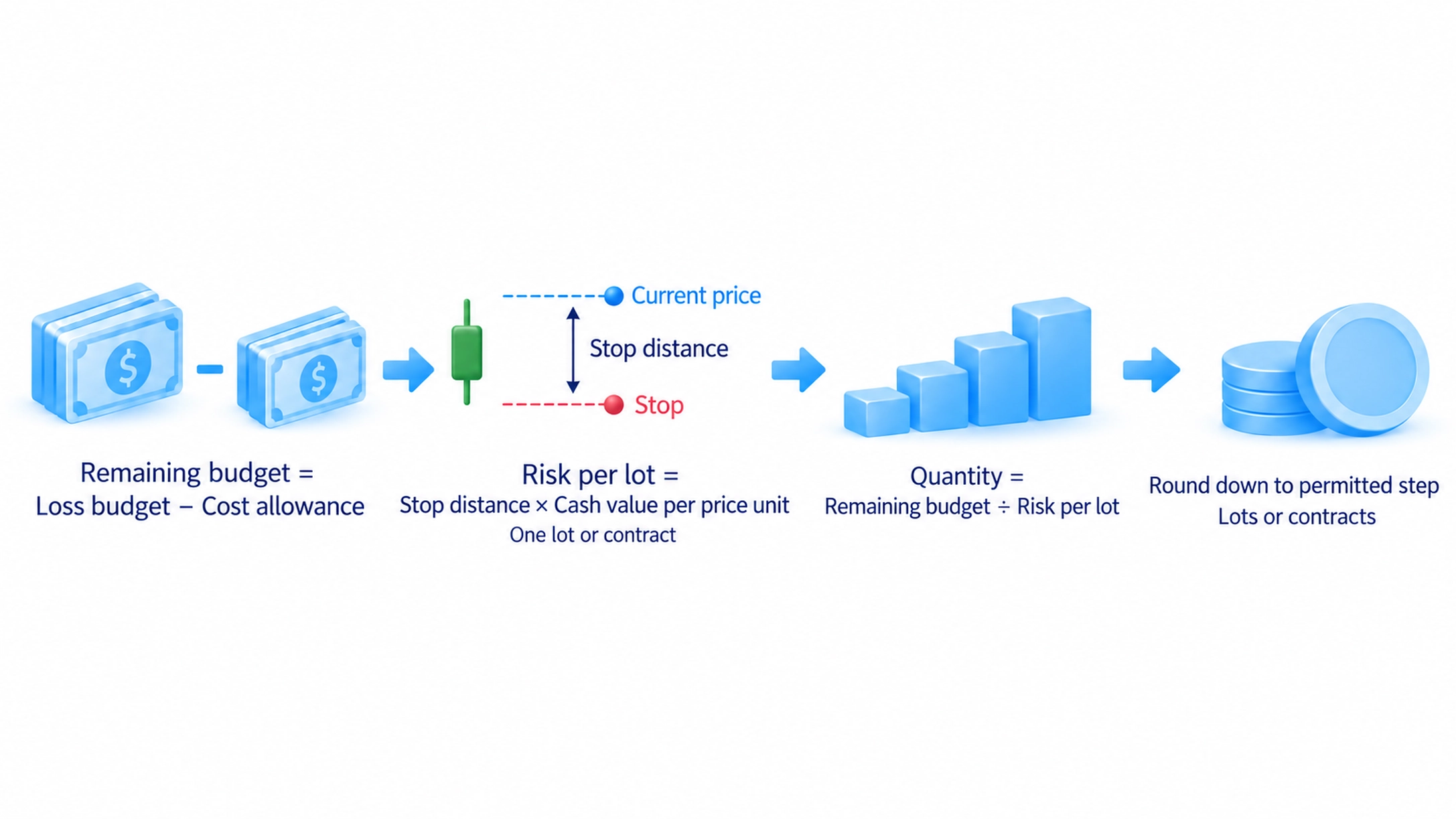
The position-sizing lesson in my course connects the loss budget, stop distance and value of a price unit. Practise the calculation on a demo account using the actual specifications of your instrument, then check the order quantity before submitting it. The position-sizing discussion is an optional video supplement.
How to Manage Risk Across Open Trades
A per-trade limit does not cap the whole account. Before adding a position, total the extra amount your open trades could lose from current prices to their stops, including estimated exit costs and worse execution. Add the proposed trade's risk and compare the total with your account-wide limit.
If current equity already includes an open loss, do not add that loss a second time to the remaining risk. Measure the additional loss from current prices. Otherwise you count part of the same loss twice and cannot see how much more the account could lose.
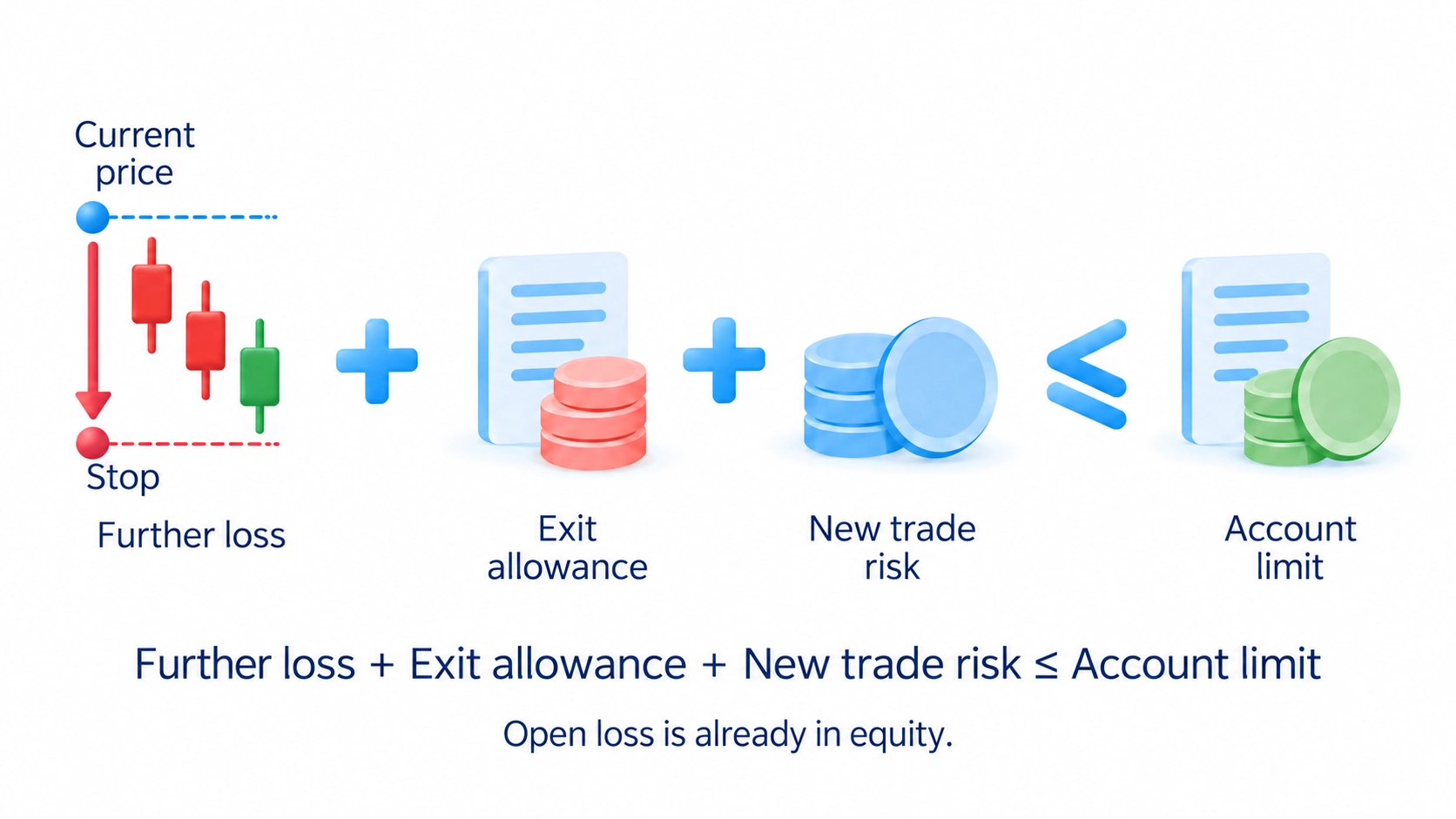
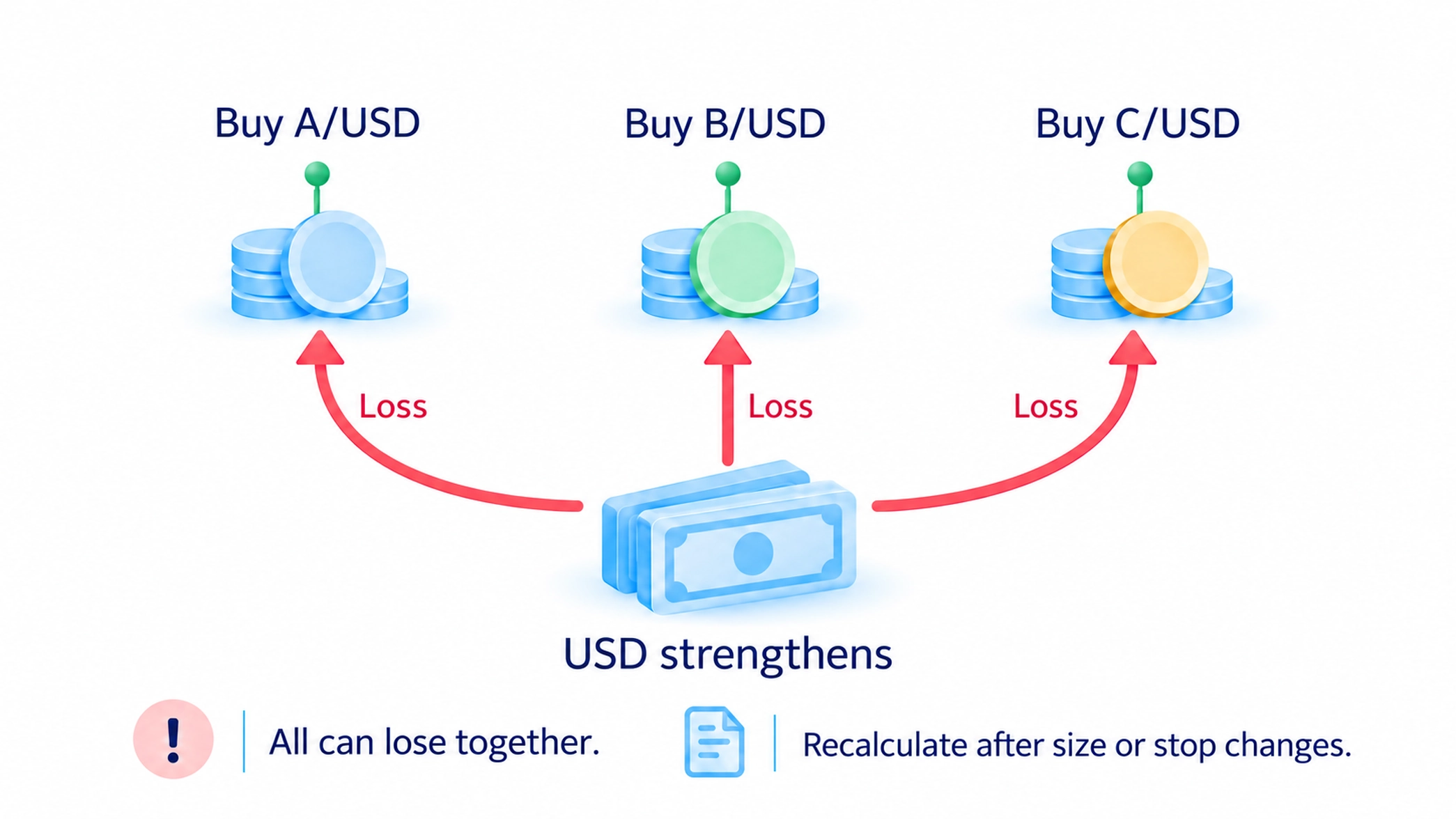
Different instruments can still depend on the same market move. Several purchases of currencies against the US dollar can all lose when the dollar strengthens. Check whether the positions depend on the same market move rather than assuming that different instrument names make the risks independent.
Adding units, closing part of a position, or moving its stop changes the calculation. An unchanged stop will not preserve the same dollar risk after you increase the quantity. Averaging and martingale examines adding to a position; trade management covers changes while it is open.
With leverage, you can hold a position larger than the capital committed to it. Margin is the funds or other assets required to open or maintain that position, not the loss you could suffer before your stop. If the account no longer meets the provider's requirements, positions may be forcibly closed before your planned exit. Check both the money-risk calculation and the margin requirements before entering.
How Losing Streaks Affect the Account
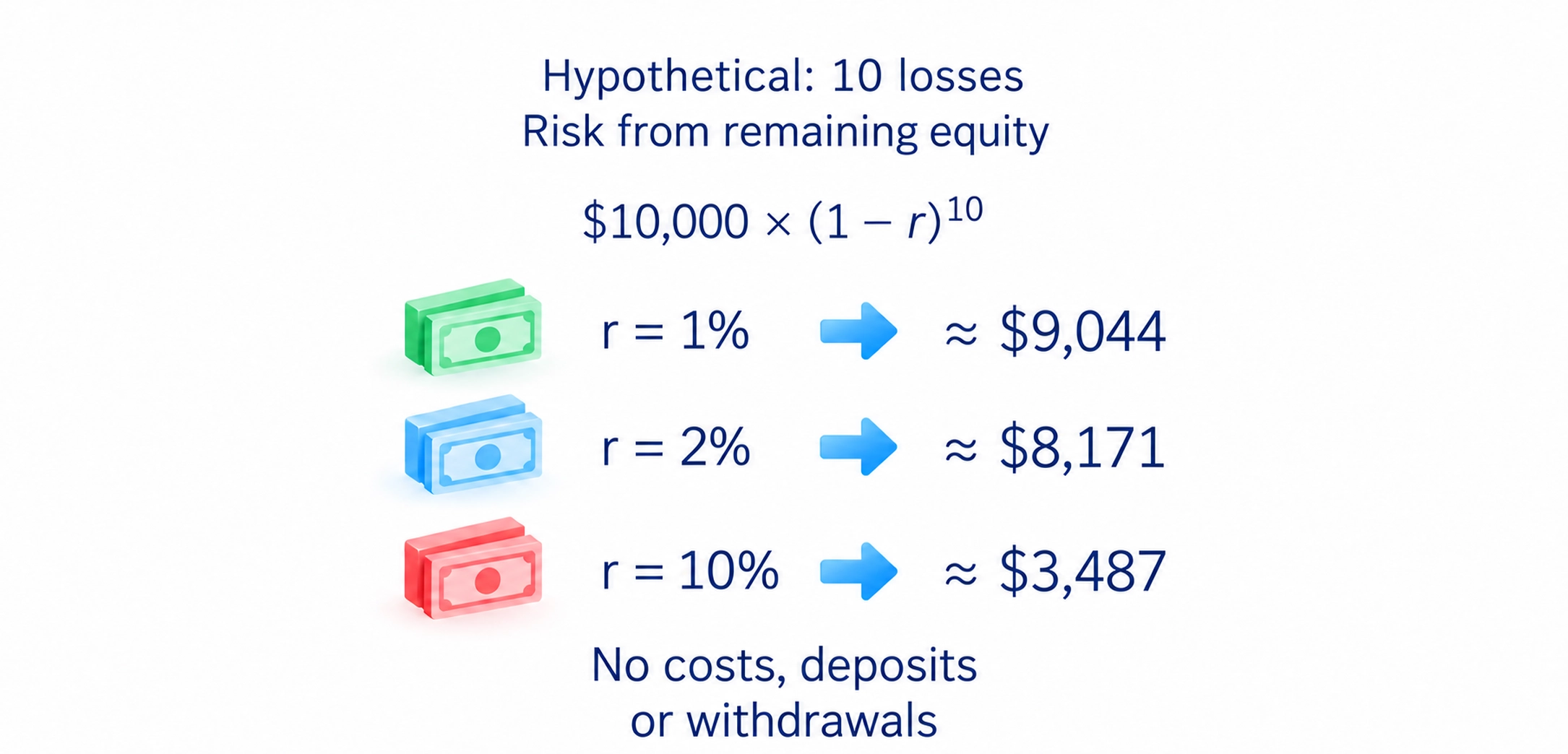
Use a series of losses to test the consequences of your chosen percentage. In this hypothetical calculation, the starting equity is $10,000. Each of ten trades loses the stated percentage of the equity remaining before that trade; there are no extra costs, deposits or withdrawals.
- At 1% risk, about $9,044 remains, a decline of 9.56%.
- At 2% risk, about $8,171 remains, a decline of 18.29%.
- At 10% risk, about $3,487 remains, a decline of 65.13%.
To check the 1% case, multiply $10,000 by 0.99 ten times. The dollar risk gets smaller after each loss because the account is smaller. This calculation shows the effect of a series, not the probability of ten losses or evidence that any percentage is safe.
Compounding in trading means keeping realised profits in the account so they can form part of the money used in later trades. With a fixed risk percentage, a larger account permits a larger cash loss budget; later losses reduce that base again. This is not a promised interest payment or a guarantee of growth. Keeping the same dollar risk after losses raises its percentage of the account. Recalculate the next position from current equity instead of trying to recover losses by increasing quantity.
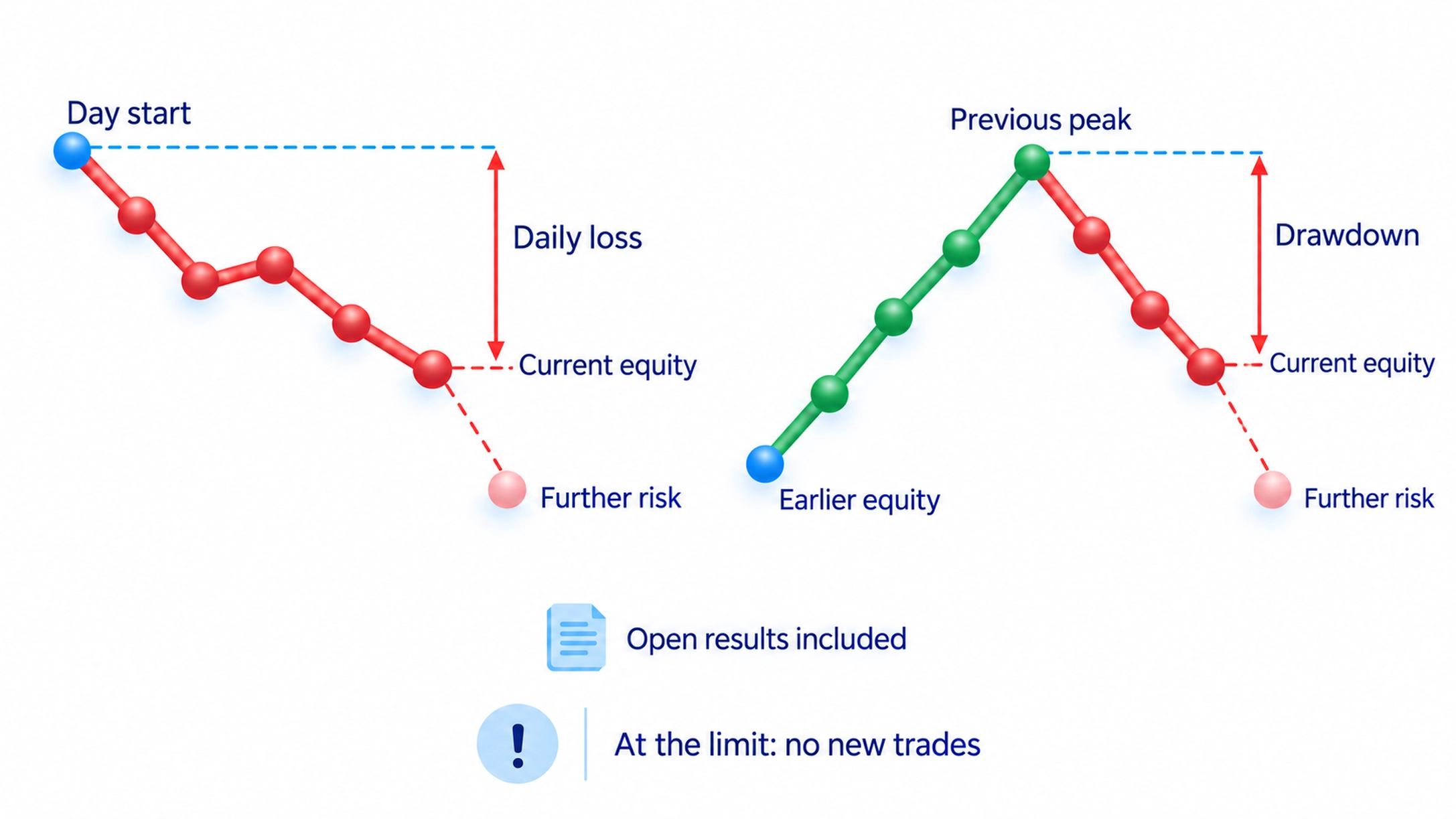
Set a daily loss limit before trading. One method measures the fall in equity from the start of the day, including open-position results and assuming no deposits or withdrawals during that day. Add the possible further loss from open trades and the proposed trade. If that sum exceeds the daily allowance, reduce or skip the new position; once the limit is reached, stop opening trades.
Also set a maximum drawdown: the fall in account equity from its previous peak. Reaching this limit is a reason to stop trading and review the cause. The urge to win money back does not cancel the limit; trading psychology examines decisions made under that pressure.
How to Check Whether You Followed the Risk Plan
Record the planned loss, entry, stop, quantity and any changes in your trading journal. After closing the trade, compare the actual loss with the plan. Trading systems and trading plans explains how to use these records in a review.
If the loss exceeded the estimate, check whether you increased the risk after entry and whether execution or charges differed from your assumptions. A rule violation calls for a change in your actions; a poor estimate calls for a better calculation before the next trade. Both can occur in the same position.
In my approach, a planned loss is acceptable when the rules were followed. A profitable trade does not justify exceeding a limit: the same decision can cause a much larger loss next time.
Frequently Asked Questions
It is a set of rules for controlling possible losses. Before a trade, choose a loss budget, protective exit and trade quantity. Also check the remaining risk of open trades and the account's daily loss limit.
The 1% or 2% guideline is not a guarantee of safety. Choose a percentage that accounts for a possible losing streak, your maximum acceptable account decline and existing positions. Calculate the dollar amount from the current account value, including gains or losses on trades that are still open.
Subtract estimated costs and an allowance for execution differences from the loss budget. Divide the remainder by the planned money loss on one unit, such as one share, between entry and the protective exit. Round down to a permitted quantity.
Add the possible further losses from current prices to the stops, including estimated costs and execution differences. Add the proposed trade's risk and compare the sum with your account limit. Do not count an open loss again if it is already included in the current account value.
The stop provides a planned protective exit when the reason for the trade no longer holds. Its distance also lets you calculate a quantity that fits your loss budget. The actual exit price may differ from the trigger price.
In my approach, risk control remains necessary even when the entry looks convincing. A planned loss is acceptable when the rules were followed. A profit does not justify taking more risk than the plan allowed.
About the Author
Igor Arapov, a practising trader since 2013 and author of the ArapovTrade library. ORCID: 0009-0003-0430-778X.




