Averaging a position means adding to a trade or holding you already have at a different price. The quantity and average entry price change. Martingale means increasing the amount risked on the next trade after a loss, traditionally by doubling it. These methods can be combined, but they are not the same: averaging changes an open position, while martingale determines how much to risk after losing.
A lower average entry price does not erase the loss on an earlier purchase. This article explains the calculation, how repeated doubling uses up an account, and what to check before adding. The numerical examples are hypothetical, not records of my trades.
How to Calculate the Average Entry Price
Suppose you buy an asset, its price falls, and you buy more at the lower price. The average entry price falls, so a smaller recovery would bring the combined purchases back to their cost. You also own more of the asset. If it keeps falling, that larger holding loses more money from the same further price change.
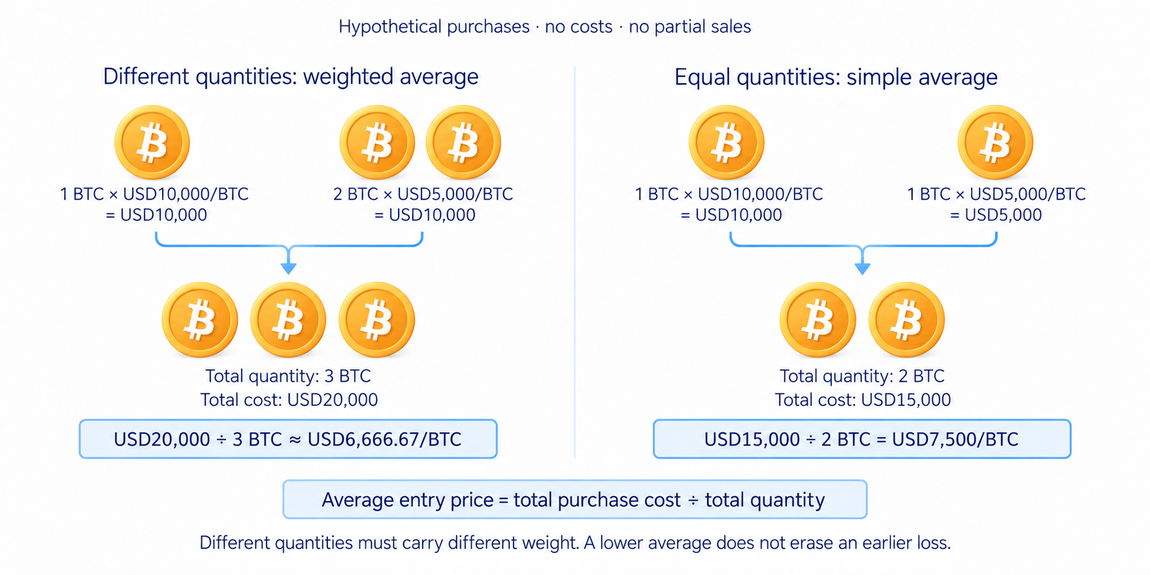
Consider one Bitcoin bought for $10,000 and another for $5,000. The two purchases cost $15,000 for two BTC. Their average price is $7,500 per BTC. Here BTC is the unit of Bitcoin; the figures are chosen to make the calculation clear, not to report a current market price.
When each purchase has the same quantity, you can add the prices and divide by the number of purchases. That shortcut does not work when the quantities differ. Use the total purchase cost divided by the total quantity instead.
Average entry price = total purchase cost ÷ total quantity.
For example, one BTC at $10,000 plus two BTC at $5,000 costs $20,000 for three BTC. The average is approximately $6,666.67 per BTC. Buying two units at the lower price gives that purchase more weight than the first purchase of one unit.
These examples use purchases of the same asset, with no partial sales and no fees. To break even after selling, the proceeds must also cover buying and selling costs. Some contracts use a different method of calculating profit. Check the product-specific formula instead of assuming this simple asset calculation applies unchanged.
Why Averaging Down Does Not Remove the Loss
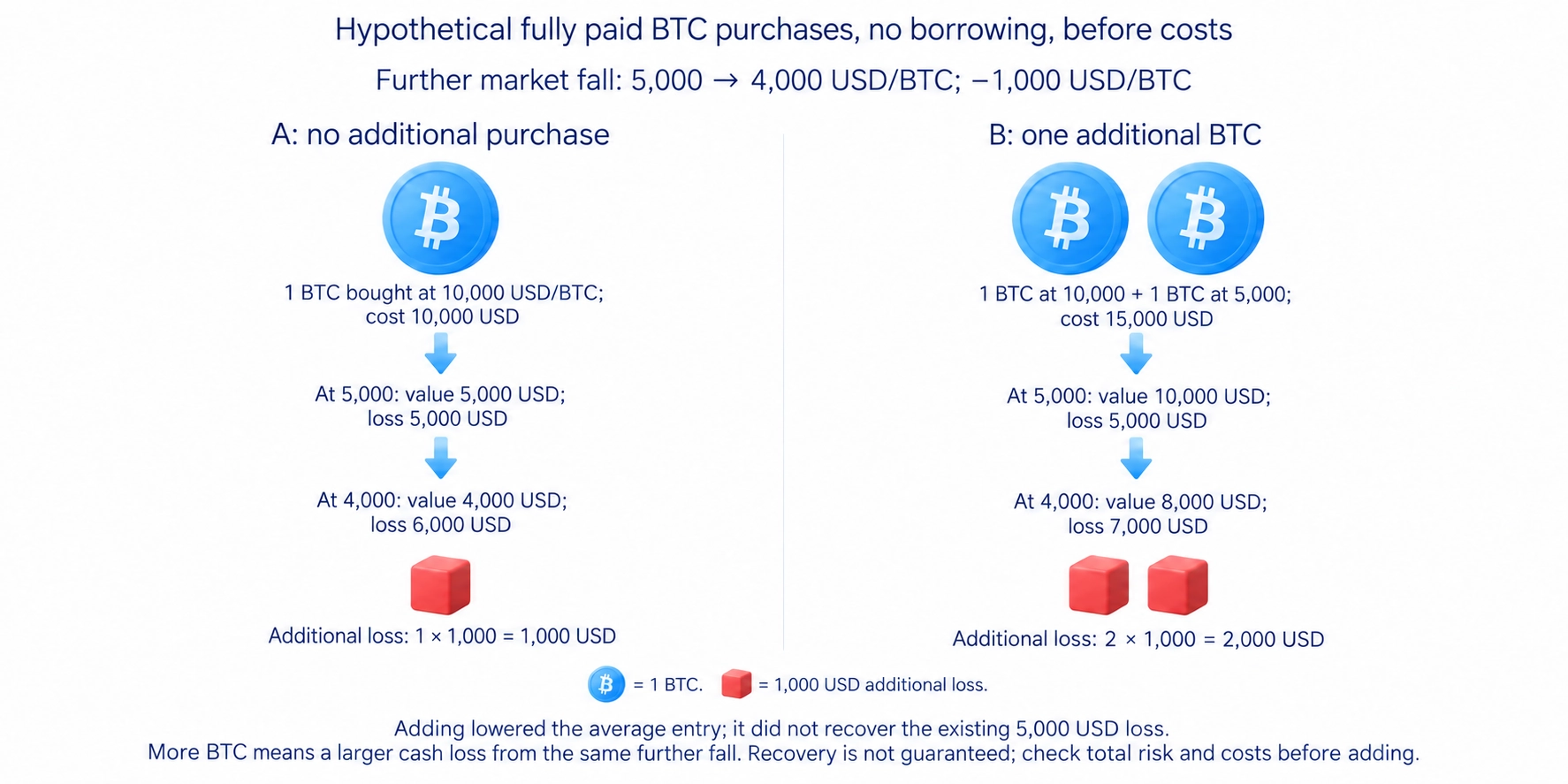
Return to the two BTC bought for $15,000, with an average price of $7,500. At a market price of $5,000 per BTC, the holding is worth $10,000. Its loss is $5,000 before costs. Before the second purchase, the first BTC had already lost $5,000. Buying another BTC at the current price changed the average, but did not recover the lost value.
If the price then falls to $4,000, the two BTC are worth $8,000, a loss of $7,000. Without the second purchase, the first BTC would be worth $4,000, a loss of $6,000. The further $1,000 fall per BTC has therefore added $2,000 to the combined loss rather than $1,000. Twice as many units are exposed to the fall.
Averaging down brings the break-even price closer. It does not, by itself, make a recovery to that price more likely. Your purchase price does not oblige the market to return. If the reason for entering no longer holds, another purchase does not restore it. The Wyckoff-method guide explains a separate way of assessing market conditions; a cheaper price alone is not such an assessment.
Leverage allows a position larger than the money put up for it. Adding quantity increases the monetary effect of a further adverse price change and can increase the required margin, the funds needed to keep the position open. If the account no longer meets the provider's requirements, the position may be closed forcibly. The crypto margin and perpetual-contract guide explains those contract rules separately.
A fully paid purchase of an ordinary asset, with no borrowing, has a different limit: the loss from the asset falling to zero cannot exceed the amount invested, before costs. Every additional purchase increases that amount. A finite possible loss does not mean recovery is likely or that losing the entire investment is acceptable.
How Martingale Uses Up an Account
The classic sequence doubles the stake after each loss: $100, $200, $400, $800, and so on. The idea is that a later win will repay all earlier losses and leave a profit equal to the first stake. This requires a particular payout model: a win earns the amount risked, while a loss loses that whole amount. Real trades do not automatically have those payoffs.
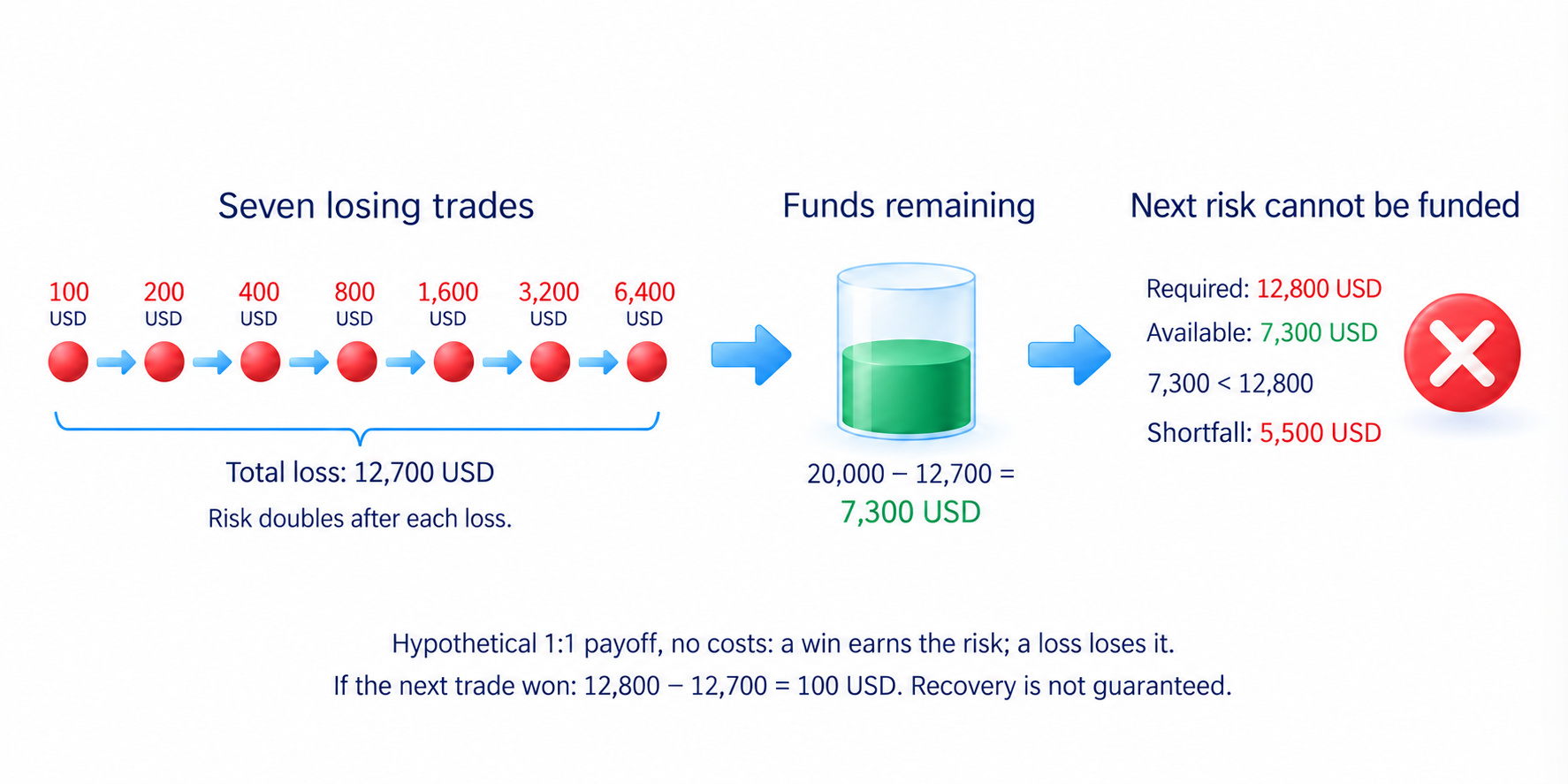
Assume a hypothetical sequence in which the monetary risk doubles after each losing trade, a winning trade earns exactly its risk, and there are no costs. Seven losses of $100, $200, $400, $800, $1,600, $3,200 and $6,400 total $12,700. The eighth attempt requires risking $12,800. If it wins, the entire sequence earns only $100: $12,800 minus $12,700.
If the eighth attempt loses, the cumulative loss becomes $25,500 and the next required risk is $25,600. An account starting with $20,000 cannot complete that sequence: after seven losses it has $7,300 left, insufficient for the next $12,800 risk. Doubling requires a rapidly growing supply of money, not simply the willingness to wait.
Doubling a position's quantity does not always double its monetary risk. The distance from entry to the planned exit, the value of a price movement and the costs can change. The next trade's profit may also be less than the model requires. Increasing the stake does not improve the reason for entering or make the assumed payoff available.
A trader can apply a similar progression within an open position by buying increasing quantities as the price falls. The earlier loss is not closed between purchases, but the funding problem remains. Further adverse movement affects a growing holding. A trading program can submit those orders automatically; it cannot remove the account's limits.
Many small profitable exits do not establish that the method can withstand larger losses. Include losses still held in open positions when assessing the account. The trading-system guide explains how to assess a series of trades without treating completed winners as the whole result.
Planned Additions Versus Attempts to Rescue a Trade
A planned entry in parts specifies the conditions, quantities and exit before the first order. An attempt to rescue a losing trade develops after the loss: the trader adds because they want their money back sooner. Both can look like several purchases, but in the second case the existing loss starts determining the next decision.
Ask: “Would I buy now if I did not already hold this position?” The answer does not replace a risk calculation, but it can reveal when avoiding recognition of a loss is the only reason left. The trading-psychology guide addresses that pressure to change a decision.
A written plan does not make an addition safe. Before each extra order, calculate the possible loss of the entire position at the planned exit, including costs. If the original loss budget is already used, another purchase exceeds it even when the additional quantity looks small. The risk-management guide explains how the loss budget, exit and quantity fit together.
Do not move the exit farther away merely to make room for another purchase. That removes the original limit rather than making the new position fit it. Adding in the direction of a trend also requires a risk calculation: if the price reverses, the larger quantity increases the loss from the same move. Direction alone is not a risk limit.
Dollar-cost averaging, often abbreviated DCA, means investing equal amounts of money at regular intervals regardless of market fluctuations. It differs from doubling after a loss: the next purchase follows a schedule, not the outcome of the previous one. It does not guarantee a profit or prevent further falls. Renaming a short-term rescue attempt as long-term investing changes the original task after the trade has gone wrong.
In the beginner-mistakes lesson in my course, an unplanned addition to a losing position is a breach of the initial risk plan. The practical order is to choose the acceptable loss and exit condition first, then decide what quantity fits. An extra purchase must not become a way to cancel that limit.
What to Check Before Adding to a Position
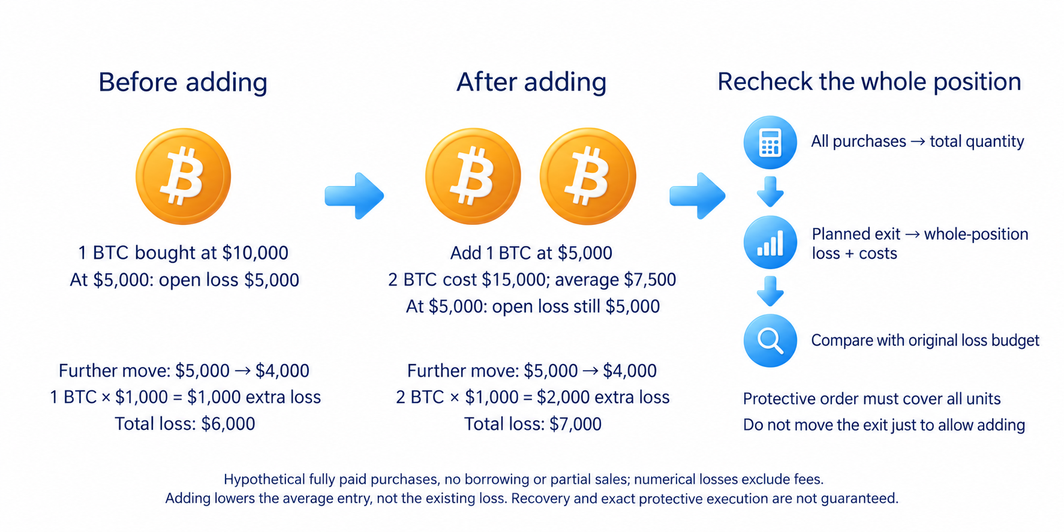
Write down the prices and quantities of all purchases. Calculate the new average and total quantity, then the monetary result at the planned exit after costs. Check whether the protective order covers the entire position. An order for the first part does not automatically protect an addition unless the platform updates it under its own rules. The order-types guide explains how these instructions are executed.
Compare the planned loss with the limit chosen before entering. Check that the entry condition still holds and that the account can meet any margin requirements after further adverse movement. If the only reason for adding is to recover money, do not submit another order just to lower the average. Apply the original exit rule when its condition occurs.
The optional averaging-position explanation uses the two-purchase Bitcoin example. The calculation and its limitations are fully explained above; watching the video is not required to understand them.
Frequently asked questions
It means adding to a trade or holding you already have at a different price, changing its total quantity and average entry price. Buying at a lower price reduces the average, but does not erase the loss on an earlier purchase.
After an additional purchase, more units are exposed to the next fall. The same further price change therefore causes a larger monetary loss. With borrowing or funds required to keep the trade open, the account may also run out of available funds before any recovery.
It is an increase in the amount risked on the next trade after losing, traditionally a doubling. A long losing sequence requires rapidly increasing amounts. Doubling does not improve the entry condition or guarantee recovery of previous losses.
It lowers the average entry price and brings the price needed to cover the combined purchase cost closer, before charges. This can feel like an alternative to closing a loss. Hope of recovery still needs a valid reason for a new purchase and a calculation of the whole position's risk.
Yes, with conditions and a total risk limit chosen in advance. Before adding, recalculate the whole position's possible loss and check the entry condition. A plan does not guarantee a profit or execution at the exact protective price.
About the author
Igor Arapov, a practicing trader since 2013 and author of the ArapovTrade library. ORCID: 0009-0003-0430-778X.




