Cryptocurrency is a digital asset whose transfers are recorded under a computer network’s rules. Many networks use a blockchain, a record arranged in linked blocks. The asset you buy, the service you buy it through and the way you keep access to it are different things. Understand all three before sending money.
Buying a coin does not guarantee income or usually give you ownership in a company. Check the particular asset’s purpose, creation rules, transfer restrictions and any holder rights. A recognisable logo or rising price does not explain what you are acquiring.
How blockchains record cryptocurrency transfers
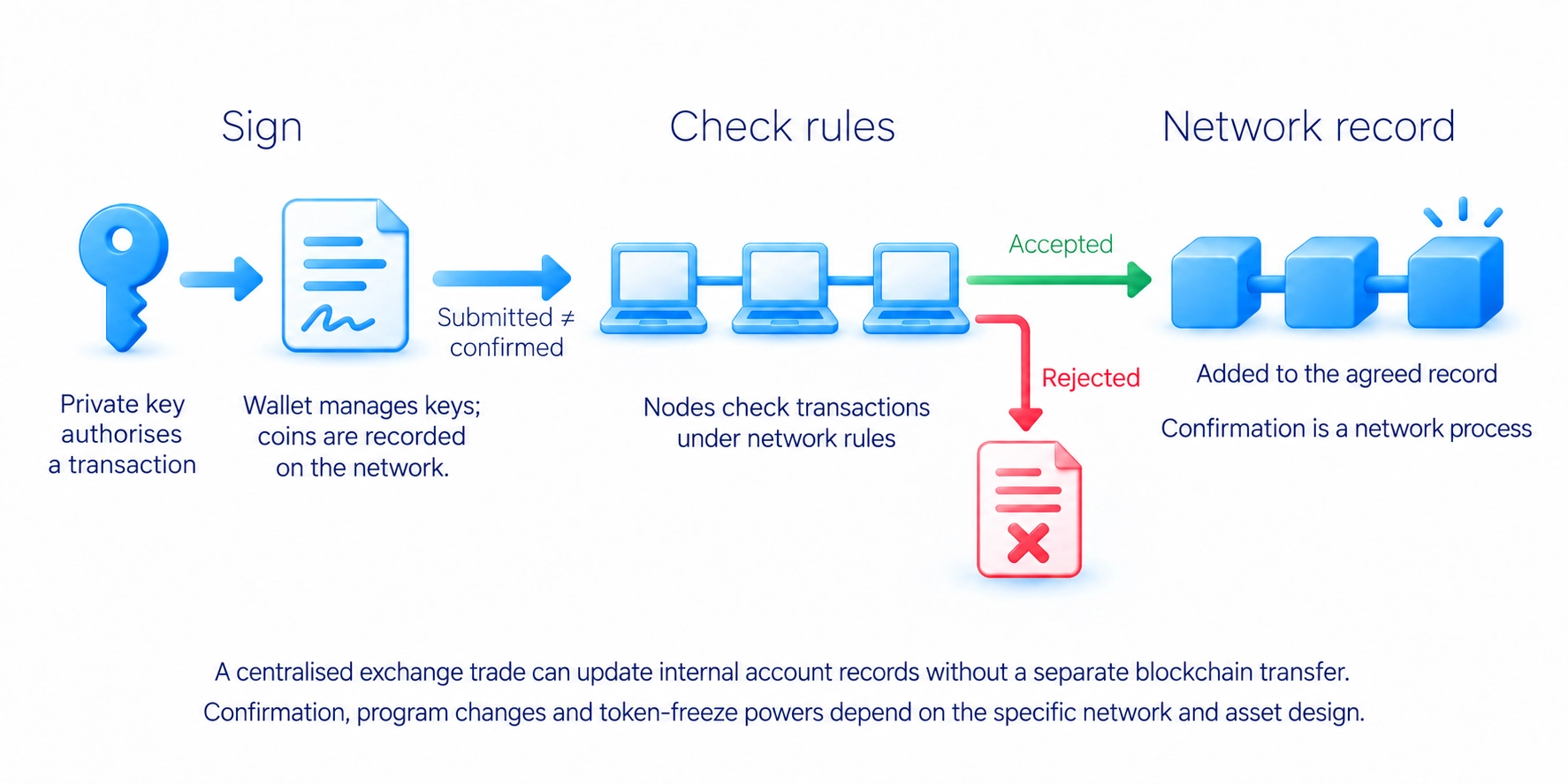
A blockchain stores records in linked blocks. Network nodes, computers participating in the system, check transactions against shared rules and maintain the agreed record. Not every participant must keep the complete history, and submitting a transaction does not immediately confirm it. The checking process and concentration of control differ among networks.
A private key is secret information used to create a cryptographic signature authorising a transaction. A wallet helps you manage keys and interact with the network; coins are recorded on the network rather than stored inside an app like cash. On a centralised exchange, the company generally manages the keys while you access its account system.
Proof of Work uses computational work to help add blocks; mining is this process in networks such as Bitcoin. Proof of Stake instead involves validators, participants checking blocks who commit assets under the network’s rules. Neither mechanism is a quality certificate for a coin. Staking and its risks explains the second process in detail.
An ordinary confirmed transfer cannot be undone with a bank-style reversal button. A wrong destination or lost access to a key can leave funds inaccessible. But a token’s ability to be frozen or a program’s ability to be changed depends on its design. Do not apply Bitcoin’s properties to every cryptoasset.
Coins, tokens and stablecoins
Coin usually means a network’s own asset, such as Bitcoin or ETH. Token commonly means an asset operating through an existing network’s programs. Altcoin often means a cryptocurrency other than Bitcoin, including ETH, though usage varies. These categories describe arrangements rather than rank reliability.
Bitcoin has its own supply and transfer rules. A supply limit does not guarantee a rising price; Bitcoin halving explains the separate reduction in new block rewards. Ethereum is a network for programmable transactions, and its asset ETH pays for network work, among other uses.
Other networks are not simply copies of those two. XRP and Solana have different structures and constraints. Find the specific asset’s rules before assigning it a familiar label. Tokenomics explains how to examine future supply and distribution rather than relying on the project’s name.
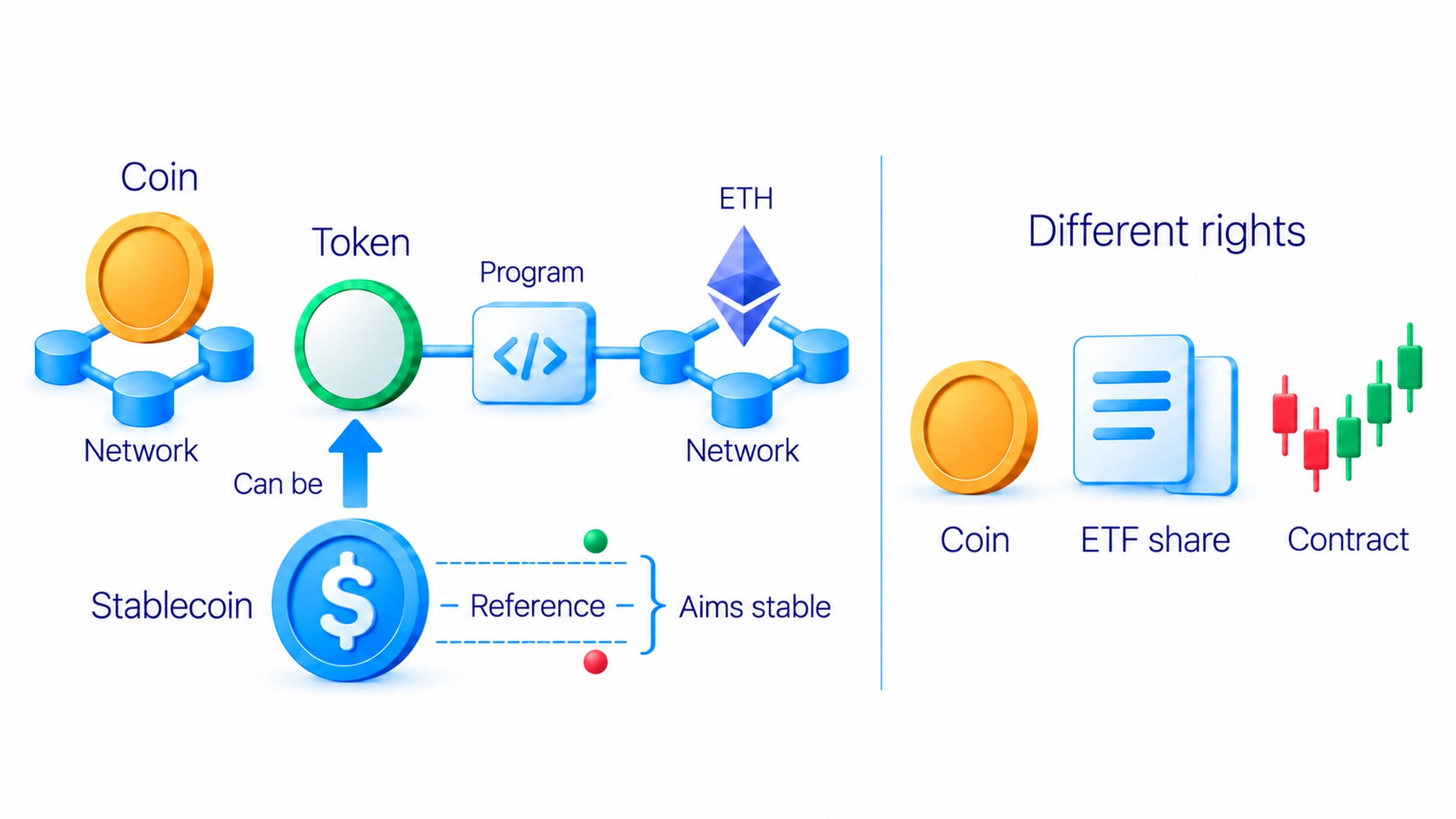
A stablecoin aims to keep its price near a reference, such as the US dollar. That is a mechanism’s objective, not a promise against loss. Check reserves, redemption rights and restrictions imposed by the company issuing it; stablecoins and Tether develops these questions. Memecoins can depend heavily on attention and speculative demand, which do not establish a lasting price.
A share in a Bitcoin exchange-traded fund, or ETF, is a different product from Bitcoin in a wallet you control. Trading access, expenses and rights depend on the fund and market. Before buying, identify whether you are acquiring the asset, a fund share or a contract linked to price changes.
Choosing an exchange and storage arrangement
A crypto exchange provides a buying and selling service. On a centralised platform, a trade can update its internal account records without making a separate blockchain transfer. Around-the-clock trading does not guarantee uninterrupted service: maintenance, trading restrictions and suspended withdrawals remain possible.
Identify the company serving your account, where its services are available and the permitted operations. Registration or a licence applies within a particular scope; it does not guarantee recovery of every loss. Compare purchase, sale and withdrawal charges, minimum amounts and supported networks. Being able to buy a token does not establish that you can withdraw it by your chosen method.
Many platforms request identity verification, often called KYC, or know your customer, to meet service and compliance requirements. This does not prove the company is reliable. Before providing identification, check the official site or app and whether the request genuinely concerns your account. Do not send documents to an unknown person claiming to be support.
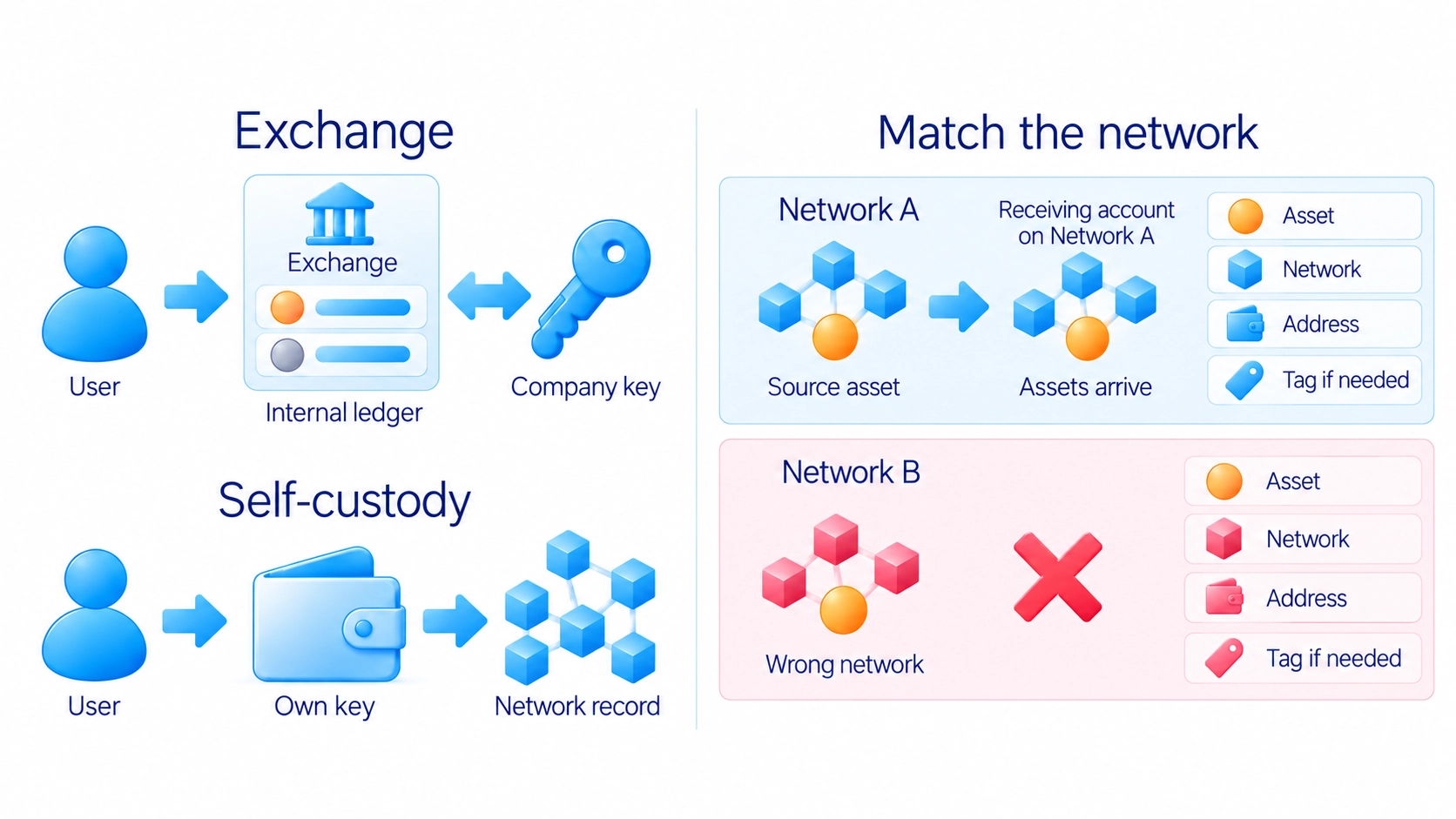
Exchange storage depends on the company’s security, finances and withdrawal rules. A self-custodial wallet gives you control of the keys but makes preserving access your responsibility. A recovery phrase, words used to restore access to wallet accounts, must not be shared or entered on an unsolicited site. Learn recovery and transfers before committing money, not just how to install an app.
Match the asset, supported network and receiving address when transferring. Some services also require an extra identifier to credit the correct account; follow the receiving service’s instructions. A small test transfer can expose a mistake, but does not remove fees or the need to verify each later transaction.
Price changes, storage failures and fraud are different causes of loss. A guarantee of profit or a request for your secret recovery phrase is a reason to stop and verify the situation. Crypto risks and scams explains warning signs without treating every loss as the same problem.
Before placing a first crypto trade
Choose the product and trading pair first. In BTC/USDT, quantity is measured in Bitcoin and price in USDT. Ordinary spot trading without borrowing means buying with available funds. Leverage, which lets you control a larger amount than the money committed, brings different obligations and possible forced closure. Its availability is not a reason to use it.
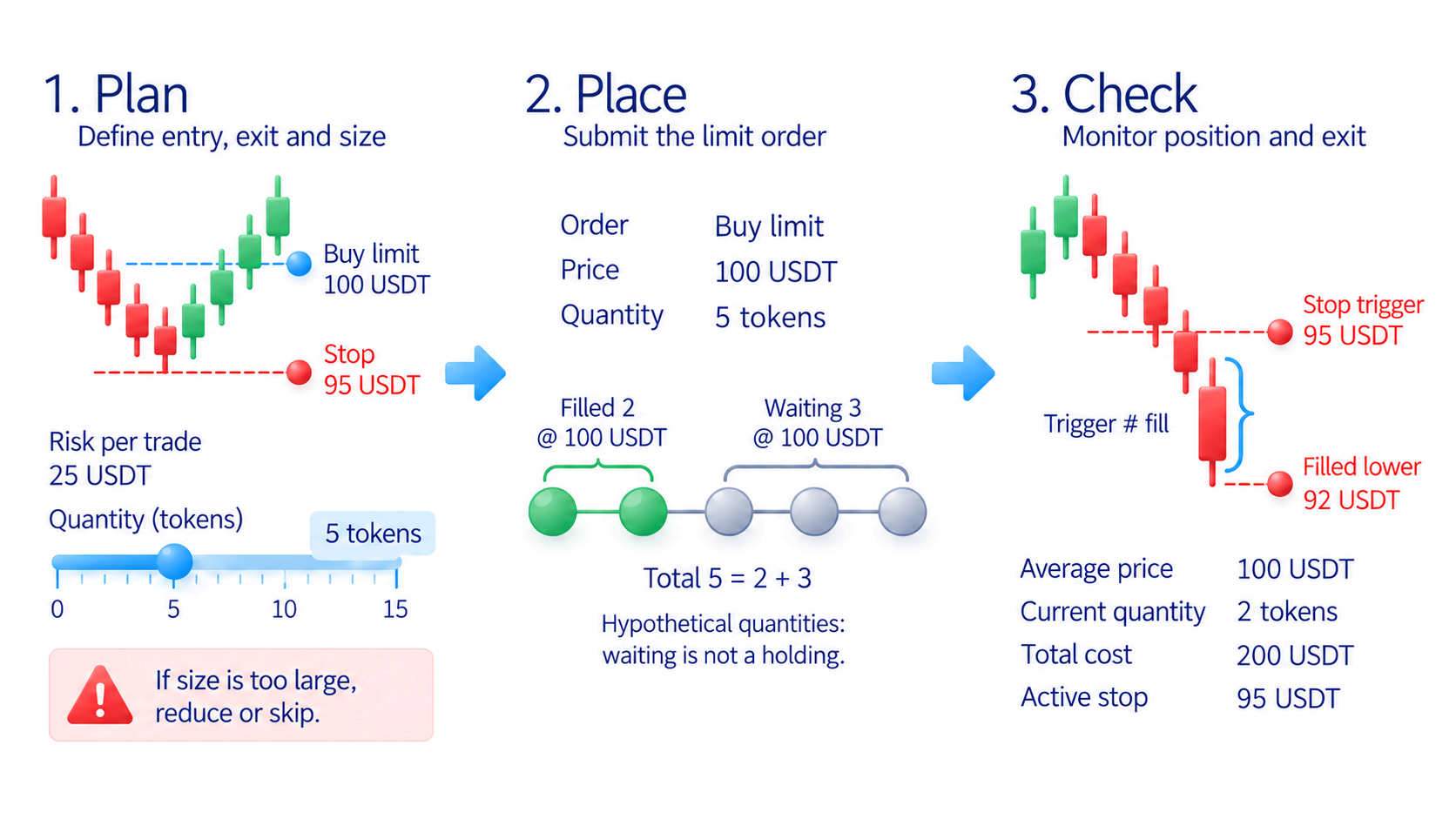
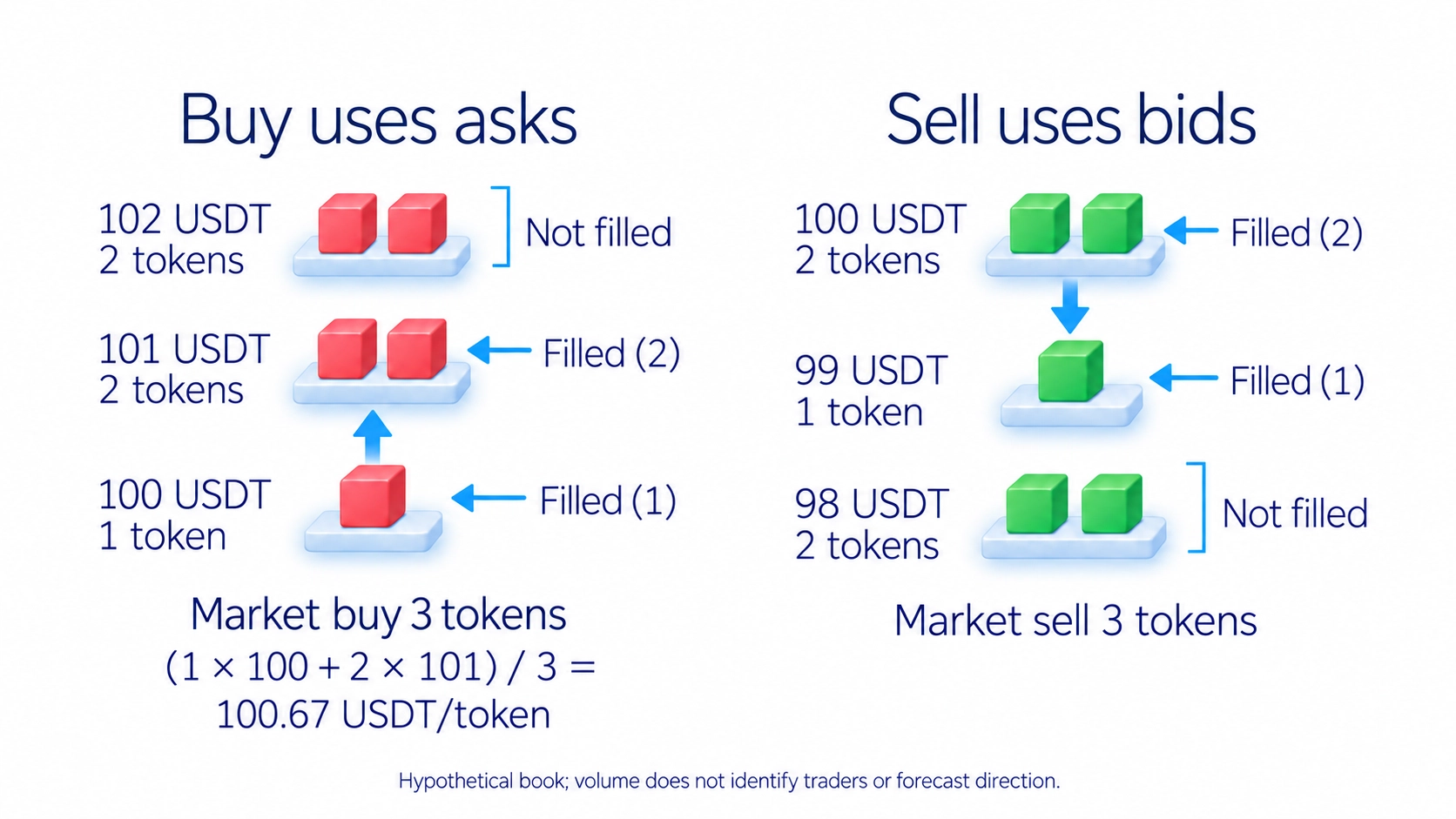
A market order trades against available opposing orders and can fill at several prices. A buy limit sets a maximum purchase price but does not guarantee a fill. A protective order intended to close the holding also depends on its type and platform rules. Market microstructure explains the underlying order-book and execution process.
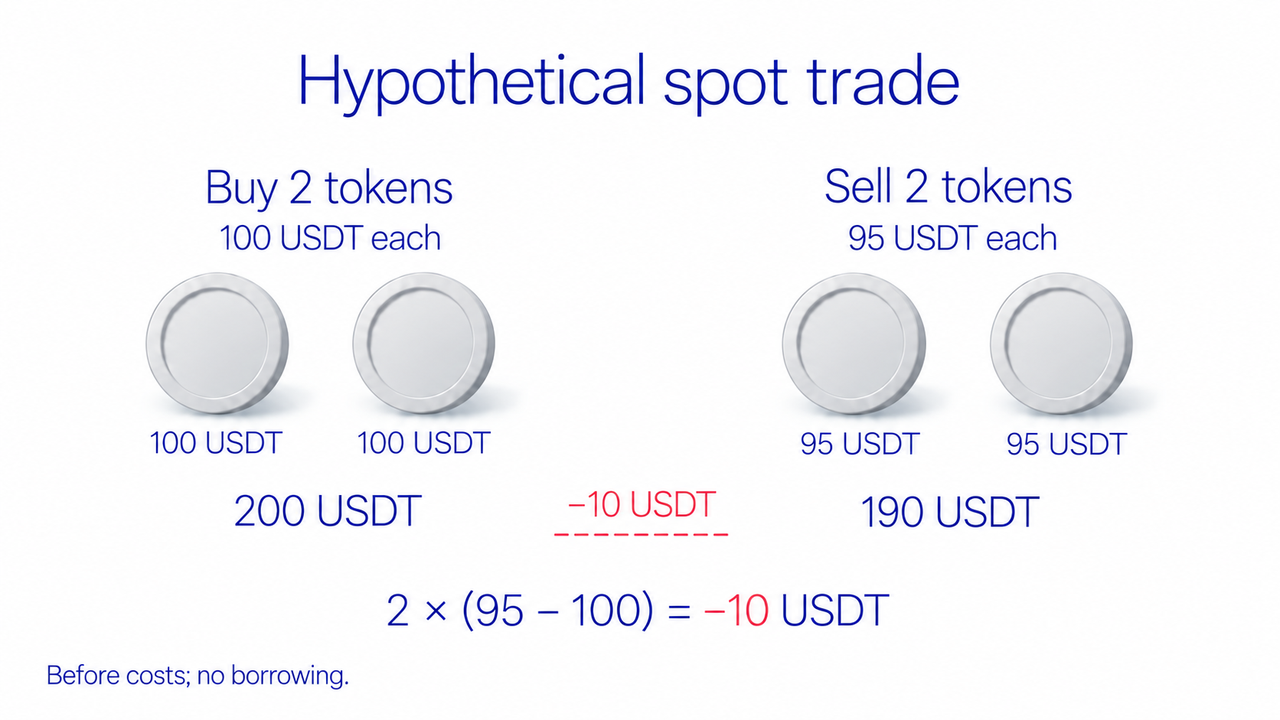
For a hypothetical purchase without borrowing, buy two units of a token at 100 USDT each and later sell both at 95 USDT. Before costs, the result is 2 × (95 − 100) = −10 USDT. The unit is USDT, not automatically US dollars. Fees and different actual fill prices change the final result.
Before sending an order, decide the entry condition, permitted money loss and exit instruction. A protective stop does not guarantee a sale at its trigger price; a stop-limit can remain unfilled. If the possible adverse movement makes your quantity too costly, reduce the quantity or skip the trade. Do not move the exit farther away merely to keep a larger purchase.
After execution, check the actual quantity, average fill price and active exit orders. For a limit purchase, distinguish the filled amount from the remainder still waiting. Record actual executions and costs rather than the price you hoped to receive.
Reading price and activity on a crypto market
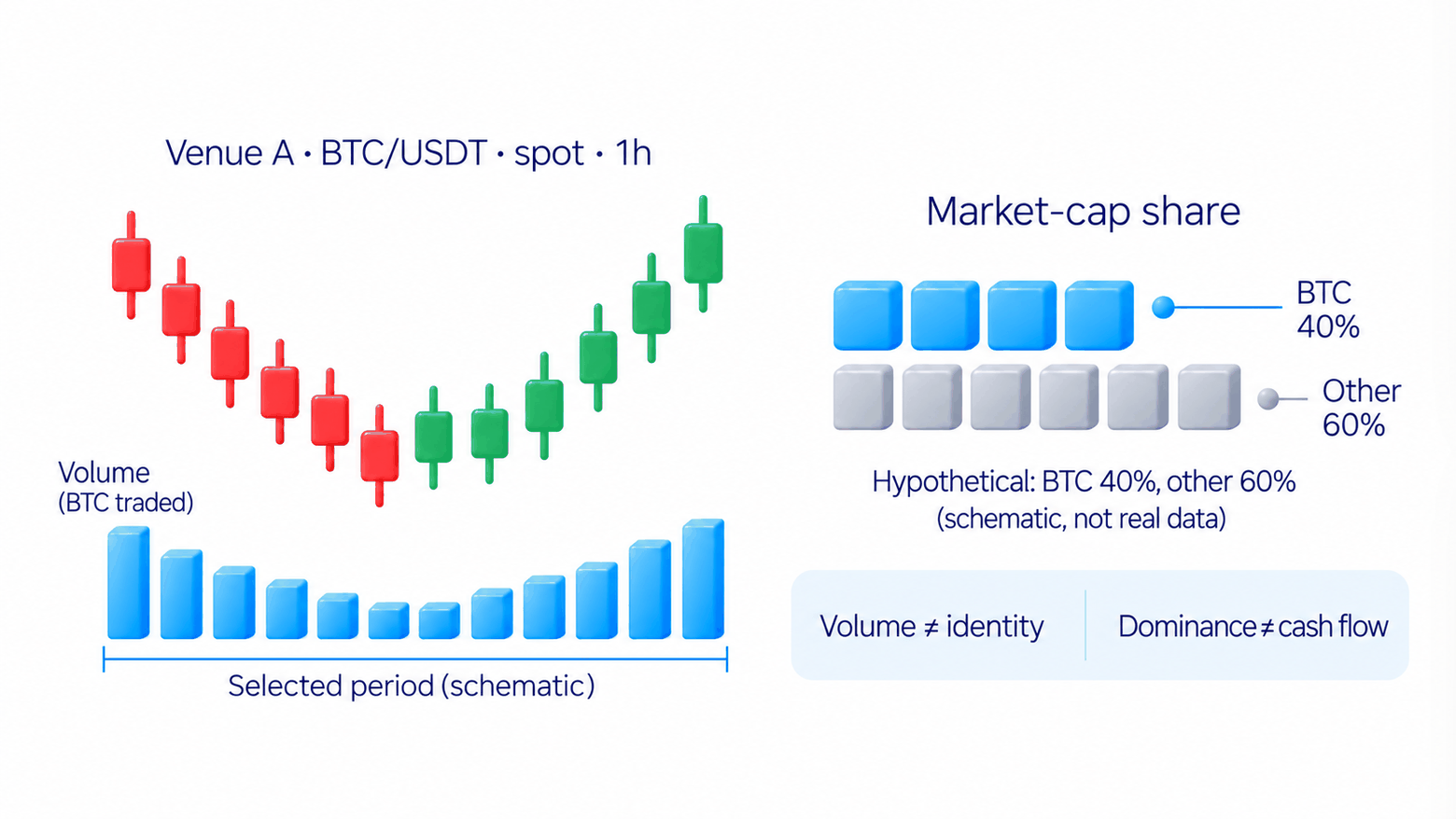
Identify the exchange, pair, spot or contract product and chart interval. Trading volume measures activity in that data source, not automatically the whole world’s crypto market. Check whether its units are tokens, contracts or traded money value. Volume analysis explains how to read the measurement alongside price.
Compare price behaviour at a chosen area with the trading activity there. A volume surge does not identify the buyers or guarantee a reversal. If venues show different prices, first establish that you are comparing the same asset and product. Crypto arbitrage examines the execution constraints on using such differences, rather than promising a profit from them.
Bitcoin can supply context for other assets without determining their individual behaviour. Bitcoin dominance measures its share of a selected market-capitalisation estimate, meaning an estimate based on asset prices and quantities. It does not directly measure money being transferred between coins or command an altcoin purchase.
Prices can differ between exchanges because their available buy and sell orders differ. A large order can use several price levels. New issuance or existing holdings becoming available for sale can change supply, while interest from buyers changes demand. The number of coins issued does not set a market price without actual buying and selling conditions.
Transfers take time and incur costs, so a price difference need not disappear immediately. On the selected market, purchases executed at higher available prices accompany an advance; sales executed at lower prices accompany a decline. More traded volume alone establishes neither the participants’ identities nor the next direction.
Starting with demo practice
My course treats moving to real money without preparation as a beginner mistake. Learn the rules and practise applying them to a recorded series of demo trades first. This tests whether you can follow the process rather than merely recognise the buttons. A successful demo result is not proof of future live profit.
The optional demonstration of using a demo account shows this practice in TradingView. Virtual-money trading helps you learn orders without risking real trading funds, but it can model execution differently and does not test an exchange’s ability to safeguard money. Real money also changes the emotional experience.
Before a first real purchase, record the asset and product, quote source, quantity, exit condition and storage arrangement. If you cannot explain the possible loss or restore access to your chosen wallet, resolve that gap before transferring funds. The ability to click Buy is not the same as being ready to hold the asset.
Frequently asked questions
It is a digital asset whose transfers follow a network’s rules. Purpose, supply and holder rights differ among assets. Buying one does not guarantee income.
It is a record arranged in linked blocks. Network computers, called nodes, check transactions against network rules. Confirmation and the ability to change particular programs depend on the system’s design.
Many crypto markets operate around the clock on separate platforms. This does not guarantee continuous service or withdrawals. Check the chosen product, storage arrangement and account access separately.
Check the company, available services, charges, supported networks and withdrawal process. A self-custodial wallet requires you to protect keys and recovery access; an exchange account depends on the company’s operations and rules.
Identity verification, or KYC, supports service and compliance requirements. It does not prove an exchange is reliable. Check the official channel and authenticity of the request before providing documents.
Choose the asset, product, quantity, entry condition, permitted loss and exit method. Check costs and the type of protective order. A rising price alone does not provide a plan.
A demo account lets you learn orders and rules without losing real trading capital. Live trading can differ in execution and emotional pressure. A demo account does not verify the safety of money held by a service provider.
About the author
Igor Arapov, practising trader since 2013 and author of the ArapovTrade library. ORCID: 0009-0003-0430-778X.




