Bitcoin is a payment network whose digital asset is called BTC. Its rules explain how BTC can be issued and transferred. They do not tell you whether today's market price is a good buying price. Before a trade, identify the product you would own, the market you are reading and the amount you could lose.
My starting point is the movement already visible on the chart. A large fall does not by itself confirm a recovery, and a news story does not replace an entry condition. For Bitcoin, the useful task is to connect the chosen market's behaviour with a plan you can check before committing money.
What Bitcoin is and how its price forms
Satoshi Nakamoto published the original proposal for Bitcoin. The network allows transfers without a central bank issuing its units. Participating computers check transactions, while accepted records form a blockchain: a chain of linked blocks containing transaction records. Buying through an exchange adds a company between you and that network, so the company's obligations are a separate question.
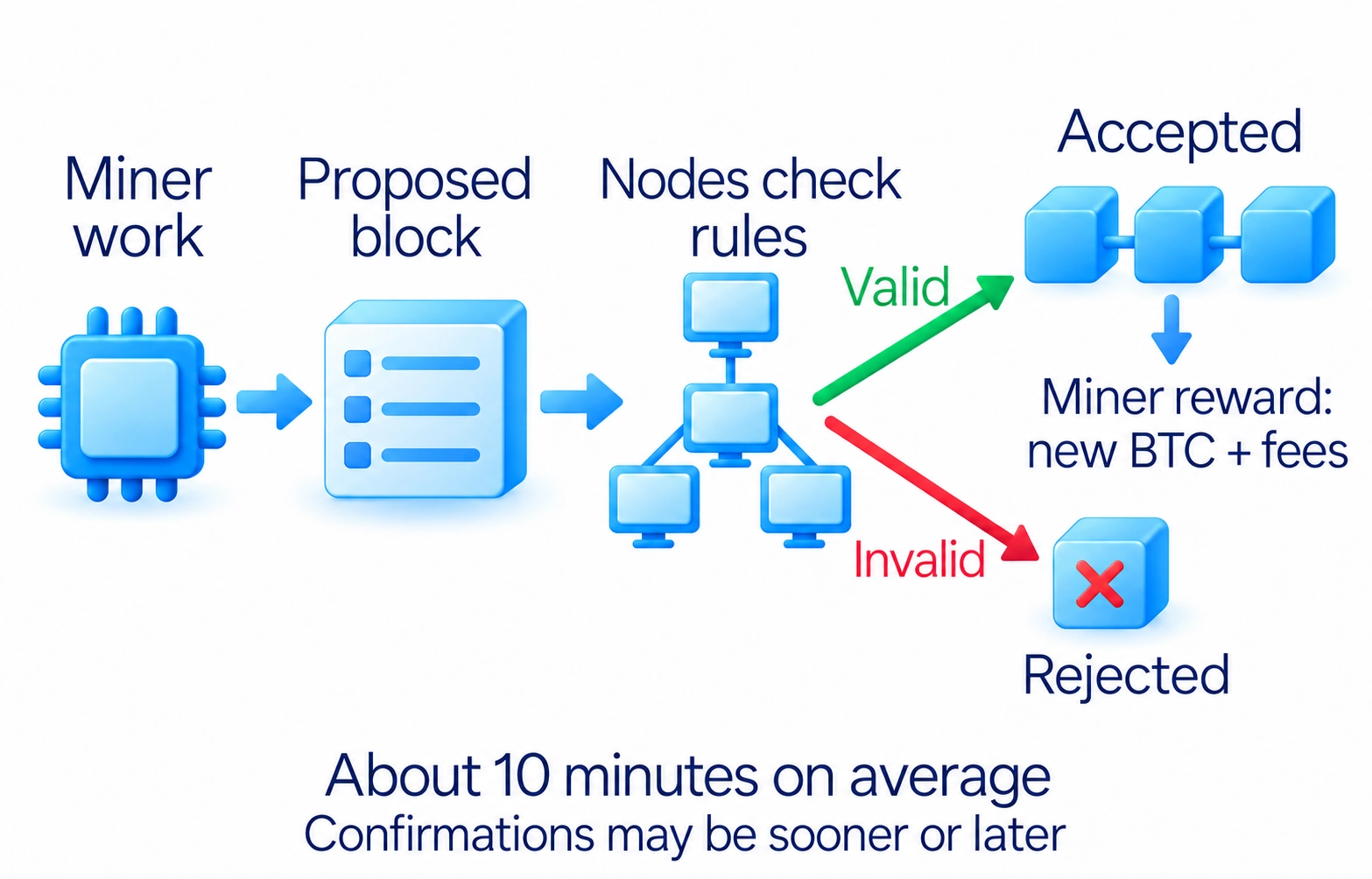
Miners perform computational work to propose new blocks. Validating nodes, the computers checking the rules, accept only blocks that meet those rules. A miner can receive newly issued BTC and fees from transactions included in an accepted block. The system targets roughly ten minutes between blocks on average; a particular confirmation can arrive sooner or take much longer.
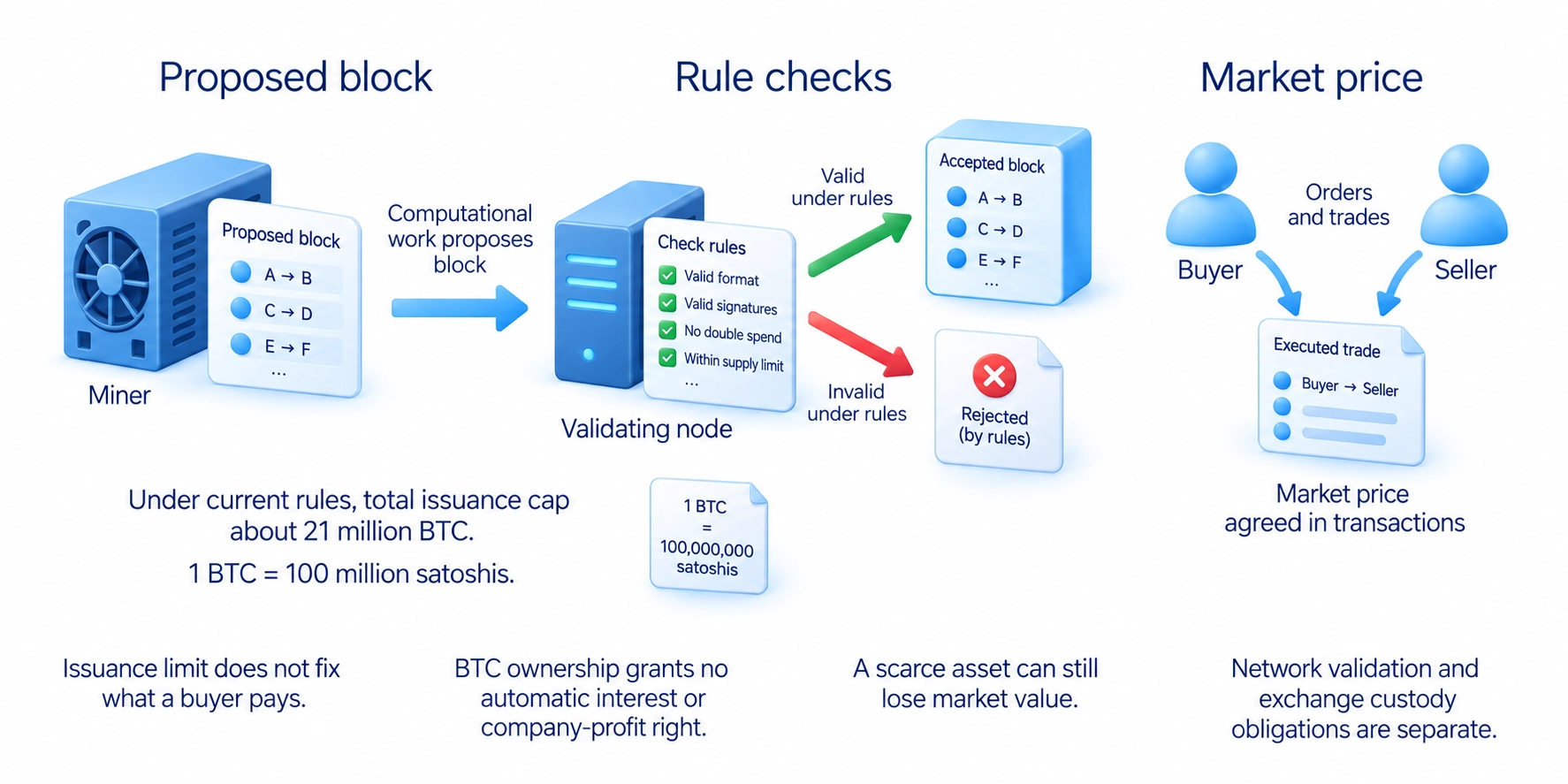
Under the current rules, total issuance is limited to about 21 million BTC. One BTC can be divided into 100 million satoshis, so a purchase need not involve a whole bitcoin. The issuance limit restricts the creation of new units. It does not fix what another buyer will pay for existing units.
A market price comes from transactions between buyers and sellers. Their willingness to trade, available orders and expectations change. BTC does not automatically entitle its holder to company profits or interest. Calling it digital gold describes an argument about scarcity, rather than a promise that it will preserve purchasing power at every purchase price.
Bitcoin transactions and addresses are public, but an address is not automatically a person's name. Other information can link an address to an owner. Also distinguish controlling the secret keys that authorize spending from holding an exchange balance. Cryptocurrency for beginners explains the basic buying and custody choices; the network's features do not remove a provider's withdrawal or security risks.
Which Bitcoin market are you reading?
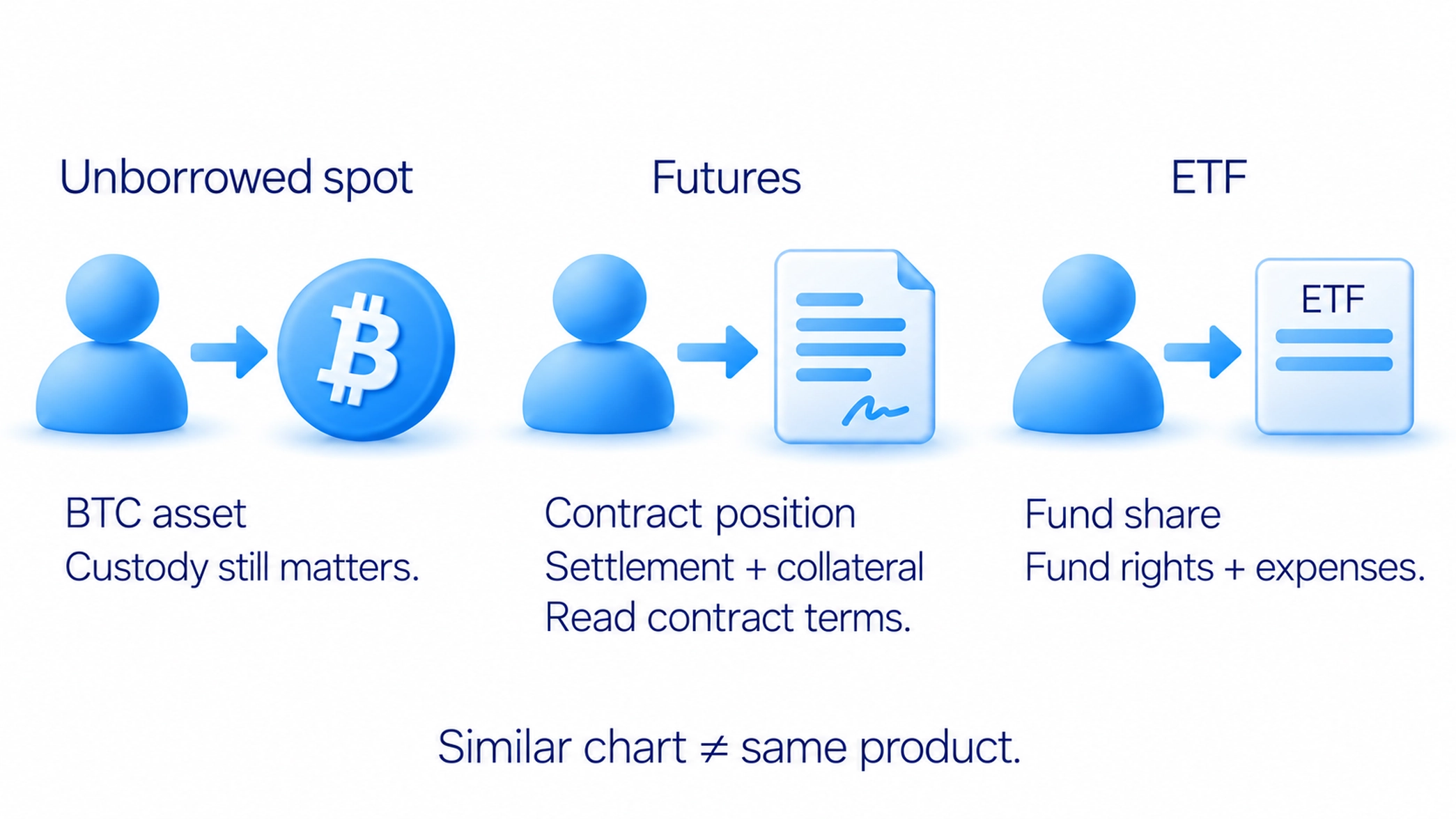
The letters BTC on a screen do not identify the product. A spot purchase without borrowing buys the asset using available funds. A futures contract creates rights and obligations under its own settlement and collateral rules: collateral means funds pledged to support the contract position. Some Bitcoin futures settle through a cash payment rather than delivery of BTC to a wallet. Spot trading and derivatives explains these product differences.
A share in a Bitcoin exchange-traded fund, or ETF, is another product. You own a share with stated rights and expenses, rather than BTC in your personal wallet. Its trading hours and market price can differ from the underlying Bitcoin market. The Bitcoin ETF guide explains what the share represents and why tracking does not mean identical returns.
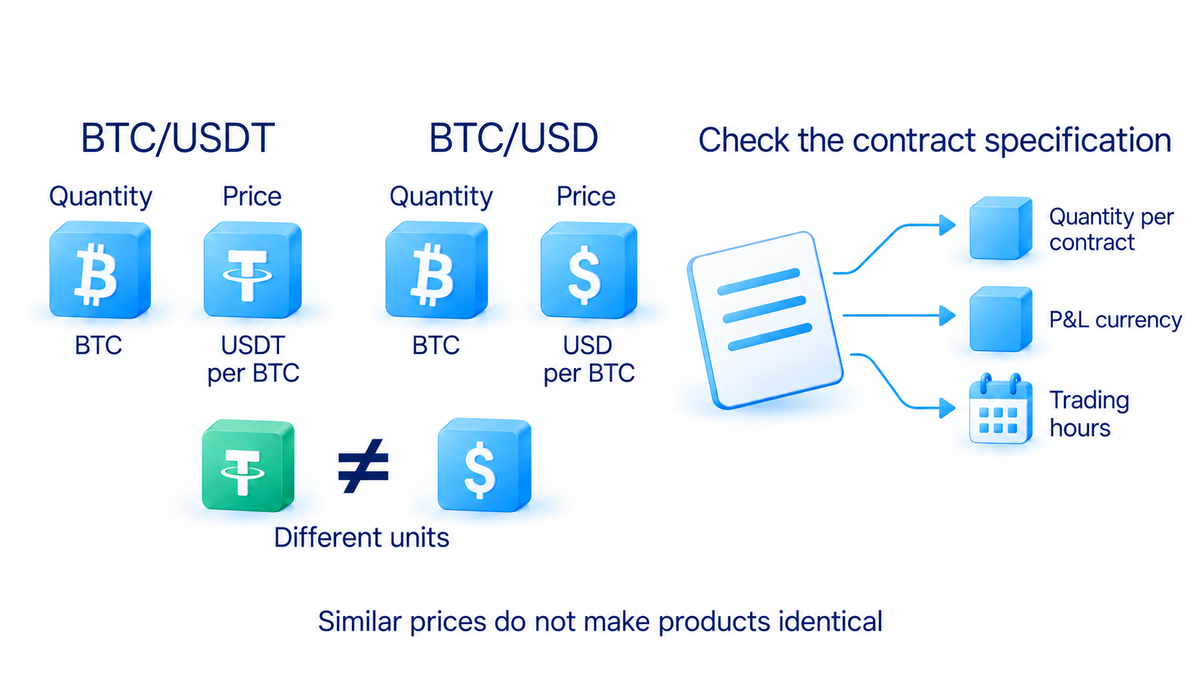
Before opening a chart, check the venue, product, price currency and trading hours. In BTC/USDT, quantity is expressed in BTC and price in USDT, a token designed to track the US dollar. BTC/USD expresses price in US dollars. USDT and USD are different units, even when their quoted values are close. For a contract, also check the asset quantity represented by one contract and the currency used to calculate gains and losses.
Keep a consistent data source and chart interval while comparing observations. Moving from spot to a futures contract or another venue calls for another check of levels and data. Different products can trade at different prices. That difference alone does not establish a mistake or a profit opportunity after execution costs.
How interest rates and the dollar can affect Bitcoin
Interest rates affect borrowing costs and the appeal of other investments. Expectations of more expensive borrowing can reduce willingness to hold risky assets. Changes in the dollar also affect how purchases and asset values look in other currencies. These are possible channels of influence, not a formula that determines the next BTC movement.
An announcement matters partly through its difference from expectations. An anticipated rate decision may already be reflected in prices; an unexpected detail can change the market's assessment. Bitcoin's relationship with share prices also varies. A relationship observed during one period cannot be assumed for every future trade.
Around a major announcement, allow for sudden movement and worse execution. If your plan requires a clear reaction at a level, a price jump does not provide that reaction automatically. When the required exit becomes too far away for your loss budget, reduce the quantity before entry or skip the trade. The news does not authorize a larger loss budget.
Bitcoin dominance describes BTC's share of a selected cryptocurrency market-capitalization measure, an estimate based on asset prices and circulating quantities. It does not measure money moving directly from altcoins into Bitcoin. Treat it as a separate observation about the market's composition, with a stated calculation method, rather than an instruction to buy BTC.
Finding price levels on a BTC chart
Support is a price area where previous declines met buying and turned upward. Resistance is an area where previous advances met selling and turned downward. These are places to examine the next reaction, not guarantees of another bounce. Mark a meaningful past change in direction, then check what price is doing there now.
Read the sequence of highs and lows on the selected chart interval. Lower highs and lower lows describe a falling structure; higher highs and higher lows describe a rising one. In a sideways market, identify the range boundaries. A small rise inside a broader decline does not by itself reverse that structure. Chart reading explains how to make these observations consistently.
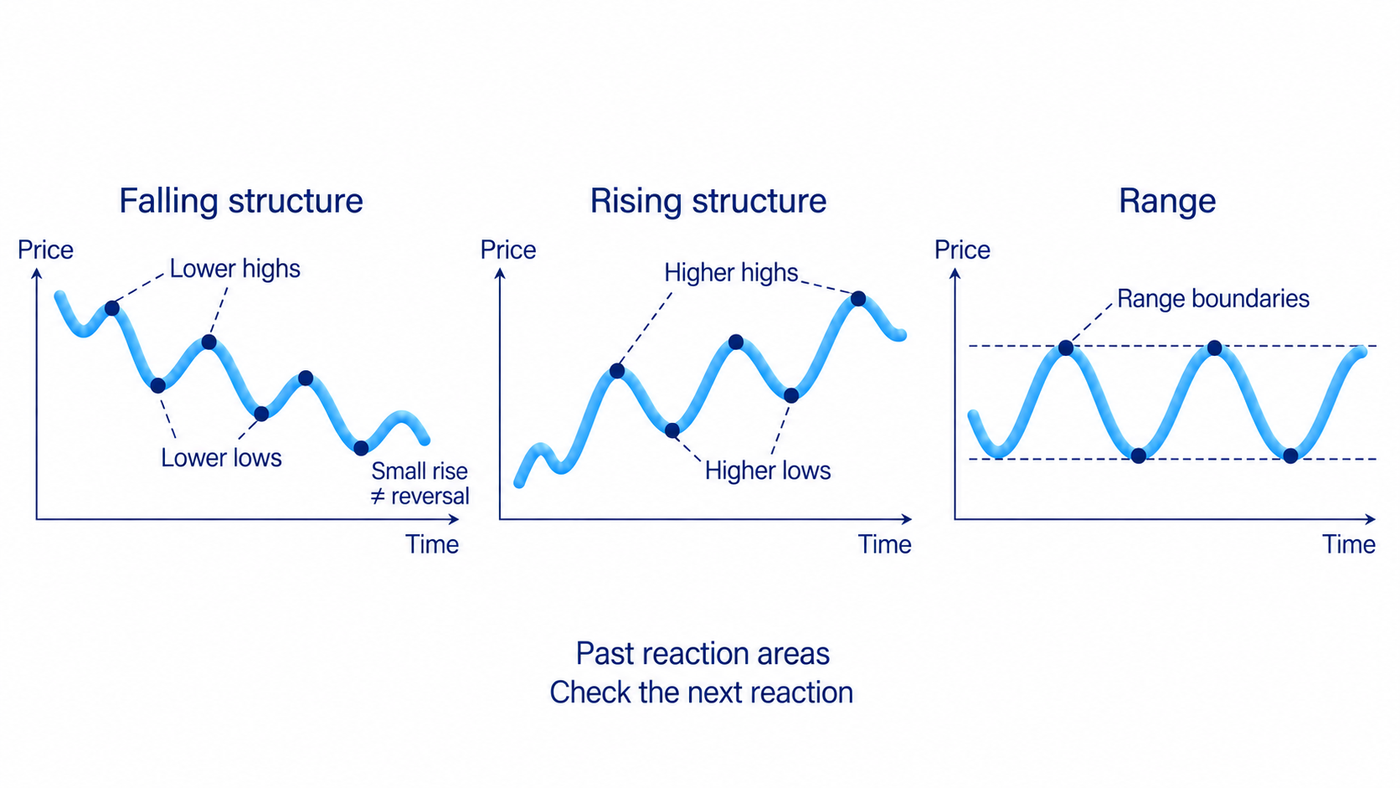
In my course's priority-change-level example, EUR/USD makes new lows and I mark the resistance areas associated with the decline. A range forms before a rising structure develops, changing which direction the example supports. For Bitcoin, the same task is to read the actual structure on its own chart. Crossing a drawn line alone does not prove that a new trend has begun.
The optional video on building price levels shows the method using EUR/USD. It adds a chart demonstration to the written explanation; it is not evidence that a particular Bitcoin trade will be profitable.
What Bitcoin trading volume measures
Trading volume is the quantity traded in the selected market during a period. For exchange-traded futures it is measured in contracts; a spot venue may report BTC quantity or the money value traded in the quote currency. Tick volume counts quotation updates instead. Check the source's definition before comparing bars, because these measurements do not all count the same thing.
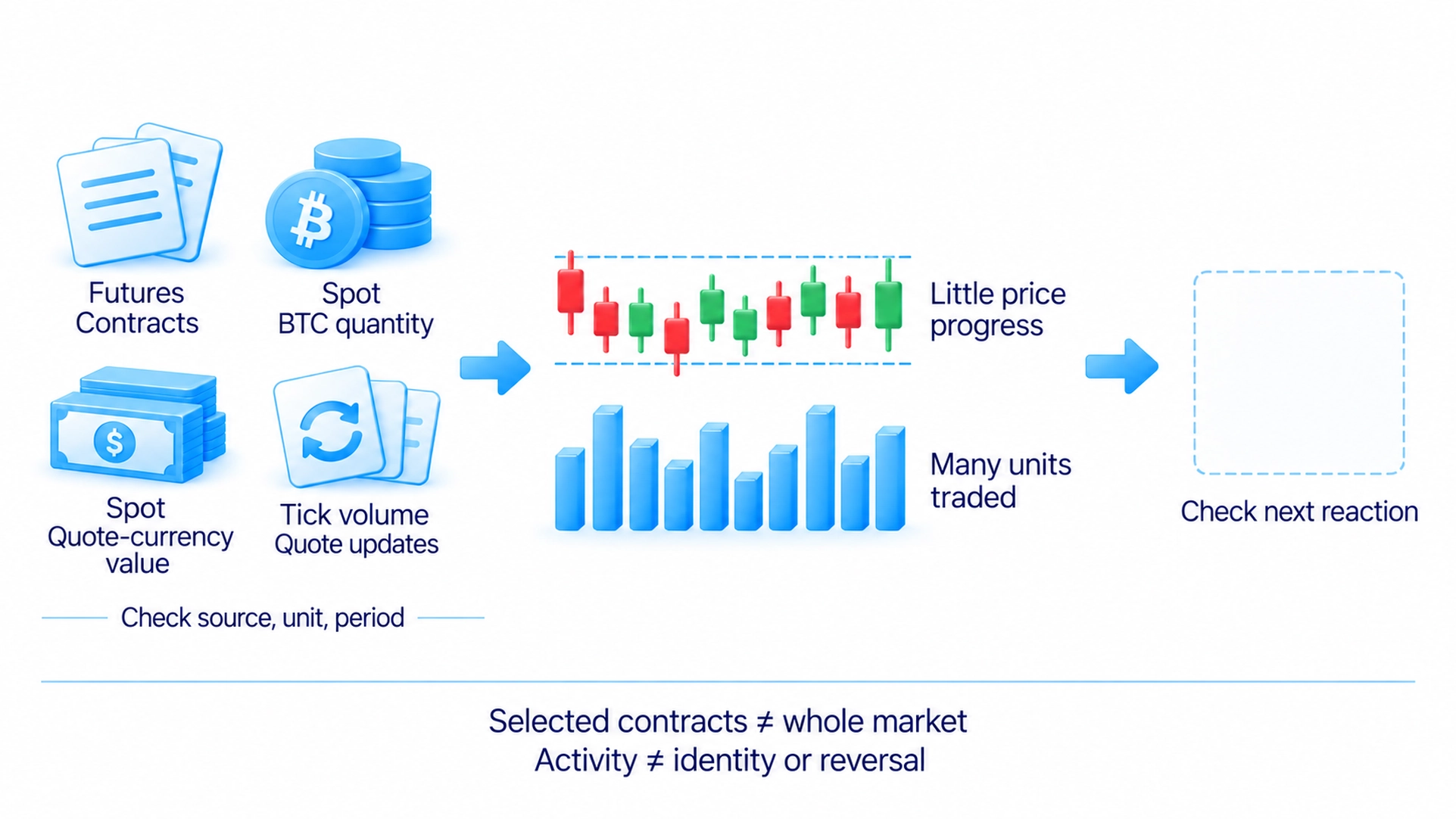
CME Bitcoin futures volume describes transactions in the selected contracts, not every Bitcoin trade worldwide. It also does not equal purchases by spot Bitcoin funds. Activity may move from an expiring contract to a later contract. Check whether your chart displays one contract or a combined series before interpreting a change in volume.
Compare activity with the price movement near your marked area. High volume with little price progress means that many units traded while price moved only a limited distance. The next reaction still matters. This observation does not identify a particular fund's purchases or guarantee a reversal. Volume analysis explains the distinction between recorded activity and an interpretation of it.
Before a purchase, check whether the area holds and whether your planned confirmation of upward movement appears. If price remains below resistance and makes fresh lows, a volume spike does not remove that weak structure. An observation should change a decision through a stated condition, rather than through an assumed identity of a large trader.
Connecting the background with a trade plan
Bitcoin halving reduces the new BTC subsidy issued for a block. It does not reduce the number of BTC already in existence or require demand to increase. Past cycles do not provide a schedule of future highs. Treat the issuance change separately from the conditions needed for a trade in your chosen market.
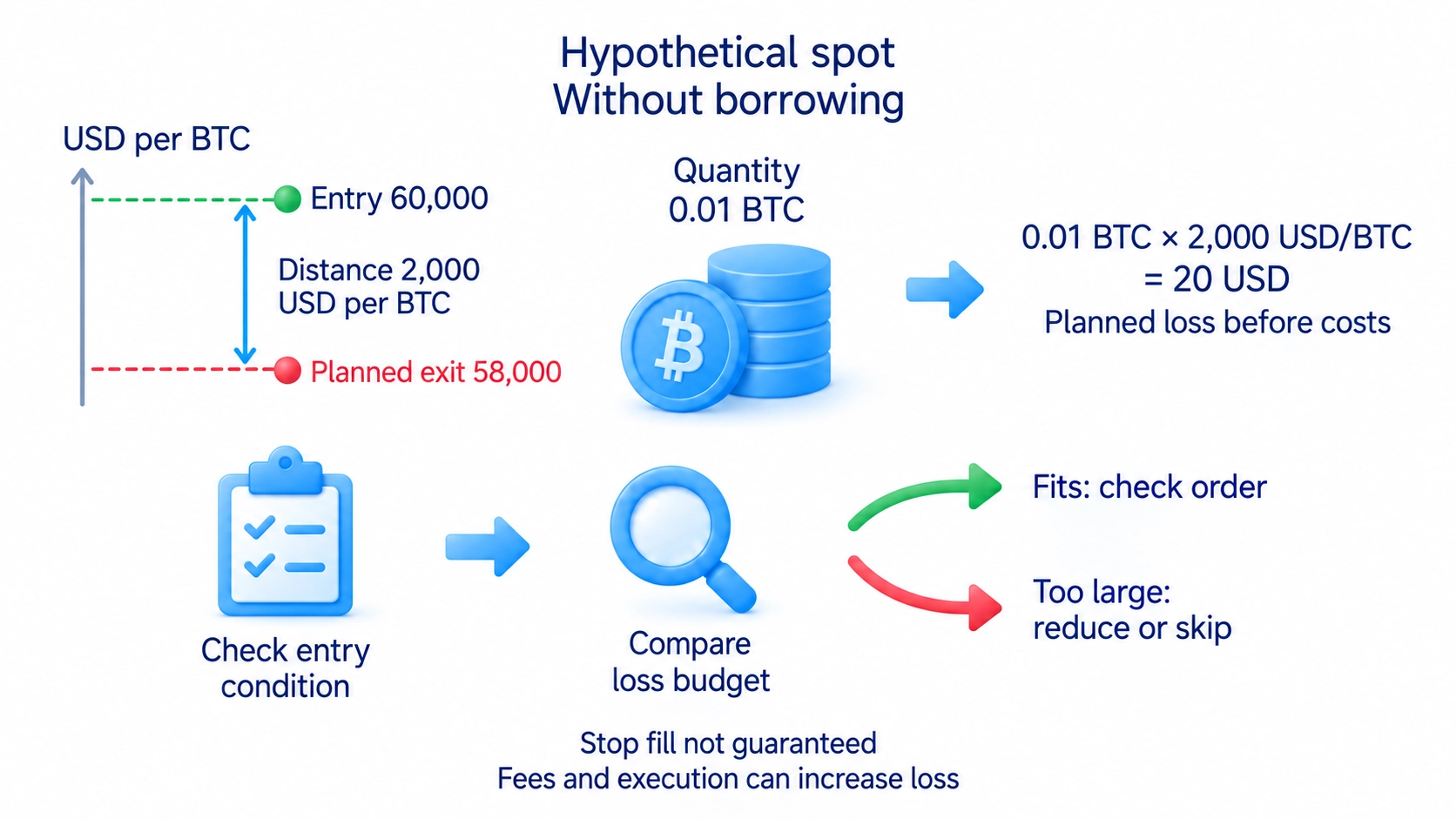
Consider one hypothetical spot purchase without borrowing. Entry is planned at 60,000 USD per BTC, with an adverse-movement exit at 58,000 USD. For 0.01 BTC, the planned loss before costs is 0.01 × (60,000 − 58,000) = 20 USD. This calculation uses those prices and that quantity; it does not apply unchanged to every contract carrying the Bitcoin name.
First check that the entry condition is present, then compare the planned loss with your account's permitted loss. If it is too large, reduce the quantity or leave the trade alone. A protective stop is an instruction intended to close the trade when its trigger condition occurs; it does not guarantee an execution price of 58,000 USD. Fees and execution can increase the loss. Risk management explains how to calculate quantity from a chosen loss budget.
After the trade, record actual execution and whether the structure and reaction met your stated conditions. Buying only because price fell or a calendar event arrived is a different decision from following those conditions. A record lets you examine the action you actually took instead of fitting an explanation to every outcome afterwards.
Frequently asked questions
BTC can be transferred under the rules of a distributed network, with issuance limited by its protocol. Those rules do not fix its market price or guarantee appreciation. Using an exchange also adds the obligations and risks of that intermediary.
They can affect borrowing costs, alternatives to holding BTC and willingness to take market risk. The reaction depends on expectations and circumstances. There is no permanent rule that a particular rate or dollar movement must produce a particular BTC direction.
Mark areas of meaningful earlier turning points, read the sequence of highs and lows, and check the current reaction. A marked level does not guarantee a bounce. A fall alone does not confirm that a purchase condition is present.
It measures activity in the selected contracts. Compare it with price movement and the reaction at a marked area, while checking the contract and units used. It is neither a record of all Bitcoin trading nor proof of the participants' identities.
Halving reduces newly issued BTC, but it does not guarantee increased demand or a higher price. A purchase still needs its own entry conditions and a loss calculation for the product being traded.
About the author
Igor Arapov, practising trader since 2013 and author of the ArapovTrade library. ORCID: 0009-0003-0430-778X.




