Bitcoin halving cuts the permitted creation of new BTC per block in half. The event occurs every 210,000 blocks, rather than on a fixed calendar date. To understand its effect, separate new issuance from miners' total receipts and from the price buyers pay for Bitcoin.
What Bitcoin halving reduces
A miner assembles transactions into a proposed block and performs computational work to find a valid solution. An accepted block can pay newly issued BTC and fees from its included transactions. The new BTC are called the block subsidy. Halving cuts the permitted new BTC subsidy per block in half, not automatically the fees or every payment a miner receives.
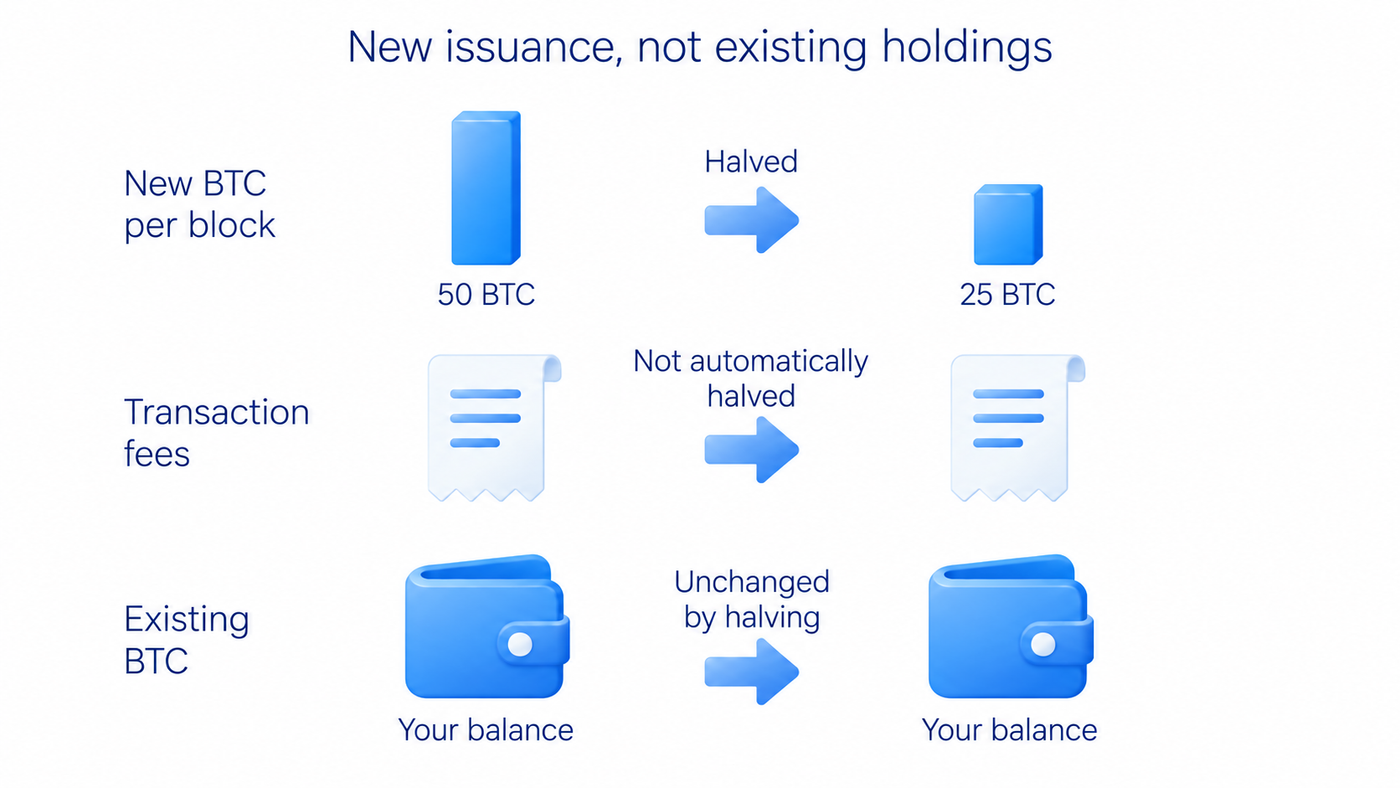
The permitted subsidy depends on block height, the block's numbered place in the chain starting from zero. Network nodes, the computers checking the rules, reject a block that creates more than its permitted subsidy plus fees. A miner cannot simply create extra BTC to replace the reduction in new issuance.
Halving does not remove or halve BTC already held. It slows the addition of new units, while existing coins can still change hands. Cryptocurrency for beginners explains the network and the different ways of holding an asset; the halving rule is a change to issuance, not to a holder's balance.
Repeated subsidy reductions limit total issuance to about 21 million BTC under the current rules. Bitcoin amounts are measured in satoshis, with 100 million satoshis in one BTC. Eventually the permitted subsidy becomes smaller than the amount represented by those whole units and falls to zero. An estimate around 2140 concerns that issuance stage, not the network's expiry date.
When a halving happens and how dates are estimated
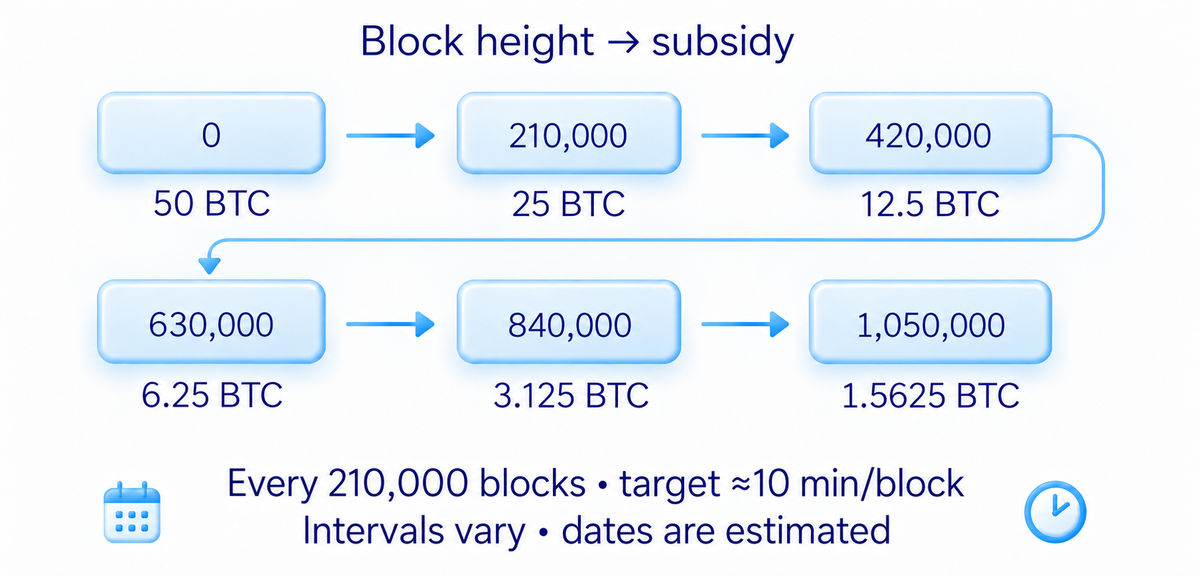
The network targets an average interval of about ten minutes between blocks. Individual blocks can arrive sooner or later. Reaching 210,000 more blocks therefore takes roughly four years, but not an identical number of days each time. The event's condition is a block height, not a date supplied by a countdown website.
The initial subsidy was 50 BTC per block. At height 210,000 it became 25 BTC, at 420,000 it became 12.5 BTC, and at 630,000 it became 6.25 BTC. These values refer to new coins, excluding transaction fees. They describe the issuance rule rather than the total earnings of a mining business.
The fourth halving occurred at block 840,000 on 20 April 2024 in UTC. Its subsidy fell from 6.25 to 3.125 BTC per block. A publication using a different time zone may label the event 19 April. Check the block height and time zone instead of treating two calendar labels as different events.
The next scheduled boundary after 840,000 is block 1,050,000, where the subsidy becomes 1.5625 BTC. Its calendar date is estimated from how quickly blocks arrive. A countdown can change when its estimate of that pace changes; it does not change the protocol's target height.
To check a claimed date, record the target height and the current main-chain height from a consistent source. Then check the average block interval used to estimate the remaining time. The date answers approximately when the boundary might be reached. The height states the condition that must actually occur.
Why total miner income need not halve
A block's total reward includes its subsidy and transaction fees. Halving does not prescribe those fees, which depend on the transactions included and the demand for block space. Consequently, the change in the total reward need not equal the percentage reduction in the subsidy.
For one hypothetical comparison, let the pre-halving subsidy be 6.25 BTC and the chosen block's fees be 0.5 BTC. The total is 6.25 + 0.5 = 6.75 BTC. With the subsidy reduced to 3.125 BTC and the same assumed fees, the total is 3.125 + 0.5 = 3.625 BTC. The subsidy halved; the combined amount did not.
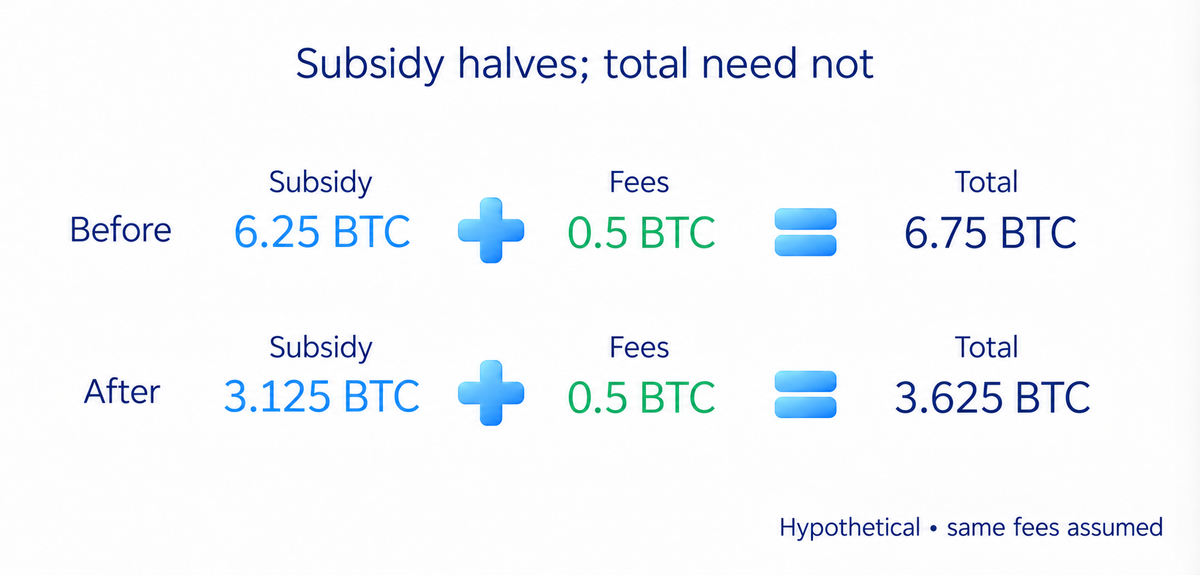
Equal fees are an assumption of this example, not a forecast. Income measured in dollars also depends on the BTC price, while profit requires deducting electricity, equipment and other operating costs. A participant in a mining pool, a group sharing computational work and proceeds, receives payment under its distribution rules. That payment need not be an entire block reward.
If some miners switch off equipment, the network's total computational work can decline and blocks can temporarily arrive more slowly. The difficulty of the required calculation is adjusted under network rules to move the average pace toward its target. Difficulty does not have to rise after a halving, and its adjustment does not reimburse a company's costs.
Must the Bitcoin price rise after halving?
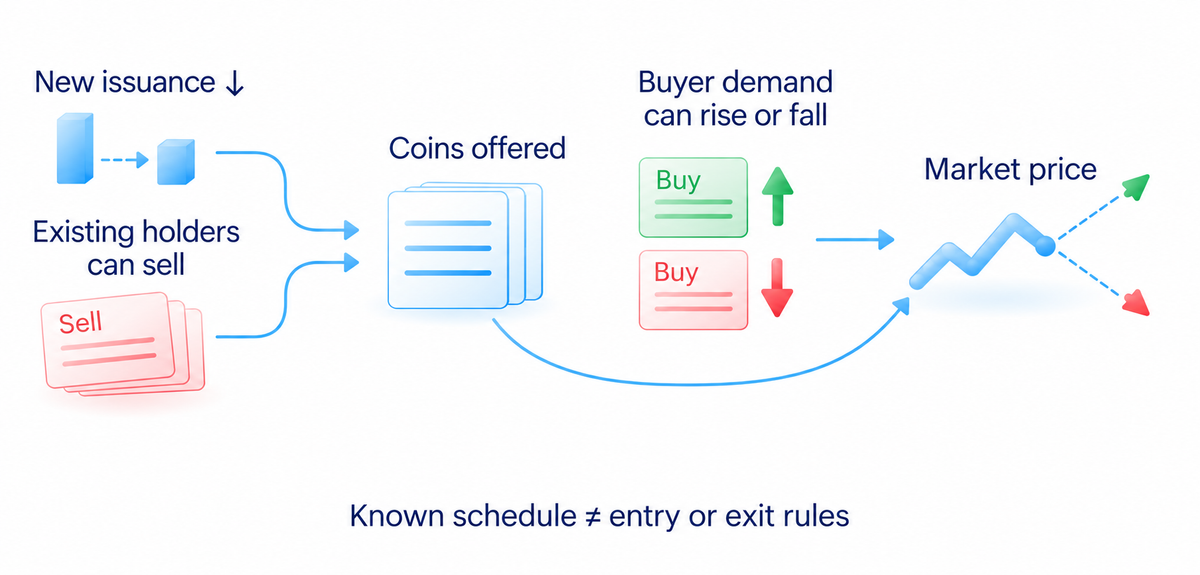
No. Lower new issuance changes one source of supply; it does not set a market price. Owners of existing BTC can also sell, while potential buyers can increase or reduce demand. Fewer newly created coins do not guarantee that fewer coins are offered for sale at every moment.
Participants know the issuance schedule in advance and can act on expectations before the boundary arrives. If purchases based on that expectation have already occurred, the subsidy change need not create another wave of demand. A purchase made before a known event can still lose value.
When comparing past cycles, specify the venue and the start and end of each price-measurement period. A gain from the halving date to a selected peak differs from a gain over the same fixed period after each event. Choosing only favourable peaks can produce a pattern that disappears under another consistent comparison.
There have been few halvings, each taking place under different demand, product access and wider market conditions. A rise after an event does not establish that the event alone caused it. A claim that each subsequent price rise must be weaker is also not a Bitcoin protocol rule and needs a stated dataset and comparison method.
Exchange-traded funds can be one route through which investors obtain access to Bitcoin's price, but they are not required to buy a fixed quantity of BTC each day. The Bitcoin ETF guide explains the product and its creation and redemption arrangements. A change in Bitcoin dominance is likewise not direct evidence of money moving between BTC and altcoins. Keep these measurements separate from the issuance rule.
Using halving information without treating it as a forecast
Write down the established fact separately from the expectation. The target block and permitted subsidy are network rules; an expected price rise is a hypothesis. If the purchase argument consists only of a date, it still lacks an entry condition and an exit plan. A known event is not a promise of a profitable trade.
The fundamental-analysis section of my course places that subject after learning to read price structure and trading volume, the quantity traded in the chosen data source. It supplies additional context rather than a separate halving strategy. An issuance announcement can explain the background, but it does not replace the trade rules a learner needs to carry out.
When checking someone else's forecast, find the event height, the subsidy source and the method used to compare prices. Ask what must happen beyond the issuance reduction, and what observation would contradict the forecast. Without a stated period, data and a condition for being wrong, an attractive rising line is not a conclusion you can properly check.
Frequently asked questions
It is a halving of the permitted new BTC subsidy per block every 210,000 blocks. Transaction fees do not automatically halve with the subsidy, and existing holders do not lose half their coins.
The boundary is a number of blocks, and the network targets an average interval of about ten minutes. Individual block arrival times vary. Around four years is therefore an estimate, rather than a fixed calendar rule.
At block 840,000, the new-coin subsidy fell from 6.25 to 3.125 BTC per block. That does not require every block's combined subsidy and fees, or every miner's total income, to fall by half.
No. Halving reduces newly issued BTC, while price also depends on buyers and the sale of existing coins. Past price changes do not guarantee that a similar movement will follow another halving.
Participants know the schedule and can change their demand before the event. A smaller subsidy does not ensure new buyers will appear afterwards. The asset's price can still fall after a purchase.
About the author
Igor Arapov, practising trader since 2013 and author of the ArapovTrade library. ORCID: 0009-0003-0430-778X.




