A Bitcoin ETF, an exchange-traded fund, is a way to hold a listed security whose result depends on Bitcoin. Buying its shares does not send BTC to your personal wallet. Before placing an order, find out what the product owns, what rights its shares give you, and which costs can make its result differ from the coin's price.
The name ETF is used loosely for several Bitcoin products. It does not tell you their legal structure, how they obtain a Bitcoin-linked result, or whether your broker lets you buy them. The product's documents answer those questions more reliably than the label alone.
What a Bitcoin ETF shareholder owns
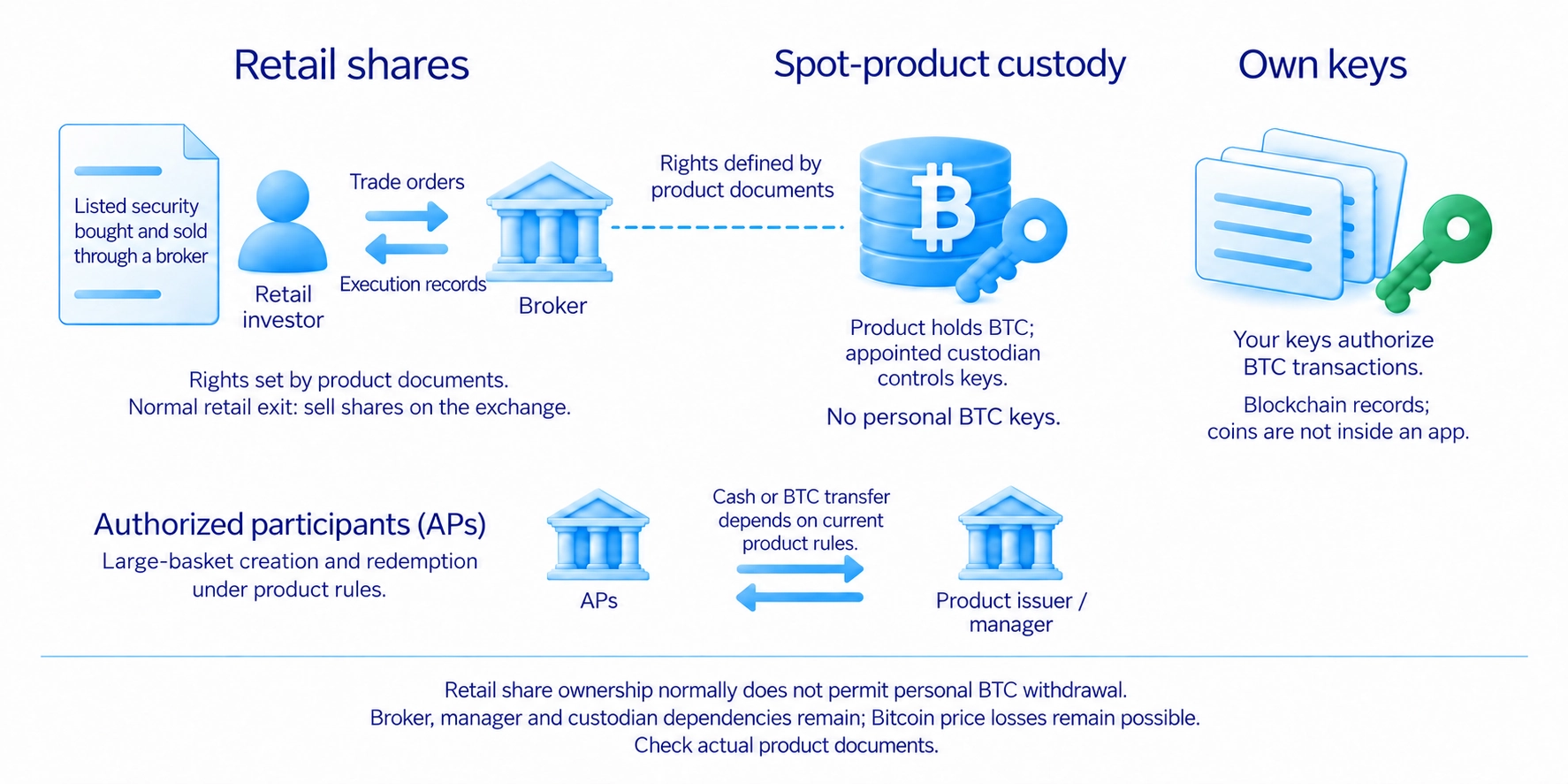
An ordinary investor buys and sells shares through a broker. A spot Bitcoin product holds BTC, but its shareholders do not receive the keys used to control those coins. They own the rights described in the product's documents, rather than Bitcoin they can spend from their own address. By contrast, BTC kept in your own wallet is controlled through your keys; BTC held by a custodial service depends on that service instead of giving you the same direct control.
Retail shareholders normally exit by selling their shares on the exchange. Holding one share does not normally entitle you to take it to the manager and demand BTC in your wallet. Availability also depends on your country, the broker and your client status.
The product delegates coin storage to its appointed organizations. That removes your need to keep the Bitcoin keys, but introduces dependencies on the broker, manager, custodian and their contracts. It does not remove the risk of Bitcoin falling. Cryptocurrency for beginners explains the difference between owning coins and holding a separate product.
Some US spot Bitcoin products are commodity trusts, structures that hold assets for their shareholders. They are not registered investment companies under the Investment Company Act of 1940 and do not have the same regulatory framework as those funds. On 10 January 2024, the SEC approved the listing and trading of a group of US spot Bitcoin products. That approval was not an endorsement of Bitcoin or a promise that investors would make money.
Spot products versus futures products
A spot product holds Bitcoin and aims to follow its value after expenses. A futures product uses contracts, and may use other instruments allowed by its documents. ProShares BITO, for example, uses Bitcoin futures and swaps, contracts that exchange payments under agreed terms, instead of directly holding Bitcoin.
A futures contract has its own terms and expiry. Replacing an expiring contract with a later one is called rolling. The two contracts can have different prices, so the fund's result is not explained by the spot Bitcoin move alone. Income on assets held to support the contracts, trading costs and other holdings also matter. A roll is not automatically a loss in every market condition.
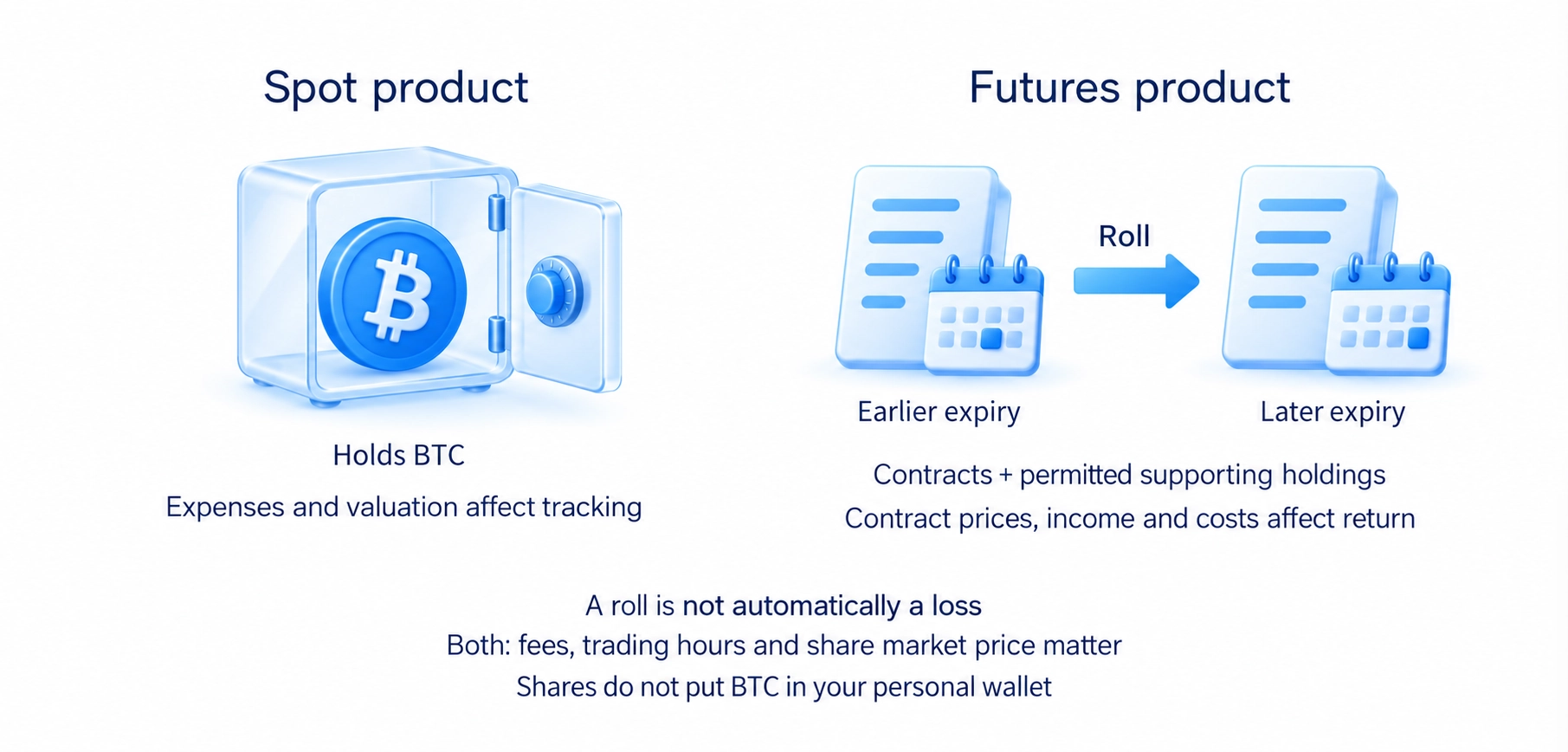
Even a spot product need not match BTC exactly. Fees, valuation rules, trading hours and the share's market price create differences. Compare the same period and currency. If a product makes payments to shareholders, compare total return including those payments rather than only the change in its quoted share price.
Simply owning Bitcoin does not pay interest. If a product offers income, check the operations behind it.
Selling a call option means receiving a premium, the price paid for the buyer’s right to buy the specified instrument or receive a cash payment under the contract’s terms. This can bring in income while limiting gains on the covered holdings and leaving losses possible. Such payments are not a guarantee of profit. Bitcoin also does not use proof-of-stake validation, so staking arrangements for other coins cannot simply be assumed to apply to BTC.
NAV and the market price of a share
Net asset value, or NAV, is the product's assets minus its liabilities. Dividing that amount by the number of shares gives NAV per share. It is a calculated value at a stated time, not a promise that your order will trade at that price.
Suppose a spot product has net assets of USD 10 million and 200,000 shares outstanding. NAV per share is 10,000,000 divided by 200,000, or USD 50. If the market price at the same moment is USD 51, the share trades USD 1 above NAV: 1 divided by 50 times 100 gives a 2% premium. These are hypothetical, simultaneous figures. Yesterday's NAV and today's share price cannot establish the same premium.
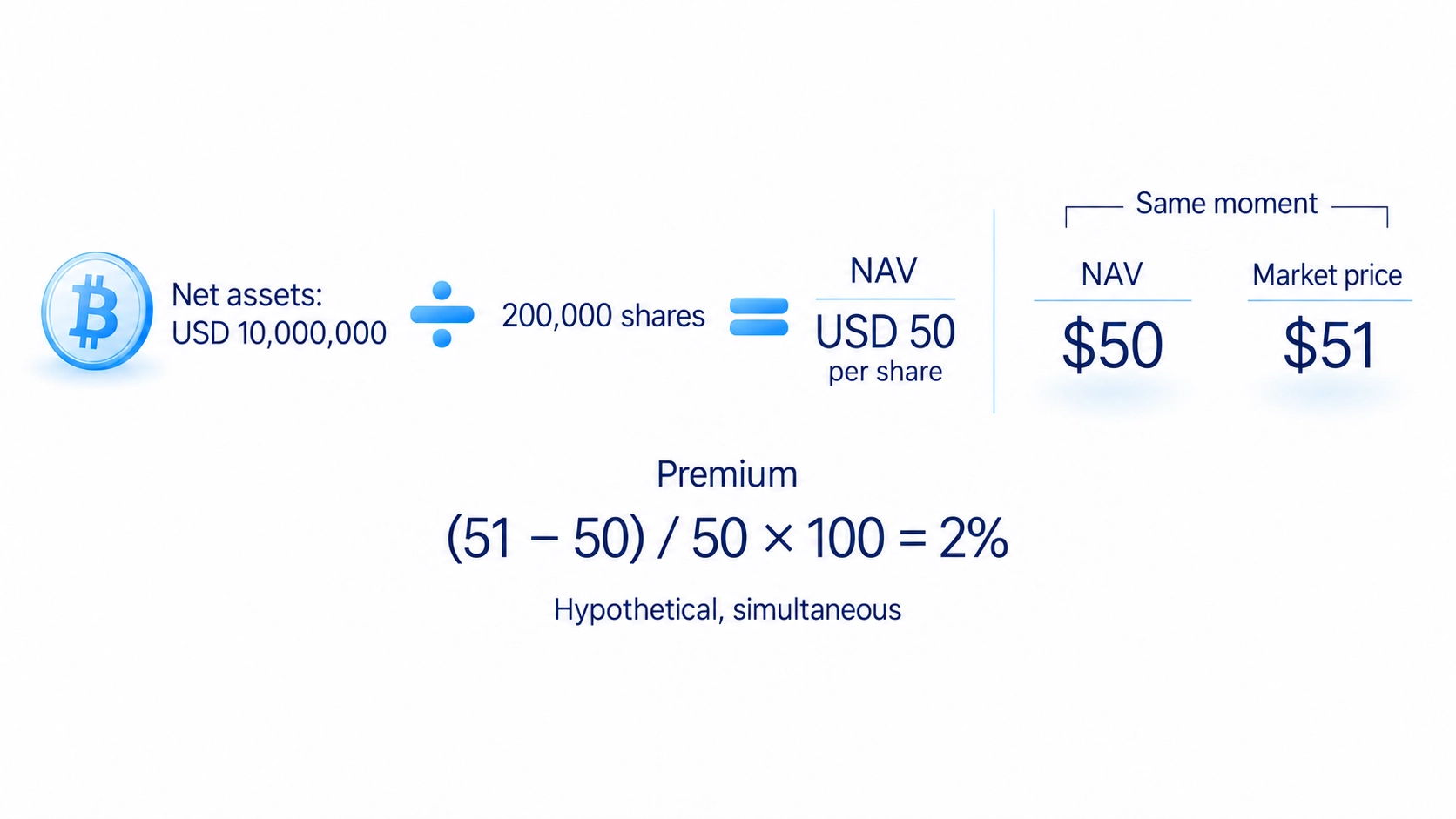
A market price below a comparable NAV is called a discount. Check the time of the valuation and the method behind it before interpreting the difference. A manager's displayed NAV may refer to the previous close. When BTC has moved since then, that old figure is not a current valuation of the share's underlying assets.
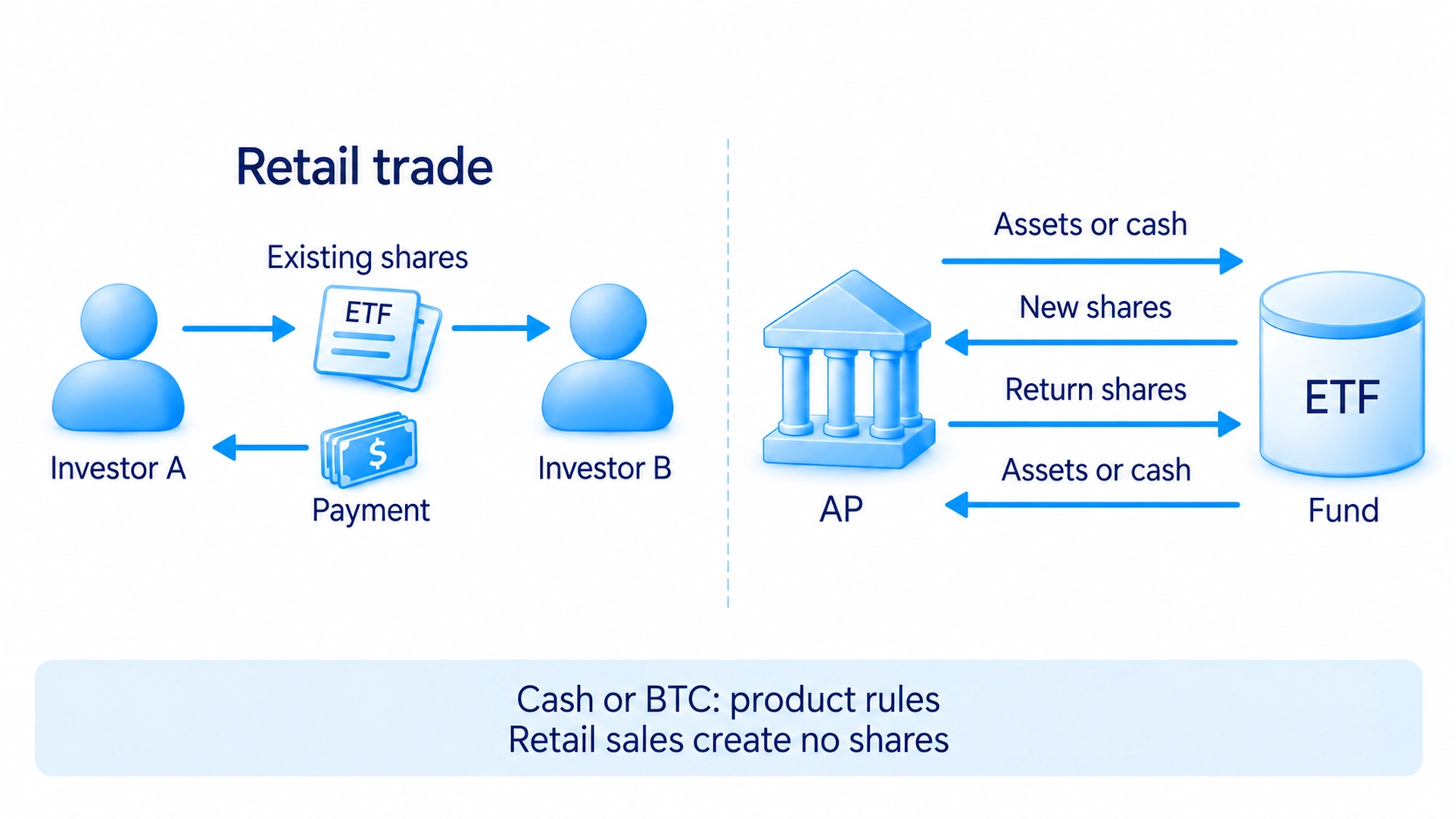
Authorized participants, or APs, are organizations allowed to create and redeem large baskets of shares. They deliver the assets or money required by the product in exchange for new shares, or return shares for redemption. Whether the process uses cash or a transfer of Bitcoin depends on that product's current rules. This is different from a retail shareholder withdrawing coins.
Creation and redemption can help bring the share price closer to the value of its assets. They do not guarantee equality at every moment, especially if trading or participant operations are restricted. A sale of existing shares between two investors does not by itself create shares or require the product to buy Bitcoin.
Costs and risks to check before buying
Start with the product's objective and permitted holdings. Then check its manager, custodian, creation and redemption arrangements, and allowed operations. Choosing from a list of the largest products does not replace these checks: size does not cancel the particular rights and risks in the documents.
The management fee is generally taken from product assets and reduces the shareholder's result over time. It is separate from your broker's charge for buying or selling. A temporary fee waiver can end. Check the normal fee, the waiver's duration and the conditions rather than assuming the introductory rate will last.
The spread is the gap between the best available buying and selling prices. Check both prices and the number of shares available before submitting an order. The last trade is not necessarily the price available for your quantity. High daily turnover does not guarantee a good execution price at the moment you trade.
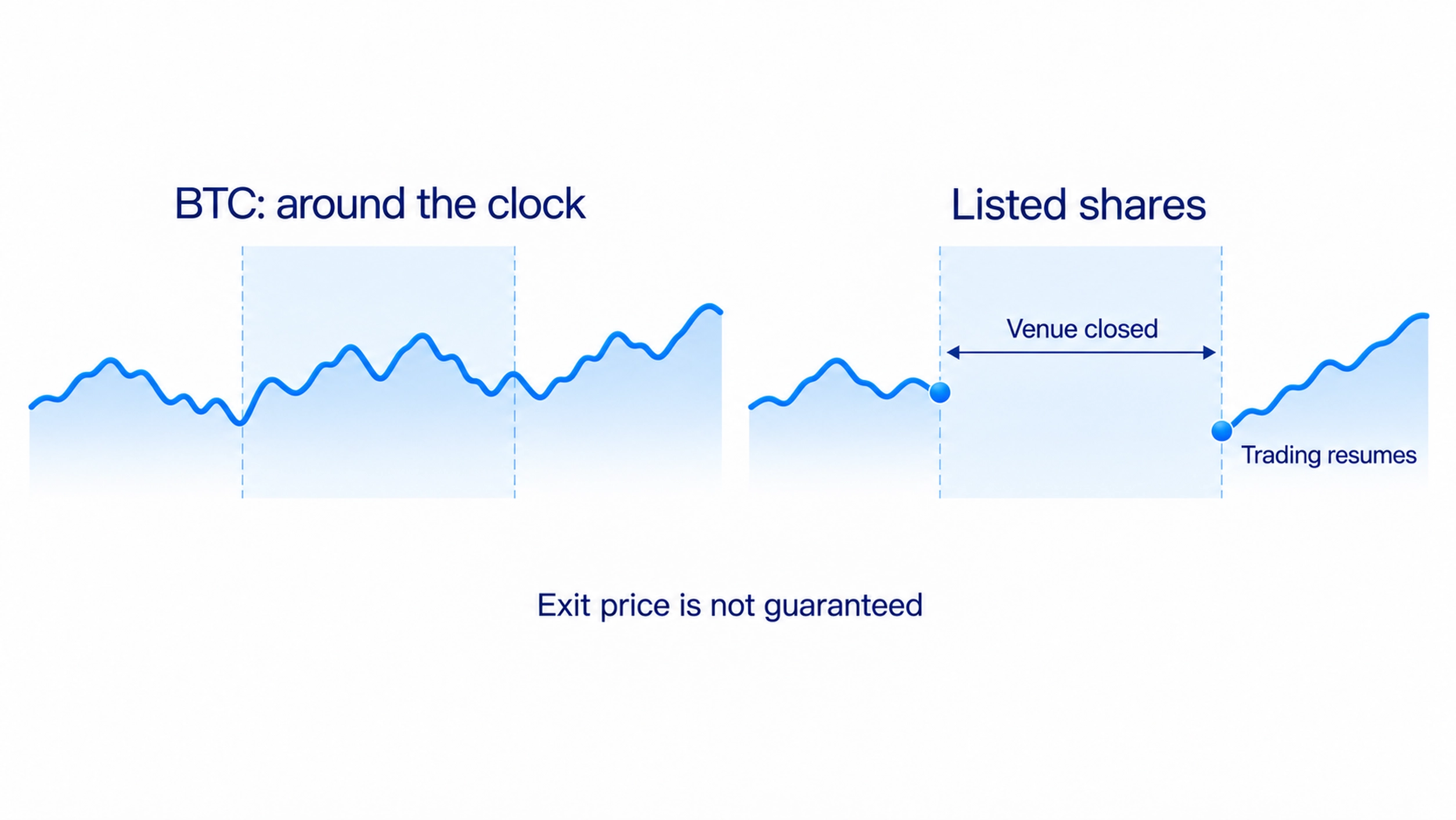
Bitcoin trades around the clock; the listed security follows its venue's trading hours. BTC can move while the security is unavailable, leaving a different price when trading resumes. A protective exit order cannot guarantee your chosen price through that gap or when there are too few matching orders.
Also check the share's currency, conversion costs, available order types and broker restrictions. Taxes depend on the owner's country and circumstances. Professional custody does not remove operational risk or make all contracts provide the same protection.
What ETF inflows and outflows measure
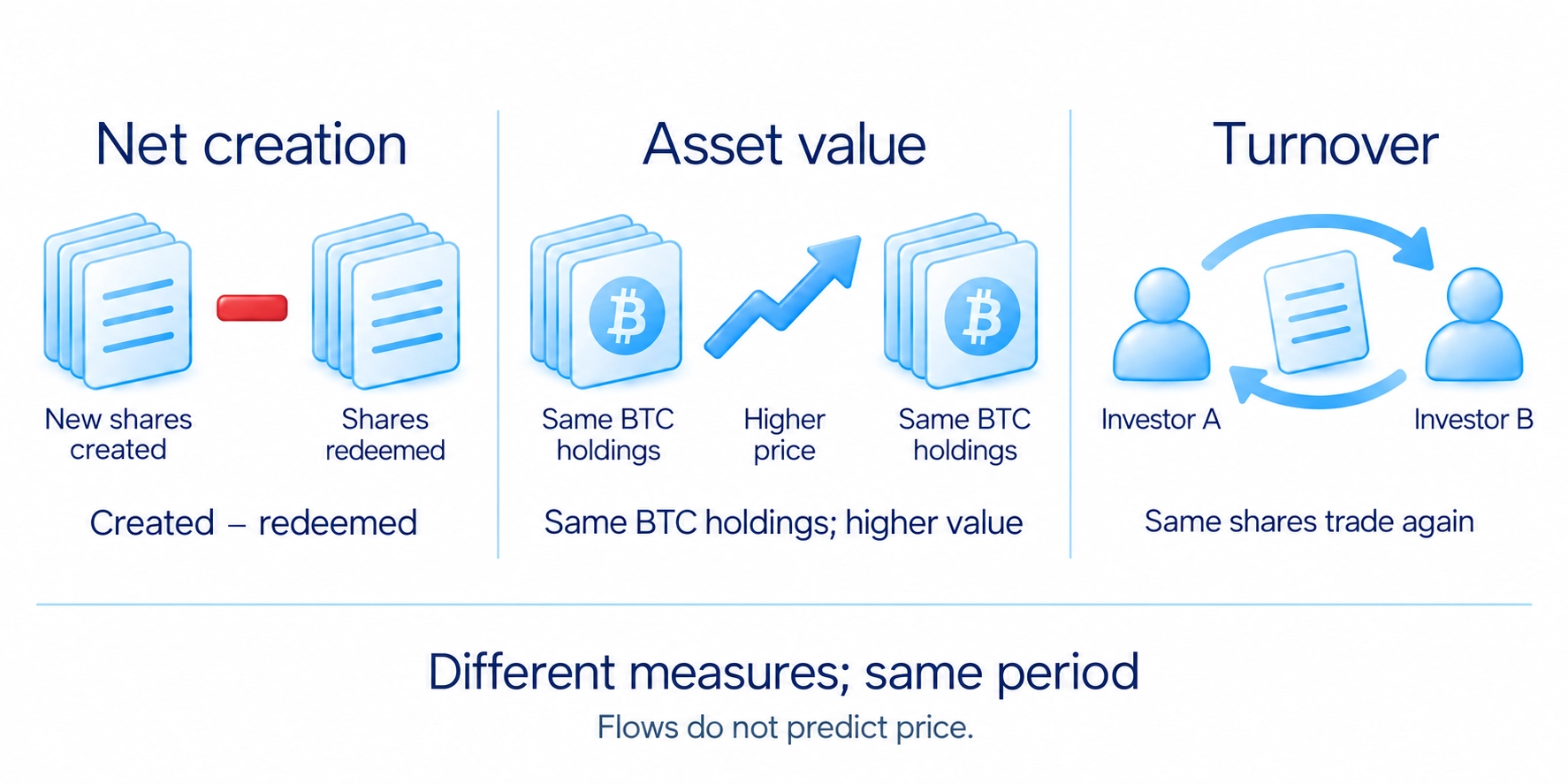
Reported inflows and outflows usually estimate net share creation or redemption over a period. A data provider may express the result in money even when assets can be transferred in kind, meaning Bitcoin rather than cash. Read the method, reporting period and update time before interpreting the figure.
An increase in assets under management is not necessarily an inflow: existing Bitcoin can rise in value without any new shares being created. Share turnover is different again, because the same shares can change hands repeatedly. Net creation, asset value and trading turnover measure different things.
Net creation can increase the Bitcoin held by a spot product, but it does not always mean an immediate cash purchase on an open exchange. If an in-kind transfer is allowed, BTC may arrive directly from a participant. A futures product changes its contract holdings instead, so its flows cannot simply be counted as direct spot Bitcoin purchases.
Buying a Bitcoin-product share does not oblige the product or its holder to buy altcoins. One product's flows also do not show every Bitcoin transaction or determine its price alone. An outflow from one product can occur alongside an inflow to another. Compare the same period and coverage before describing aggregate demand.
The fundamental-analysis section of my course places fundamental information alongside reading price structure and trading activity. ETF data can be additional context, but that section does not establish a separate personal strategy of buying after inflows. A product launch is also not a substitute for an entry condition and an affordable loss.
Before deciding, record the product name, structure, full costs, NAV source and flow methodology. If you cannot explain what its shares represent or why their price can differ from BTC, resolve those questions first. A positive inflow number on its own is not a trade plan.
Frequently asked questions
It is a listed product whose shares give a result linked to Bitcoin. You buy a security with rights set out in its documents, rather than coins sent to your own address.
A spot product holds BTC. A futures product uses contracts and may use other permitted instruments. Contract replacement, expenses and supporting holdings can make its result differ from the spot coin's price.
Retail shareholders normally sell their shares on the exchange. Authorized participants create and redeem large baskets under the product's rules. That process is not the same as an ordinary withdrawal of Bitcoin to a personal wallet.
Shares trade at a market price, while NAV is a calculated net asset value per share. Trading demand, valuation times and participant operations can create a premium or discount. Compare values from compatible times.
They usually estimate net share creation over a period using the provider's method. They are not the same as share turnover or a rise in the value of existing assets. Cash and Bitcoin transfers depend on the product's rules.
No. A launch gives investors another way to obtain a Bitcoin-linked result; it does not set Bitcoin's price. A purchase still needs clear conditions, known costs and an affordable potential loss.
About the author
Igor Arapov, a practicing trader since 2013 and author of the ArapovTrade library. ORCID: 0009-0003-0430-778X.




