Staking means putting coins into participation in a network whose right to confirm transactions depends on the amount committed. The network may reward that participation under its own rules. Before choosing a method, establish who controls the coins, what earns the reward, and how you can recover the funds.
More coins do not necessarily mean more money. A reward may fail to cover a fall in the coin's price even when the network works correctly. Read the participation and withdrawal conditions together instead of choosing the largest advertised percentage.
How cryptocurrency staking works
In Proof of Stake, a method of confirming transactions based on committed funds, a validator proposes new blocks of transaction records and checks other participants' work. The network sets the required funds and how their weight counts. Simply holding an eligible coin in an ordinary wallet does not necessarily activate staking.
Rewards support the work required by the network. They may come from newly issued coins, transaction fees, or other payments specified by its rules. Sources and distribution differ between networks, so one coin's percentage does not describe another's return. Tokenomics explains how issuance and distribution shape an asset.
Not every offer to earn money on coins is staking. Lending assets, joining an exchange promotion, and helping confirm a network's transactions have different payment mechanisms. Bitcoin's own network uses Proof of Work, confirmation through mining, rather than Ethereum-like Proof of Stake. A product advertised as BTC staking therefore needs its own protocol or service explanation. Check what actually happens to your assets and who must return them.
Your own validator, delegation or a service
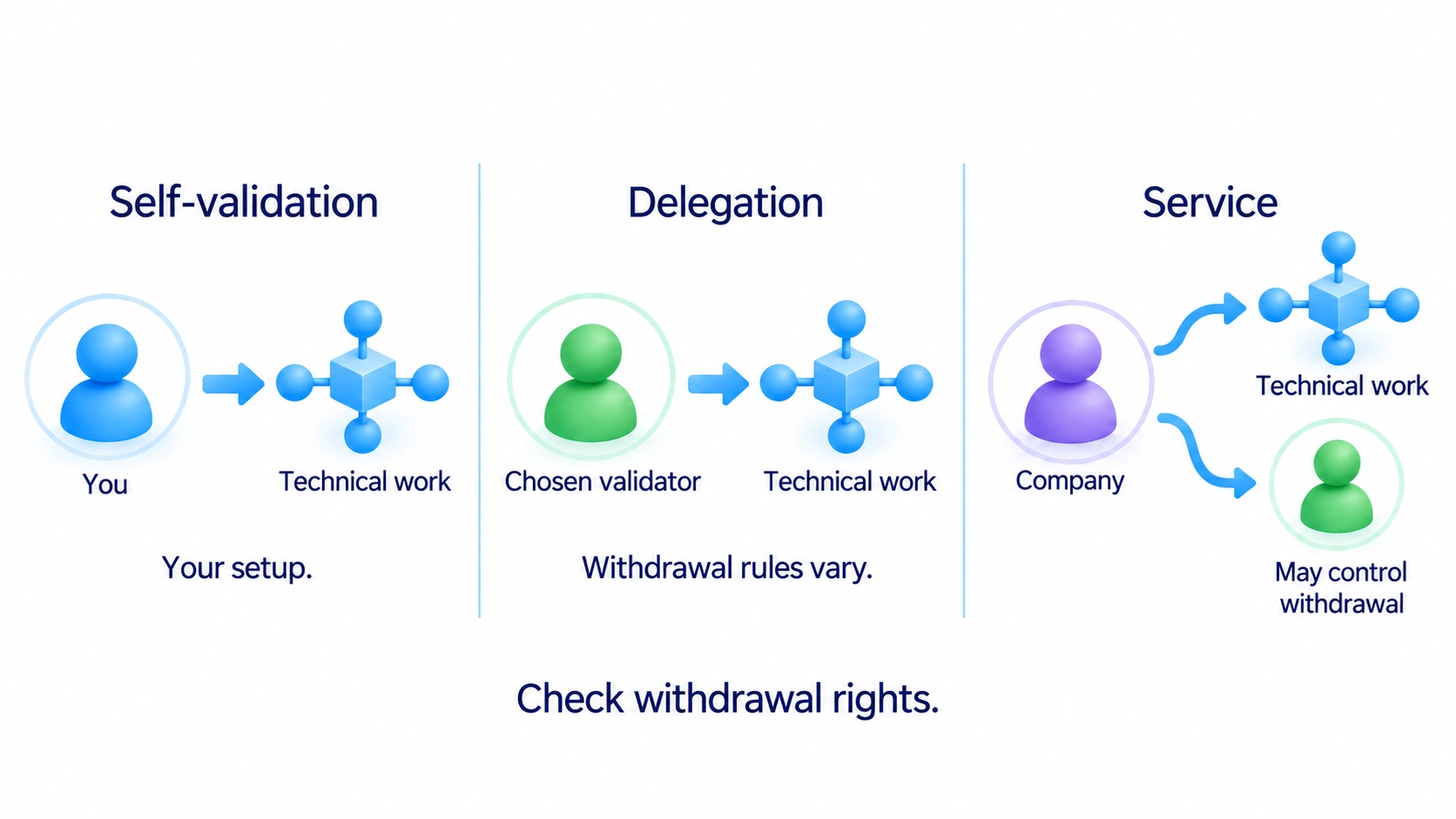
Running your own validator means maintaining its software, network connection, and the keys used to authorise its work. Ethereum requires at least 32 ETH to activate your own validator. That is a network requirement for this method, not the minimum for every service: pooled arrangements can accept smaller amounts.
With delegation, a chosen validator performs the technical work while you assign participation to it under the network's rules. In some networks, you retain control through a special stake account, but the coins cannot be used freely while committed. Assigning participation and handing over every right to the funds are different actions.
Operator services also differ. In Ethereum, the key used for validator duties and the right to withdraw funds are separate. An operator may run the software while you control the address that receives withdrawn ETH. However, its mistakes can still cause losses even if it cannot take the coins for itself.
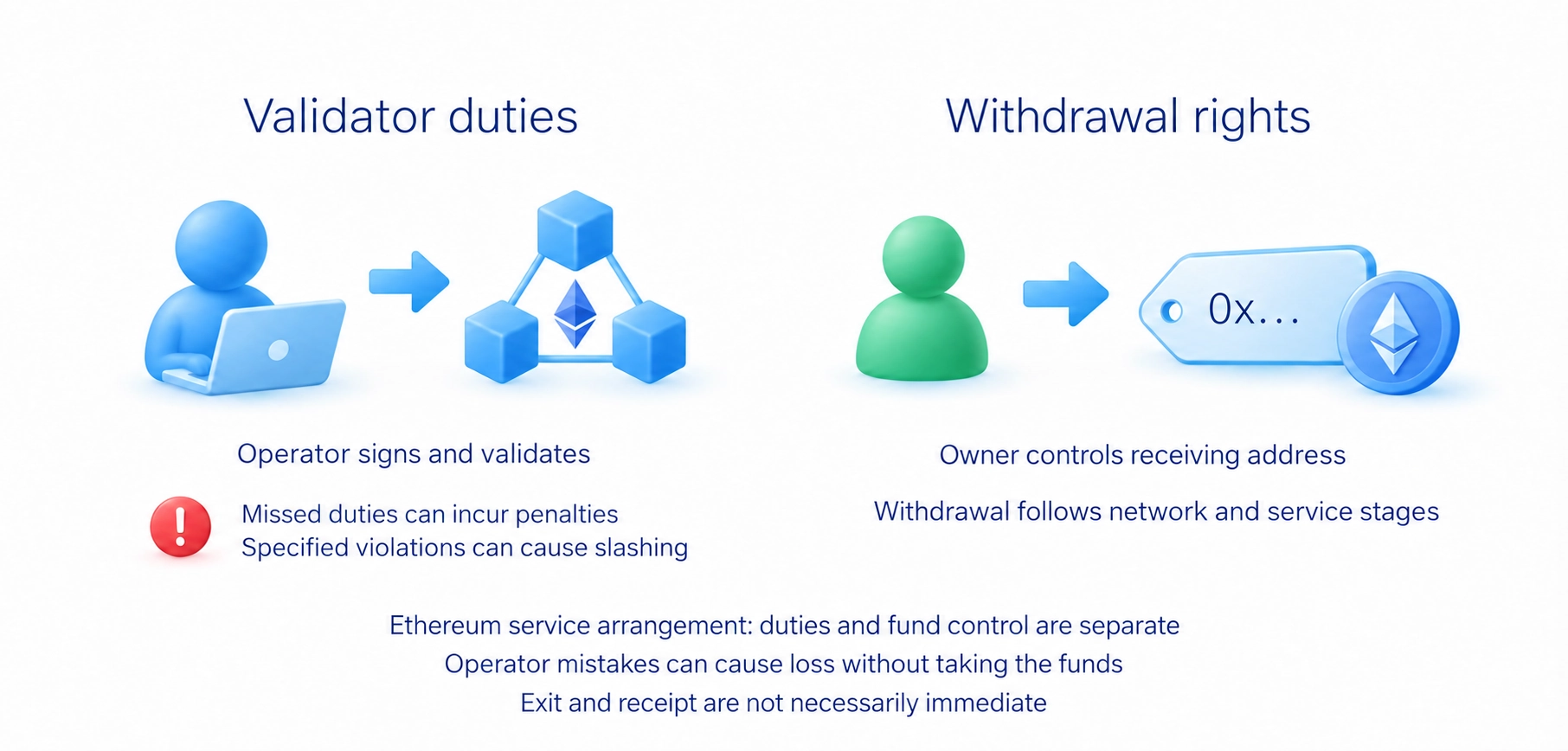
An exchange service may control both the validator and withdrawals. You then hold an account balance and a claim against the company. Its ability to pay, restrictions, and request-processing rules add risks beyond those of the network. A flexible withdrawal label does not remove those risks.
Before choosing, write down who validates transactions, who can initiate an exit, and which address receives the funds. Then check the operator's fee and the consequences of poor performance. A low fee does not establish that the operator performs its duties reliably.
How to assess staking returns
Rates usually describe a year even when rewards arrive more often. APR, Annual Percentage Rate, excludes assumed reinvestment of rewards. APY, Annual Percentage Yield, includes the effect of reinvestment. Your result depends on whether rewards can actually be reinvested, how often, and at what cost. A current annualised figure does not promise the same payments over the next year.
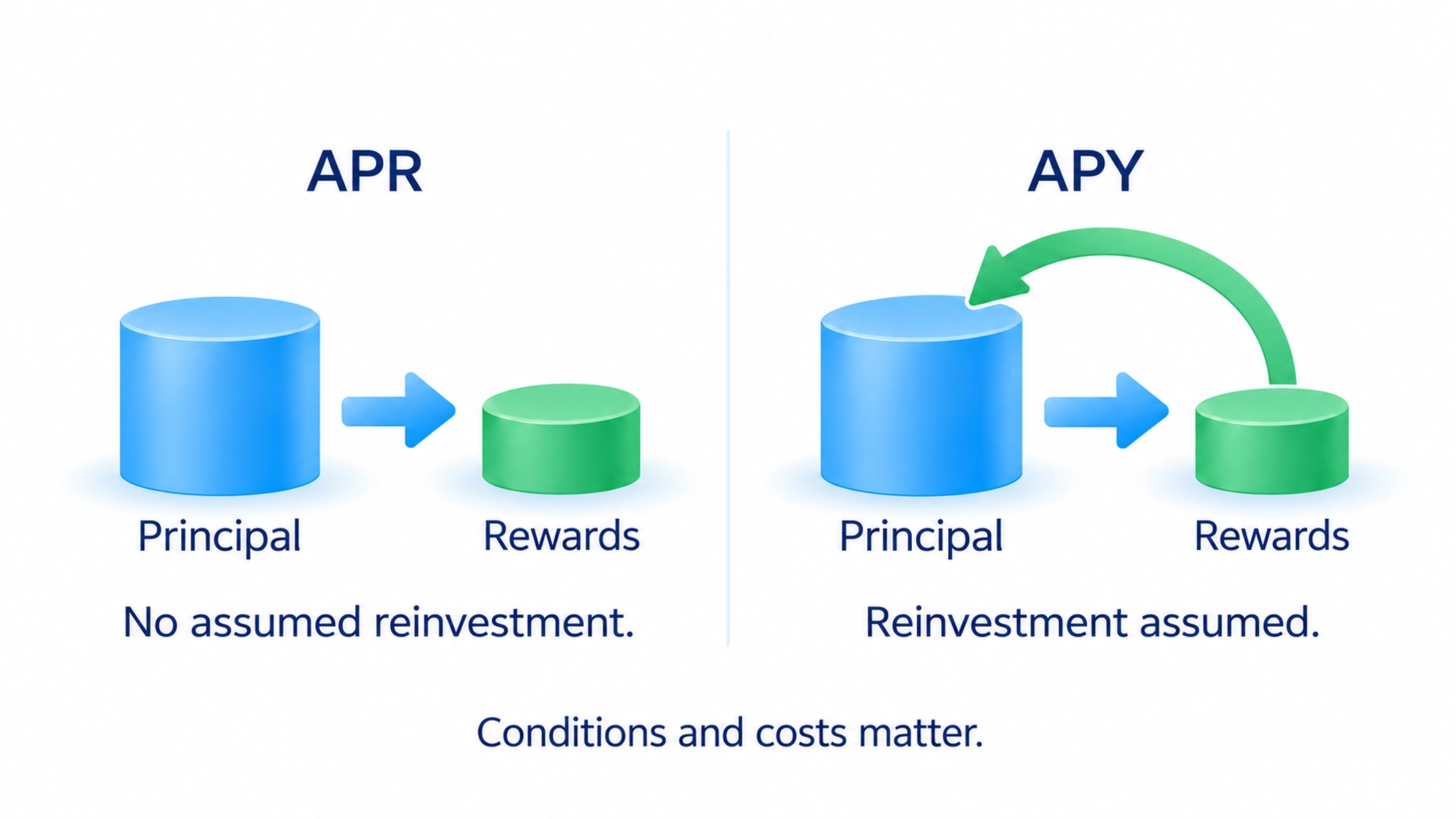
Compare returns after the operator's fee and network costs. Check which coin pays the reward and when it becomes available. Distribution rules, the amount staked, and validator performance can also affect the result. Do not assume that more participants always mean lower rewards for everyone without checking the network's formula.
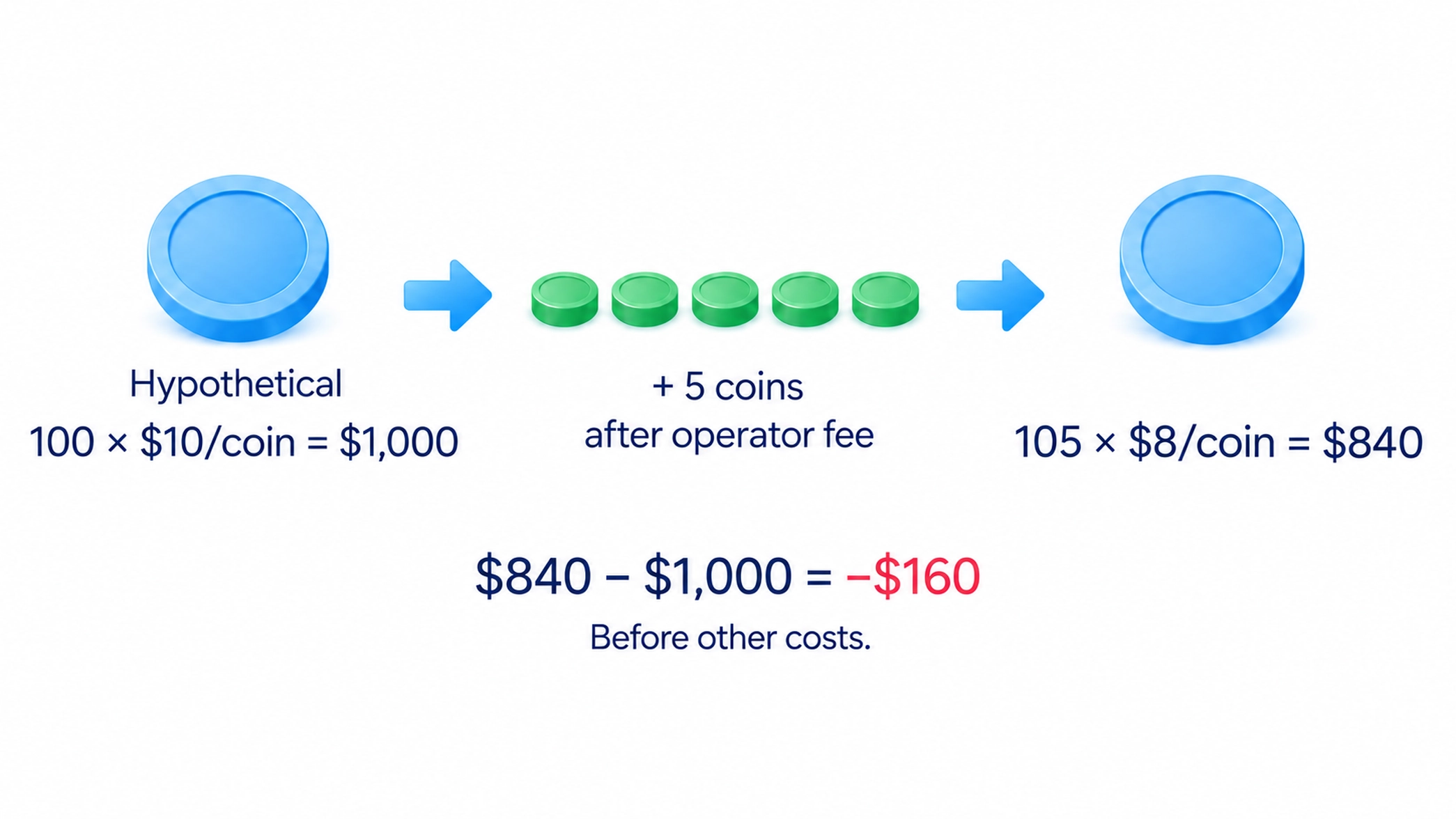
Consider a hypothetical example. You commit 100 coins purchased for USD 10 each and receive five more coins after the operator's fee. You now have 105 coins.
If they are worth USD 8 each when you can exit, their value is 105 × 8 = USD 840, compared with the original 100 × 10 = USD 1,000. The cash result is a loss of USD 160 before other costs. The increase in coins did not produce a dollar profit.
New issuance can reduce a holder's share of the total supply; staking rewards may partly offset that change. However, subtracting an issuance rate from a staking rate does not calculate your exact dollar profit. That calculation needs purchase and exit prices, the number of coins received, and costs. Keep changes in supply share separate from the cash result.
An exchange-traded Bitcoin product uses a different mechanism; it does not earn rewards from the network you originally chose. Bitcoin ETF explains that form of access. Comparing it with ETH or another coin solely because it lacks a staking lock also changes the underlying asset.
Exit conditions and penalties
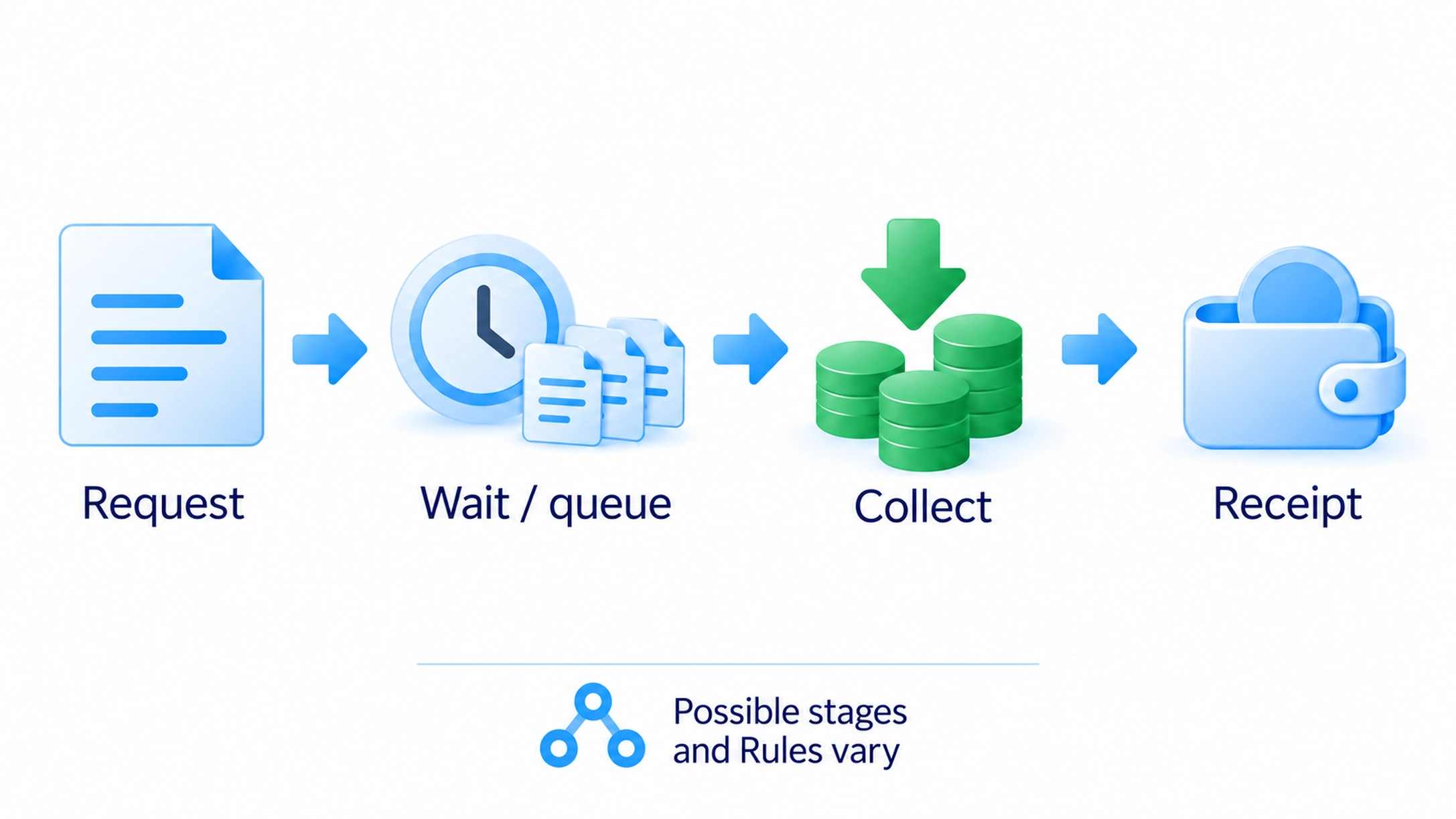
Committed coins may be unavailable for ordinary transfers. Some networks require a waiting period after an exit request, called unbonding. A fixed wait, a queue, and final receipt of the funds are separate conditions. Check every stage rather than relying on a withdraw button.
For example, networks built with Cosmos SDK set their own waiting parameter. You may remain liable for a validator violation committed while your coins were participating. Ethereum has validator exit and withdrawal procedures, and a service can add its own queue. There is no single release time for all coins.
Rewards during the wait also depend on the rules. Do not assume that every network pays until the coins arrive, or that every network stops paying immediately. Check when active participation ends, which rewards have already been counted, and what becomes available after exit.
Slashing is a reduction of staked funds imposed for specified validator violations. In Ethereum, serious violations such as conflicting signatures differ from ordinary penalties for missed duties. A brief outage should not be described as automatic slashing in every network.
A validator's violation can also affect delegated funds. The loss and its allocation depend on the network and product. If an operator advertises protection, check exactly what it covers. Insurance alone does not explain exclusions, payout limits, or the company's ability to pay.
What liquid staking adds
Liquid staking gives you a token representing participation in the committed funds. You may be able to transfer or sell it if a market exists. That offers a separate exit route, but does not cancel the protocol's conditions for returning the underlying coins.
Selling stETH on a market and receiving ETH through Lido's withdrawal queue are different transactions. The token's market price can differ from the value it represents. A quick sale can therefore return less; check available buyers and transaction costs as well.
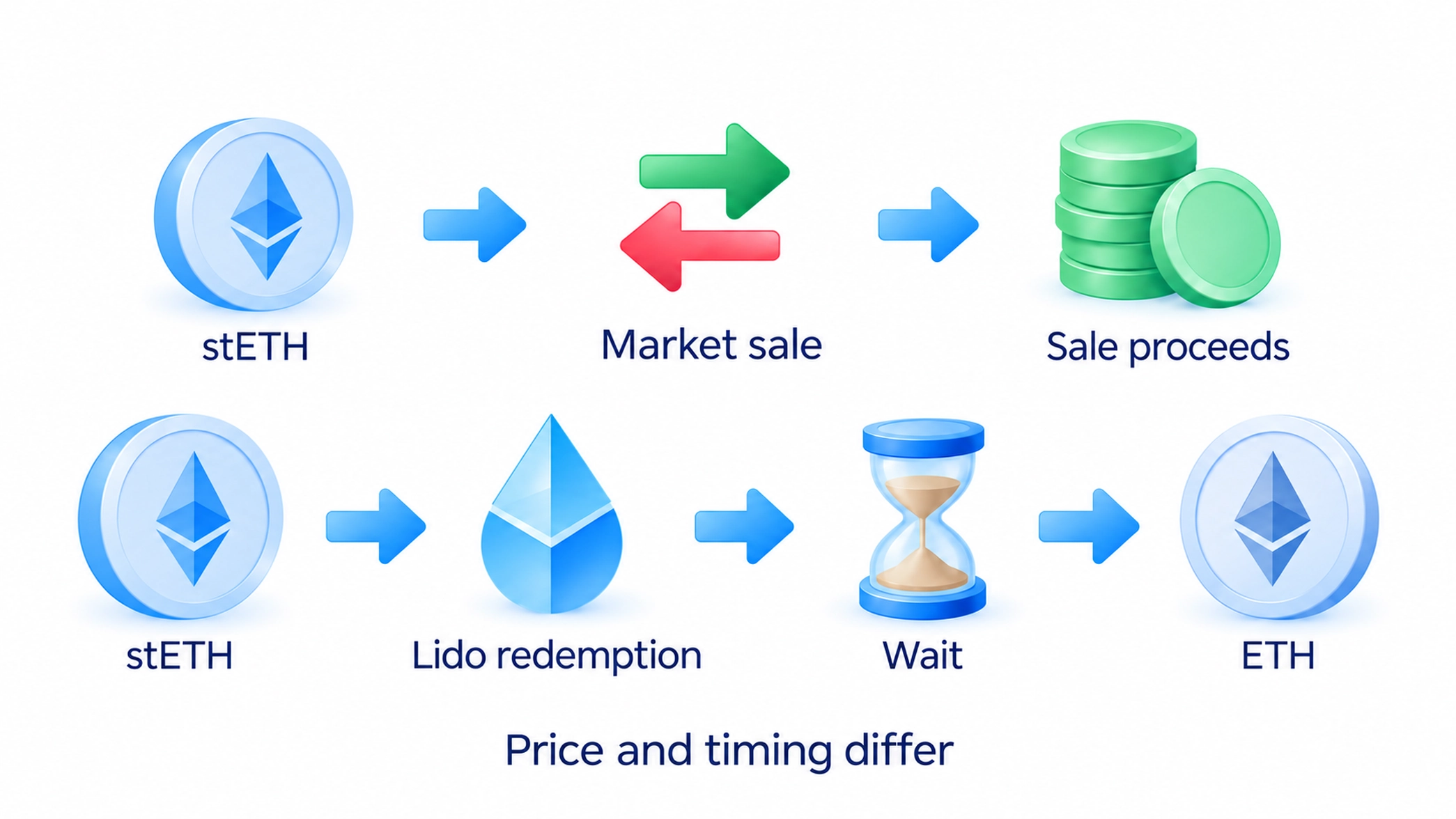
Rewards may appear as more tokens in your balance or as more underlying funds represented by each token. These methods require different readings: an unchanged token count does not always mean that no reward accrued. Check the product's mechanism and what redemption or sale can actually return.
You also depend on the programs managing the funds and the product operator's rules. A smart contract is a program that carries out defined operations on the network; errors in it can cause losses. An external code review does not guarantee that no error remains. Holding a participation token in your own wallet does not give you direct control over the validator or its exit.
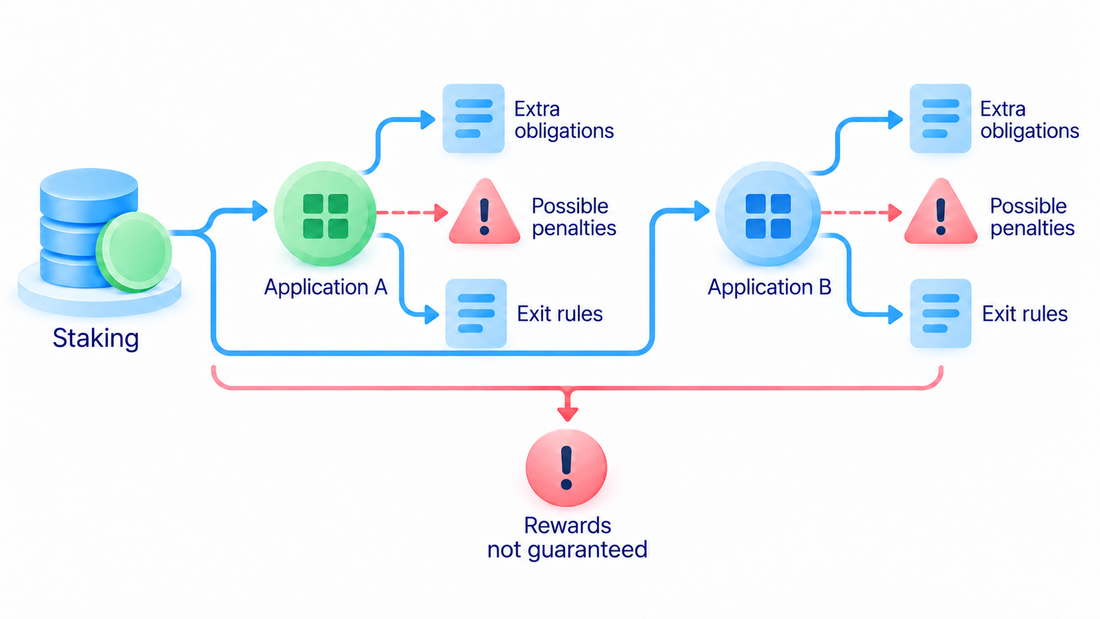
Restaking uses already committed funds to support additional applications. It adds obligations and possible losses beyond the original network, rather than increasing its reward for free. Check each application's additional penalties and exit conditions; ordinary staking conditions do not describe the entire arrangement.
Checks before committing coins
Record the network and asset, participation method, withdrawal rights, reward source, fees, exit stages, and possible penalties. For a liquid token, also record whether you intend to redeem it or sell it on a market. Those are different actions with different timing and prices.
Compare access conditions with the date you may need the money. A plan that requires immediate sale after a price fall cannot rely on a mandatory exit wait. Choosing a smaller amount does not make staking a trade that an ordinary stop-loss order, an order intended to close a trade after a price condition, can immediately close.
Cryptocurrency basics explains the asset and ways of accessing it. In any staking offer, you should be able to identify the action that returns the coins and who must carry it out. A high advertised percentage does not fill that gap.
Frequently asked questions
Staking commits coins to a network where participation in confirming transactions is based on committed funds, a method called Proof of Stake. Its rules determine rewards. Check the participation method, withdrawal control, and availability of the coins separately.
Running your own validator requires performing its technical duties. With delegation, a chosen validator performs that work while you assign participation under the network's rules. Control of the coins depends on how you participate.
No. You may receive more coins while their cash value falls. Check fees, prices, reward availability, and reinvestment conditions. A current annualised figure does not guarantee future payments.
It depends on the network and product. There may be a wait, a queue, and a separate collection step. Selling a liquid token on a market is another route and may return a less favourable price.
No. Slashing reduces staked funds for specified validator violations. Each network defines its penalties; Ethereum distinguishes missed duties from serious slashable violations. Check what those conditions mean for delegated coins.
A liquid token adds program risk and the possibility that its market price differs from the funds it represents. Restaking adds obligations to other applications and their penalty and exit conditions. An additional reward does not remove those risks.
About the author
Igor Arapov, a practising trader since 2013 and author of the ArapovTrade library. ORCID: 0009-0003-0430-778X.




