Tokenomics describes a token's issuance, distribution, uses and incentives. It helps you check which units are available now, who may receive more later and what a holder can actually do with the token. These rules help assess supply risks; they cannot predict a future price on their own.
What the token does and what a holder receives
Start with the action that needs the token. It might pay for network processing, unlock a service, give a vote or fund rewards. Calling it a project's token does not explain either demand or a buyer's rights. Cryptocurrency for beginners distinguishes network coins, application tokens and the products used to trade them.
Then identify the right granted by the rules. Voting on a program's changes is not the same as owning shares in a company or receiving its earnings. A token representing another asset can have different rights, but these must be established in the issue documents. A technical standard for moving tokens does not automatically create those rights.
A working service does not necessarily create demand for its token. Users may pay with another asset, and the project may earn money without passing it to token holders. Identify the connection between using the service and needing to buy or hold the token. Do not replace a missing connection with an assumption about price growth.
Existing supply and future issuance
Circulating supply estimates units available to the public market. Total supply counts units already created, less those verifiably destroyed. Maximum supply describes an issuance ceiling, if one exists. An existing token can remain locked and be excluded from circulation, so these numbers answer different questions.
The circulating figure depends on the provider's method. It may exclude team reserves, locked allocations and other categories. Compare figures at the same date and check which addresses or holdings are excluded. The figure is not a list of tokens that can all be bought or sold immediately at the displayed price.
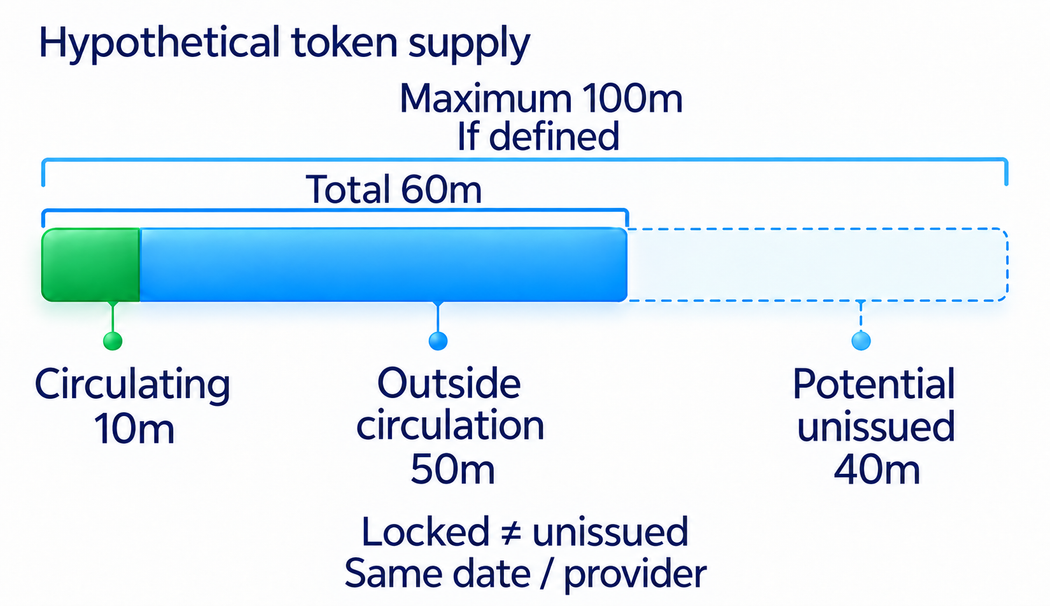
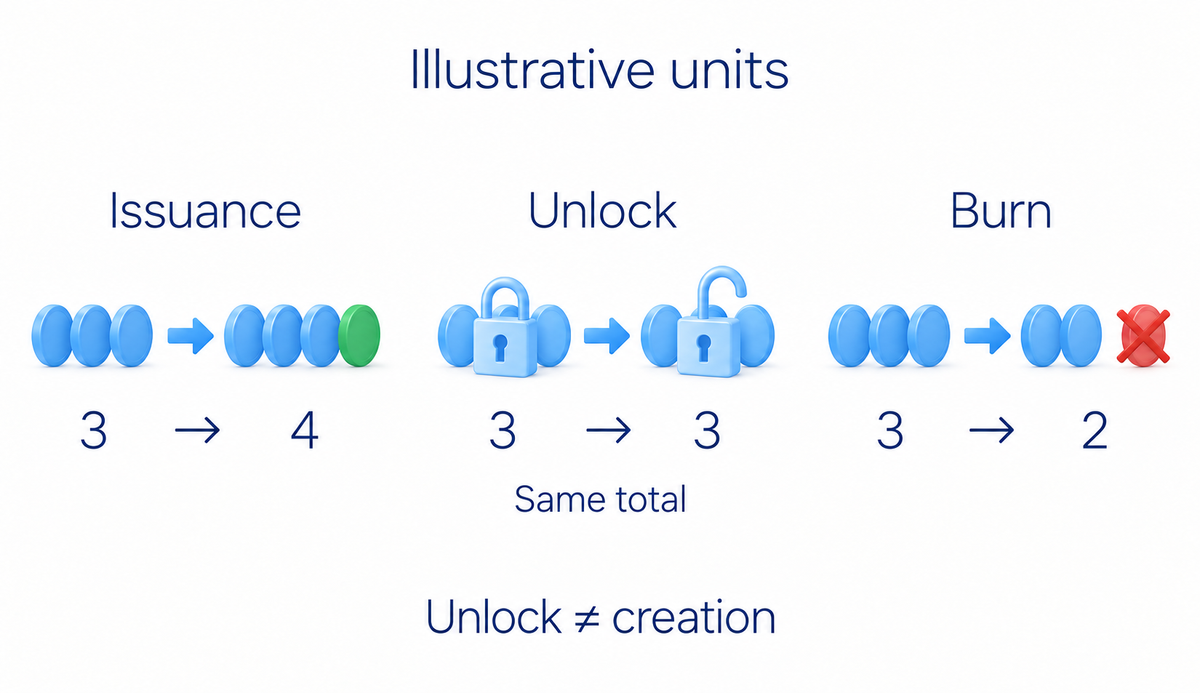
Issuance creates new units. Unlocking previously created tokens changes their availability without itself increasing total supply. Do not count the same tokens as two new issues. Check whether a planned distribution uses an existing reserve or requires new tokens to be created.
Burning reduces supply when units are actually destroyed or become verifiably inaccessible under the mechanism. Moving tokens to a reserve that can spend them later is different. If new units are created at the same time, compare creation and destruction over the same period. A burn mechanism does not mean supply always falls.
Check who can change the rules: create units, upgrade the token contract or authorise changes through voting. A smart contract is a program that carries out rules on a blockchain, the network's shared record. Whether it can be upgraded depends on its design. Verify a stated ceiling alongside these powers, rather than relying on an allocation chart.
Market capitalisation and fully diluted valuation
Market capitalisation multiplies the current token price by circulating supply. Fully diluted valuation, or FDV, applies that price to a broader supply figure. A provider may use maximum supply or total supply. Establish the actual input before comparing two projects' FDV figures.
Consider a hypothetical token priced at USD 2. Ten million units circulate, sixty million already exist, and the stated maximum is one hundred million. Market capitalisation is 2 × 10 million = USD 20 million. Using maximum supply for FDV gives 2 × 100 million = USD 200 million. The difference comes from the selected quantity, not additional money already paid by buyers.
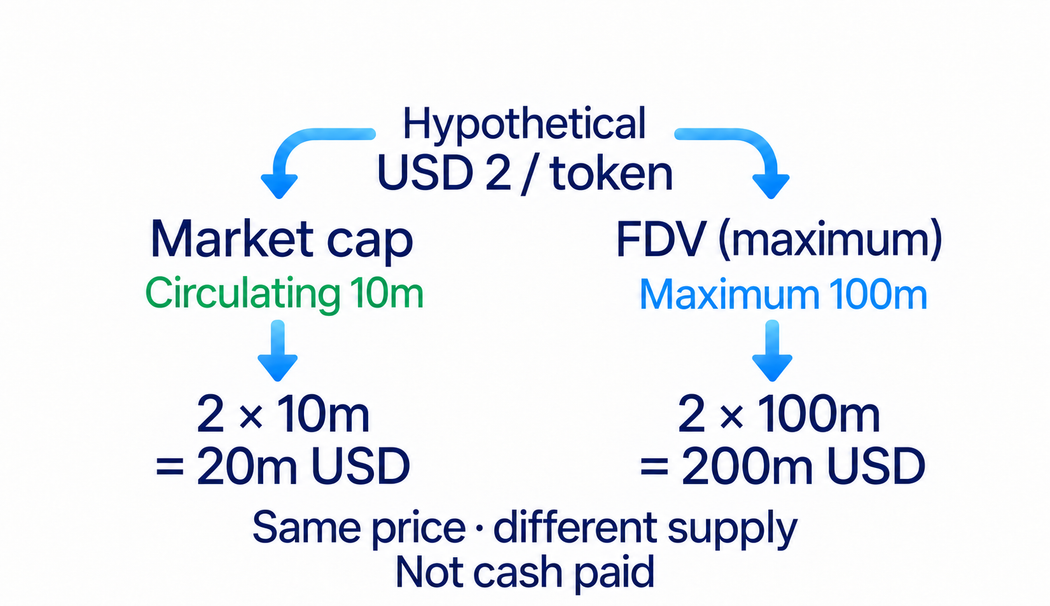
Neither figure tells you how much all holders could receive by selling together. They apply the current price to the selected supply. Buyers and execution prices can change during a large sale. FDV also does not forecast the valuation after every unlock, because the future price is unknown.
A small circulating share compared with future availability means the quantity offered for sale could grow substantially. It does not establish that price must fall. Timing, recipients, their ability to sell and buying demand matter. There is no universal circulating percentage that makes every project bad.
Allocations and rewards
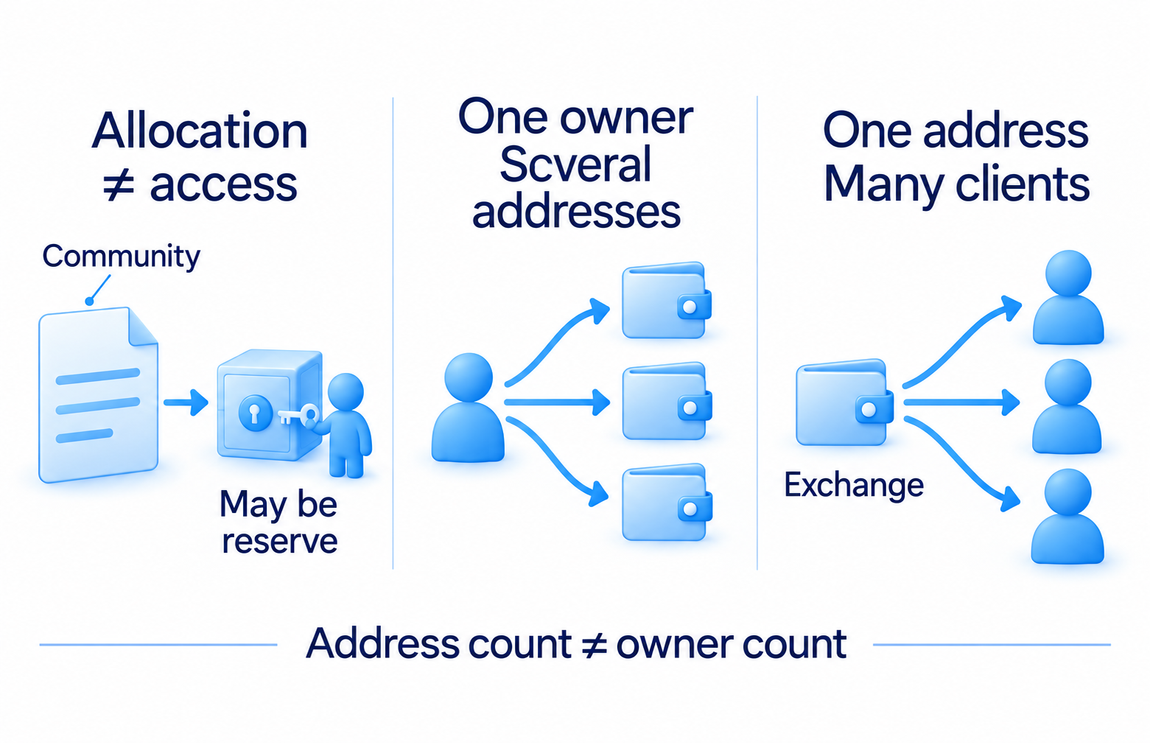
Allocation shows which parts are intended for the team, early investors, users, a project reserve and other groups. Check each share's purpose and availability. An allocation labelled community may still sit in a controlled reserve; it does not prove that many independent people already hold those tokens.
Address count is not owner count. One person can use several wallets, while an exchange address can hold assets for many clients. Identify what a large address represents: a reserve, an exchange, a locking program or an individual holder. The largest balances alone do not establish ownership concentration.
Rewards also have a source. They can come from new issuance, existing reserves or service revenue. Receiving more tokens does not guarantee that the holding gains value: price can change and sale may be restricted. Check the source, duration and powers to alter the programme.
An incentive tells you which behaviour the project pays for, such as using a service, providing resources or temporarily holding a token. If most activity depends on distributing new units, ask what will support it when rewards shrink. A high advertised reward rate does not establish a sustainable model.
Vesting, cliffs and unlocks
Vesting sets when and under which conditions an allocated quantity becomes available to its recipient. Access can appear gradually or in separate portions. A lock-up restricts use or transfer until a specified time. Read the agreement and program rules rather than treating similar names as identical schedules.
A cliff is an initial period during which the allocation is not yet available under that schedule. At its end, an accumulated portion may become available, gradual release may begin or another stated rule may apply. A cliff is not a synonym for every large one-off distribution.
An unlock removes a restriction on access to a portion of tokens. The recipient may then be able to collect or transfer them, sometimes through a separate claiming transaction. It does not mean that every unit has been sold or deposited on an exchange.
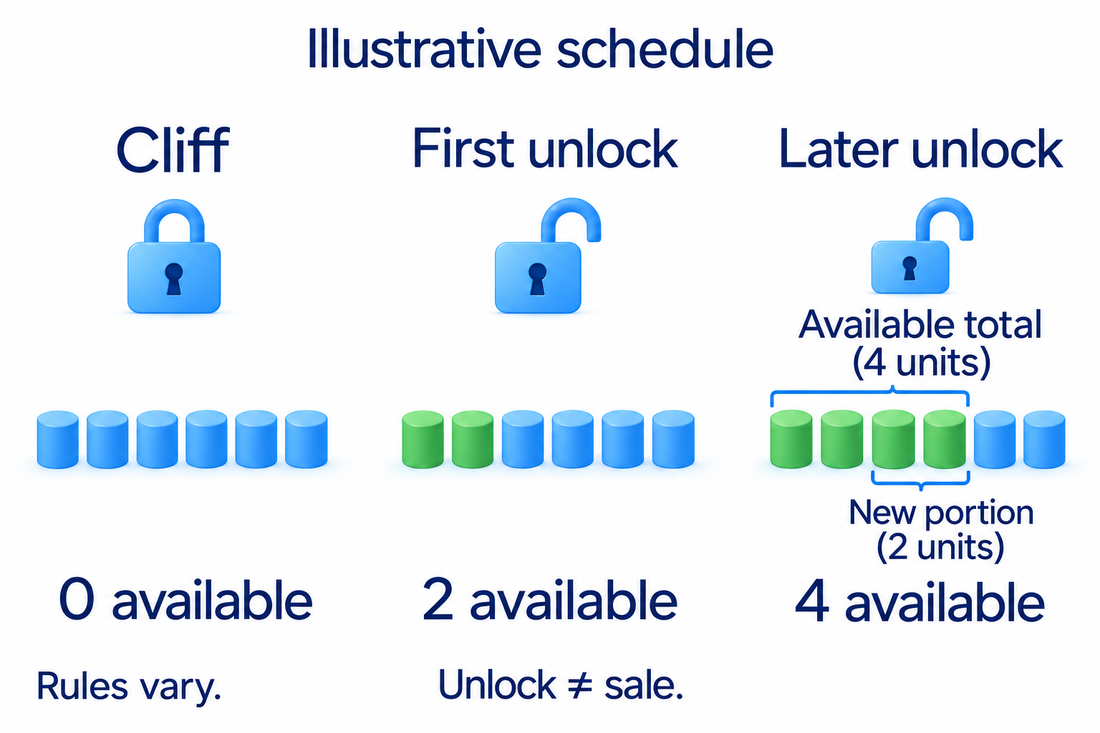
Read the schedule separately for each recipient group. Record when it starts, when the cliff ends, the first available portion, subsequent frequency and the ending date. The starting point might be token launch, investment date or another event. Distinguish each period's amount from the accumulated total, or you could count tokens twice.
Compare an available portion with circulating supply at the same date, and identify its recipient. A team reserve, an investor distribution and a user-reward budget can have different spending conditions. Permission to sell expands, but actual orders and demand determine price, not a calendar date alone. Crypto arbitrage concerns price differences between venues rather than the issue schedule.
Checking tokenomics before a decision
First find the official issue documents and identify the token's address on the correct network. Compare supply, allocation and release dates with network records and the data provider's method. Documents describe rules; records show their state at a particular time. Resolve differences before using the figures in a valuation.
Unexplained additional issuance, unknown powers to change rules, unclear team distributions and rewards without a stated funding source need investigation. They do not by themselves prove fraud. Memecoins separately considers speculative demand where use of the token is not compulsory.
In my course, beginners learn to read price structure and trading activity before adding fundamental context. The fundamental-analysis section explains that sequence. It does not provide a separate tokenomics rating system. Checking a token's rules clarifies holding conditions; it does not replace a trading condition for entry.
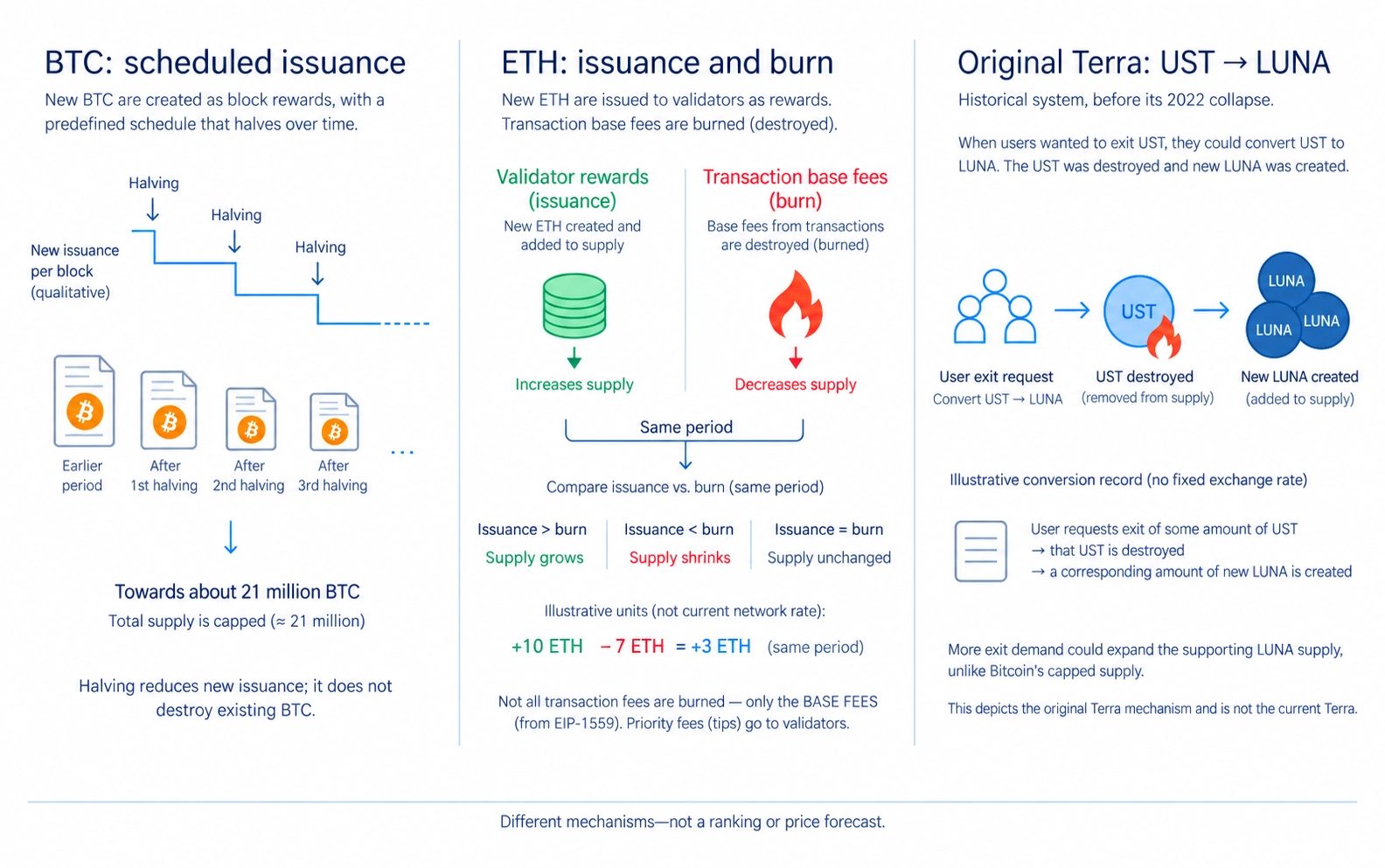
Compare mechanisms rather than assuming every coin has the same supply rules. Bitcoin’s scheduled new-coin issuance declines toward a limit of about 21 million BTC. ETH is created as validator rewards while transaction base fees destroy existing ETH; their balance determines whether supply grows or shrinks.
In the original Terra system, before its 2022 collapse, converting UST into LUNA destroyed UST and created LUNA. This linked the supporting token’s supply to demand for leaving UST rather than to a Bitcoin-style cap. These are different issuance and destruction rules, not a ranking or a price forecast.
Finish with a short record: token purpose, verified holder right, supply date and source, FDV input, next available portion, recipient and powers to change the rules. An empty field identifies something specific to investigate. If the schedule cannot be reproduced from the documents, a colourful chart does not establish a clear issuance plan.
Frequently asked questions
Tokenomics describes a token's issuance, distribution, uses and participant incentives. It helps you examine the project's economic rules, but does not guarantee price growth.
Check current and future supply, recipient groups, release conditions, token uses and powers to change the rules. Record the data date and the input for fully diluted valuation, or FDV: the current price applied to the provider’s broader supply figure.
Vesting sets availability under a schedule. A cliff is its initial period without access. An unlock removes a restriction on a portion, but does not mean it is sold immediately.
Available supply can increase substantially later. Assess the release dates, recipients and demand. A low circulating share alone does not prove a future price decline.
Unclear additional-issuance rules, an opaque release schedule, unknown powers to change the system and rewards without an explained source all require investigation. They are questions to resolve, not automatic proof of fraud.
About the author
Igor Arapov has traded since 2013 and writes the ArapovTrade learning library. ORCID: 0009-0003-0430-778X.




