A derivative is a financial contract whose value and payments depend on an asset or another reference, such as an interest rate. A futures contract is one type of derivative. A spot purchase is a purchase of the asset itself. That distinction determines what you hold, what you owe and how a price change affects your account.
Check the product before reading its chart. A screen labelled Bitcoin might show BTC, a dated futures contract or a perpetual contract. Similar-looking prices do not give you the same rights. The library's guide to gold, oil and stock indices explains the particular instruments used to trade those markets.
What are the main types of derivatives?
The underlying asset is what the contract refers to, for example gold, a share or a currency. An index or interest rate can also provide the reference. The contract does not necessarily gain one dollar whenever that reference rises one dollar. Its payment rules determine the result.
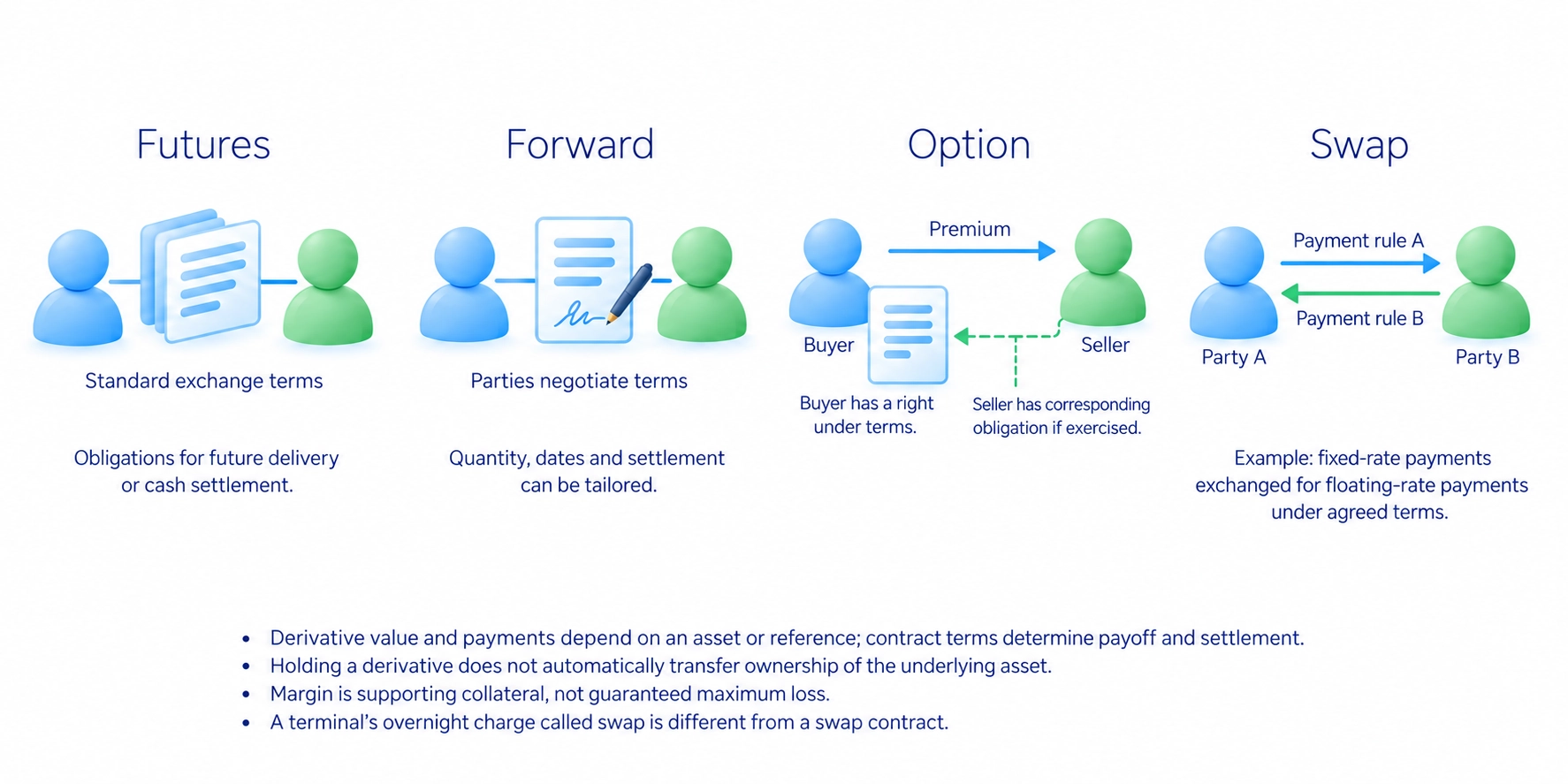
A futures contract follows standard exchange terms. A forward also agrees a future transaction, but its parties negotiate the terms. Quantity, dates and settlement arrangements can be tailored to them. A forward therefore is not simply an exchange futures contract with a different name.
An option gives its buyer a right, rather than an obligation, to buy or sell the specified instrument, or receive a cash payment, under the contract's terms. The buyer normally pays a premium for that right. The seller accepts the corresponding obligation if the option is exercised. Options can trade on exchanges or through agreements outside an exchange.
A swap exchanges payments under agreed rules, such as payments based on a fixed interest rate for payments based on a changing rate. This is a contract between parties. A Forex terminal may also use the word swap for a charge or credit when a position is held overnight; that account entry is not the same thing as a swap contract.
Derivatives can take on price risk or reduce an existing risk. Reducing it is called hedging: a producer might use a contract to protect the price of a future sale. The hedge still has its own terms and costs. It does not mean every derivative trade is an insured investment.
How does a futures contract work?
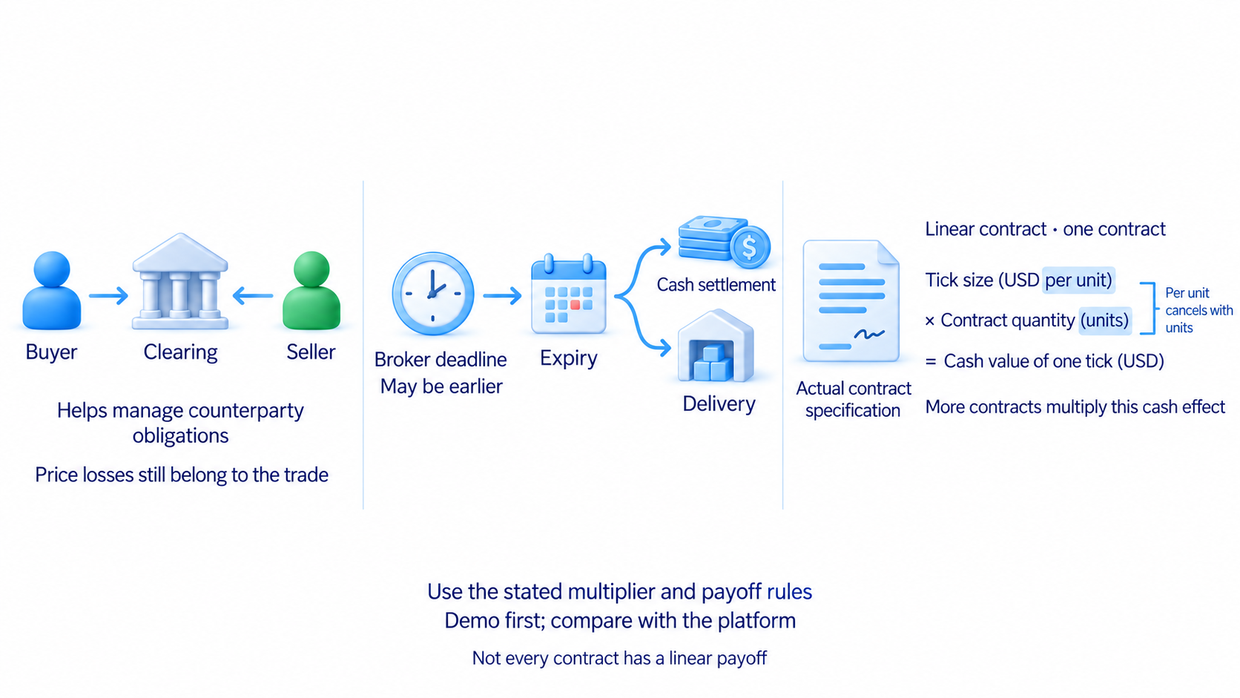
A futures contract is a standardised agreement to buy or sell the specified instrument at an agreed price for future delivery or cash settlement, a payment instead of delivery. It creates obligations under the exchange's rules. Its specification states the underlying instrument, contract quantity, price quotation, trading dates and settlement method. Read that specification before placing an order: one contract is not necessarily one unit of the asset.
The tick size is the smallest permitted price change. Its cash value depends on the quantity or multiplier specified for the contract. A move of one chart point can have a very different dollar value in two contracts, even if their charts look similar.
The clearing house manages obligations between clearing participants, including the funds required to support positions and settlement. This reduces the risk that the other side fails to meet its obligations. It does not protect you from a falling price or guarantee that your trading account cannot lose money. The guide to how an exchange works explains the roles of the exchange, broker and clearing house.
A dated contract reaches expiry. Some contracts settle in cash; others provide for delivery of the underlying asset. Check the actual contract and your broker's earlier deadlines. A broker may require you to close before delivery procedures begin. Do not assume that every futures position ends with a cash payment.
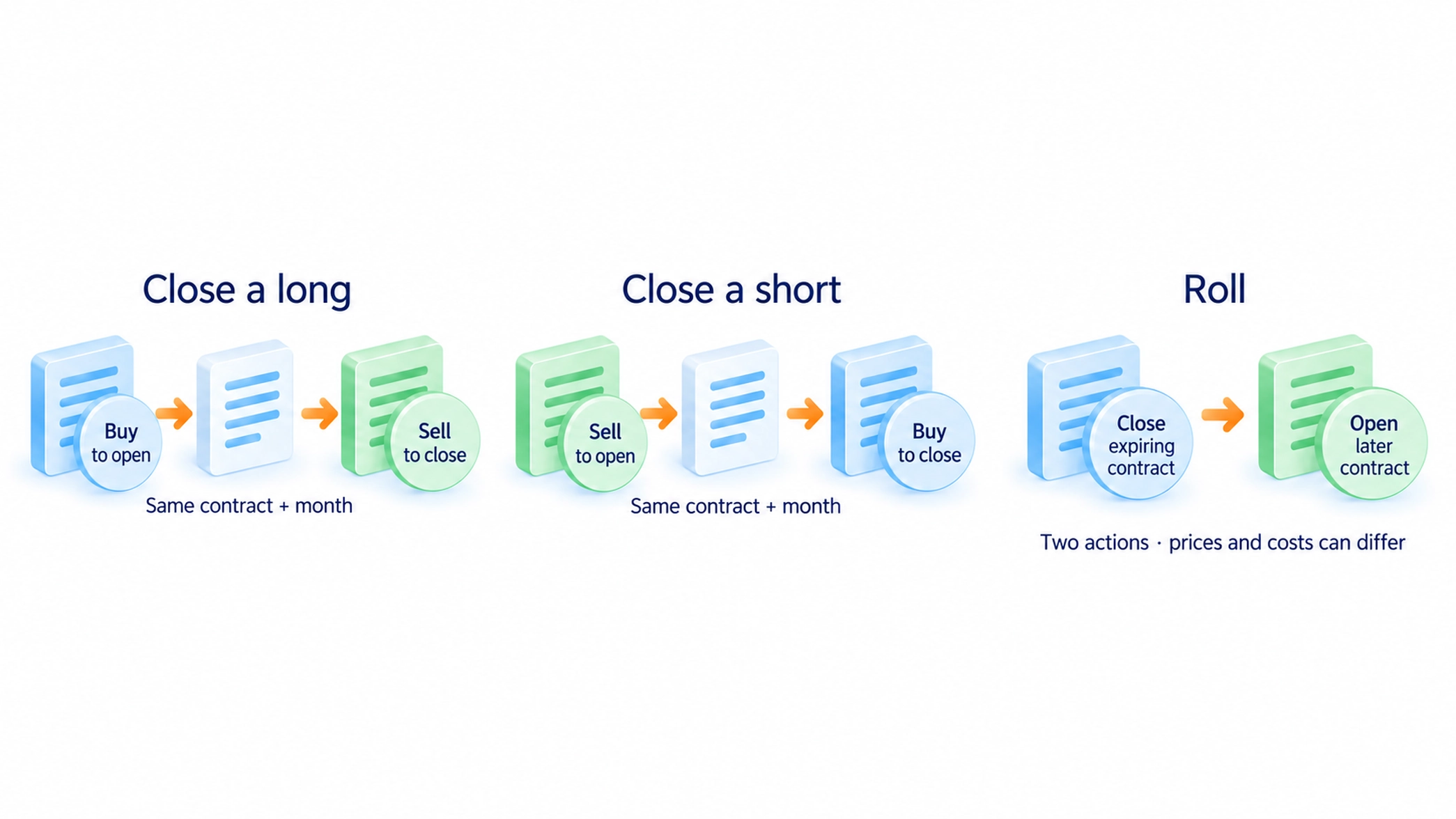
You can normally close a long position, opened by buying, by selling the same contract. A short position, opened by selling, is closed by buying it back. The contract month matters: a purchase in one month and a sale in another can leave two positions open. Rolling means closing the expiring contract and opening a later one. The two prices and the trading costs can differ.
Many exchange futures use daily settlement. Gains and losses are calculated using the exchange's settlement price and credited or debited under the applicable rules. That price is not necessarily the last trade visible on your chart. Daily accounting also does not remove the possibility of an intraday demand for additional funds to support the position.
What is the difference between spot and futures?
A spot trade buys or sells the asset for current delivery or settlement. Settlement is the completion of the transfer of the asset and payment; it need not occur at the instant the order fills. A fully paid purchase uses your own funds. A futures position follows contractual rules rather than automatically transferring the underlying asset into your ownership.
Margin is collateral: funds or eligible assets pledged to open or maintain a position. It is neither the full purchase price of the underlying asset nor a promise that this amount is your maximum loss. Borrowed spot positions can also require collateral and face forced closure. The useful distinction is between a fully paid purchase and the particular financed or derivative product, not just the word spot.
Consider one hypothetical asset priced at $100 per unit. Buying ten units outright costs $1,000 before fees. Suppose a futures position also represents ten units at $100, but requires $200 of initial margin.
Its dollar gain or loss equals the quantity multiplied by the price change; this is called a linear payoff. Both positions have $1,000 of exposure, the value represented by the position. The $200 is an illustrative contract requirement, not a standard margin rate.
If both prices fall to $95, the loss is ten units × $5 = $50, before fees and other costs. That is 5% of the fully paid purchase, but 25% of the initial futures margin. The same dollar loss looks larger against the smaller collateral amount. A percentage measured against the whole account would depend on its other funds and positions.
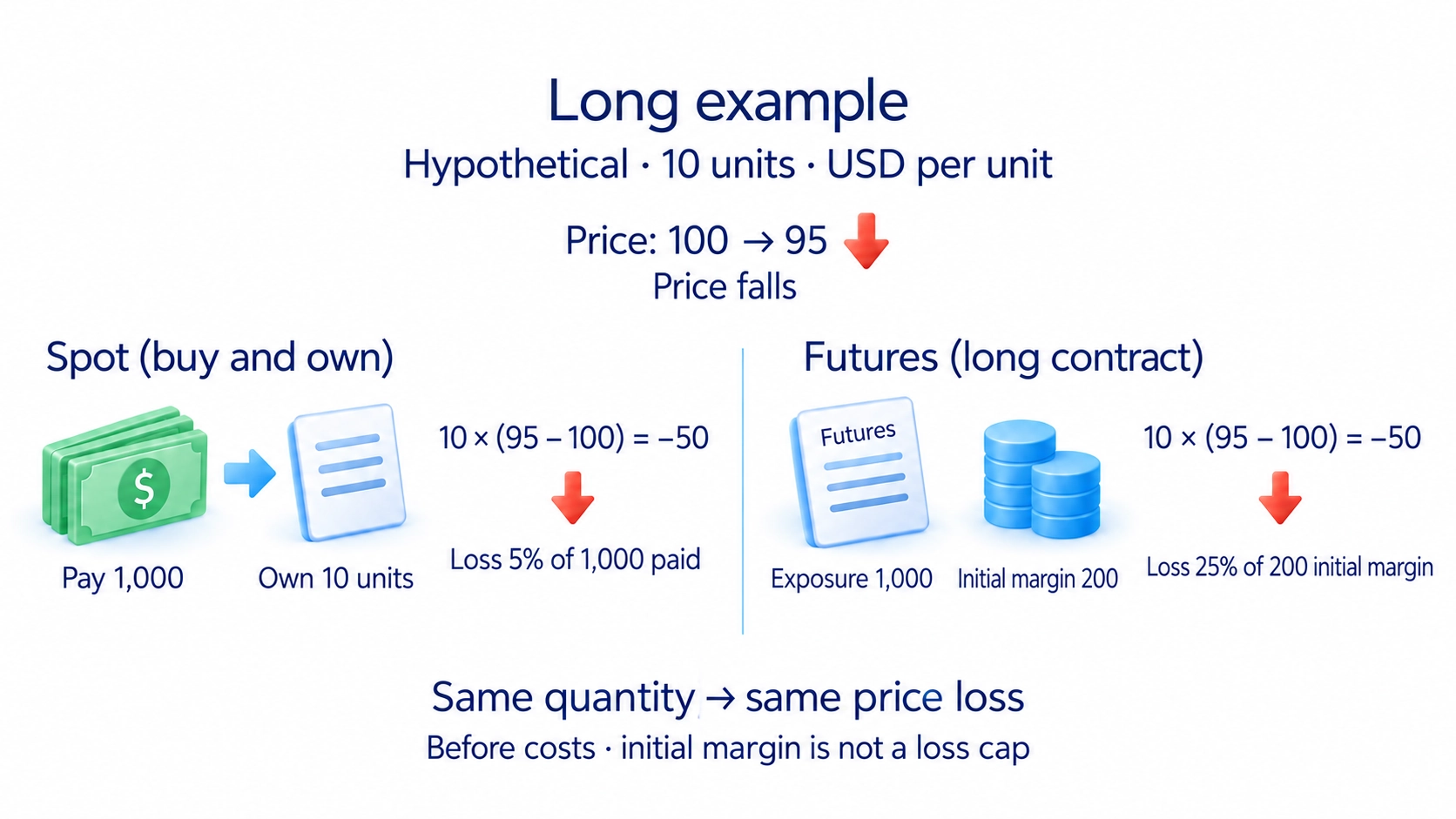
This comparison assumes the same price change and a linear futures payoff in dollars. Real spot and futures prices can differ. Some contracts use other payment formulas or collateral currencies. Use the actual contract rules to calculate profit and loss rather than applying this example to every product.
A fully paid asset purchase does not create a margin liquidation merely because its price falls. It can still lose much or all of its value, and holding it may involve storage, custody or other costs. Futures have their own costs and deadlines. Neither label tells you that waiting will restore a loss.
Why do margin and leverage increase risk?
Initial margin is the collateral needed to open the position. Maintenance margin is the minimum required to keep it open under the applicable rules. Requirements can change. If the available collateral becomes insufficient, the broker or platform can reduce or close positions. A warning is not guaranteed to arrive in time for you to act.
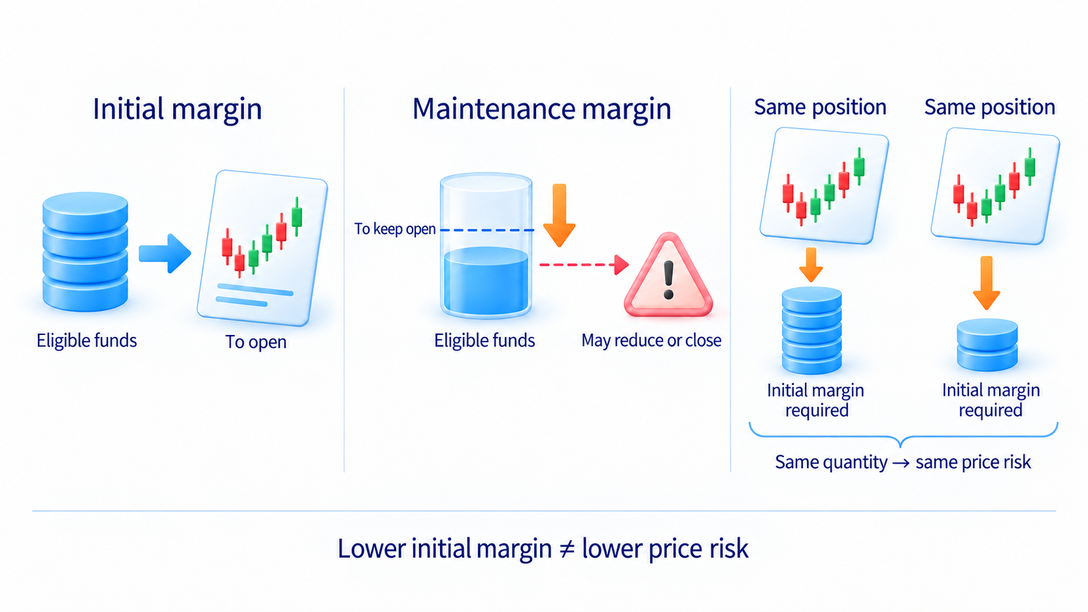
Leverage describes how large your exposure is relative to the funds supporting it. A larger position makes the same price change a larger gain or loss for your account. Reducing the margin required for a fixed position does not reduce that position's price risk.
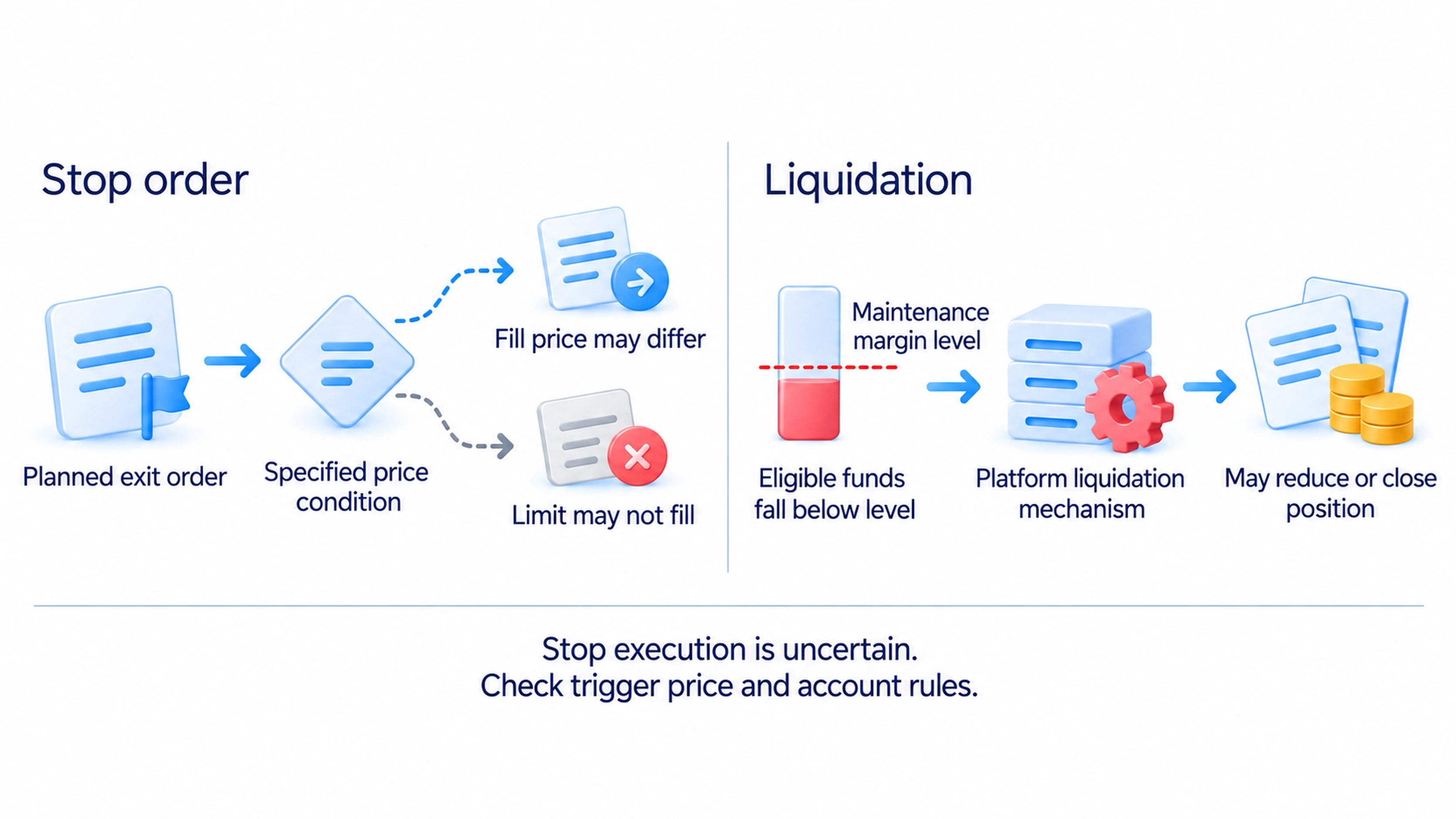
A stop-loss is your planned exit; liquidation is the platform's response to insufficient collateral. They are different mechanisms. A stop can execute at a worse price than planned, and some orders may not fill. Depending on the product and its protections, losses can exceed the initial deposit. Do not use the displayed liquidation price as your acceptable loss budget.
In my course section on leverage, I recommend that beginners use minimal leverage or practise without it while learning the system. The point is to understand the position you control before increasing its size. A small deposit requirement is not a reason to open a large trade.
How are perpetual futures different?
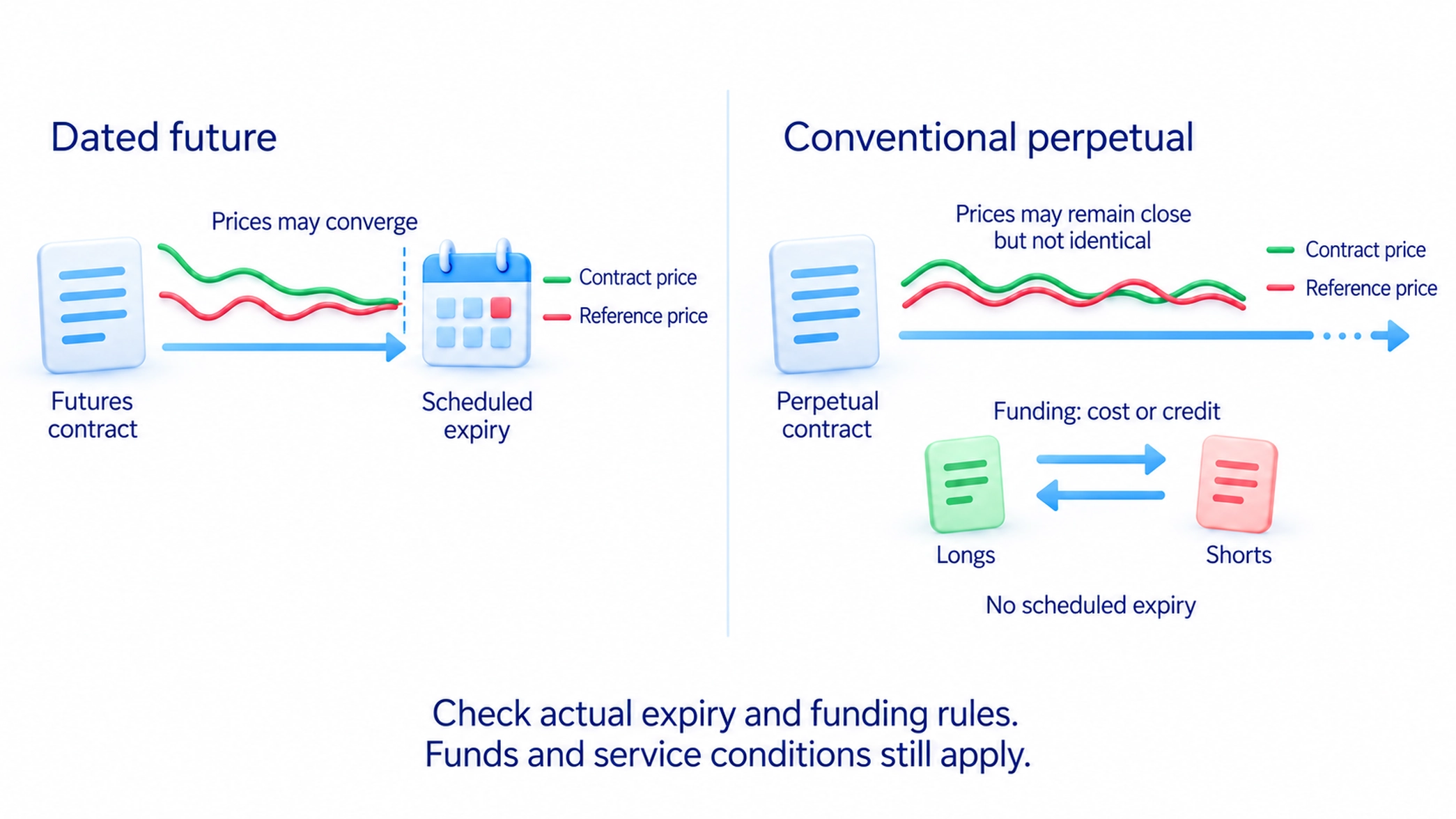
A perpetual futures contract generally has no scheduled expiry. Many crypto perpetuals use funding: periodic payments between long and short positions, calculated under the venue's rules. Funding can be a cost or a credit. It is intended to help keep the contract price near its reference, not to guarantee that both prices are always equal.
Check the exact product name and specification. Some products marketed as perpetual-style futures still have an expiry date. The payment schedule, funding calculation, collateral currency and liquidation rules also vary. The guide to perpetual futures and margin covers these mechanisms in detail.
What should you check before trading?
Find the contract specification and answer four questions in your own words: what do I hold, how much does one contract represent, how is its dollar profit or loss calculated, and what can require me to close or add collateral? For a dated future, include expiry and settlement. For a perpetual, include funding and the price used for liquidation.
As a practice task, choose a contract in a demo account using virtual money and calculate the cash effect of one tick before placing an order. Then compare it with the platform's specification. If you cannot explain that amount, changing the leverage setting will not solve the missing understanding.
The optional video Futures contracts explains the contractual obligation and the difference between physical delivery and cash settlement. The written definitions and comparison above stand on their own.
Frequently asked questions
It is a financial contract whose value and payments depend on an asset or another reference. Futures, forwards, options and swaps are examples. Their contract terms determine the rights and obligations you take on.
It is a standardised agreement for future delivery or settlement on the exchange’s terms. The specification sets the quantity, price quotation, dates and settlement method. Some contracts settle in cash; others provide for delivery.
A spot purchase buys the asset itself. A futures position creates rights and obligations under the contract. A fully paid purchase and a futures position requiring funds to support it can need different amounts of funds to open and hold them, even when they represent the same quantity.
No. Margin is funds or eligible assets committed to support the position, not a guaranteed maximum loss. Price changes affect the full position. Depending on the product and its protections, losses can exceed the initial deposit.
A conventional perpetual has no scheduled expiry, but some products marketed as perpetual-style contracts do have one. Check the specification, funding rules and settlement dates of the exact product.
Start by identifying the product and calculating the cash effect of its smallest price change, a tick, in a demo account using virtual money. Check the quantity, funds or other assets required to support the trade, and the contract’s delivery or payment rules before opening it. Increasing leverage cannot replace understanding those terms.
About the author
Igor Arapov, a practising trader since 2013 and author of the ArapovTrade library. ORCID: 0009-0003-0430-778X.




