An exchange organises trading under shared rules. Its systems bring together instructions to buy and sell. When compatible instructions match, a trade takes place. The price of that trade can become the next point on a chart.
To understand the buy button, follow the instruction beyond your screen: who receives it, where it can execute, and what confirms the result. A displayed price and an accepted instruction do not, by themselves, prove that you bought anything.
What is the difference between an exchange and a broker?
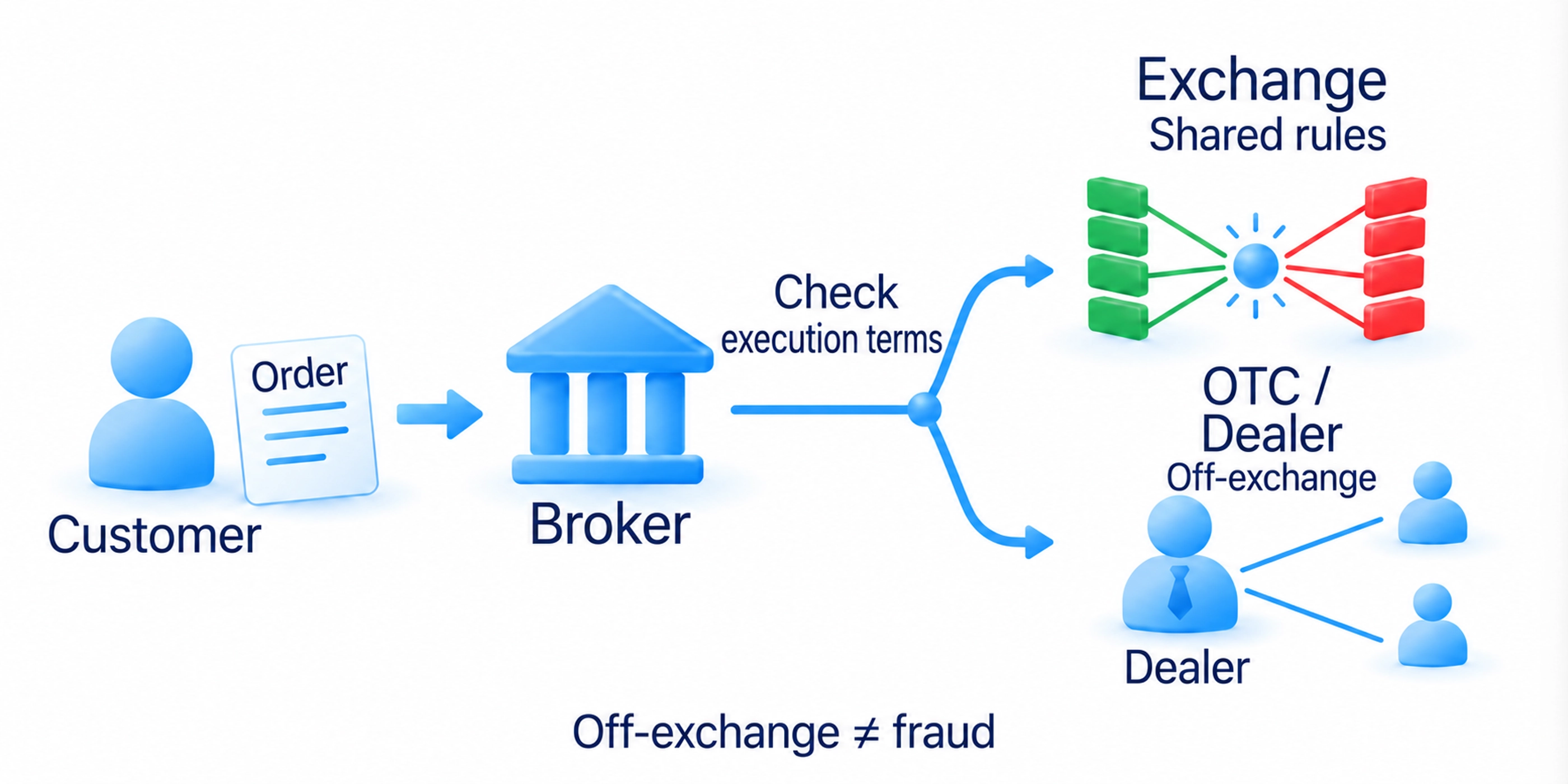
The exchange operates a trading venue. A broker serves the account holder and accepts instructions to buy or sell. The exchange sets rules for its markets and eligible participants; the broker provides the service through which a retail customer sends an order.
Your trading platform displays information and sends commands. Its appearance does not establish where those commands execute. A broker can send an order to different venues, or act as a dealer and take the other side itself. Read the account's execution terms to identify the arrangement. The guide to trading platforms and brokers explains what to check when selecting that service.
In an over-the-counter market, or OTC market, trading takes place through dealers and other arrangements rather than one shared exchange for the entire market. Off-exchange does not automatically mean unregulated or fraudulent. Even an exchange-listed share can trade away from its listing exchange.
Who takes part in exchange trading?
Participants include individuals, banks, funds and companies. They may want to own an investment, make a short-term trade or reduce the risk of a changing price. An order's size does not reveal that purpose. A large sale could close an existing investment or create a new position.
A market maker quotes prices at which it is prepared to buy and sell. This supplies opportunities for other participants to trade, within the relevant rules and available quantity. Holding the resulting positions carries risk. A market maker does not promise to fill every order of any size, and the difference between its quotes is not automatic profit.
The broker handles the customer's instructions. A clearing house helps organise obligations arising from completed trades and manages associated risks. Systems for holding securities maintain records of ownership. These are different functions, even when companies in the same group provide several of them.
What can you trade on an exchange?
Different exchanges list different products, including shares, bonds and futures on currencies, commodities or indices. A familiar asset name does not identify the rights you acquire. A company share, an index future and a dealer's price-difference contract are different products.
A share represents part ownership of a company. Its rights depend on its class and issue terms. Common shares generally carry voting rights; preferred shares can have priority over common shares for dividend payments, payments a company may make to shareholders, with rights set by their terms. Neither label guarantees a dividend.
Buying an already-issued share from another investor is different from buying shares in a new issue. In an ordinary secondary-market sale, the seller receives the purchase money, rather than the company raising new capital. The share can then change owners again at a different price. If additional shares of the same class are issued, a holder who keeps the same number can own a smaller percentage of that class. Buying enough additional shares can maintain that percentage; a smaller percentage does not by itself establish a fall in the company’s total value.
A bond represents a debt owed by the company or government that issued it. Its payment terms and the borrower's ability to meet them matter. The guide to bonds explains that instrument's income and risks.
A future creates contractual obligations, with a specified quantity and terms for fulfilling the agreement. Buying a gold future does not simply hand you a gold bar. The guide to spot purchases and derivatives explains asset ownership versus a contract position. The separate guide to trading and investing considers what you are trying to achieve by holding it.
How does an order become a trade?
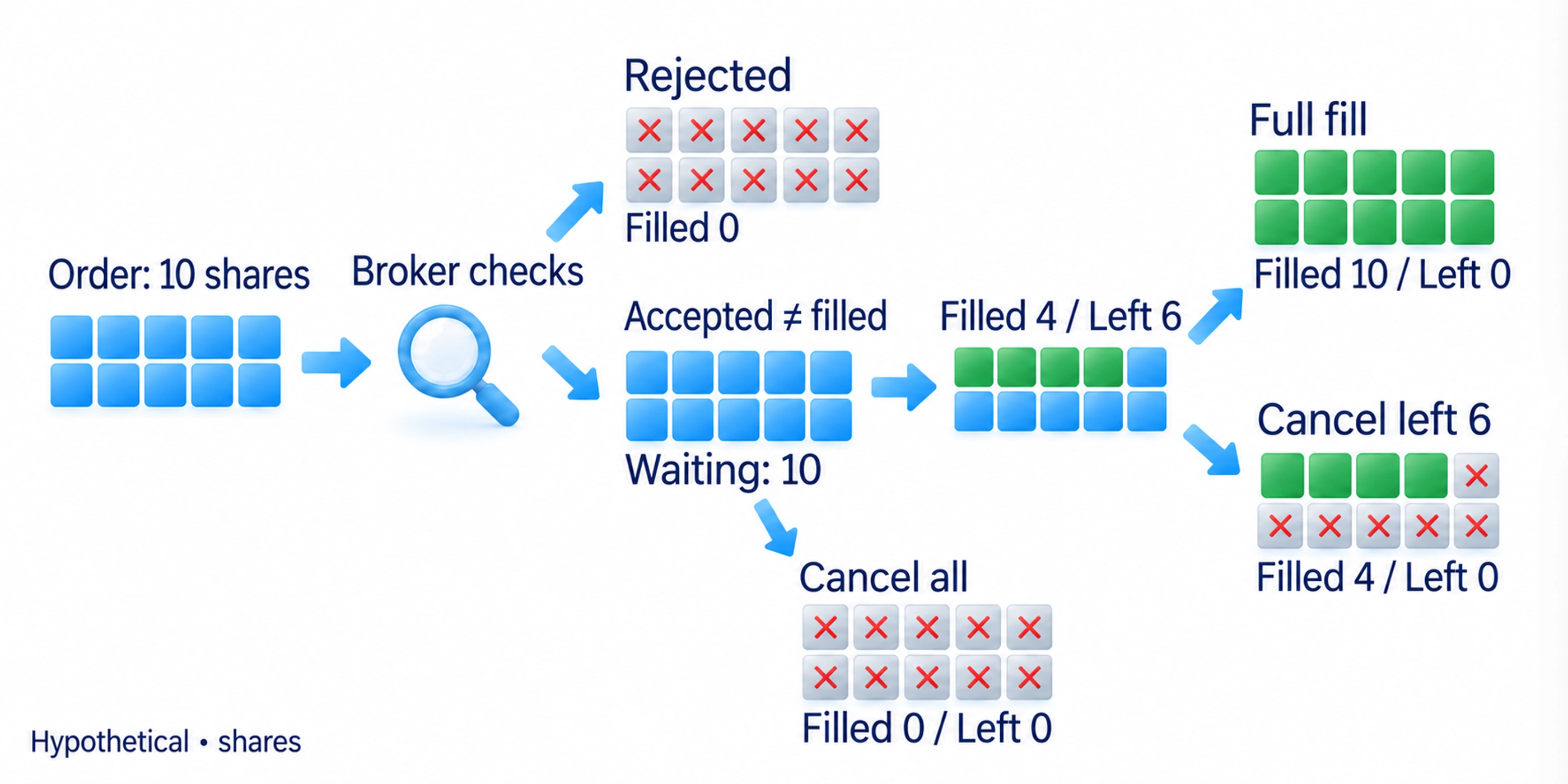
An order is an instruction with conditions. You specify the instrument, whether to buy or sell, the quantity and the order type. The broker checks the instruction against the account's permissions and requirements before it can proceed to execution.
In continuous electronic exchange trading, the trading system matches compatible buying and selling instructions. The prices matter, but so do the venue's rules for allocating available quantity. Not every venue uses the same queue priority.
Submission, acceptance and execution are different events. An accepted order might wait, execute only in part or later be cancelled. A rejected instruction has not created the requested trade. Check the execution status and quantity actually bought or sold before treating the position as open. Repeating an order merely because you have not noticed its confirmation can create an unintended additional position.
What do quotes, the order book and the trade tape show?
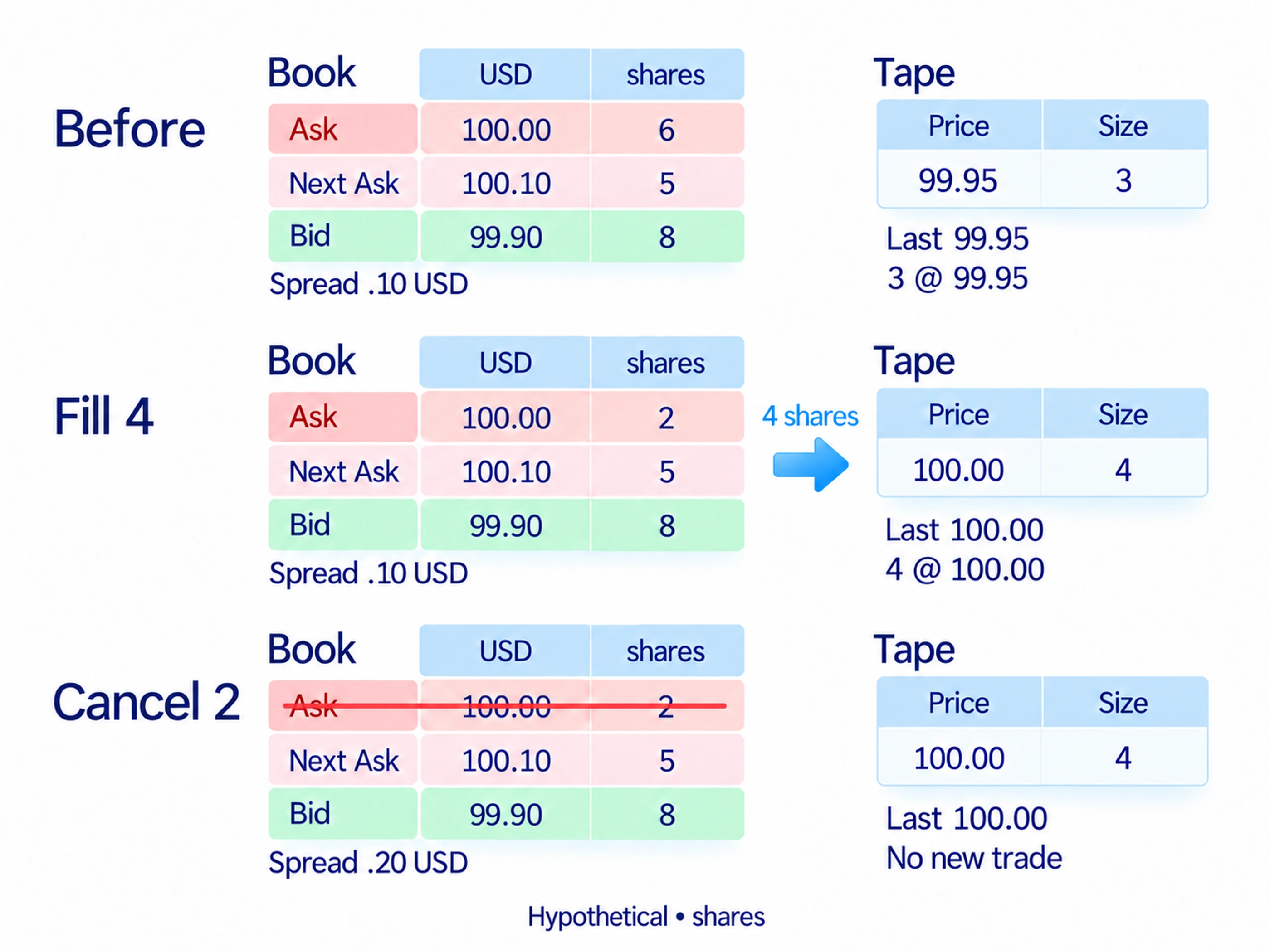
Bid is the highest available buying quote in the displayed data; Ask is the lowest selling quote. The difference is the spread. Last is the price of the most recent completed trade. That trade is in the past, so its price may no longer be available for your next order.
The order book displays buying and selling instructions, commonly grouped by price. Your subscription and platform determine how much depth you see. This is not a complete list of everyone’s intentions: some quantity is hidden, instructions can be withdrawn, and many stop orders do not appear as ordinary waiting orders.
The trade tape records completed trades, with their prices and quantities. The book shows what is currently offered; the tape shows what has executed. Creating or cancelling a waiting order can change a quote without producing a new trade.
Check which price your chart uses. One feed may plot Last, while another shows Bid, Ask or a calculated value. They can describe the same instrument differently. The fuller guide to market microstructure explains how quotes, displayed quantity and execution interact.
Why can trades take place at different prices?
Every completed trade has both a buyer and a seller, with the same quantity bought and sold. A price rise therefore cannot be explained simply by saying that there are more buyers than sellers. What matters is the quantity offered at each price and which terms participants accept.
A market buy order seeks available sellers; a market sell order seeks available buyers. A limit sets the highest purchase price or lowest sale price you will accept. If that limit is compatible with an existing offer, it can execute straight away. A limit order does not always wait in the book. Other price, trigger and duration conditions are covered in types of trading orders.
If the available selling quantity at the lowest price is used up or withdrawn, a later buyer may have to accept a higher price. A sale can similarly reach lower buying prices when the higher ones are unavailable. This explains a change in traded price without claiming to know who placed the orders or why.
Your execution price can differ from the quote you expected. Available instructions can change while yours is being processed. The amount shown on a screen is not a reservation for your future trade, and a large displayed order is not proof that the price will continue in one direction.
What happens after execution?
Clearing establishes the obligations created by completed trades. In a system with a central counterparty, that organisation becomes the buyer to the seller and seller to the buyer for its clearing participants. It uses rules, limits and collateral, funds or eligible assets pledged against obligations, to manage the risk of a participant failing to perform.
Settlement fulfils the obligations by transferring money, securities or contractually specified payments. Its timing and procedure depend on the product and market. Seeing an executed trade in the terminal does not mean that every later transfer is already complete.
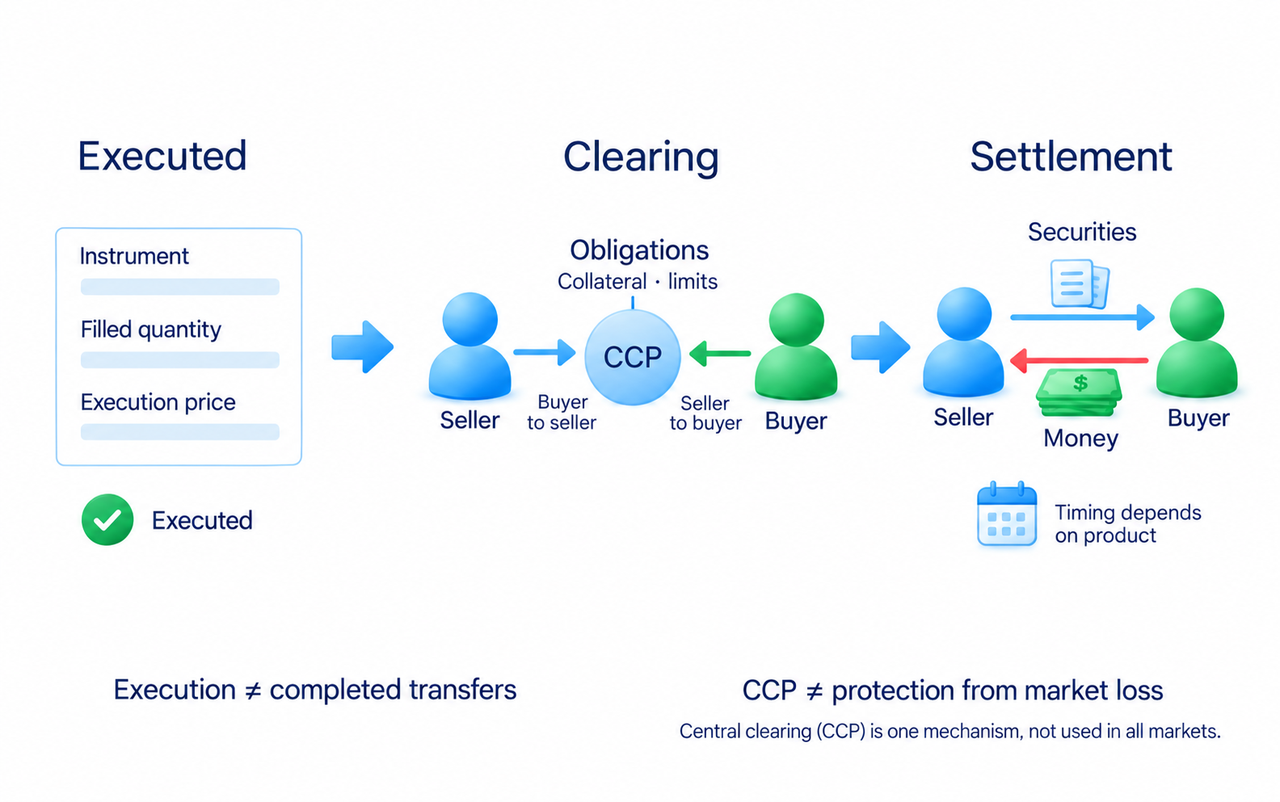
Central clearing reduces certain risks between counterparties. It does not remove a loss caused by the market moving against your position, or eliminate every operational risk. Nor does clearing certify that every volume display is accurate or impossible to manipulate. A data figure still needs an identified source and method.
Which market does your data actually cover?
Exchange trading volume records completed trades in the selected instrument within the stated data source. It is normally measured in shares, contracts or other units traded, rather than the number of separate transactions. Volume in a currency future is not the total quantity of that currency traded worldwide.
The same asset can trade at more than one venue. One exchange's order book is not the whole market's book, and its trade feed need not include trades elsewhere. If a provider combines feeds, check which sources it includes.
Spot Forex, the market for exchanging currencies, mainly operates through banks, dealers and electronic systems outside a single central exchange. There is no one publicly available book of all currency transactions. A platform's tick volume may count updates in its quotation stream, rather than the total currency quantity traded. The guide to Forex explains those arrangements.
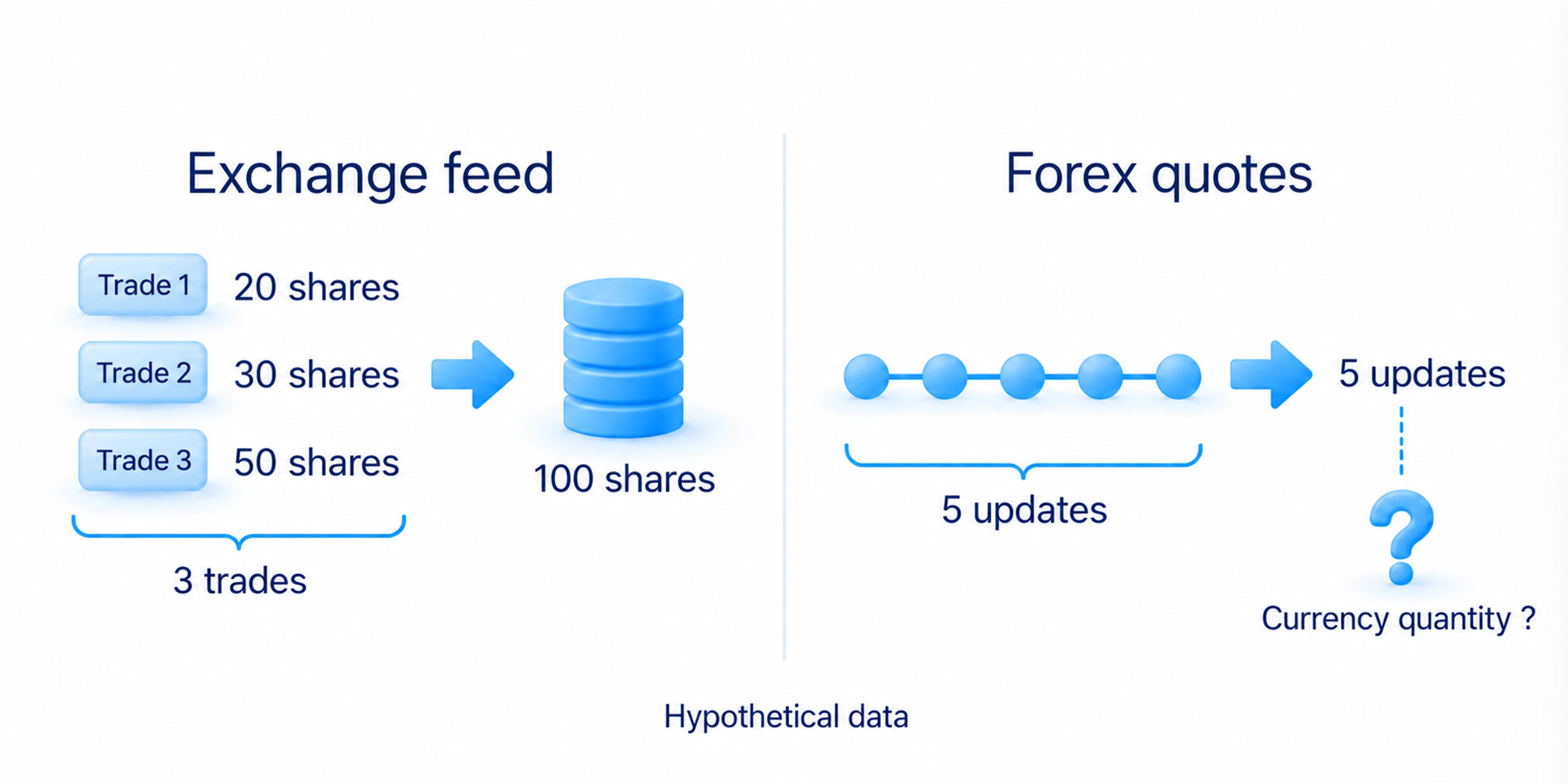
Identifying the source comes before interpreting volume. Completed trading activity does not label its owners as a particular bank or fund. The guide to volume analysis explains how to relate that activity to price, once the data's scope is understood.
Why do trading hours matter?
Each venue and product has its own schedule, including breaks and sometimes separate auctions. In an auction, instructions can accumulate before matching at a common price under the auction's rules. That differs from matching successive instructions during continuous trading. A platform remaining online does not mean every product is open for execution.
Activity and available quantity change during the day. One rule about Asian, European or American sessions does not fit every instrument. Check the venue's hours, the platform's time zone, holidays and daylight-saving changes for the product you selected.
In my lesson on trading sessions, I discuss the European-US overlap as an active period and recommend distinguishing trading hours rather than watching a screen all day. This is a teaching example about market activity, not a universal timetable. Check whether those hours and conditions apply to your selected instrument.
Before sending an order, compare the time with the present spread and available quantity. After a break or around important news, quotes can change before execution. A familiar session name does not promise a good fill, and greater activity does not make a trade profitable.
How can you check the mechanics in a terminal?
In my course section on exchange orders, I distinguish Bid, Ask and Last before connecting the order book with price movement. The practical task is to separate the price of a completed trade from the terms available for another one. Choosing a trade still requires the trading system's conditions; understanding an order does not supply a reason to enter.
Start by observing without a real order. Choose the instrument and data source, identify Bid, Ask and Last, and compare book updates with the trade tape. Note delayed data or unavailable depth: those conditions limit what you can check about live execution.
Then use a demo account using virtual money to compare an instruction with its result. Check the requested and filled quantity, status, execution price and fee. Demo execution can be simulated and differ from the live market. The optional video Limit and market orders illustrates the order-book mechanism; the written explanation above is complete without it.
Frequently asked questions
The exchange operates a trading venue and sets its rules. The broker serves the account holder and handles instructions. Check the account terms to establish where and with whom your trade executes.
If the chart uses Last, it shows completed trade prices. Bid and Ask are buying and selling quotes and can differ from Last. Check the selected price type and data source.
The book displays buying and selling instructions; the tape records completed trades. Instructions can be withdrawn, and some quantity is hidden. A displayed book depends on the data available to your platform.
It organises trade obligations and manages risks between participants. In central clearing it takes the other side of trades for participants using that service. Clearing does not prevent market losses or eliminate every operational risk.
A share represents part ownership of a company. Its rights depend on its class and issue terms. Its traded price can change, and dividends are not guaranteed.
There is no universal hour for every product. Check its trading schedule and the current spread, available quantity and activity. A session name alone does not ensure a good execution price.
About the author
Igor Arapov, a practising trader since 2013 and author of the ArapovTrade library. ORCID: 0009-0003-0430-778X.




