Forex is the market for exchanging one currency for another. A currency pair tells you how much of the second currency buys one unit of the first. To understand a forex trade, read that quote, identify the product and work out how its size and costs affect the result.
How does the forex market work?
Much of currency trading takes place between banks, dealers and other participants across different platforms. This is an over-the-counter, or OTC, market: transactions are arranged outside a single exchange. Retail forex trading may be a contract with a dealer rather than a purchase on an exchange.
Banks exchange money for customers and manage their own positions. Companies pay overseas suppliers, funds change the currencies in their holdings, and central banks carry out policy operations. These participants do not all trade to profit from the next short-term move.
A market maker quotes buying and selling prices. The available price and quantity can change; the role does not promise a permanently narrow gap between those prices. The article on market quotes and order matching explains how available orders differ from completed trades.
There is no single live record of every forex transaction worldwide. That does not make all volume data fictitious. A venue can report its own completed trades, and an exchange records its currency futures. Tick volume counts quote updates in a particular feed, not currency units traded. The guide to trading volume and its data sources explains the distinction.
Shares represent ownership in a company; a currency pair expresses the price of one currency in another. Listed shares can trade on and outside exchanges, while currency futures trade on exchanges too. Currency trading commonly passes between financial centres through the working week; access to a stock or currency product still depends on its venue and provider’s hours. Compare the actual product and venue, not a rule that all stocks are centralised and all currency products are alike.
Before opening an account, find out what you would hold. It may be delivered currency, a financed currency position or a contract for difference, a CFD. A CFD pays the difference between opening and closing prices under the provider's terms without delivering the currency. Currency futures are separate exchange contracts with their own specifications.
Currency pairs, pips and lots
In EUR/USD, the euro is the base currency and the dollar is the quote currency. A price of 1.1000 means one euro costs 1.10 US dollars. A rise means the euro has strengthened relative to the dollar. USD/JPY has a different order: it quotes yen per US dollar.
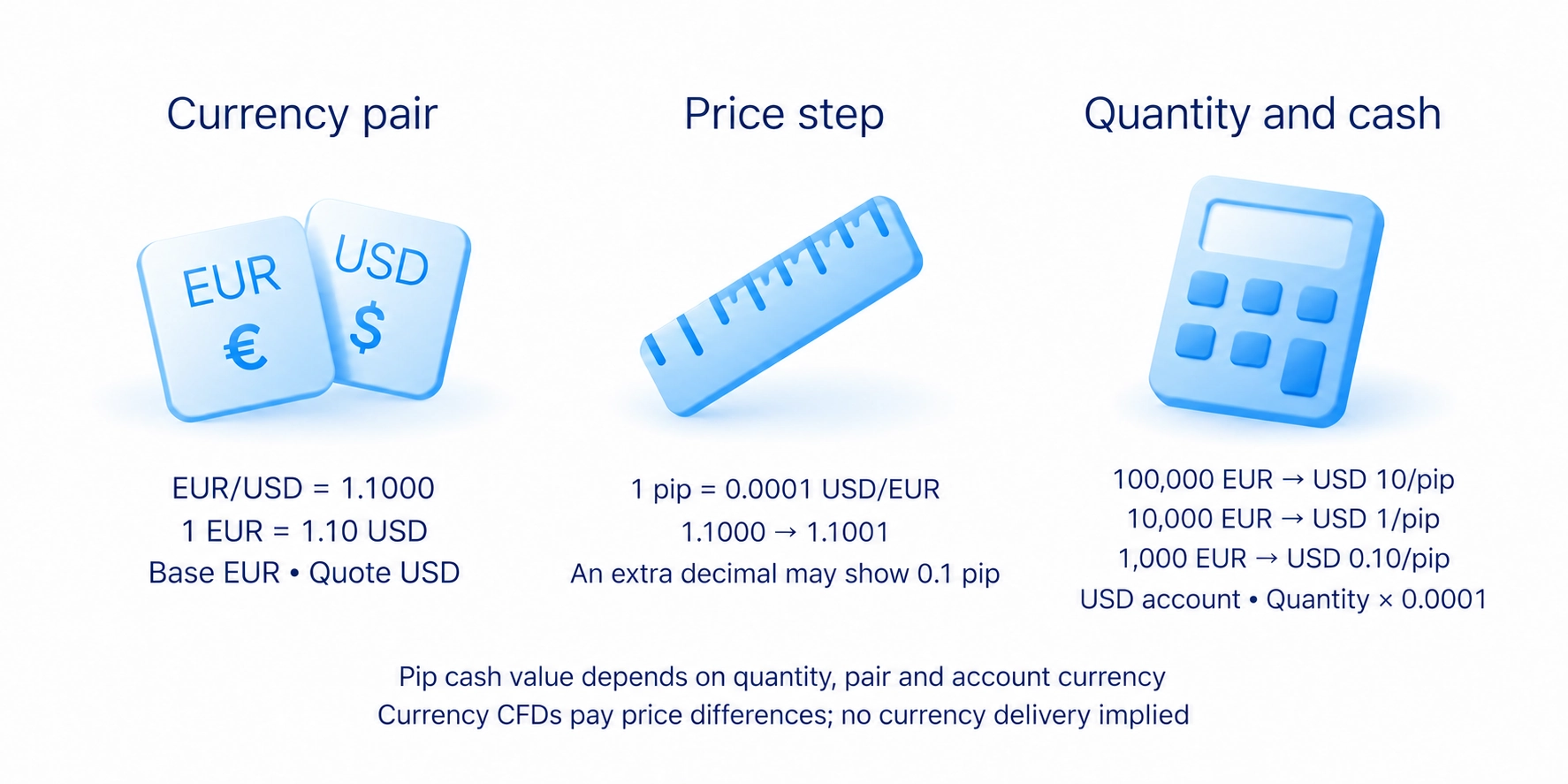
Major pairs include the US dollar and widely traded currencies, such as EUR/USD. Cross pairs, such as EUR/GBP, do not include the dollar. Exotic pairs usually include a less widely traded currency. These categories describe the pair; they do not guarantee low costs or easy execution at every hour.
A pip is a conventional unit of currency-price movement. It is usually 0.0001 for most pairs and 0.01 when yen is the quote currency. Platforms may display an extra decimal place, a tenth of a pip. The smallest displayed price step is therefore not necessarily one pip.
A lot describes trade size. A standard forex lot normally means 100,000 units of the base currency; a mini lot is 10,000 units and a micro lot is 1,000 units of the base currency. Some platforms accept units directly rather than fixed lot fractions. Check the contract size and minimum increment instead of assuming every instrument uses the same lot.
The cash value of a pip depends on position size, the pair and the account currency. For a USD-quoted pair, multiplying base-currency units by the pip size gives the value in dollars. If the quote currency differs from your account currency, the result must also be converted. A pip count alone cannot tell you the account's profit or loss.
Buying and selling a currency pair
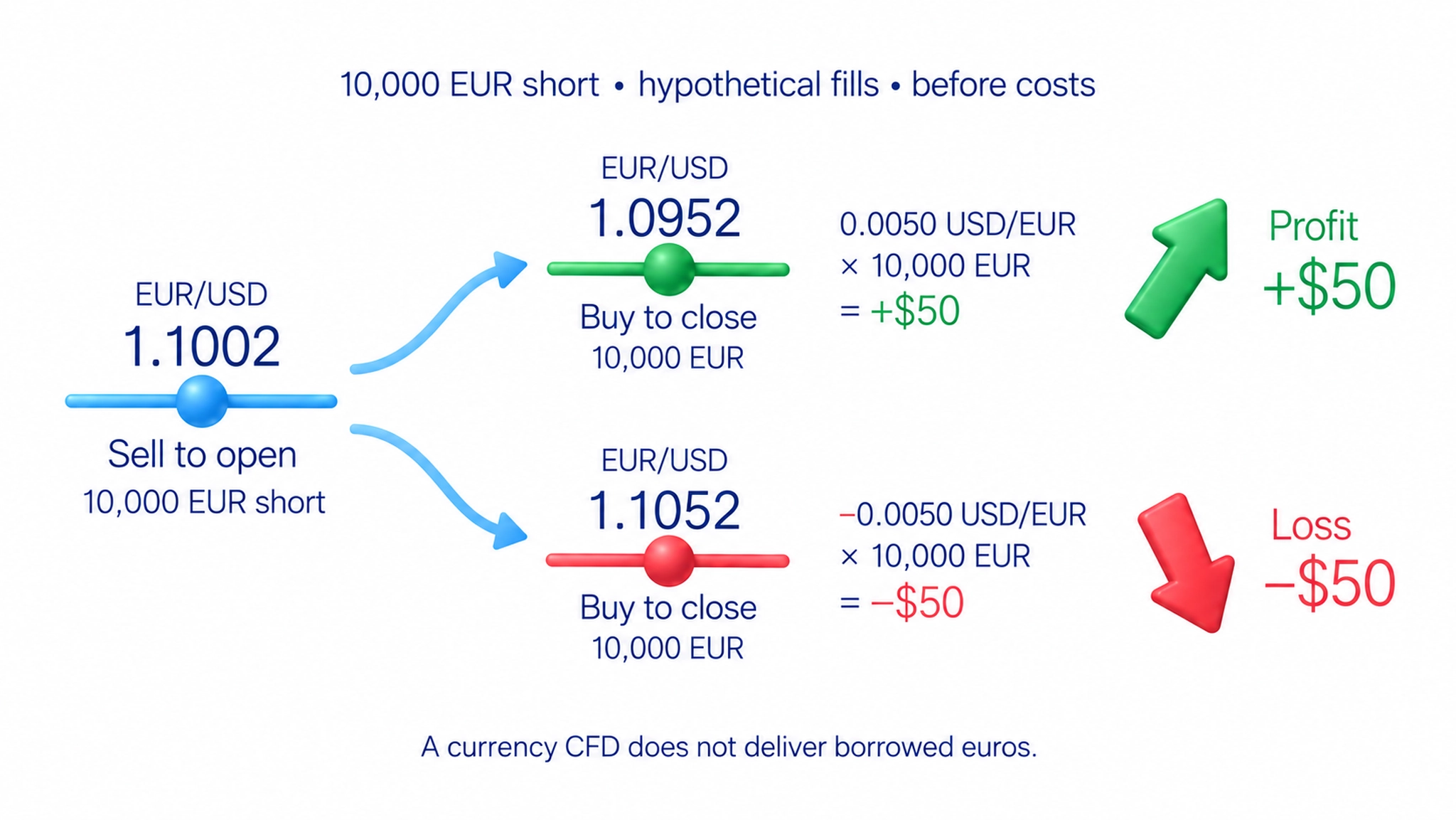
A long position in EUR/USD benefits when the euro rises against the dollar. A short position benefits when it falls. Buying the pair means buying the base currency relative to the quote currency; selling reverses that direction. In a currency CFD, this does not require borrowing and delivering physical euros as in a traditional short sale of shares.
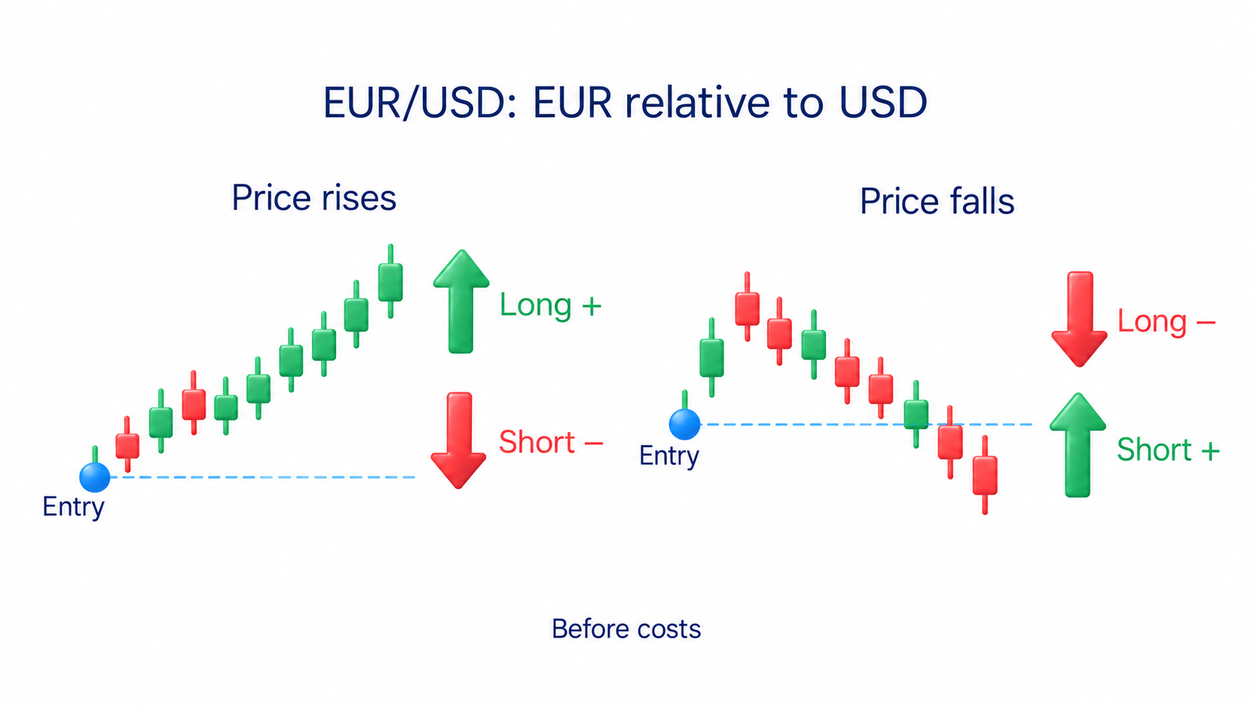
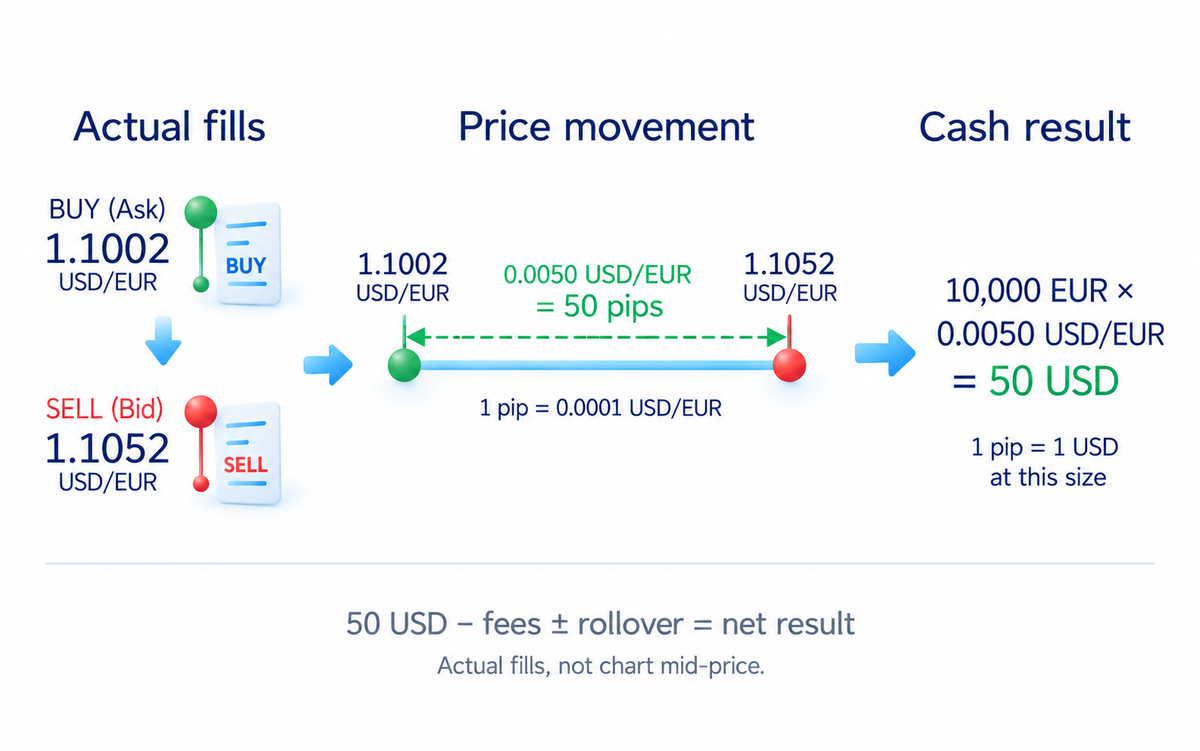
Consider a hypothetical long position of 10,000 euros. The available EUR/USD prices are bid 1.1000 and ask 1.1002: bid is the selling price for the customer, and ask is the buying price. You enter at the ask, 1.1002. An immediate exit at the unchanged bid would lose 10,000 × 0.0002 = $2, before any separate fees.
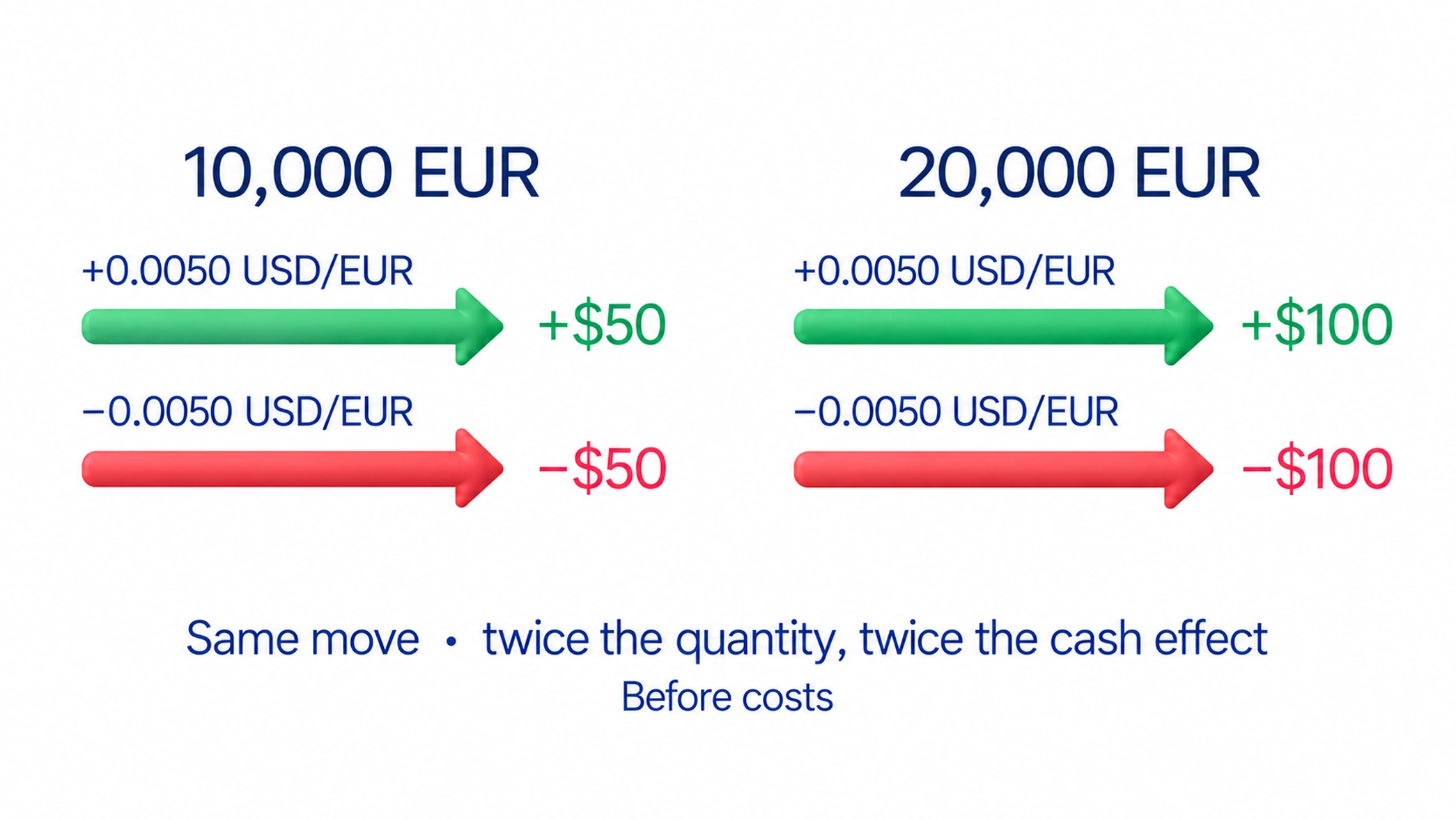
Suppose the position later closes at an actual selling price of 1.1052. The change from your entry is 0.0050 dollars per euro, or 50 pips. The price-movement profit is 10,000 × 0.0050 = $50. Here one pip is worth $1. These figures use the actual entry and exit prices; commissions and financing charges or credits for holding overnight would change the final account result.
A short position has the opposite price-movement result. The product's payment formula and any account-currency conversion still apply. Neither direction makes the funds pledged for a leveraged position a guaranteed maximum loss.
Use the platform's close command or the specified closing operation. On some accounts, placing an opposite order can create a second position rather than close the first. Check the position and execution records afterwards. The guide to order types and execution conditions explains price limits, triggers and unfilled orders.
Spreads and overnight swap charges
The spread is the gap between bid and ask. It explains the immediate loss in the example above. Providers may also charge commissions, so a quoted minimum spread is not the complete cost of a trade.
The spread can widen during news, quiet periods or reopening after a break. A chart may display bid, ask or another price field. Check which quote triggers your stop and how the resulting order executes. A stop can fill at a worse price than planned, especially after a gap when trading resumes.
A retail forex swap, or rollover adjustment, is a debit or credit for holding a position through the provider's financing cutoff. It depends on the direction, market financing rates and the provider's charges. The difference between central-bank policy rates alone does not give you the exact account charge.
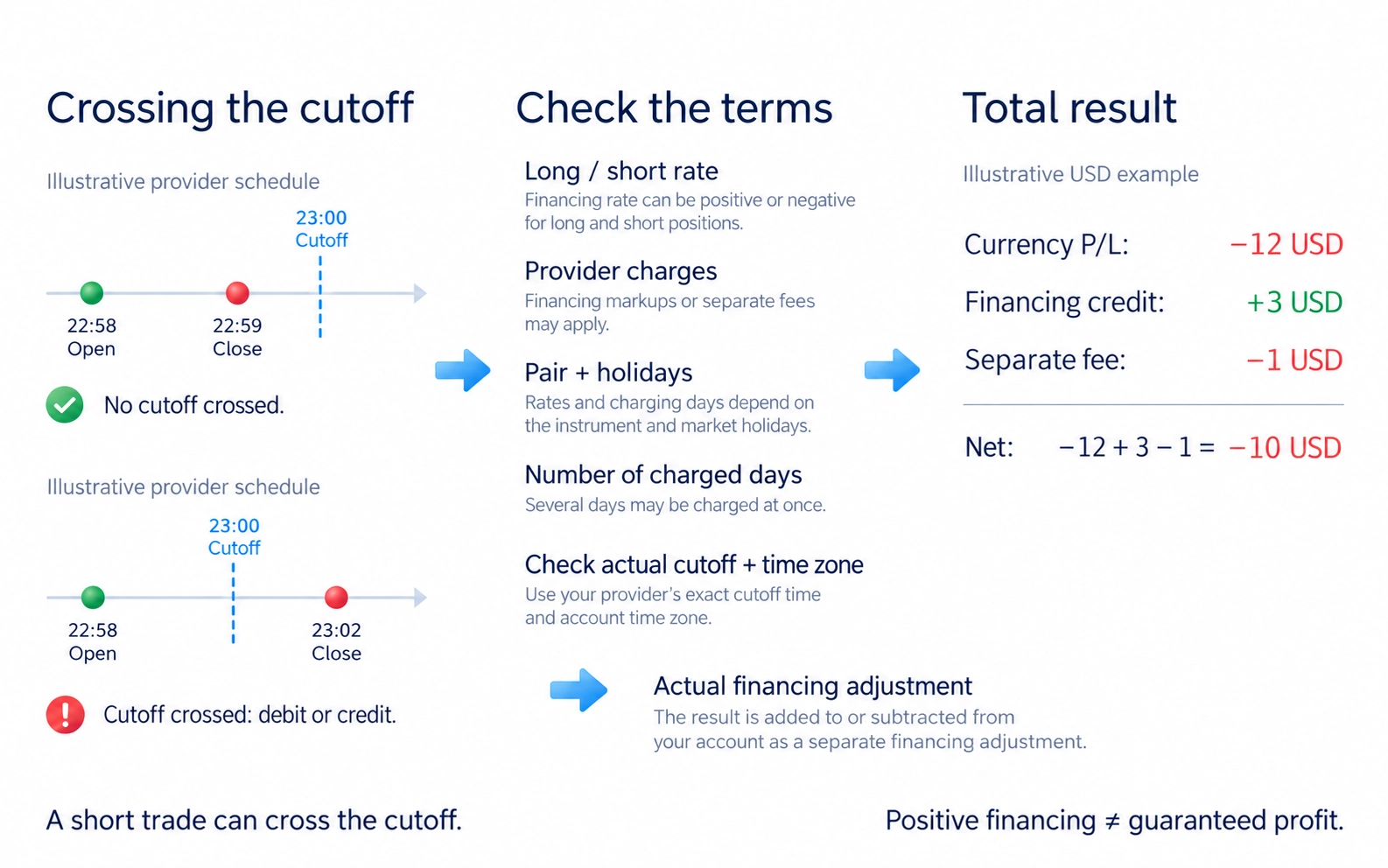
Some schedules charge several days at once to cover a weekend, often on Wednesday. The day and amount depend on the pair, holidays and contract terms. Even a short-duration trade can incur financing if it crosses the cutoff. Check the long and short rates and the cutoff before holding a position through it.
Leverage, margin calls and forced closure
Leverage allows a position larger than the funds put up for it. Margin is collateral, money or eligible assets pledged to open and maintain that position. It is not the loss you planned to accept.
Increasing the position size makes the same currency move produce a larger cash gain or loss. A higher permitted leverage limit can reduce the collateral required for the same size; it does not force you to trade more. Do not choose a size merely because the account permits it.
A margin call concerns insufficient funds under the provider's requirements. It may involve a warning or a demand to reduce positions or add funds. A stop-out is forced closure under the account rules. Do not rely on receiving a phone call or having time to respond: automatic closure may be allowed.
In the course's lesson on leverage, Igor Arapov recommends minimum leverage or none while beginners learn and practise on a demo account using virtual money. The decision is to avoid making a large position the starting point of training. Check the exit conditions and cash loss you could accept before increasing size.
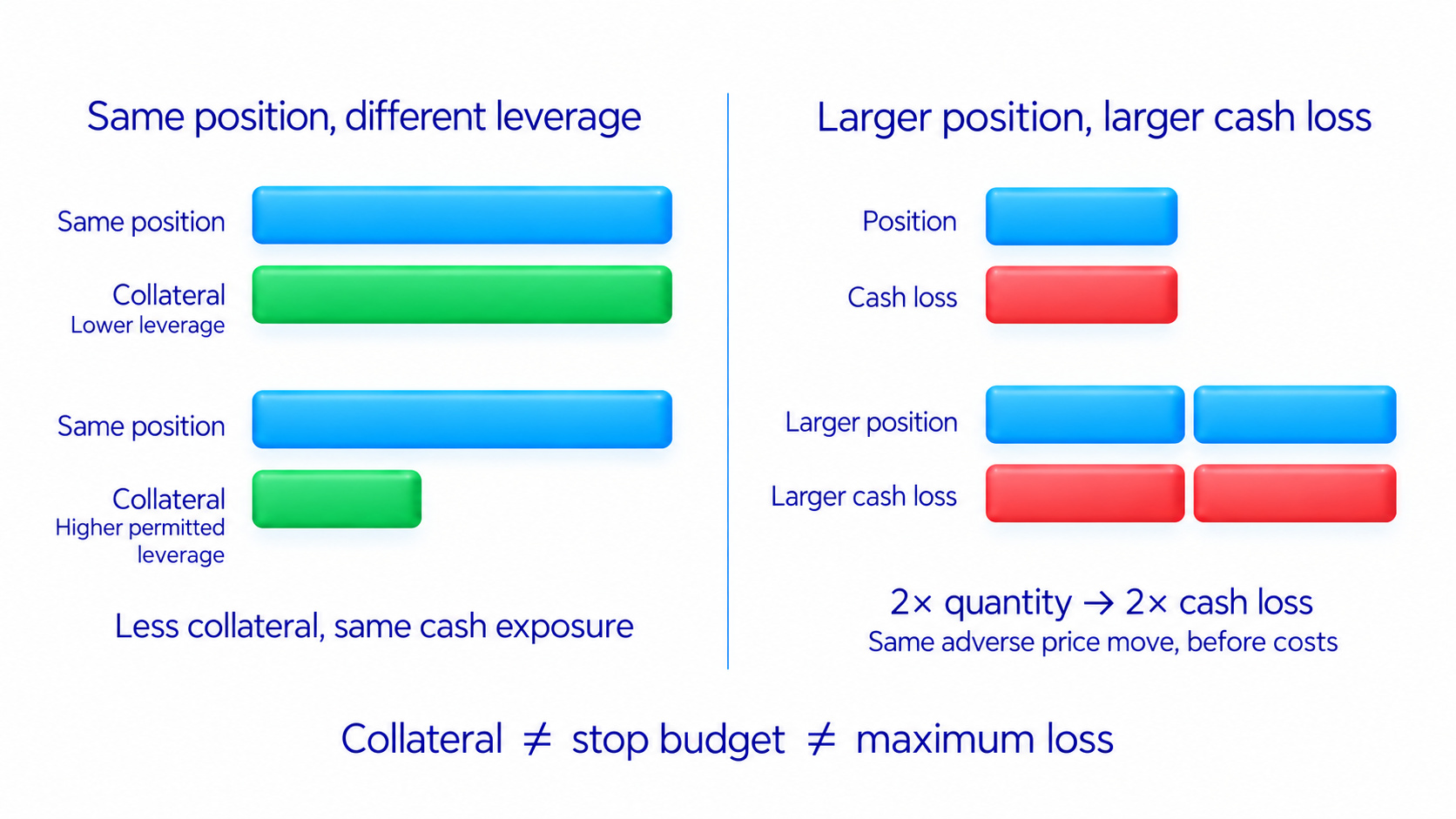
There is no leverage ratio that makes every trade safe. Check available collateral, financing, forced-closure rules and any contractual protection against a negative balance. Actual losses can exceed a stop calculation. The risk-management position-size calculation sets size from the loss budget and exit distance rather than the maximum permitted position.
Currency risk and the carry trade
Currency risk is the possibility that an exchange-rate change reduces your result. It affects a trader's position, a company's overseas payment and an investor's foreign assets after conversion into the home currency. The same rate movement can help one participant and hurt another.
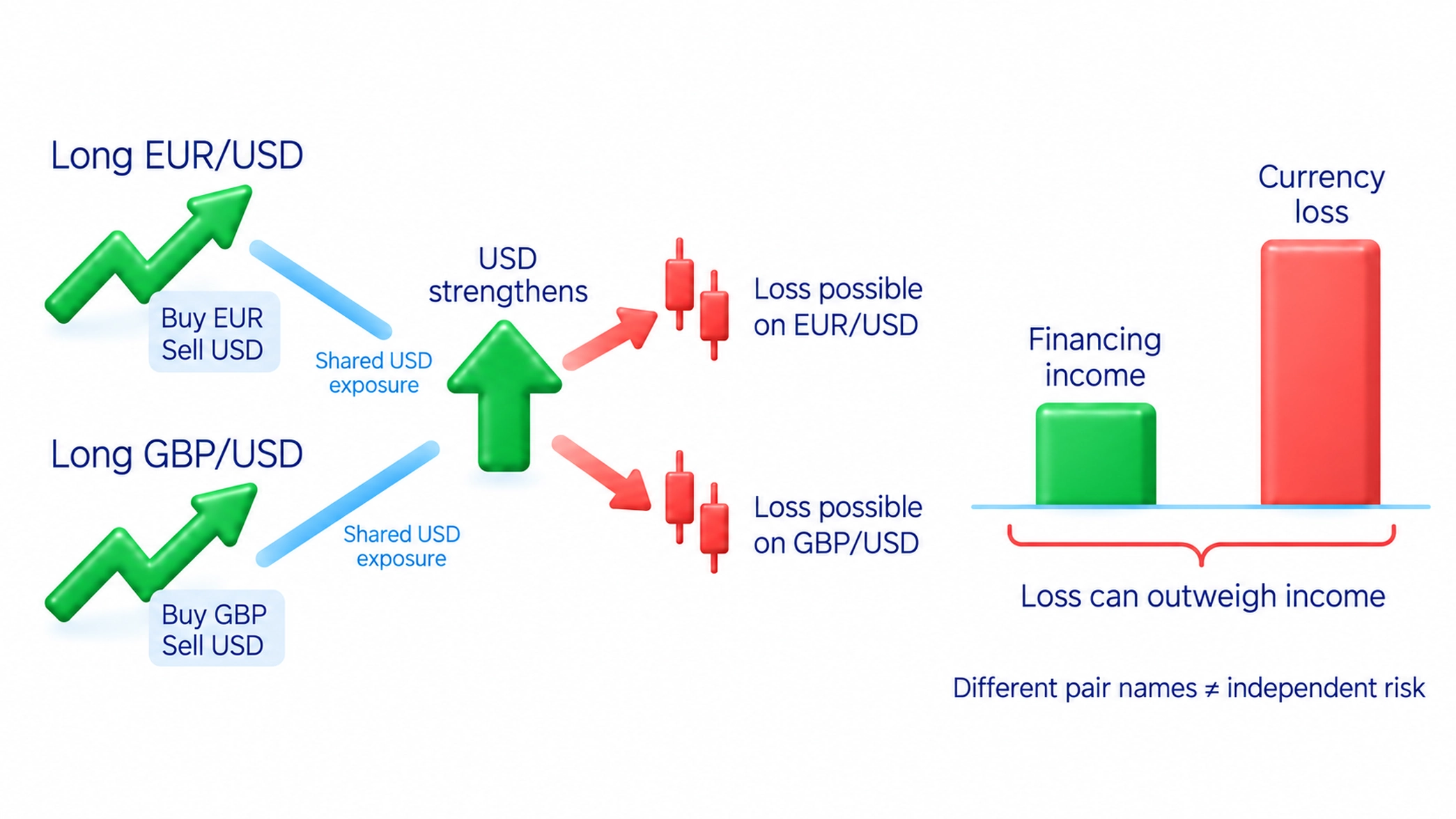
Different pairs can share the same side of a currency risk. Long EUR/USD and long GBP/USD both benefit from their base currency strengthening against the dollar. They are not independent simply because their names differ. Check the combined potential loss of open positions as well as each trade separately.
A carry trade seeks to earn a return by funding in a lower-interest currency and holding an investment in a higher-interest currency. In retail forex, a related approach may involve holding a position with positive rollover. The product's actual financing terms matter; a favourable policy-rate difference does not automatically produce a credit.
An adverse exchange-rate move can outweigh the income accumulated. Leverage increases the effect of that move on the account, but is not required for every investment using an interest-rate difference. Compare the currency loss you could face with the financing income; a positive swap is not risk-free income.
Forex trading sessions and market hours
A forex session describes the active hours of a financial centre. Trading passes between centres across time zones, mainly through the working week. Sessions are commonly described as Pacific, Asian, European and American. Your provider sets the hours available for the chosen instrument, including breaks, holidays and weekend closure.
The London-New York overlap can be active for major pairs, but it does not guarantee a large one-way move. Events affecting yen or Australian-dollar pairs can matter during Asian hours. Select a working window for the actual pair and method rather than assuming every night session is useless.
In his session lesson, Arapov highlights European-US activity and advises beginners to separate working hours instead of watching the screen all day. The optional video Forex trading sessions adds that practical time-management context. It does not make one session a universal entry signal.
Check the platform's time zone and daylight-saving changes: countries may change clocks on different dates. Before news or a reopening, quotes can widen or jump. Being inside an active session does not remove those execution risks.
What does the US Dollar Index show?
The US Dollar Index, commonly called DXY, measures the dollar against a basket of six currencies: the euro, yen, pound, Canadian dollar, Swedish krona and Swiss franc. ICE's methodology gives the euro the largest weight, 57.6%. A comparison with EUR/USD is therefore not an entirely independent check: that pair materially affects the index.
A rising DXY means the dollar has strengthened against the basket overall. It does not require every other currency to fall or tell you where to enter a trade. EUR/USD often moves in the opposite direction, but a permanently fixed correlation cannot be assumed. Dollar crosses and pairs without the dollar need their own analysis.
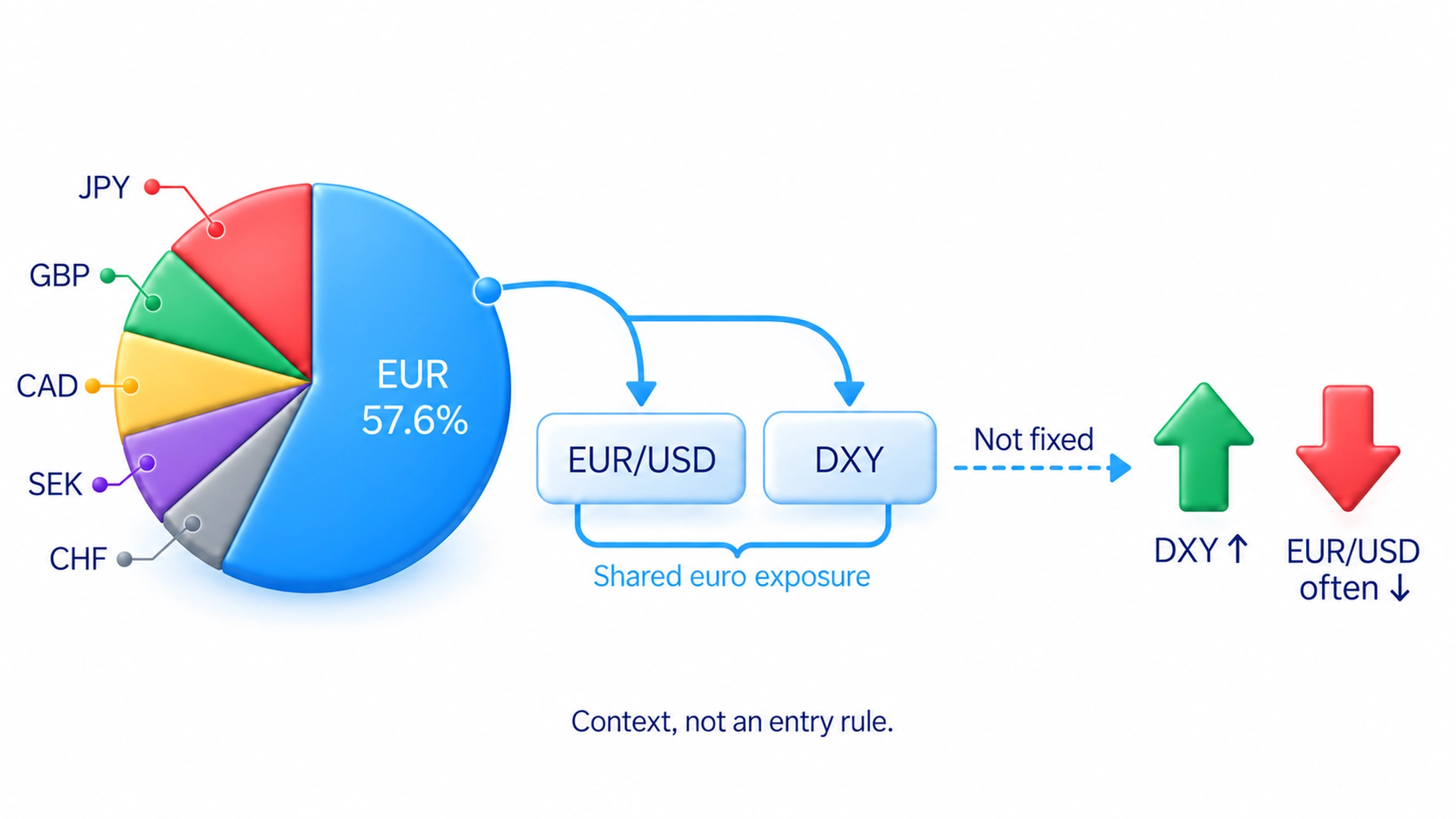
Interest rates, policy expectations and demand for currencies influence exchange rates. A rate increase does not guarantee a rise, because expectations may already be reflected in the price. The guide to fundamental analysis and market expectations explains that distinction. DXY is context, not a replacement for the chosen pair's entry conditions.
What to check before your first forex trade
Find the product type, lot size, price step, cash value of a move, hours, spreads, commissions and financing schedule. Read who your counterparty is and when the provider can close positions. On a demo account, confirm that buying and selling change the result in the expected direction and that the close command closes the intended position.
Before a live trade, record the reason for entry, planned cash loss and exit condition. The beginner's trading guide gives the learning sequence. If you choose currency futures, read their separate contract rules and the explanation of exchange trading and settlement. An OTC quote and an exchange contract are not interchangeable.
Frequently asked questions
Forex is the market for exchanging currencies. A pair quotes the first currency in units of the second. Your retail account may trade a currency contract rather than receive actual currency; check the product terms.
A pip is a conventional price-change unit, usually 0.0001 or 0.01 when yen is the quote currency. Its cash value depends on position size, the pair and the account currency. It is not always the smallest displayed price step.
A long benefits when the currency named first in the pair rises against the second currency; a short benefits when it falls. A currency contract for difference (CFD), which pays according to price changes, does not require the physical borrowing used in a traditional short sale of shares. Costs and contract terms still matter.
Holding through the financing cutoff can produce a debit or credit. The direction, market financing rates, provider charges and calendar determine it. Positive financing does not guarantee a positive trade result.
No ratio makes every position safe. Arapov recommends minimum leverage or none during learning. Choose size from the cash loss and exit conditions you can accept, and separately check the funds or other assets required to support the trade and the forced-closure requirements.
The useful window depends on the pair, method and actual conditions. The London-New York overlap can be active, but activity is not a guarantee of direction. Check the provider’s hours, news and time zone.
About the author
Igor Arapov, a practising trader since 2013 and author of the ArapovTrade library. ORCID: 0009-0003-0430-778X.




