A bond records a debt. Its issuer, the company or public body borrowing the money, promises payments under specified terms. Buying it makes you a creditor, not an owner of the business. A promise to pay is different from money received: the borrower can default, and selling before repayment can return less than you paid.
Start with three questions: what must this bond pay, when are those payments due, and what could prevent you receiving them? Then compare those promises with the full purchase cost. A large coupon does not establish that a borrower can afford its debt.
Bonds versus shares
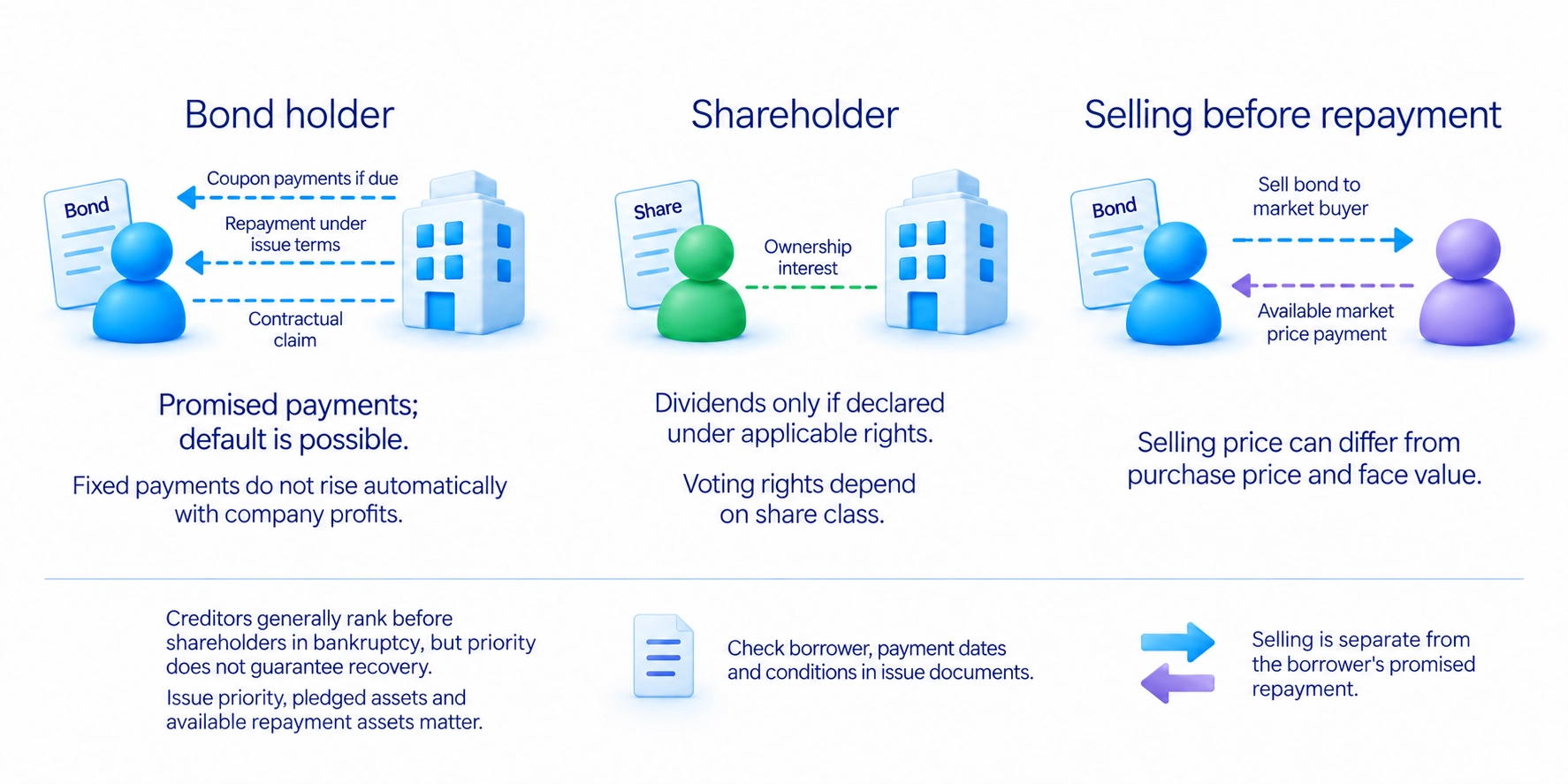
A share gives ownership in a company; a conventional bond gives contractual claims on that company. Rising profits do not automatically increase a fixed bond payment. Financial trouble does not remove the debt obligation, but it can leave the company unable to meet it.
Creditors generally rank ahead of shareholders in a bankruptcy, but they do not all recover their money. The particular debt’s priority, any assets pledged to secure it and the assets available for repayment matter. The guide to trading and investing explains the broader difference between holding an asset and trading changes in its price.
Face value, coupons and accrued interest
Face value is the amount used as a reference for the bond’s payments. A simple bond repays that amount at its maturity date, provided the borrower fulfils its obligations. You may buy above or below face value. Some issues repay parts of the debt earlier, so read the payment schedule rather than assuming every bond follows the simple model.
A coupon is an interest payment. A fixed coupon uses a specified rate; a floating coupon changes according to a formula. Check payment dates, the amount on which interest is calculated and any contractual right to change or stop payments. A zero-coupon bond makes no regular coupon payments.
Accrued interest is interest earned since the start of the current coupon period. In an ordinary transaction between coupon dates, the buyer compensates the seller for this amount. The clean price excludes it; the dirty price includes it. Check which price your platform displays and the amount payable after fees.
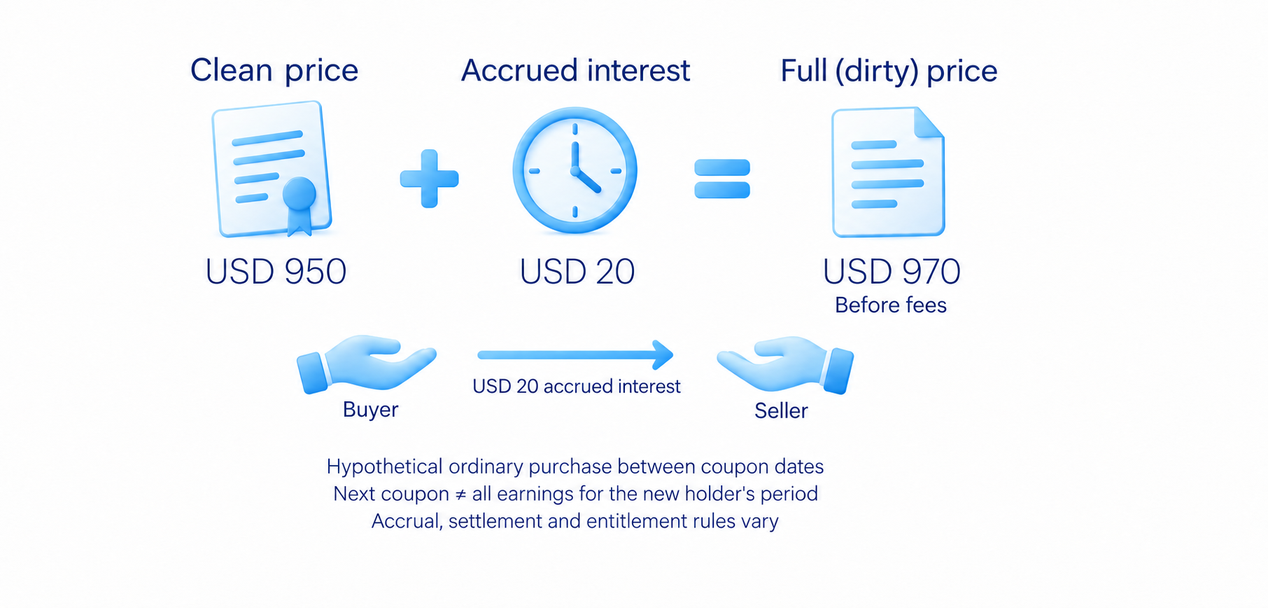
The new holder normally receives the next coupon if the payment conditions are met. That entire payment is not earnings for a few days of ownership: part was already paid to the seller as accrued interest. Accrual conventions, settlement dates and entitlement rules vary. Bonds in default and special transaction terms can depart from this ordinary arrangement.
Coupon rate versus yield
The coupon rate describes interest relative to face value. Current yield compares annual coupon income with the market price. Yield to maturity considers the scheduled future payments and repayment of the debt. These are different measures, especially when the purchase price differs from face value.
Consider a hypothetical dollar bond with USD1,000 face value, a fixed annual coupon rate of 5%, a USD950 clean price and USD20 accrued interest. Annual coupons total USD50. Buying costs USD970 before fees. Current yield calculated from the clean price is 50 ÷ 950 × 100%, approximately 5.26%. That is neither a guaranteed annual return nor yield to maturity.
In this example, repayment at USD1,000 also returns USD50 more than the clean purchase price, if the borrower pays as promised. But calculating an annual yield from all those payments requires the remaining maturity and coupon dates. Neither has been specified, so an exact yield to maturity cannot be stated. Costs and taxes also affect what the investor keeps.
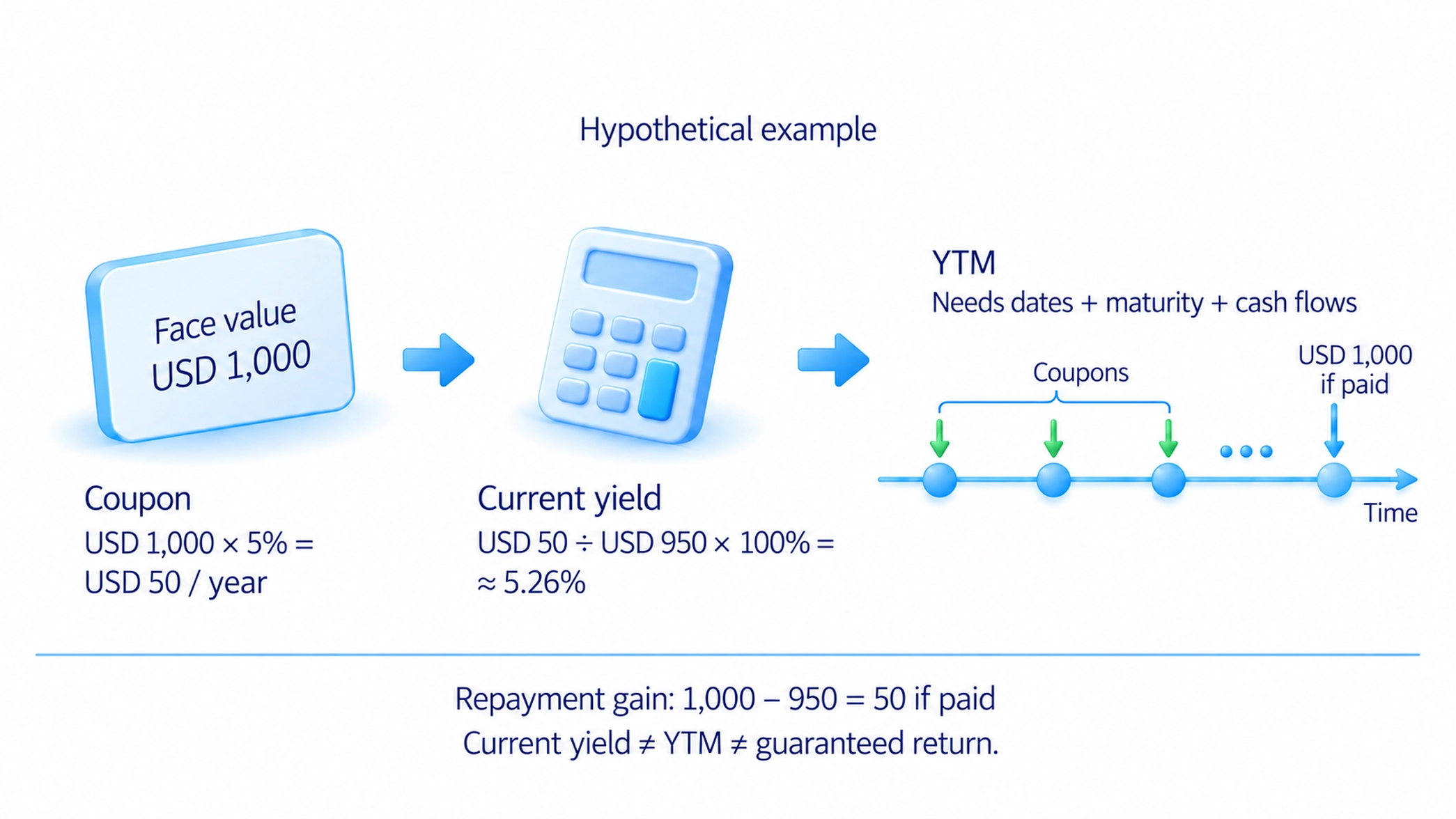
Yield to maturity is the annualised calculation rate that makes the value today of scheduled future payments equal the purchase price. It accounts for payments arriving at different times. The calculation assumes the promised payments occur; achieving the corresponding compounded return also depends on reinvesting coupons at that rate. It is a conditional calculation, not a guarantee.
A callable bond lets the issuer repay early under its terms. Check the return calculated to the relevant call date as well as maturity. After repayment, future coupons stop. A high coupon does not automatically compensate for paying too much or having to reinvest at a lower rate.
Types of bonds
Governments issue sovereign bonds, regional or local public bodies issue municipal bonds, and companies issue corporate bonds. These labels are not a universal safety ranking. The borrower’s finances, payment currency and specific contract matter more than an assumption that any government debt is safe.
High-yield bonds typically offer a larger yield in exchange for greater credit risk, the risk of missed debt payments. A rating is an assessment of credit quality, not insurance against loss. Investigate the borrower’s debt burden and ability to pay rather than treating a higher quoted yield as free additional income.
Payment structures also differ. Floating-rate terms specify a reference rate, an added amount and reset dates. A zero-coupon bond bought below its repayment amount earns the difference if the borrower pays. Inflation-linked issues can adjust the amount owed or payments according to their own formula. A bond fund holds bonds, but a fund unit does not promise the repayment of an individual bond’s face value on its maturity date.
Why bond prices change
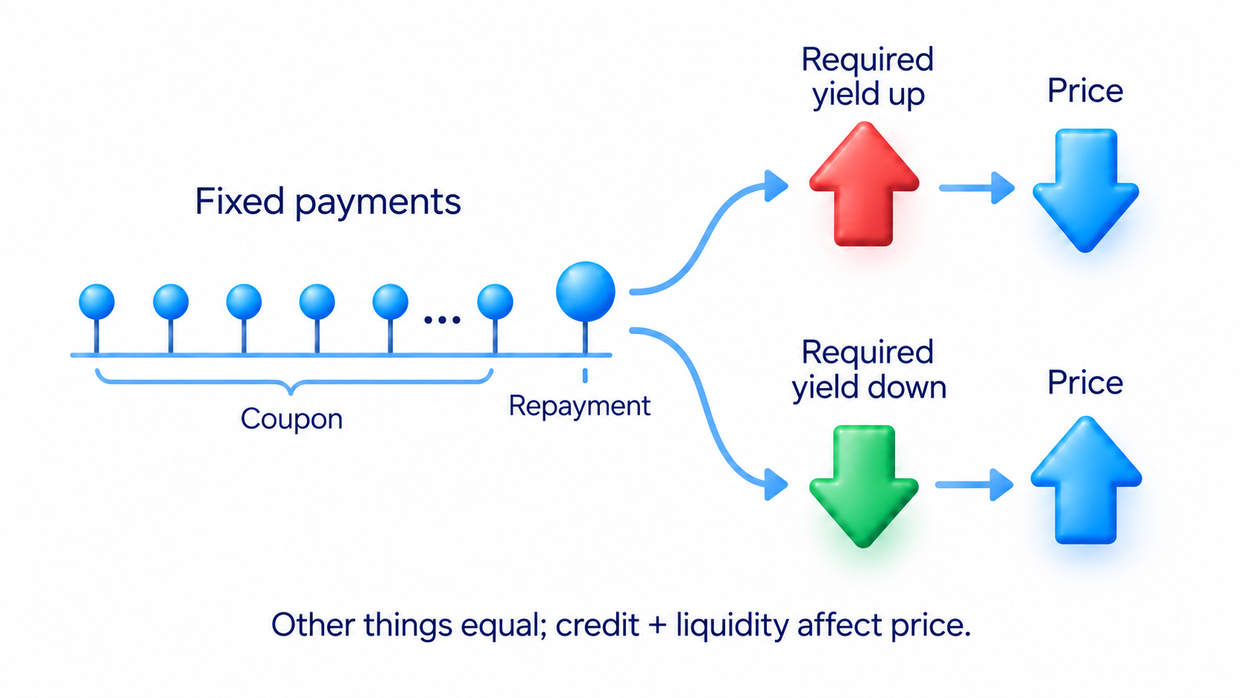
A bond’s market price reflects what its future payments are worth to a buyer today. Other things equal, a higher return required by buyers lowers the price of a simple fixed-payment bond; a lower required return raises it. Market yields also reflect expectations, credit quality and ease of trading. A central-bank decision alone does not determine every bond’s price.
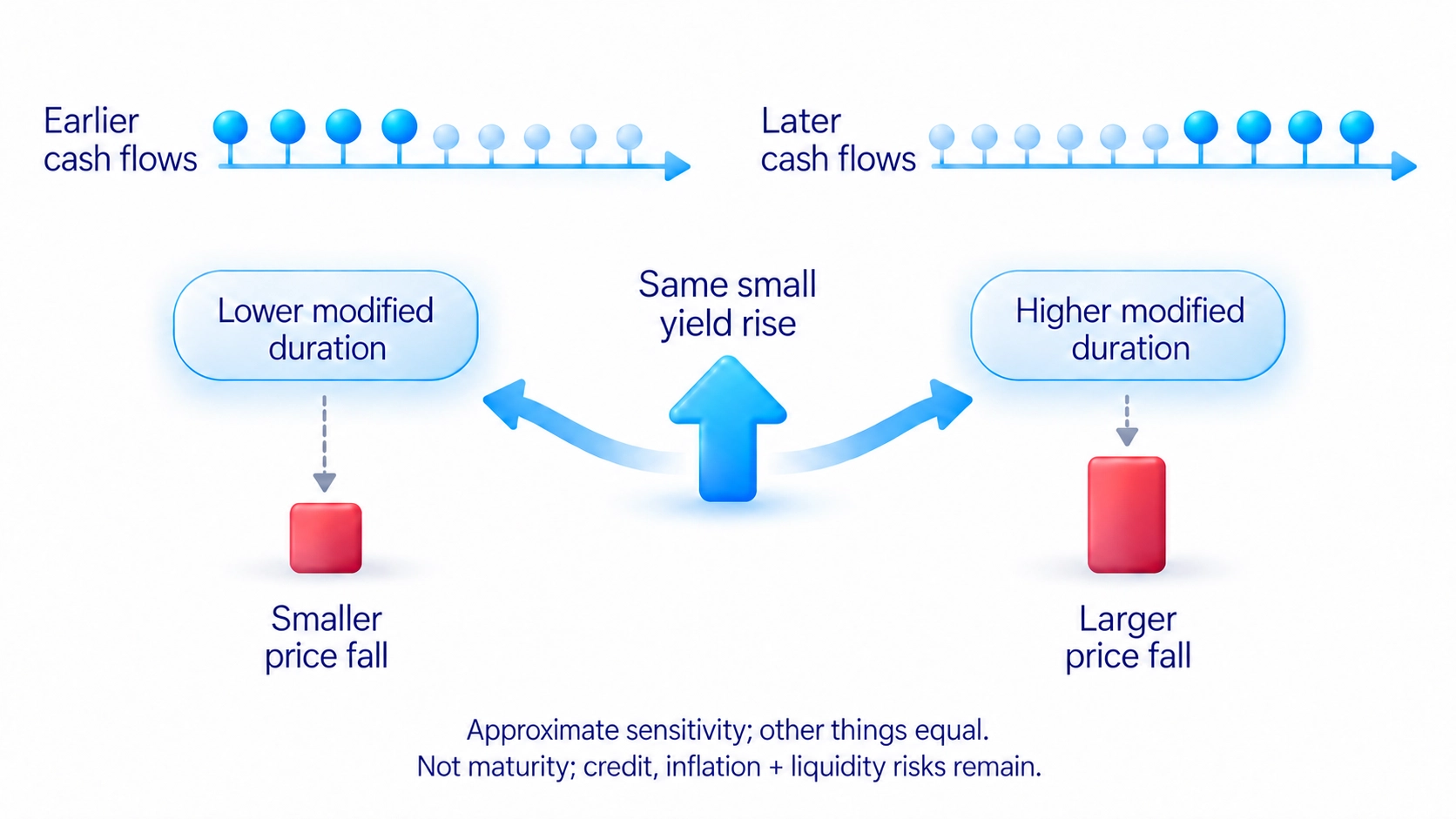
Duration describes the timing of a bond’s payments and helps assess sensitivity to yield changes. Macaulay duration is the average payment time, weighted by the payments’ values today. Modified duration estimates price sensitivity to a small change in yield. Effective duration can account for terms that change expected payments, such as an early call. None means the time needed to recover the price from coupons.
Other things equal, a higher modified duration means a larger price response to a small yield change. This is an approximation; large changes and changing payment expectations complicate it. Low duration does not remove default risk, loss of purchasing power or difficulty selling.
A yield spread is the difference between yields on comparable bonds. A corporate borrower may have to offer more than a government reference because of credit risk or poorer trading conditions. Compare similar maturity or duration, currency and repayment rights. A wide spread can reflect a genuine repayment problem rather than a bargain.
A yield curve compares yields across maturities for comparable debt. An inverted curve has higher short-maturity yields than longer-maturity yields. It can reflect expectations of lower future rates or weaker economic conditions. That interpretation does not establish a recession date or provide a trade entry in another asset.
Risks to check before buying
Default means failure to fulfil payment obligations. Deteriorating finances can reduce the price before a coupon is missed. Security backed by pledged assets does not ensure an immediate or complete recovery. Check the borrower’s ability to service its debt and the repayment priority of this issue.
Interest-rate risk matters especially if you may need to sell before maturity. You sell at an available market price, not automatically at face value. With little trading activity, a buyer may be unavailable when needed. A wide gap between available buying and selling prices adds to the cost of exiting.
Inflation reduces the purchasing power of future payments. A different payment currency adds exchange-rate risk relative to your spending currency. Coupons and early repayment create reinvestment risk: comparable terms may no longer be available when you receive the money. These risks remain even if every debt payment arrives on time.
Before buying, record the repayment amount, coupon schedule, floating-rate formula, early-call rights and repayment priority from the issue documents. Check the full purchase cost, an available selling price and fees. If you cannot explain a payment or redemption condition, the yield assessment is not complete.
For a trader, bonds provide economic context rather than a substitute for an entry condition. In the course section on fundamental analysis, I recommend learning price structure and trading volume before adding economic forecasts. That is a learning sequence, not a personal bond-trading strategy. A rate announcement must still be compared with what actually happened in the instrument being traded.
The fundamental analysis guide explains the broader role of interest rates and economic releases. For the bond itself, keep the assessment tied to payments, price and contractual rights. Save your reasoning before buying: which payments you expect, when they should arrive and what change would require you to reconsider.
Frequently asked questions
A bond is a debt security. Its issuer promises payments under specified terms, and the holder becomes a creditor. Knowing the terms does not guarantee their fulfilment or the price available when selling.
The coupon is an interest payment under the contract. Yield also depends on the purchase price and timing. Current yield compares annual coupons with price; yield to maturity considers scheduled future payments and repayment.
Accrued interest is interest earned in the current coupon period. In an ordinary purchase between payments, it is paid to the seller in addition to the clean price. The next full coupon is not all earnings for the new holder’s ownership period.
Issuers include governments, local public bodies and companies. Payments can use fixed coupons, floating coupons or no regular coupons. Reliability depends on the borrower and contract, not only the category’s name.
Yes. The borrower may default, the selling price may fall and inflation can reduce the purchasing power of payments. Currency, limited trading activity and early repayment create additional risks.
Duration describes payment timing. Modified duration estimates the price response to a small yield change: a larger value normally means more sensitivity, other things equal. It does not measure or remove all the bond’s risks.
Comparable short-maturity debt has a higher yield than longer-maturity debt. That can reflect expectations of lower future rates or weaker economic conditions, but it does not guarantee a recession or determine an entry time.
About the author
Igor Arapov, a practising trader since 2013 and author of the ArapovTrade library. ORCID: 0009-0003-0430-778X.




