Trading and investing differ mainly in why you hold an asset and what would make you sell it. A trader plans transactions to profit from price changes. An investor usually holds an asset longer, expecting its value to grow or ownership to provide payments. Compare the purpose, time commitment, costs and rules for leaving before choosing an approach.
What is the difference between trading and investing?
Trading is active buying and selling with the aim of benefiting from price movements. A trade may last seconds, hours, days or longer, depending on the method. That does not make trading a source of daily income: there may be no suitable opportunity, and a completed trade may lose money.
Investing means putting money into an asset with the expectation of a return over time. A long-term investor asks what the asset represents, why it might retain or increase its value, and how long the money can remain invested. The holding period is important, but it is not a complete definition. An investor can also review, sell and replace investments.
A share is a small ownership stake in a company, whether you buy it for a short trade or a long-term investment. A trader might sell when a planned price condition changes. An investor might keep the same share while the business continues to meet the reasons for buying it. Calling yourself a trader does not remove your ownership rights, and calling yourself an investor does not create a dividend payment.
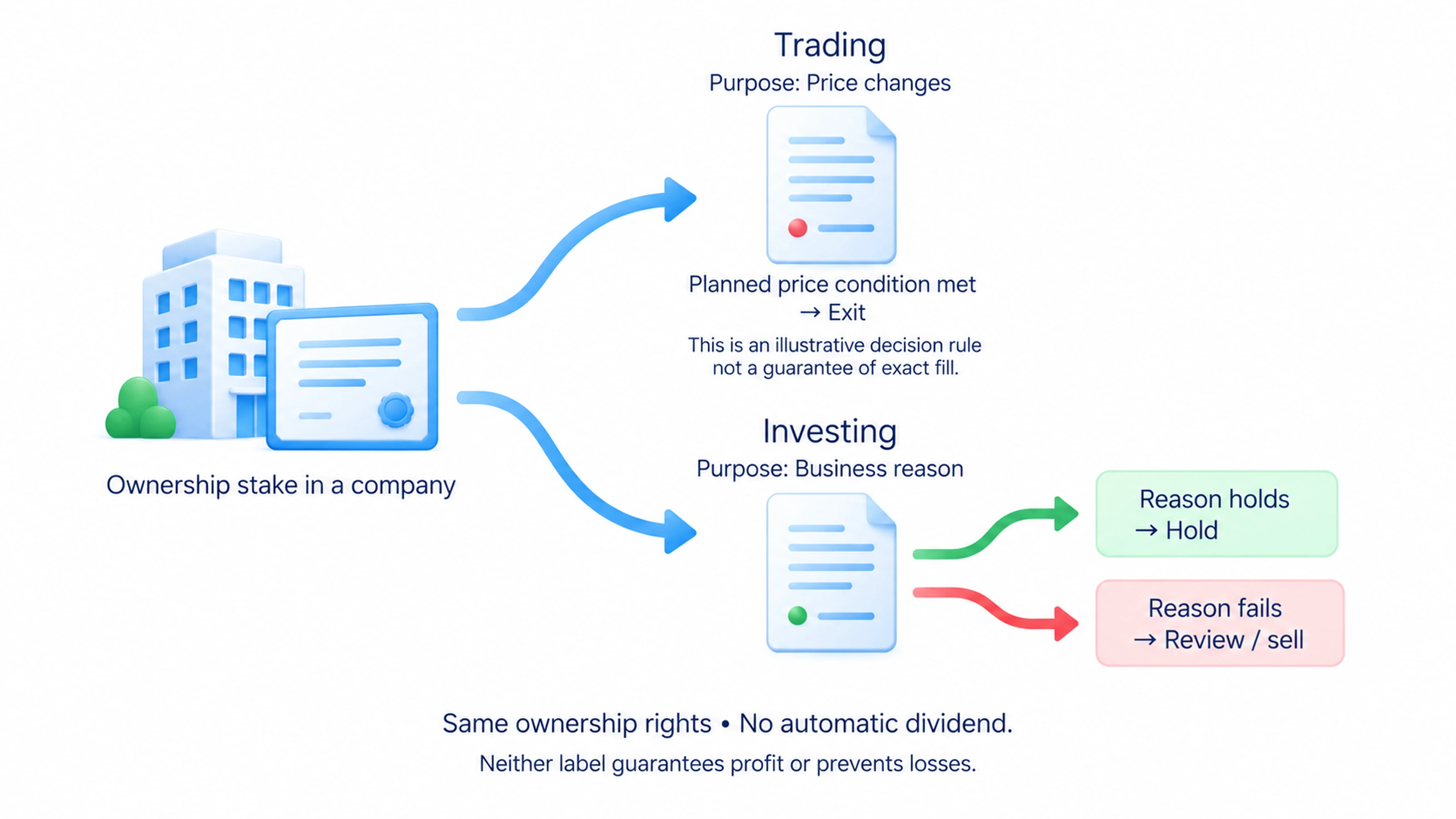
Both approaches involve transactions. An investor also buys and sells through a broker, a firm that arranges access to the market. How an exchange works explains the execution process. The distinction here is the purpose of holding the asset and the conditions for keeping or closing the position, meaning the amount you currently hold.
Where do trading and investment returns come from?
When you buy and later sell, the price result depends on the actual purchase price, sale price and quantity. Costs then reduce the amount you keep. Some products also allow a position intended to benefit from falling prices. That mechanism has its own terms and risks; trading is not limited to buying before a rise.
An investment may provide payments as well as a change in value. A dividend is a payment to shareholders when a company declares and pays one. A bond represents a debt: its payments depend on the contract and the borrower's ability to meet it. Not every share pays dividends, and an expected payment does not protect the purchase price from falling.
Consider one hypothetical shareholding. You buy ten shares for USD100 each. Later they are worth USD95 each, and you have received a dividend of USD2 per share.
The price change is 10 × (95 − 100) = −USD50. The payments are 10 × 2 = USD20. Together they leave you USD30 down before fees and taxes. Receiving income has not offset the decline in value.
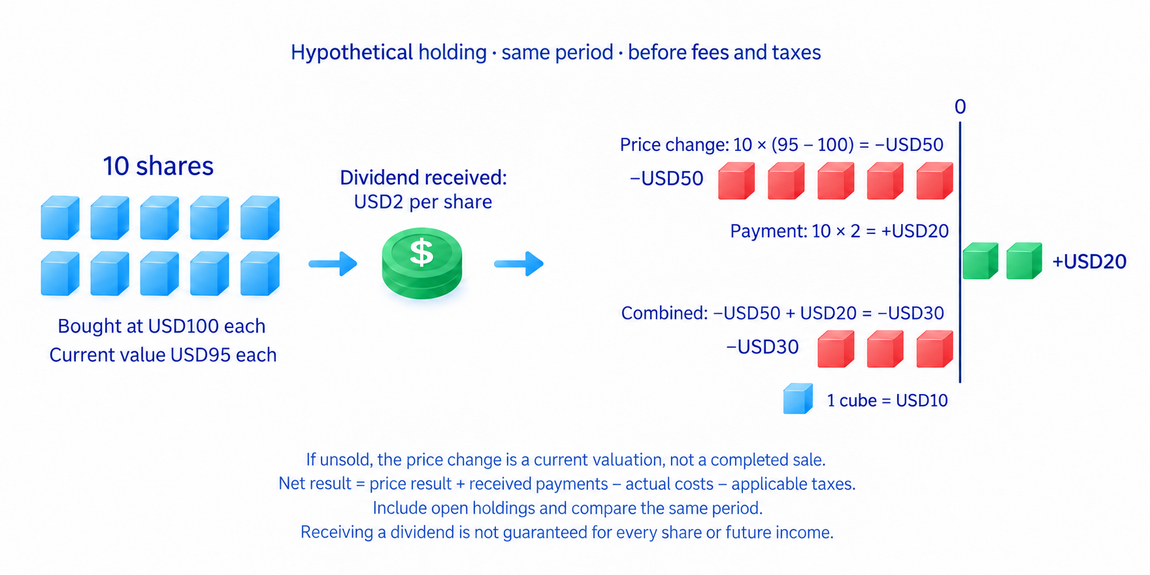
If you have not sold the shares, the price loss is a current valuation rather than a completed sale. It still matters when assessing what your holdings are worth. To compare two approaches, use the same period and include payments, costs and positions that remain open. A dividend total or a count of winning trades is not a complete result.
How much time does each approach require?
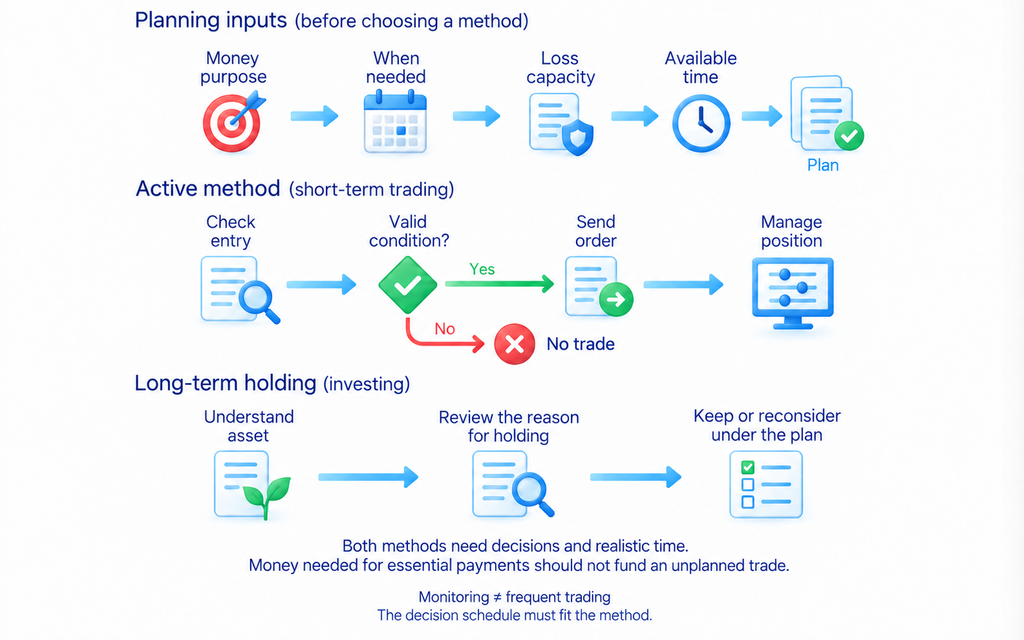
A short-term method may require you to be present when its decisions must be made. You need time to check an entry, send an order and respond to the position. If the method needs a quick decision, checking the chart once a week will not meet it. Watching frequently does not mean trading frequently: you can monitor the market without finding a valid entry.
Long-term investing may need less frequent action, but it still needs decisions. You must understand the asset, its costs, when you will need the money and what would make you reconsider holding it. There is no universal schedule such as checking every portfolio once a month. The schedule should fit the assets and the plan.
The horizon does not restrict everyone to one kind of analysis. A trader can consider company results or news that affect price and execution. An investor can use a chart to assess a purchase price. Using financial information is not reserved for investors, and looking at a chart does not automatically make someone a trader.
Write down the hours you actually have and the actions you can complete within them. Trading styles explains how different holding periods change the work involved. Choose a method you can follow, rather than a shorter holding period simply because you want money sooner.
Is trading more profitable than investing?
Neither label establishes a higher return. Results depend on the method, assets, period, losses and costs. One person's strong month does not show what a beginner can earn. More transactions do not guarantee a larger net profit, just as holding an asset longer does not guarantee that it will recover or rise.
Frequent transactions can repeat commissions and other execution costs. When the intended price move is small, these costs may consume a substantial part of the gain. Longer holdings may involve fewer transactions but still carry account charges, fund expenses or other applicable costs. Check the complete cost of the approach, not just an advertised zero purchase commission.
Borrowing can also change the comparison. Leverage means using borrowed funds or a product that lets you control a position larger than the money committed to it. That larger position can produce a larger loss from the same adverse price move. Comparing its return with an investment paid for in full without comparing losses is misleading. Tax treatment also depends on the country, account and operations; a tax advantage in one example is not a universal difference.
Following rules is not proof that a method makes money. You can consistently follow a losing method. Check the results after costs and whether the actions actually followed the rules; a trading system explains how to make that assessment. Risk control helps organise a process, but cannot turn every process into a profitable one.
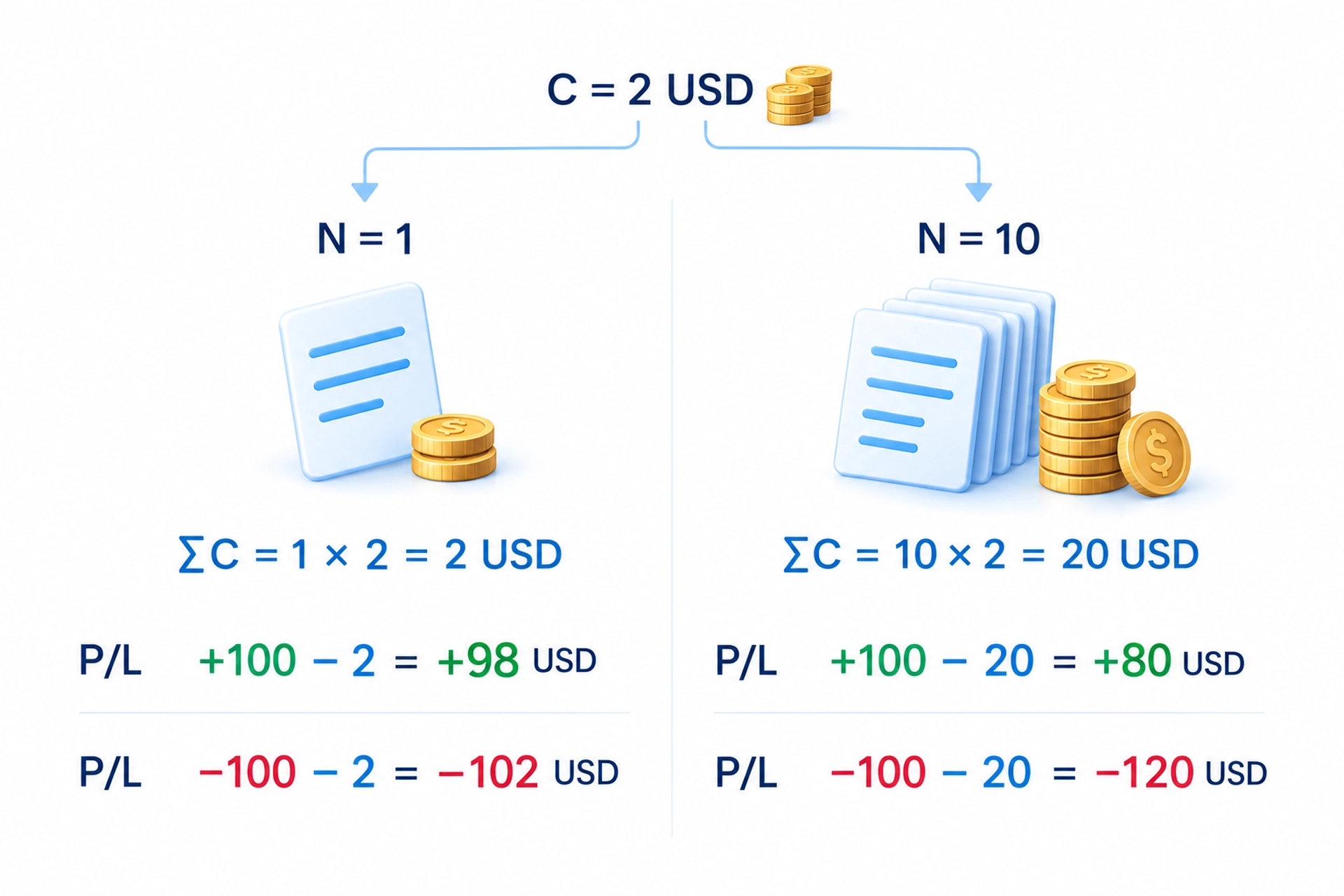
The illustration assumes a cost C of USD 2 per transaction and compares N = 1 with N = 10 transactions at the same total gross result. Costs reduce a USD 100 gain to USD 98 or USD 80, and increase a USD 100 loss to USD 102 or USD 120. This hypothetical cost comparison does not establish a return for trading or investing.
How do traders and investors manage risk?
For a trade, decide what would make you leave when the idea is wrong and how much to hold. A stop-loss order is an instruction intended to close the position when a specified price condition is met. Its trigger price is not a guaranteed execution price: a fast move or insufficient available orders can make the loss larger than planned. Risk management explains how an exit plan and position size work together.
For investments, consider the quality of the assets, the amount committed and how holdings depend on one another. Diversification means spreading money among different investments to reduce dependence on a single one. Several holdings in the same industry can still react similarly. Diversification can reduce some risks, but does not prevent losses when the broader market falls.
A long horizon can allow you to hold through short-term fluctuations. It does not fix every bad purchase. A business can lose value, a borrower can fail to pay, or you may need your money earlier than planned. Investment losses do not have to happen slowly simply because the intended holding period is long.
In my course's position-sizing lesson, I start with a planned cash loss and then check the product's units and permitted quantity. If its smallest permitted position exceeds that budget, the trade does not fit the plan. This is a decision for an individual trade, not a claim that every long-term investment needs the same exit method. The amount a broker allows is not automatically the amount I can reasonably risk.
For an optional practical explanation of that trading task, see position sizing. The distinction between trading and investing is explained in writing here; the video supplements the sizing decision rather than deciding which approach is better for you.
Should you trade, invest or combine them?
Start with the purpose of the money and when you will need it. Money required for a near-term essential payment should not automatically become a risky long-term holding. Separately identify how much loss you could withstand and how much time you can give to learning and monitoring. These are practical selection conditions, not a test of which label sounds more attractive.
If you want to learn active trading, first practise executing a defined method on a demo account, which uses virtual money. This helps you learn the process, but does not reproduce every real fill or the experience of losing your own money. Trading for beginners explains the preparation sequence. For investing, you still need to understand what you are buying and why it fits the intended holding period.
Combining the two is possible if you separate their purposes, funds and records. Decide in advance which money serves a long-term goal and which is available for testing a trading method. Two accounts do not themselves prevent losses. Do not use money reserved for an essential goal to cover an unplanned trading loss just because both accounts belong to you.
Do not rename a failed short-term trade an investment after the price moves against it. That abandons the original exit condition; it does not establish a new reason to own the asset. Before buying, write the purpose, intended holding period, permitted actions and conditions for reconsidering. If those are still unclear, prepare the plan before opening the position.
Frequently asked questions
Trading seeks to benefit from price movements through planned transactions. Investing usually involves longer ownership for a change in value or possible payments. The same asset can serve either purpose; the reason for buying and the exit conditions distinguish the approaches more clearly than a label alone.
There is no universal answer. Compare the complete result after costs with the losses and time required, over the same period. Neither a higher trade count nor a longer holding period guarantees income.
No. Some shares do not pay dividends, and other assets may provide different payments or none. Even a dividend you receive may be smaller than the decline in the value of your holding.
No. The asset can lose value or you may need to sell earlier than planned. Diversification can reduce dependence on individual holdings, but does not remove the risk of a broader market decline.
Yes, if their purposes, funds and records are clear. Do not turn a losing trade into an investment to avoid its original exit rule, or cover its loss with money reserved for an essential goal.
About the author
Igor Arapov, practising trader since 2013, author of the ArapovTrade library. ORCID: 0009-0003-0430-778X.




