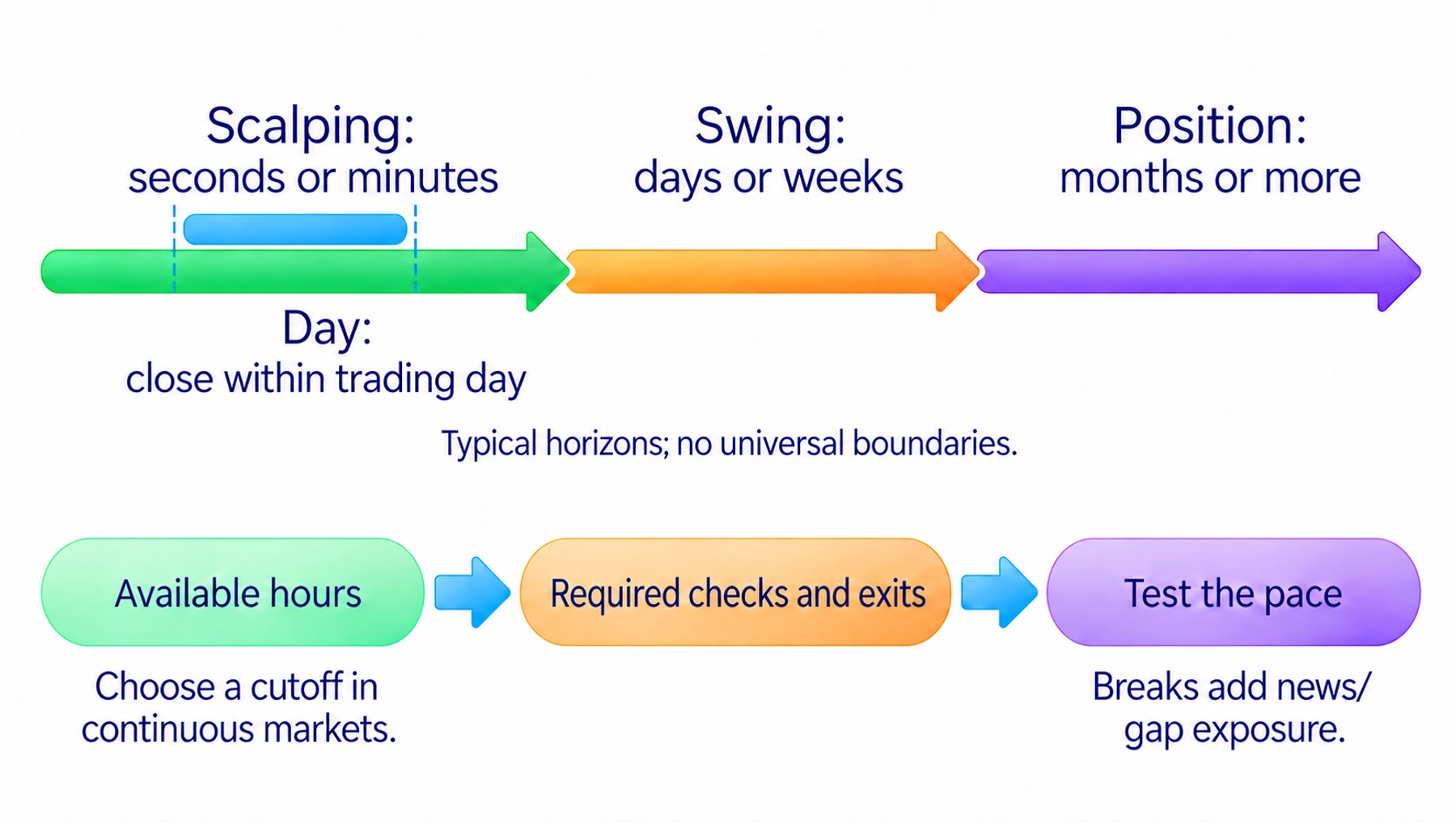
A trading style describes how long an open trade, or position, is usually held and how much attention that pace requires. Scalping seeks small, short-lived movements; day trading closes positions within a trading day; swing trading holds them for days or weeks; position trading uses a longer horizon. Choosing a style changes your schedule, costs and the risk from news while holding. It does not supply a profitable trading system.
Start with the hours you can actually observe the market. A trade that needs a response within seconds cannot be managed by checking the chart after work. A position held for several days needs rules for news and price changes between your checks. Choose a practice schedule in which you can perform the required actions, rather than the style that sounds fastest.
What Is Scalping?
Scalping targets small price movements with short holding periods, often seconds or minutes. It usually involves repeated trades during a session, but there is no fixed number that every scalper must make. A one-minute chart alone does not make a trade a scalp; the entry, intended movement and exit rules determine the task.
Small targets make execution costs important. The difference between buying and selling prices, commissions and an unexpected fill price can take a large share of a small gain. A trade that looks profitable before those costs may leave little or nothing afterward. Making more trades repeats the costs rather than removing them.
You need to watch quotes and the open position during the period your rules require. A connection failure or delayed decision can matter relative to the small movement you are trying to capture. A limit order sets a price boundary but may fill only partly or not at all. The need to exit quickly does not guarantee the price you want.
What Is Day Trading?
Day trading means opening and closing positions within the same trading day. Scalping can be a short form of day trading, while another intraday trade may last several hours. Neither the number of entries nor a particular chart interval defines all day trading.
Closing a position before a market break removes the effect of the next opening on that closed position. It does not remove risk while you are still holding it: news, trading halts, connection problems and sudden price changes can make an exit difficult. A gap is a jump between available prices, without trades at every intermediate price. Such jumps are not confined to overnight openings.
In a market with defined sessions, you can tie the end of your trading day to the session's close. A continuously traded market, such as crypto, needs your own cutoff time. Set that rule before entering. Watching short candles does not make a position intraday if you keep it after the planned cutoff.
This style needs available time when your entry and exit conditions occur. A day with no suitable entry is not a problem to solve by making an unplanned trade. More decisions mean more records to check and more chances to depart from the rules, even when the market has not offered a better opportunity.
What Is Swing Trading?
Swing trading seeks a movement lasting longer than one session, with positions commonly held for several days or weeks. The trade may follow a trend or a movement within a range. The name describes the holding horizon, not a single method of finding an entry.
Fewer decisions do not mean no monitoring. Decide when you will check the position and what requires action between checks. A platform alert can notify you of a condition; it does not close a position unless you have separately arranged an order or execution system to do that. Make sure the protection you expect actually exists.
If the market closes while you hold the position, news can change its next available price. An opening beyond your protective stop, an order intended to exit an unfavorable move, can produce a larger loss than planned. A stop does not guarantee its execution price. Continuous trading does not remove abrupt moves, interruptions or difficult execution either.
Allowing an ordinary pullback is different from waiting for every loss to recover. A pullback moves against the larger movement you are following. Your rules must distinguish a fluctuation you planned to tolerate from a change that invalidates the trade. A slower style is not permission to abandon the exit. The risk-management guide explains how an entry, protective exit and quantity determine planned risk.
What Is Position Trading?
Position trading holds a trade for a longer movement, often months or more. There is no universal calendar boundary separating it from a swing trade. The important distinction is the intended horizon and the conditions for leaving, rather than an exact number of days.
Longer holding requires attention to changes in the asset and the terms of the position. Borrowed purchase money may incur interest; borrowing shares for a short sale, selling borrowed shares in anticipation of a decline, may incur fees. These costs can accumulate while the position remains open. A fully paid purchase without borrowing has different financing terms, so infrequent entries do not automatically mean low total costs.
A position trader can use price analysis, information about the asset or a combination. The style does not require holding indefinitely when the original reason has failed. Position trading and active investing can overlap in time and decision methods. Duration alone cannot describe the whole approach.
How Costs Affect a Short Trade
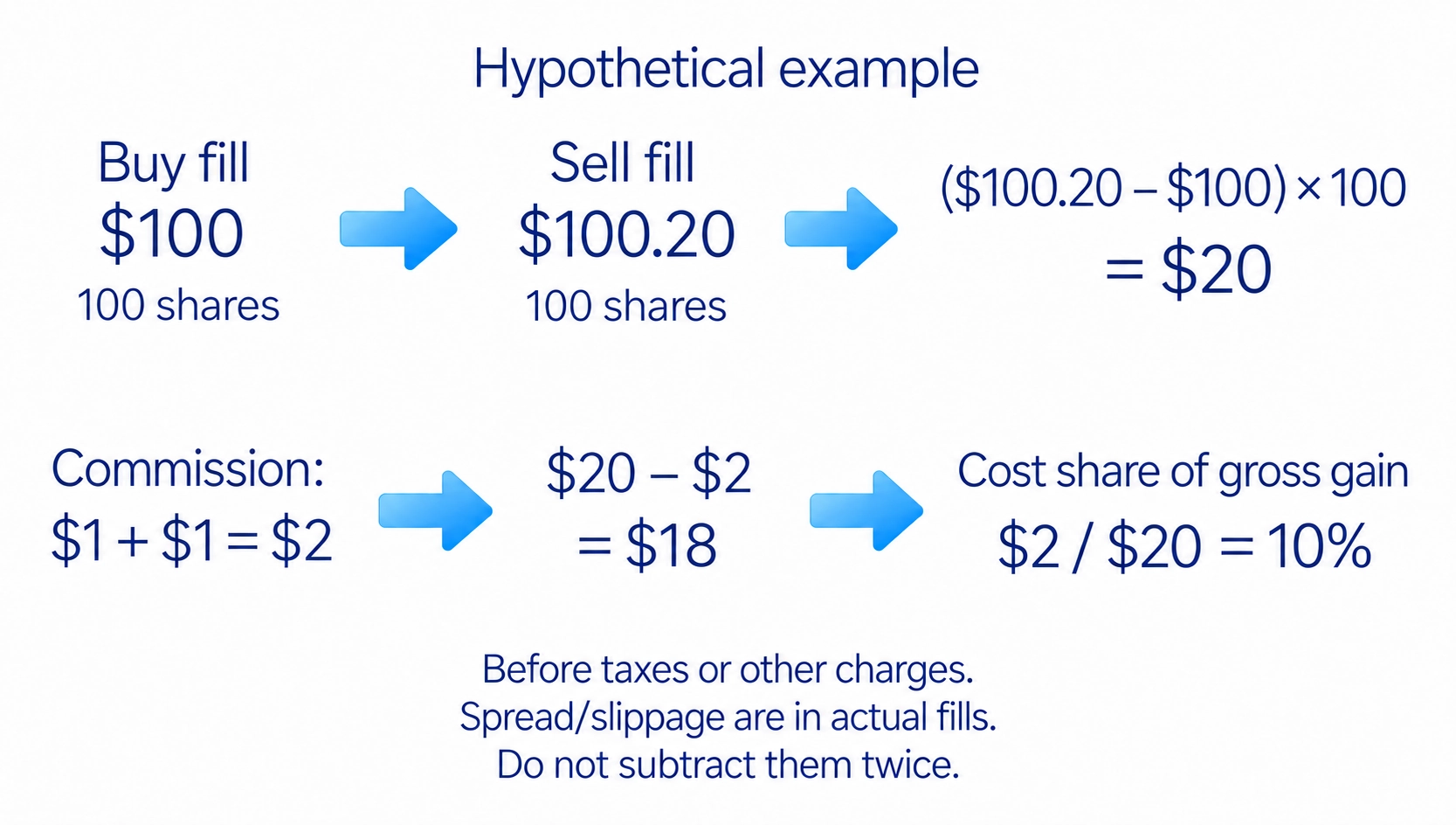
Commission is a fee charged under the broker's or venue's tariff. The spread is the difference between available buying and selling prices. Slippage is the difference between an expected fill price and the price actually received. Include their effect, but do not subtract the same price disadvantage twice.
Consider a hypothetical purchase of 100 shares filled at $100 each and a sale of all 100 at $100.20. The gain using actual fills is ($100.20 − $100) × 100 = $20. Suppose a separate commission is $1 for buying and $1 for selling. After those commissions, $18 remains, before taxes or other uncounted charges.
The $2 commission is 10% of the $20 gain before commission in this example. It is not a universal percentage for scalping. The same fee consumes a larger share when the gain is smaller. Spread and slippage have already affected the actual fill prices used here; subtracting them again would double-count that effect. A calculation starting from theoretical prices needs a separate adjustment instead.
In the optional scalping costs example, I compare the effect of the same assumed cost on a small and a larger movement. My criticism of a fast pace for beginners concerns that cost burden and the demands of execution. It does not establish that every scalper loses half the gain, that all short trading has negative expected results, or that every slower style is better. The calculation above is complete without watching the video.
Check the whole series, including losing trades: fees do not disappear after a bad decision. A zero purchase commission does not remove spreads, slippage or other applicable charges. For longer holding, add any financing costs required by the particular product and account. Compare what remains after the relevant costs, not merely the gross gain shown on a favorable trade.
Which Trading Style Should a Beginner Choose?
Choose a pace at which you can carry out the rules. Write down your available hours, how often the position needs checking and whether you can hold it through a market break. If work prevents you from managing a short trade, change the practice schedule instead of hoping the market will wait for you.
The trading-system section of my course uses a Euro futures chart to show a sequence: a change in the highs and lows, a return to the level and renewed upward movement. I wait for those conditions rather than accelerate the process to create more entries. The fifteen-minute chart in that example does not require every position to be closed within the day.
For a trial, set observation hours, entry and exit conditions, and any rule about carrying positions into the next session. Test whether you can follow them on a demo account using simulated money, and record the costs as well as the result. Repeatedly missing a required action is a concrete reason to change the pace. Simulated fills do not establish that a real order will receive the same price.
Do not rename an intraday trade a swing trade because you dislike closing its loss. That changes the holding rule after the result becomes uncomfortable. Decide beforehand whether carrying the position is allowed and under what conditions. If you break the plan, review the decision instead of changing its label.
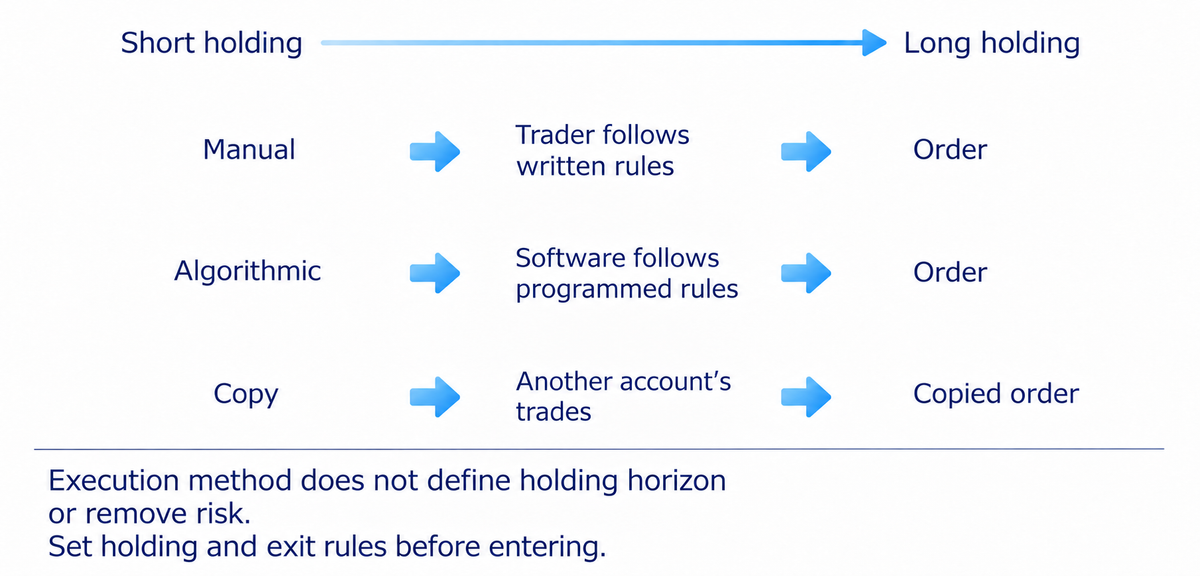
Position trading describes a long holding horizon, whereas algorithmic trading means software carries out trading rules. The second label describes execution rather than how long the position is held. It can be combined with position trading or another pace.
Copy trading also does not define a horizon or remove risk. For your own learning, trading for beginners gives the wider preparation route. The result of the style exercise is specific: either you can perform the plan at that pace with its costs, or you change the schedule and test again.
Frequently asked questions
Choose one that leaves time to perform the written rules and check costs. A slower pace does not guarantee safety; keeping a trade open can expose it to news between checks. Start by testing whether your practice schedule fits the required decisions.
Scalping targets small movements with short holding periods. Day trading closes trades within the trading day and can include scalping. The number of entries alone does not define either style.
It keeps a trade open for several days or weeks to seek a price movement. You still need monitoring and exit rules. News and jumps between available prices can affect a trade held through a market closure.
When a trade's gain is small, costs can take a large proportion of it. Costs accumulate on losing trades too. Calculate the actual cost share using your fees and execution prices rather than assume it is half for every scalper.
A position closed before a market break is no longer exposed to the next opening. While it remains open, news, halts and unfavorable execution can still cause losses.
Position trading uses a longer holding horizon, often months or more, without a universal boundary from swing trading. It can overlap with active investing. The analysis and exit conditions matter more than the label alone.
About the author
Igor Arapov, a practicing trader since 2013 and author of the ArapovTrade library. ORCID: 0009-0003-0430-778X.




