Copy trading uses a service to repeat another trader’s transactions in an account allocated to copying. You choose the trader and the amount to allocate, but the trader then makes the decisions that generate the copied orders. You take on the risk of those decisions as well as the risks of execution on your own account.
Before connecting, answer three questions: how will the service calculate the size of each copied trade, what does the trader’s history actually show, and what happens when you stop copying? A high return in a ranking answers none of them. Your result can differ from the trader’s because of settings, costs and the way orders are filled.
How Does Copy Trading Work?
You select a trader, allocate funds and authorise the copying rules. When the trader opens, changes or closes a position (an open trade), the service generates the corresponding instruction for your account. Some services copy only future trades. Others also open positions matching the trader’s existing portfolio when you join. Check which actions you are authorising before confirming.
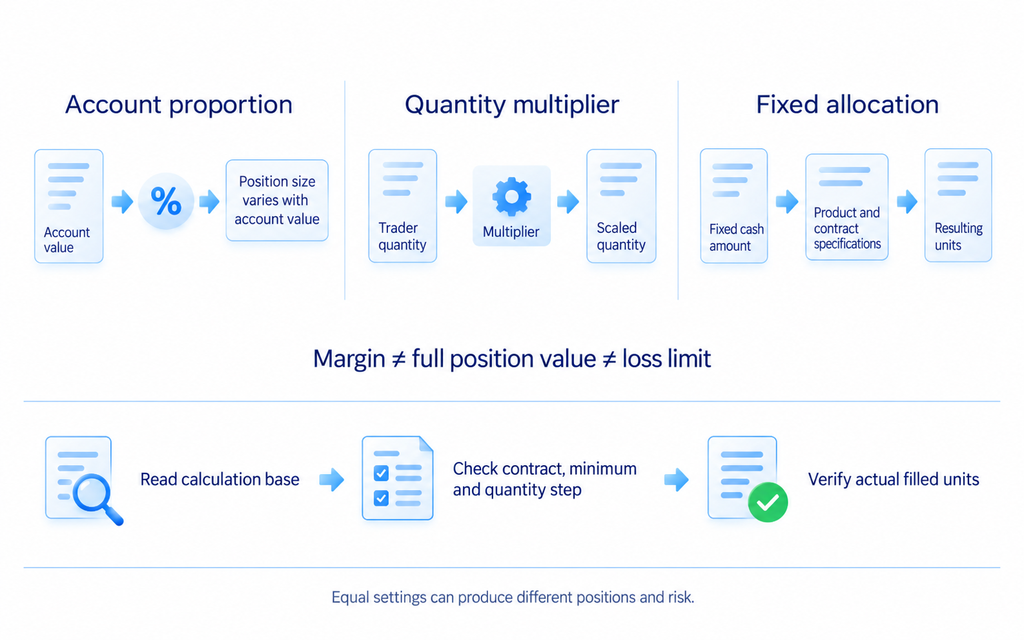
Position size is not calculated the same way everywhere. A service may copy a proportion of account value, use a multiplier of the trader’s quantity or allocate a fixed amount to each trade. With leverage, which allows a larger position than the funds put up, a setting may specify margin: funds required to support the position, rather than its full value. Equal amounts in two settings therefore need not create equal positions or equal potential losses.
Check whether copying includes new entries, additions, closures and changes to protective orders, which are orders intended to close a trade when a chosen price condition is met. Establish whether you can adjust or reject those actions yourself. Some synchronisation modes keep your account aligned with the trader and can reopen a position you closed manually. Do not assume that manual intervention will remain in effect without checking the mode’s rules.
A message you assess and enter manually differs from automatically copied orders. A social platform can provide discussion and performance statistics without placing any trades. Judge what the service does, not whether its marketing calls it social, mirror or copy trading.
Also identify the contracting company and where the money is held. A copying service may operate within a broker’s or exchange’s account or connect to a separate order executor. Choosing a trader does not replace checking the broker and trading platform. An offer to repeat trades does not establish how you can withdraw funds or what protection applies.
How to Assess a Trader’s Track Record
Start with the full available history, including the period used to calculate each return. Inspect current positions and changes in quantity. A short successful period may coincide with favourable market conditions. A longer history provides more information about different conditions, but does not promise future profits.
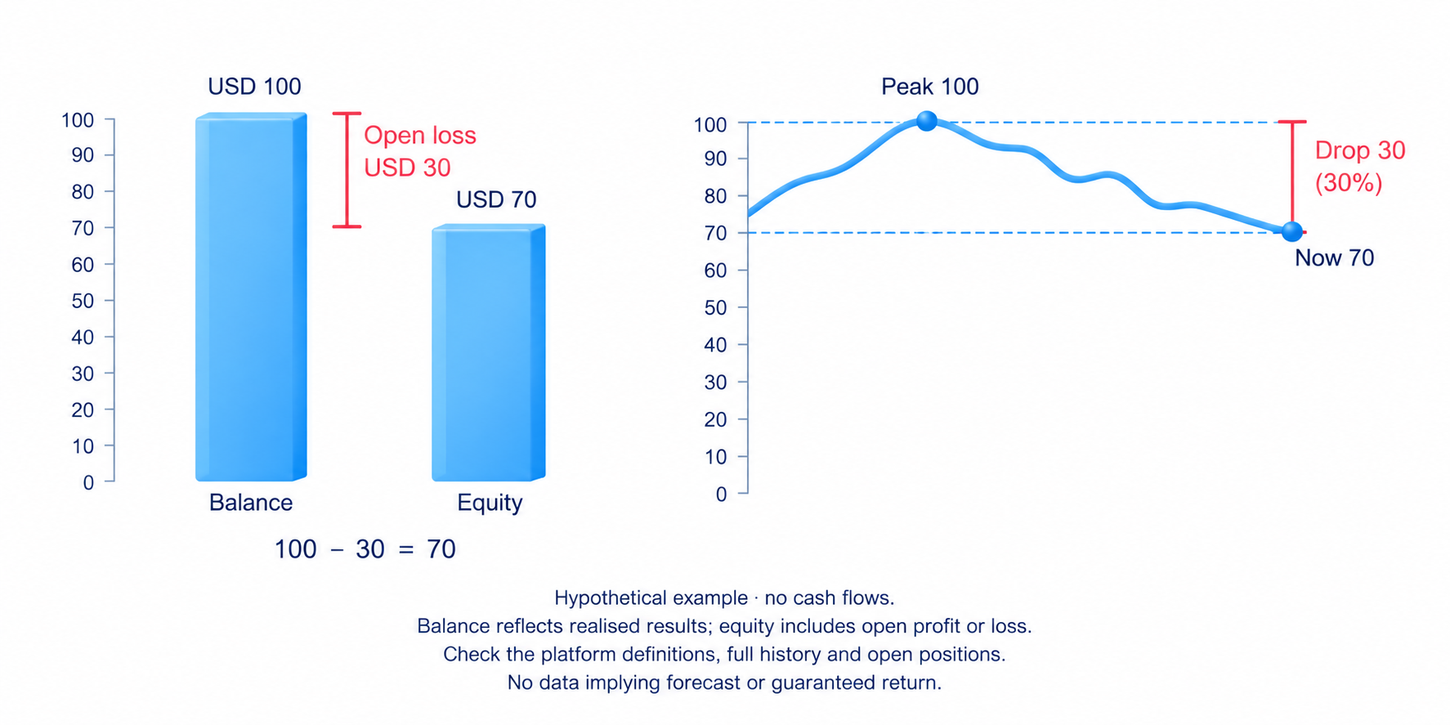
Check whether the displayed result includes the current gain or loss on open positions. Where a service reports a trading balance based on realised results, equity also reflects open-position gains or losses. Check the service’s definitions of both measures. An account can show many profitable closures while holding a large unrealised loss. Review both measures when the service provides them.
Drawdown is a decline from an account-value high to a subsequent low over the measured period. Read the platform’s definition: does it use balance, equity or whichever gives the larger decline? Does it cover the full history or only a monitoring window, and how are deposits and withdrawals treated? Identical metric names do not make figures from different services directly comparable.
Look at what the trader does after a loss. Do they limit it or add to a position as price moves against them? Repeated small wins can conceal an occasional much larger loss. If quantity increases after losses, understand averaging and martingale risks before selecting the strategy.
Review the instruments, leverage and usual holding time. A method requiring additional funds to keep positions open may not be reproducible on your account. Find out how the trader is paid, such as a share of profits, payments linked to followers or trading activity. The payment arrangement can create an incentive that differs from your aim of controlling losses.
Hidden history, unclear open risk or unexplained rule changes leave gaps in the evidence. Follower numbers do not fill those gaps. If you copy several traders, compare their actual positions: simultaneous trades in the same market can increase combined risk instead of spreading it.
Separate the trader’s decisions from execution on your account. They can choose an oversized position, add after losses or leave a loss without an exit rule. Your copied order can arrive later, fill at another price or fill only partly. A leveraged account also has margin requirements and rules for forced closure. Past profits do not remove any of these risks.
Why Can Your Result Differ from the Trader’s?
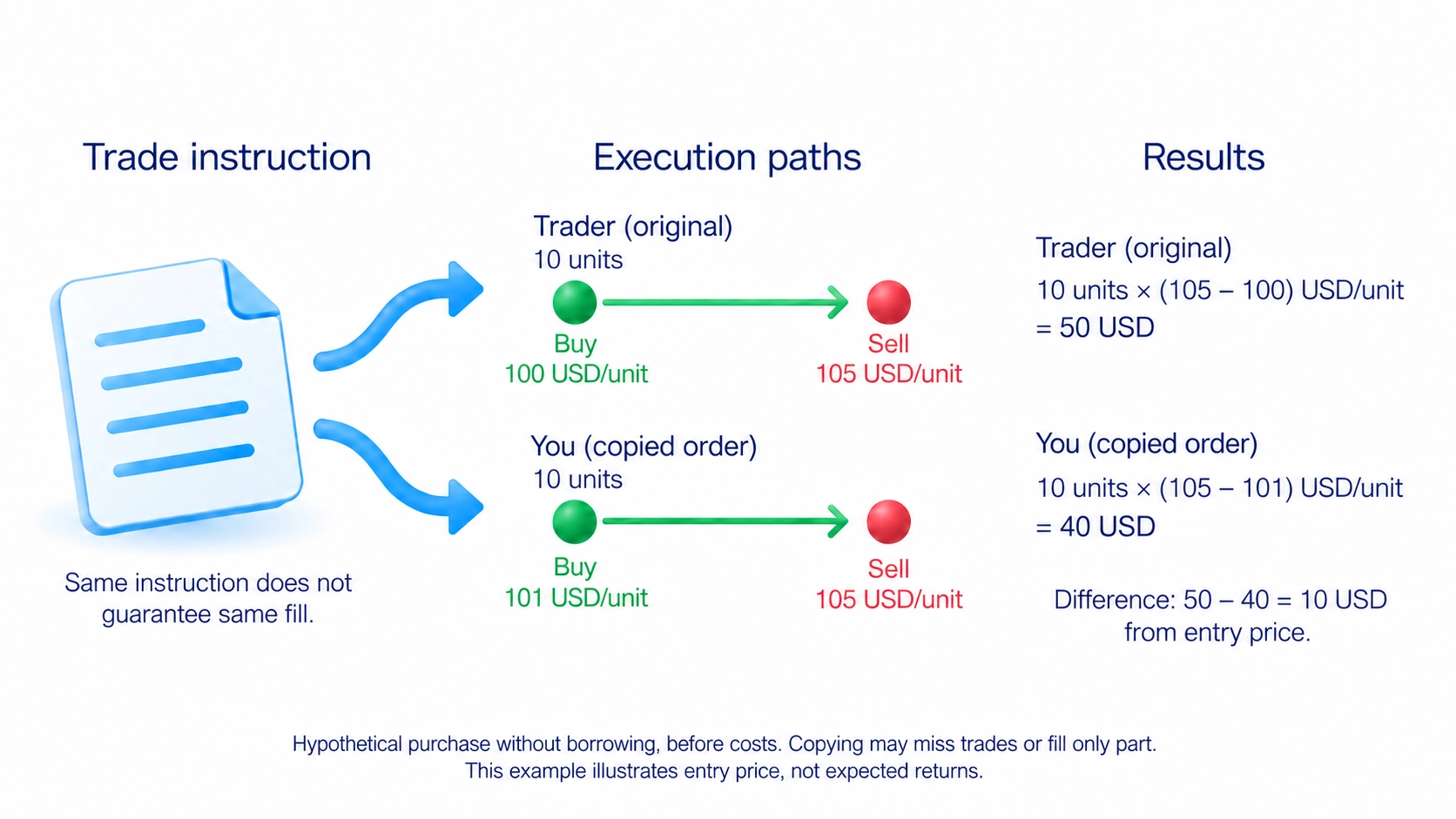
Copying an instruction does not guarantee the same fill price. Price can change between the original trade and yours. Slippage means execution at a price different from the expected or requested price; the difference can help or hurt the result. Rapid movement or insufficient quantity available at the quoted price can make it substantial.
Consider a hypothetical purchase without borrowing. The trader buys at $100, while your order fills at $101. You buy 10 units and later sell all 10 at $105.
Your result before costs is 10 × ($105 − $101) = $40. With the same quantity bought at $100, it would be $50. This shows the effect of entry price, not the return you should expect from a copying service.
An order may fail to copy because of insufficient funds, minimum quantity, an instrument unavailable on your account or a price-difference limit. Partial fills and missed additions can also leave your positions different from the trader’s. Continuing to copy does not necessarily correct that difference. Check the actual positions and any failure messages.
Costs can include commissions, the bid-ask spread, holding charges, a subscription and payments to the copied trader. The spread is the difference between quoted buying and selling prices. Establish which costs are already included in the published results. Compare the same period after a comparable set of expenses, rather than one account’s gross figure with another’s net result.
For leveraged positions, different entry prices, funds supporting the position and missed orders can change the point at which the account is forced to close it. A follower can lose a position that the original trader still holds. Copying the same strategy name does not give both accounts the same ability to withstand an adverse price move.
How to Set Limits and Stop Copying
Before connecting, decide how much to allocate, what new positions you permit and what would make you stop. Read the definition of every control. A field may specify position value, margin, a loss percentage for one position or a decline in the total value allocated to copying. A number has no useful meaning until its calculation base is known.
A limit on new orders generally restricts additional trading; it does not by itself close existing positions. A control that sends closing orders when total losses reach a threshold has a different purpose. The final loss can differ from the threshold because of price gaps, available trading quantity, charges and the service’s calculation. A technical limit is not a guarantee of an exact maximum loss under all conditions.
Distinguish pause, stop and close. A pause may prevent new entries while continuing to copy changes and exits for existing positions. Stopping can leave the assets for you to manage or send orders to sell them, depending on the mode chosen. Read what happens to both existing positions and protective orders before confirming.
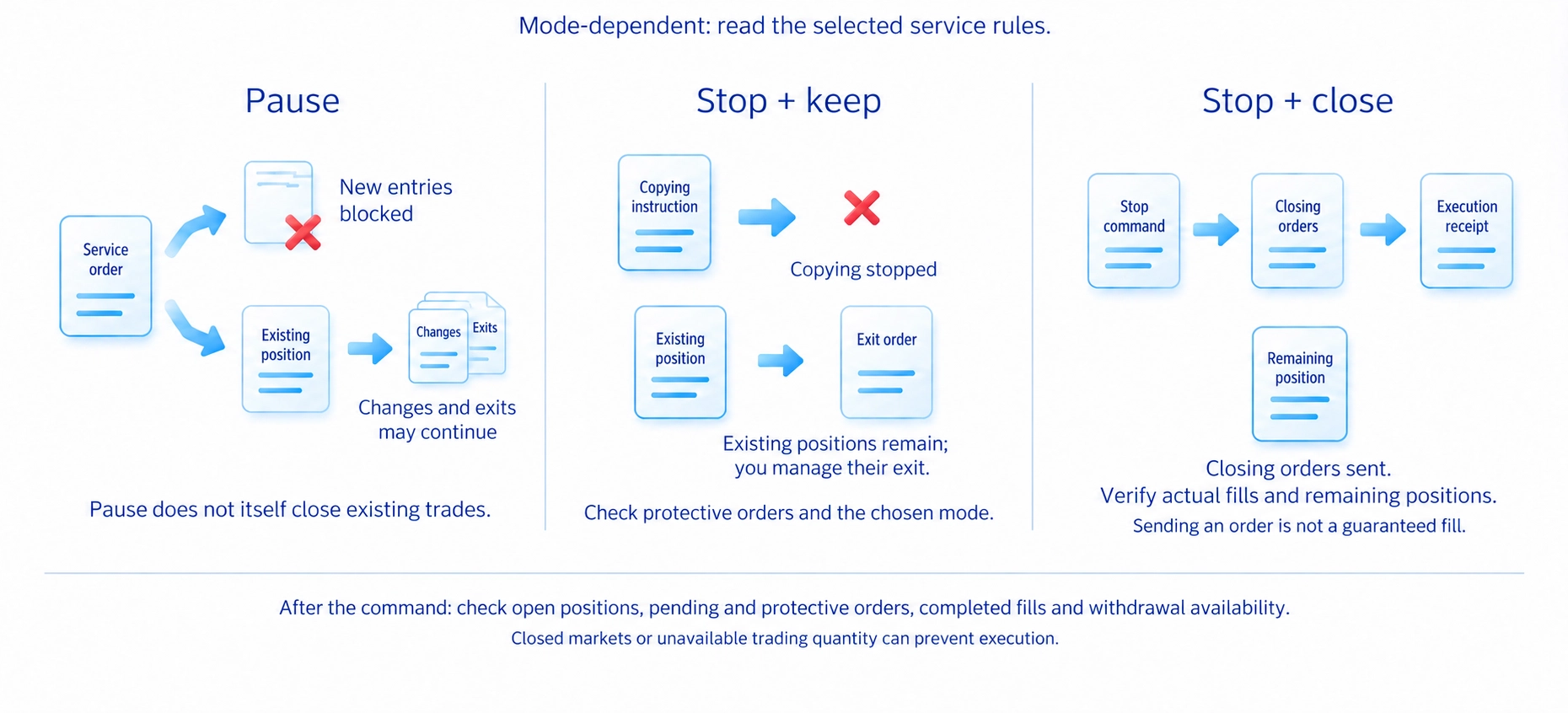
After the command, inspect its result. Are positions or pending orders left? Have all requested sales filled? Are any funds still unavailable for withdrawal? A closed market or unavailable trading quantity is not removed by pressing a button. If positions are kept, managing the subsequent exit becomes your responsibility under the account’s rules.
Monitor changes in the conditions that justified your original selection: more leverage, unfamiliar instruments, additions to losing positions or abandoned limits. Reconsider the connection when those conditions no longer apply. Notifications can help you notice a change, but delayed delivery is possible and they do not replace checking the account.
Does Copy Trading Replace Learning?
Automation removes the need to enter each copied instruction manually. It does not explain why the trade was opened or what would make it invalid. Watching can help you learn when the rules are visible and you analyse the decisions. Repetition alone does not develop an independent method.
My free trading course follows a different route: understanding the market and the system’s rules, practising independently on a demo account using virtual money and reviewing recorded trades. It is not a method for selecting a trader to copy. The preparation helps you understand a position and its risk even if a service later sends its orders.
The demonstration of demo-account practice is an optional practical addition. The beginner learning route explains the written steps. Learning to apply your own rules and authorising someone else’s decisions are different tasks; decide which one you are trying to accomplish.
Before joining, record what is copied, how quantity is calculated, what costs arise and what stopping does. Afterwards, compare those conditions with actual positions. If you cannot explain a loss or an increase in the size of positions, investigate the cause before adding money to try to recover it.
Frequently asked questions
It is a service that repeats a selected trader’s transactions in your account, usually through automatic orders. The quantity calculation and actions copied depend on the platform. Copying takes on the risks of the trader’s decisions and your own execution.
Check the full available history, open losses, trade quantities and actions after losses. Read the definitions of performance measures and copying controls. A high return or many followers alone does not establish an acceptable risk for you.
No. They describe a previous period. Market conditions, the trader’s behaviour and your order execution can change. Your result also depends on costs and settings.
Your orders can fill at different prices, miss trades or create different quantities. Trading costs and copying payments also affect the result. Compare actual open trades and results over the same period after costs.
Not necessarily. A pause may leave existing open trades following the trader, while another stopping option may keep assets for you to manage. Read the selected mode and check open trades, planned exit orders and the actual result of the command.
About the author
Igor Arapov, a practising trader since 2013 and author of the ArapovTrade library. ORCID: 0009-0003-0430-778X.




