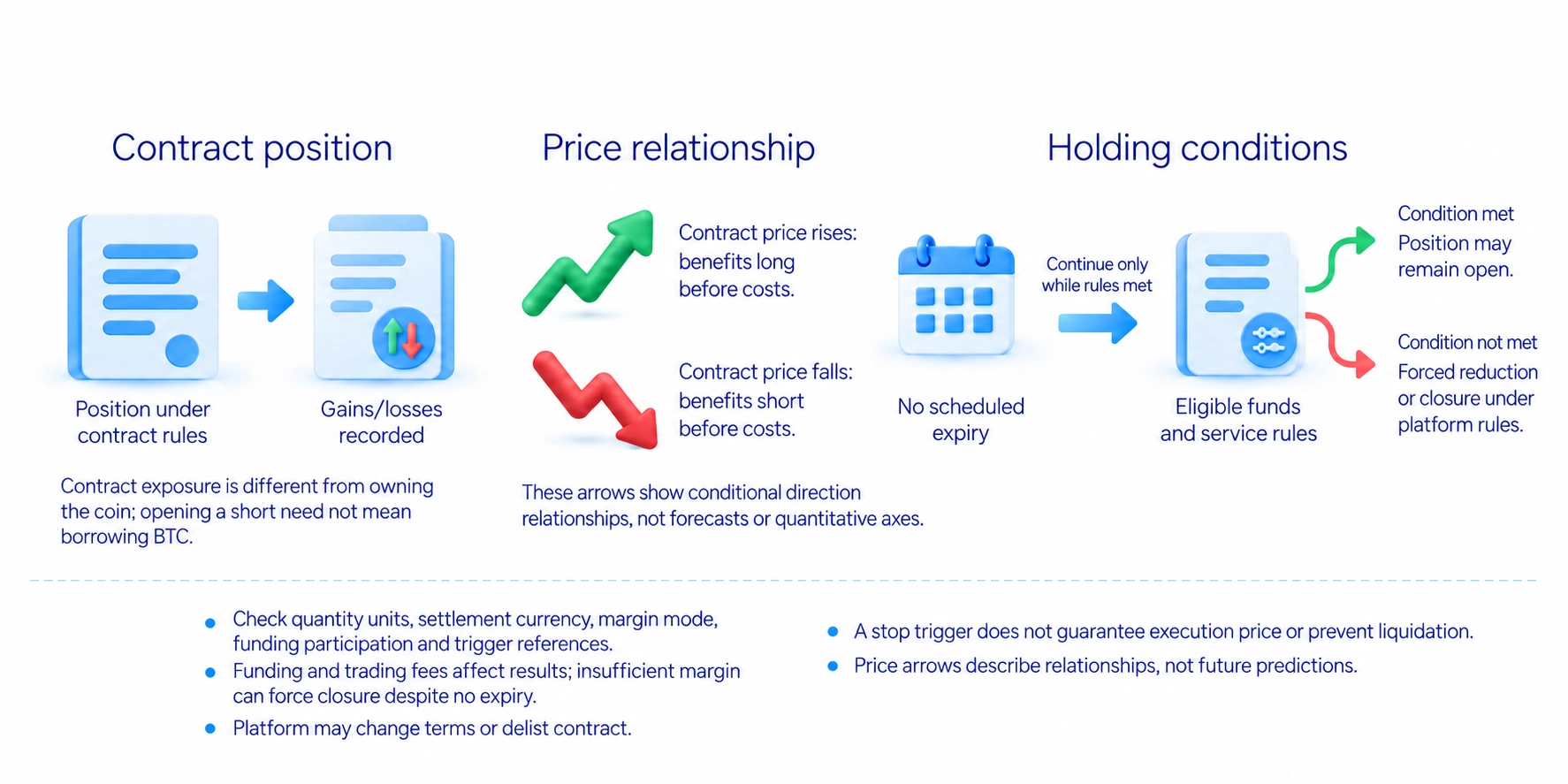
A perpetual futures contract lets you trade changes in a cryptocurrency’s price without a scheduled expiry date. Buying the contract does not give you ownership of the corresponding Bitcoin or other coin. You hold a position, an open trade whose gains and losses depend on the contract’s price. The exchange requires funds to support that position, and its rules and trading costs affect the result.
How a perpetual contract works
A long position gains when the contract price rises; a short position gains when it falls, before costs. The account records the changing value of the open trade. Opening a short perpetual does not necessarily mean borrowing Bitcoin and selling it. You are trading a contract, so check the contract’s rules rather than assuming the mechanics of a coin loan.
Unlike a dated future, a perpetual has no scheduled expiry. That does not mean you can keep the trade open regardless of your account’s condition. Insufficient funds can lead to forced closure. A platform may also change its service terms or stop listing a contract. Spot and futures explains the difference between buying an asset and holding a contract linked to its price.
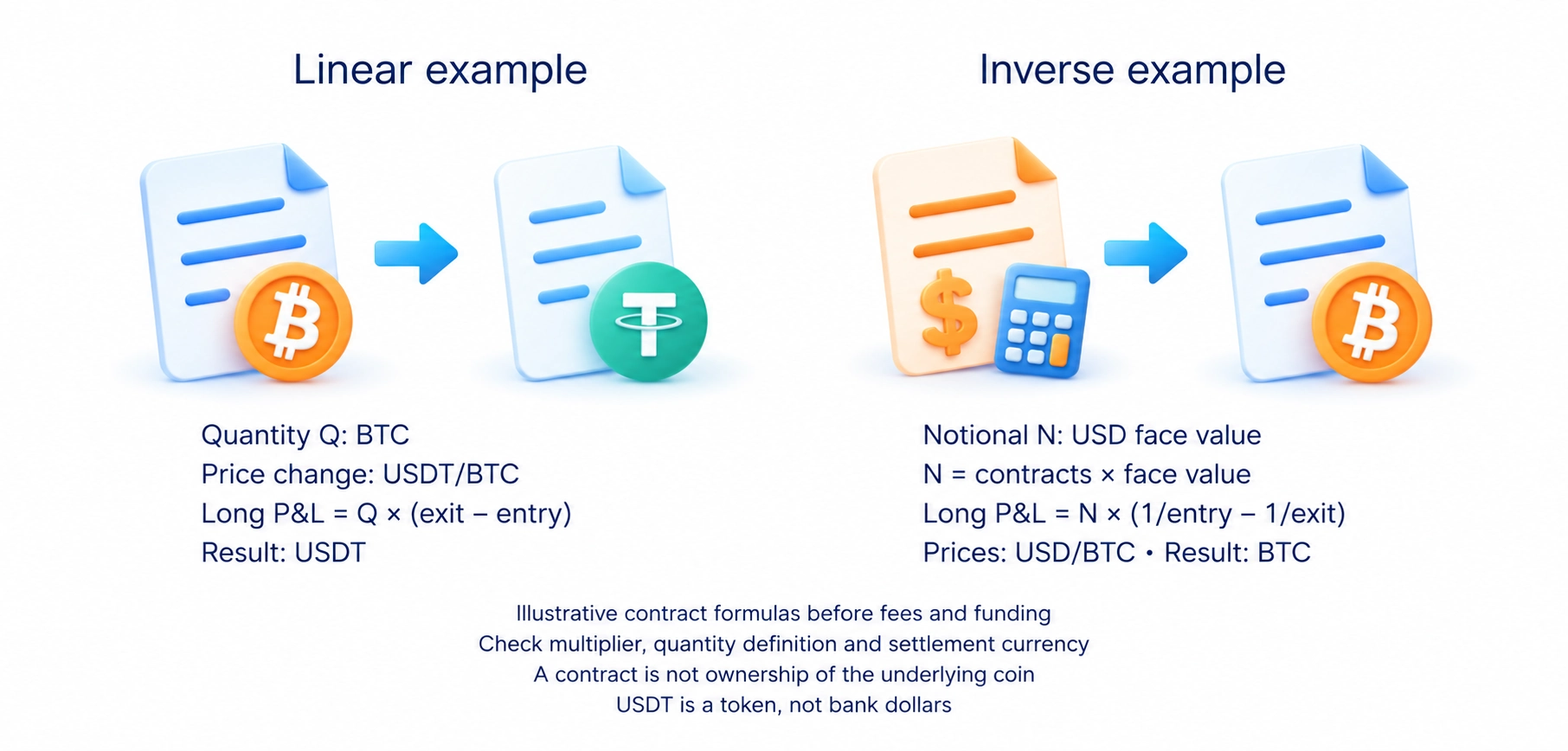
Before entering, check the contract specifications: what the order quantity measures, which assets can support it, and which currency receives its profit or loss. A linear BTCUSDT contract may express the quantity in BTC and settle the result in USDT. USDT is a token designed to track the US dollar; it is not dollars deposited in a bank account. Cryptocurrency basics explains the underlying asset and network concepts.
Some contracts use a different calculation. An inverse contract may quote its size as a number of dollar-denominated contracts but settle the result in Bitcoin, using a formula based on reciprocal prices. Do not apply the linear price-difference formula to it. The dollar value of Bitcoin used to support the trade can also change. Check the contract multiplier, the value assigned to each contract, and the settlement currency.
Funding: who pays and when
Funding is a scheduled payment between holders of long and short perpetual positions. The mechanism helps keep the contract price close to a reference price for the asset. With a positive rate, longs generally pay shorts; with a negative rate, shorts pay longs. Funding is different from the platform’s trading fee, and it does not guarantee that contract and reference prices will always match.
The payment depends on the position’s value and the rate at the calculation time. For a linear contract, position value is commonly the quantity of the underlying coin multiplied by the mark price, the platform’s reference for valuing that position. The rate applies to the whole position value, not just the funds initially committed to open it.
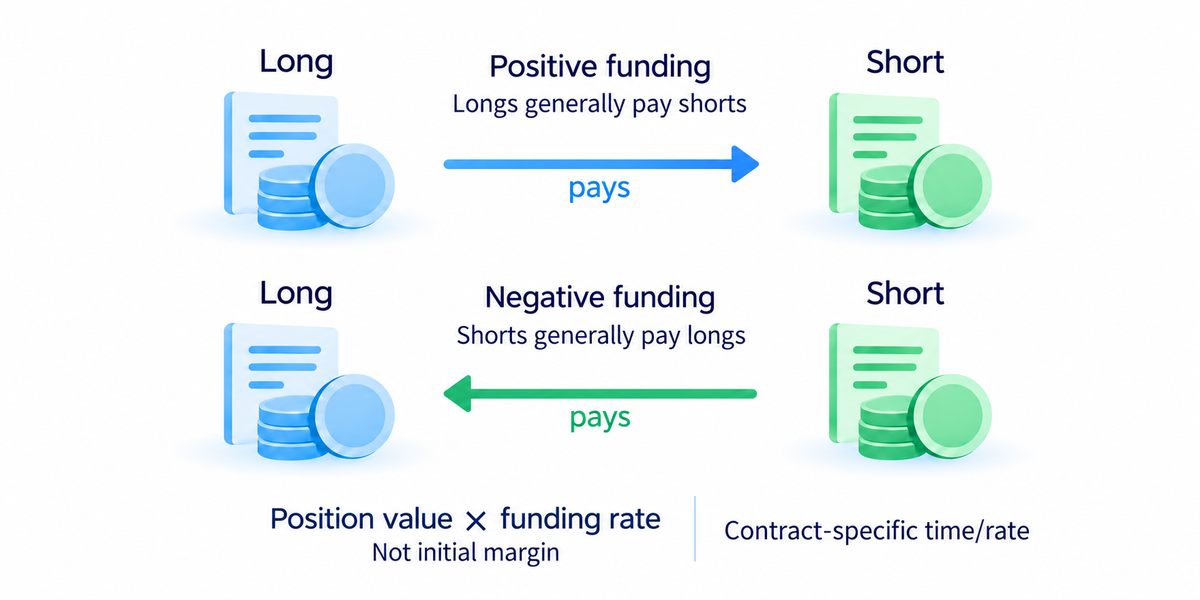
Check the schedule for that particular contract and whether your position participates at the calculation time. Funding is not always charged every eight hours: intervals can differ or change. A displayed estimate may also change before settlement. Read the next payment time and the final-rate rules rather than treating an earlier estimate as a fixed cost.
Receiving funding does not make a trade risk-free. An adverse price move can outweigh the payment, and the rate can switch direction. If a payment is deducted from funds supporting the position, it can leave less room before forced closure. Assess the payment together with price risk and other costs, rather than as guaranteed income.
Margin and leverage: funds required for the position
Margin is the funds or other eligible assets required to support a position. Initial margin is required when opening it; maintenance margin is the minimum requirement while it remains open. The exact requirements depend on the contract, account mode and position size. A larger position may enter a different requirement tier, so there is no single margin percentage for every instrument.
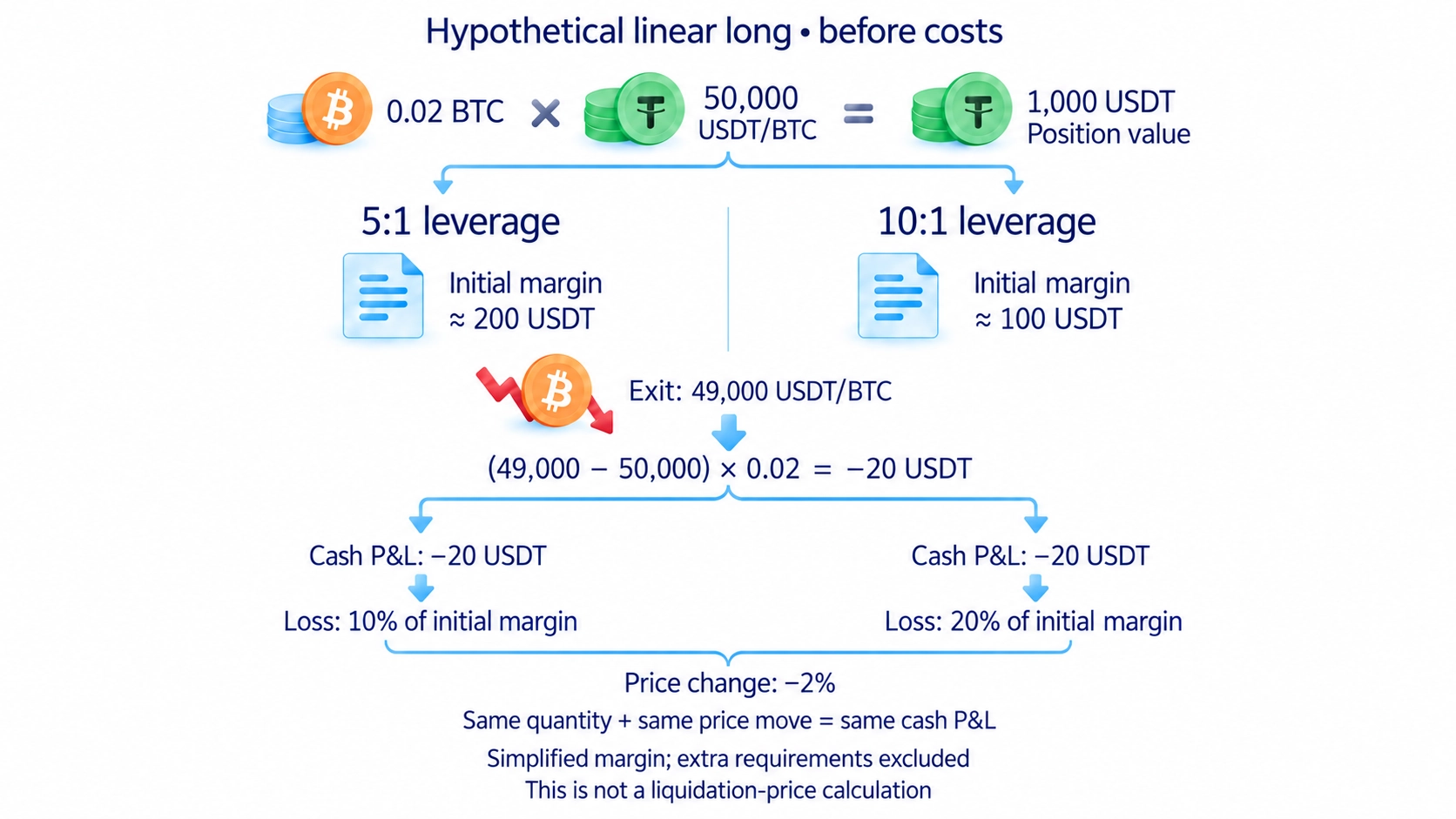
Leverage relates the position’s value to the initial margin required. With the same contract quantity, changing leverage does not multiply the money gained or lost from the same price move. Higher leverage reduces the initial funds required. If you commit only that smaller amount, there is less room for an adverse move, other things being equal. Monetary gains and losses become larger when you increase the position’s quantity.
Consider a hypothetical linear BTCUSDT long of 0.02 BTC entered at 50,000 USDT per BTC. Its entry value is 1,000 USDT. At 10:1 leverage, a simplified initial-margin calculation gives 100 USDT, assuming the reference price equals entry and excluding additional requirements and fees.
Closing at 49,000 USDT gives 0.02 × (49,000 − 50,000) = −20 USDT before costs. That is 20% of the initial margin for a 2% price fall. This calculation does not establish the liquidation price, which also depends on maintenance requirements and the account’s rules.
In isolated margin mode, funds are assigned to an individual position. An enabled automatic top-up feature can still transfer additional available funds to it. In cross margin mode, positions share eligible account funds under the service’s rules; a loss in one position can reduce the room available for others. Check which assets are included, whether automatic top-ups are enabled, and which other positions use those funds. The mode’s name alone does not establish your maximum possible loss.
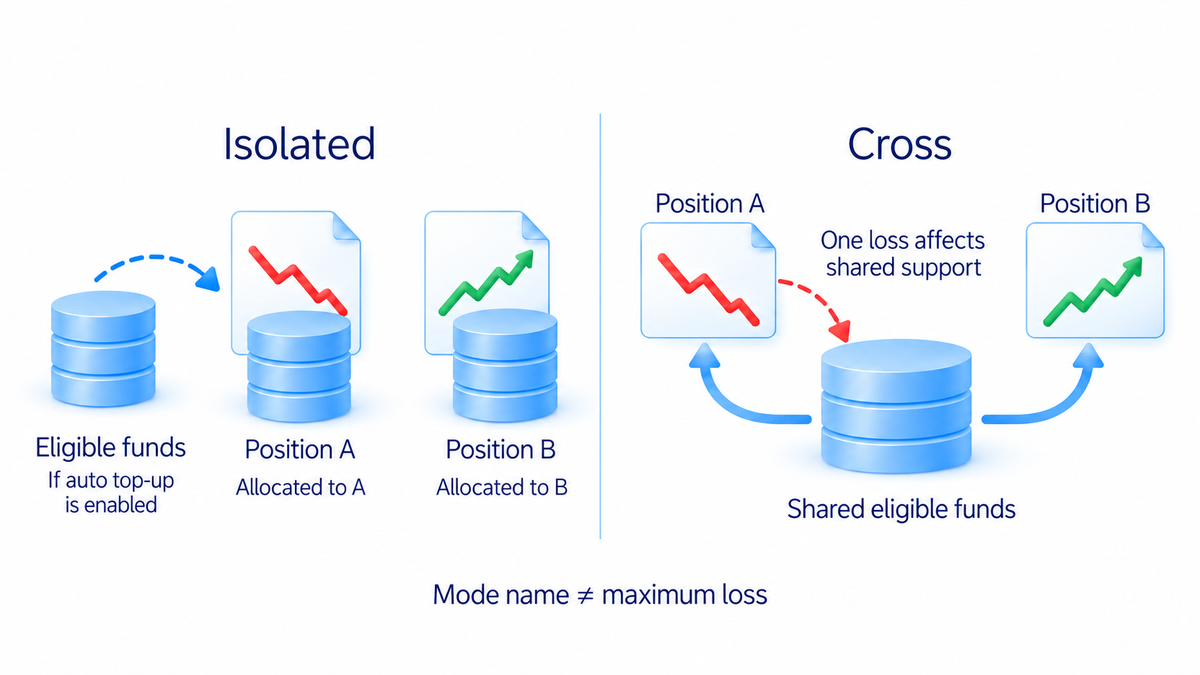
Initial margin is not the amount you plan to lose. First choose the planned exit and calculate the money lost if the trade closes there; then choose an appropriate quantity. A stop-loss is an order intended to close a trade when its specified price condition is reached. It helps implement the exit, but it does not guarantee the execution price. Fees, funding and a worse-than-planned fill can increase the final loss.
What causes liquidation
Liquidation is the platform’s forced reduction or closure of a position when the account no longer meets its margin requirements. Depending on the service and account mode, it may first cancel orders or reduce part of a position. Do not assume every liquidation immediately closes the whole trade through one transaction.
Last price, index price and mark price serve different purposes. Last price records the most recent contract trade. An index combines reference market data using the platform’s chosen sources and method. Mark price is used to value positions and assess margin; its formula may combine an index with an adjustment for the contract price. Check the actual index components, fallback methods and liquidation reference in the service’s documentation.
If liquidation uses mark price but your stop uses last price, forced closure can occur before the stop’s condition is reached. Check which price triggers the stop. Even using the same reference does not guarantee the fill price: after being triggered, the order still has to execute against available orders in the market.
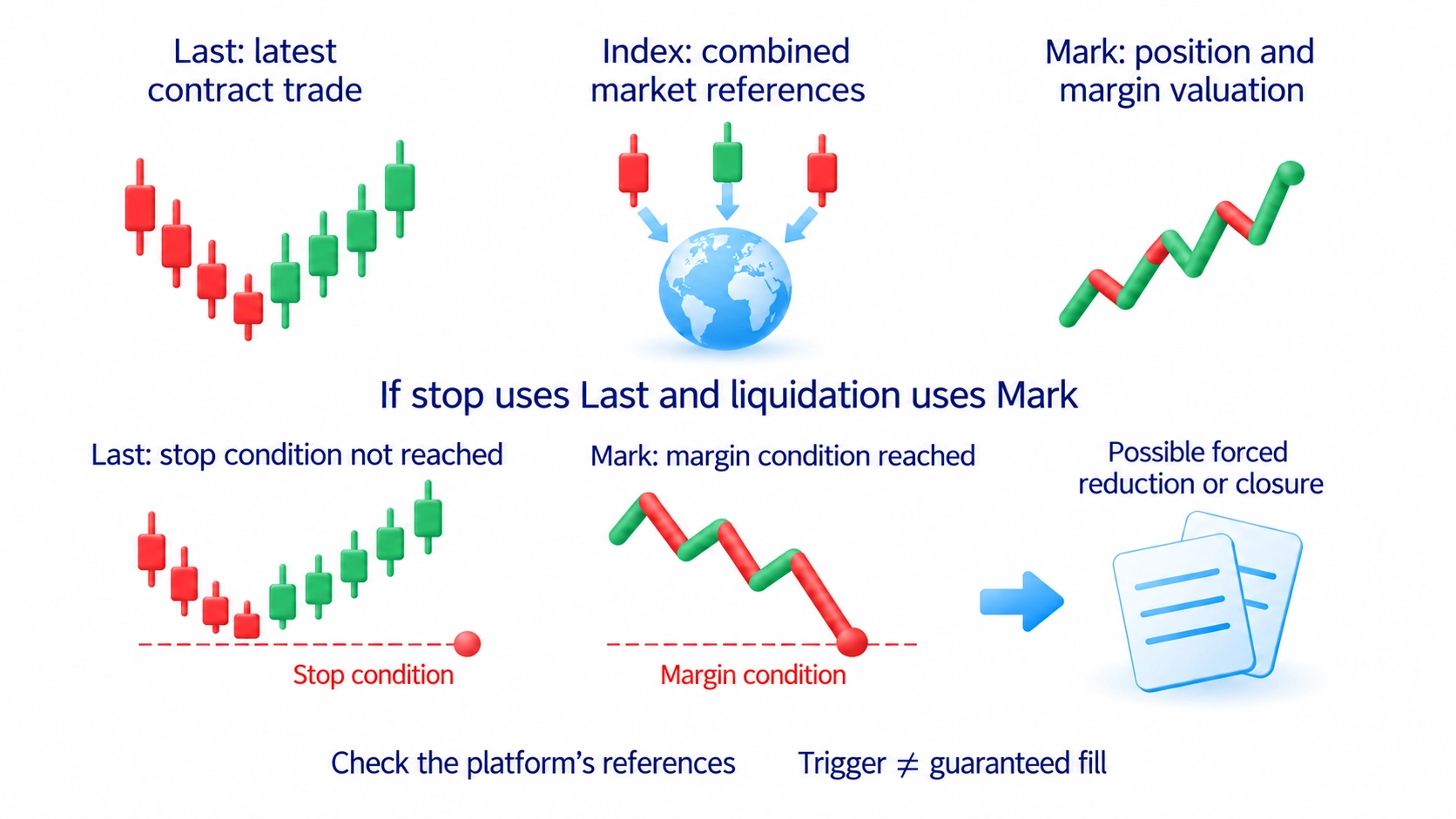
In cross margin, a displayed liquidation price may be an estimate rather than a fixed boundary. Other positions, payments and changes in the value of eligible assets can alter the account’s condition. The price that starts liquidation is also different from a guaranteed closing price. It need not equal the calculated point where all supporting funds would be exhausted.
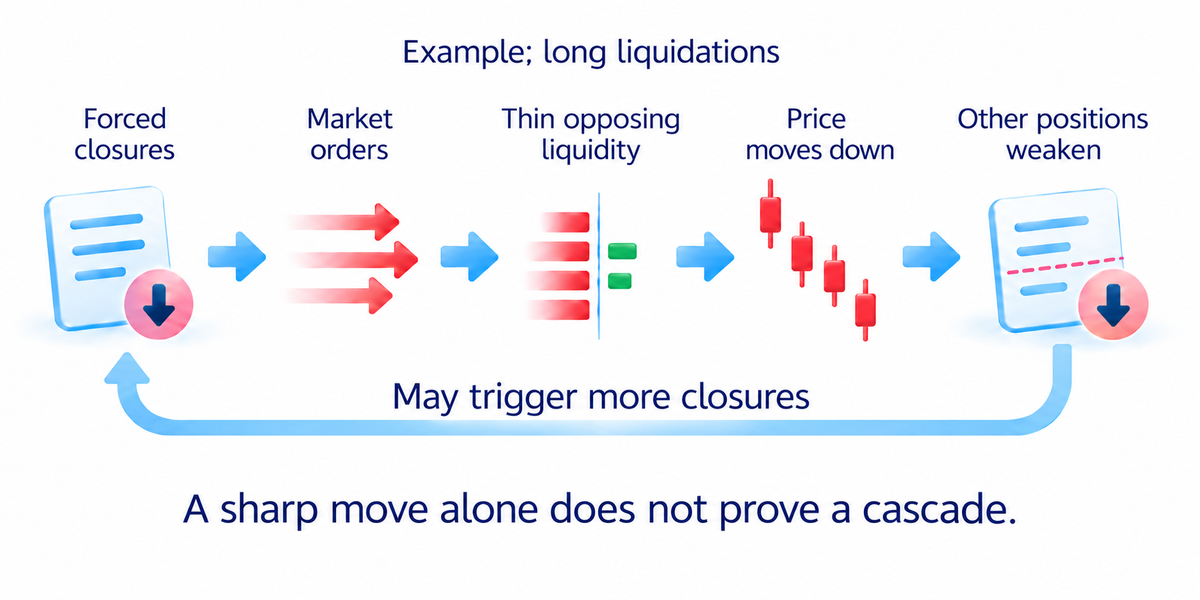
Forced closures can produce additional market orders. When little buying or selling quantity is available on the other side, those orders can move prices and weaken other positions, potentially triggering further closures. This is a liquidation cascade, but a sharp move alone does not prove that a cascade caused it. Order books and trade execution explains how available orders affect fills.
Checks before you enter
Before entering, record the settlement currency, contract size, quantity, margin mode and stop-trigger reference. Check the next funding calculation and the maintenance requirements. Calculate the planned loss at your chosen exit, allowing for costs and uncertain execution. If the units or account rules remain unclear, test an example order before increasing the quantity or leverage.
In my course, Position sizing connects the money risk, the distance to the planned stop and the value of an instrument’s price movement. The sequence matters here too: choose the risk first, then calculate the quantity. The crypto contract’s specifications must be checked separately; the course does not replace the platform’s rules.
The optional Leverage lesson explains how leverage permits trading a larger value and why I discourage beginners from using it before they understand risk. It is a general lesson, not a perpetual-futures strategy. On a demo account, which uses virtual funds, check the order quantity, the changing profit or loss and the exit settings. Then compare those settings with the actual contract’s rules.
Frequently asked questions
It has no scheduled expiry date, but the trade must retain the funds required by the platform and meet its service rules. Owning the contract is different from owning the cryptocurrency itself.
With a positive rate, holders of buying positions generally pay holders of positions opened for a fall; with a negative rate, payment runs the other way. The contract’s rate, trade value and participation at its scheduled calculation time determine the payment.
For the same contract quantity, the same price move produces the same monetary gain or loss before costs. Higher leverage reduces the required initial margin, the funds required to open it. Monetary price risk increases when you enlarge the position.
Liquidation and a stop can use different trigger prices. A triggered stop also does not guarantee execution at the intended price. Check the reference price, the order’s execution rules and the funds available to meet margin requirements.
It is a chain of forced reductions or closures in which new orders can move prices and trigger further closures. Whether this occurs depends on available orders and the platform’s liquidation process. A rapid price move alone is not proof of a cascade.
About the author
Igor Arapov, practising trader since 2013 and author of the ArapovTrade library. ORCID: 0009-0003-0430-778X.




