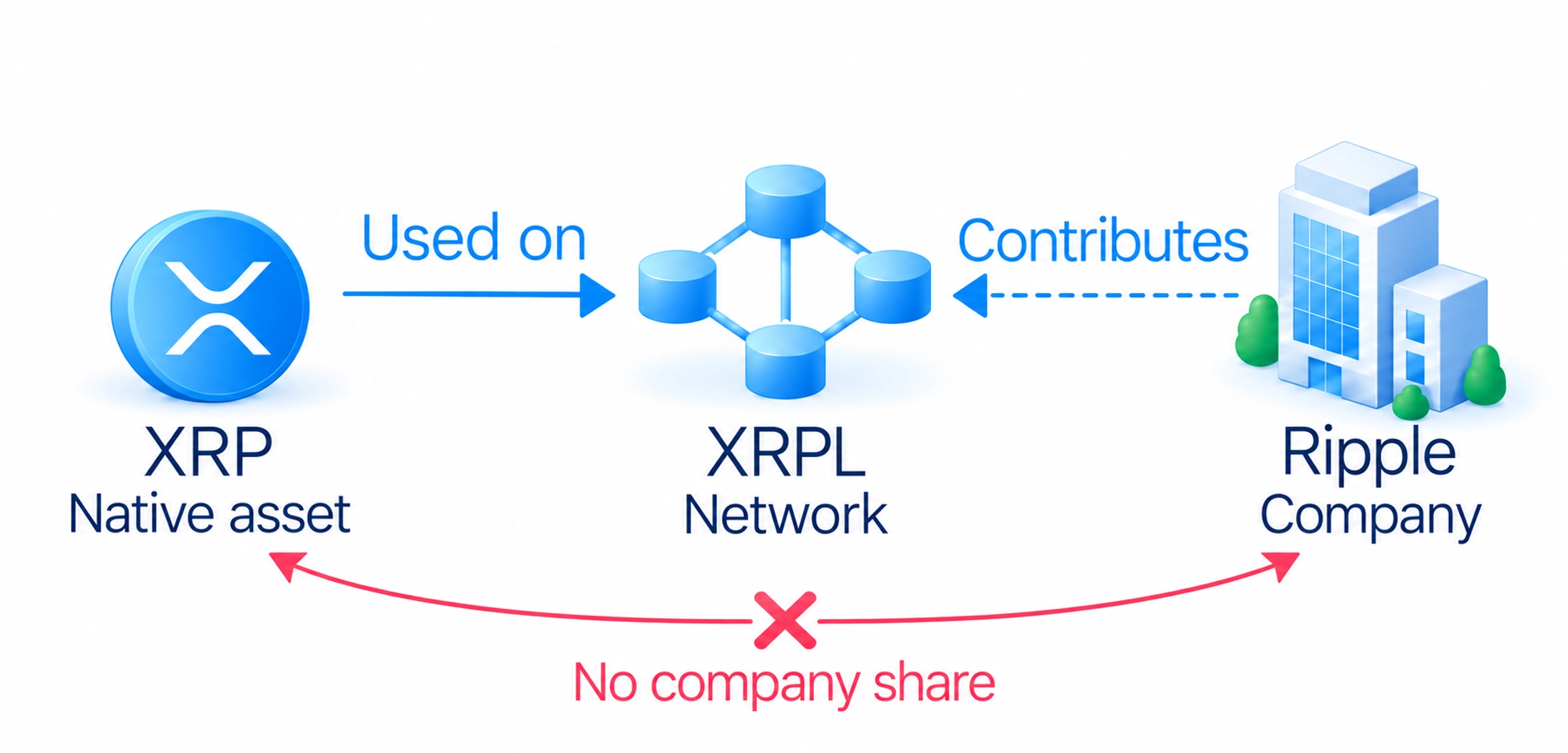
XRP is the native cryptocurrency of the XRP Ledger, usually shortened to XRPL. Ripple is a company that develops payment products and contributes to this network’s ecosystem. Buying XRP does not buy a share in Ripple or give you a claim on its profits. To assess the coin, separate what it is used for, how much is available and the prices at which people will trade it.
XRP, Ripple and Bitcoin
The XRP Ledger keeps a shared record of accounts and transactions. XRP can move between accounts, pay network transaction costs and meet account reserve requirements. Other participants can issue different tokens on the same network. A token does not become XRP simply because it uses XRPL.
The three names refer to different things: XRP is the asset, XRPL is the network and Ripple is the company. The ledger’s developers launched it before the company originally called OpenCoin was formed. Ripple holds XRP and builds payment products, but a company announcement is not a statement of the network’s rules.
At launch, 100 billion XRP were created. New XRP is not produced through mining as new Bitcoin is. Network transaction costs destroy small quantities of XRP, so the original issue and the remaining quantity need not stay equal. Cryptocurrency for beginners explains the wider differences between digital assets.
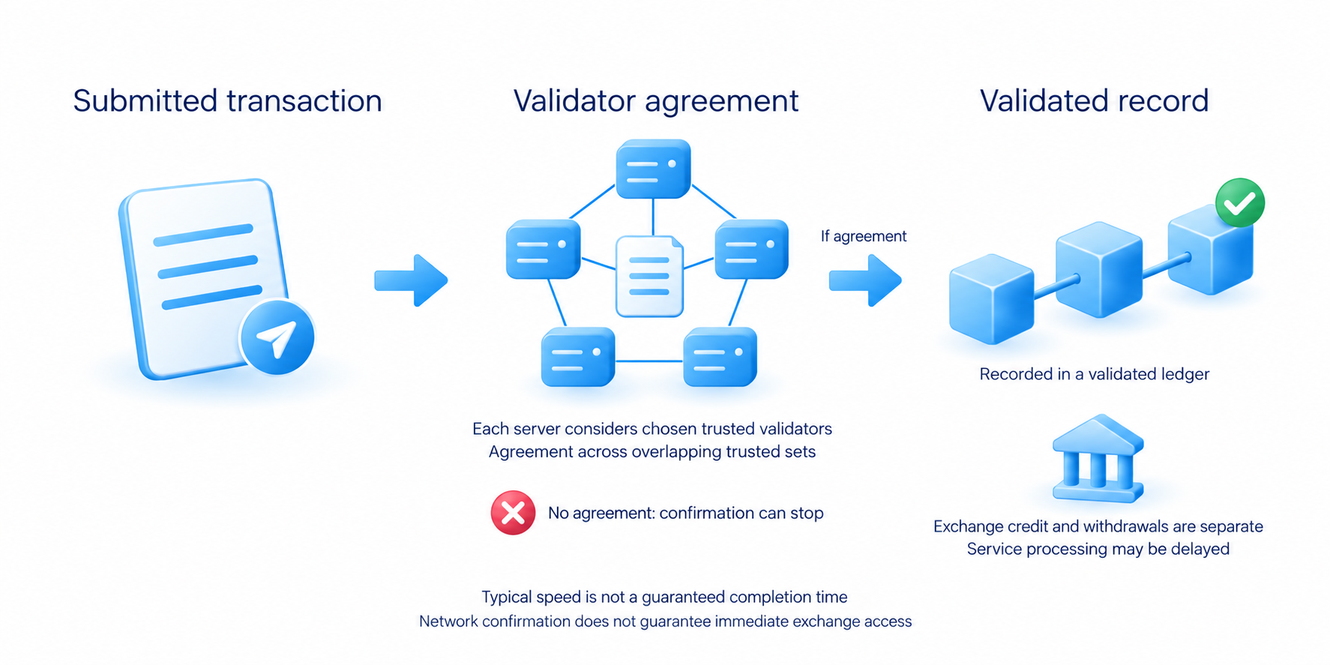
XRPL confirms its records through agreement among validators, servers participating in that process. Each server considers a chosen set of trusted validators. Enough overlap between these sets matters for agreement across the network. This differs from Bitcoin’s mining competition; it is not a payment of XRP to holders for staking their coins.
If participants cannot agree, confirmation of new transactions can stop. A fast typical transfer is therefore different from a guaranteed completion time under every condition. An exchange can also delay crediting a deposit or permitting a withdrawal after the network has confirmed the transaction.
What XRP is used for
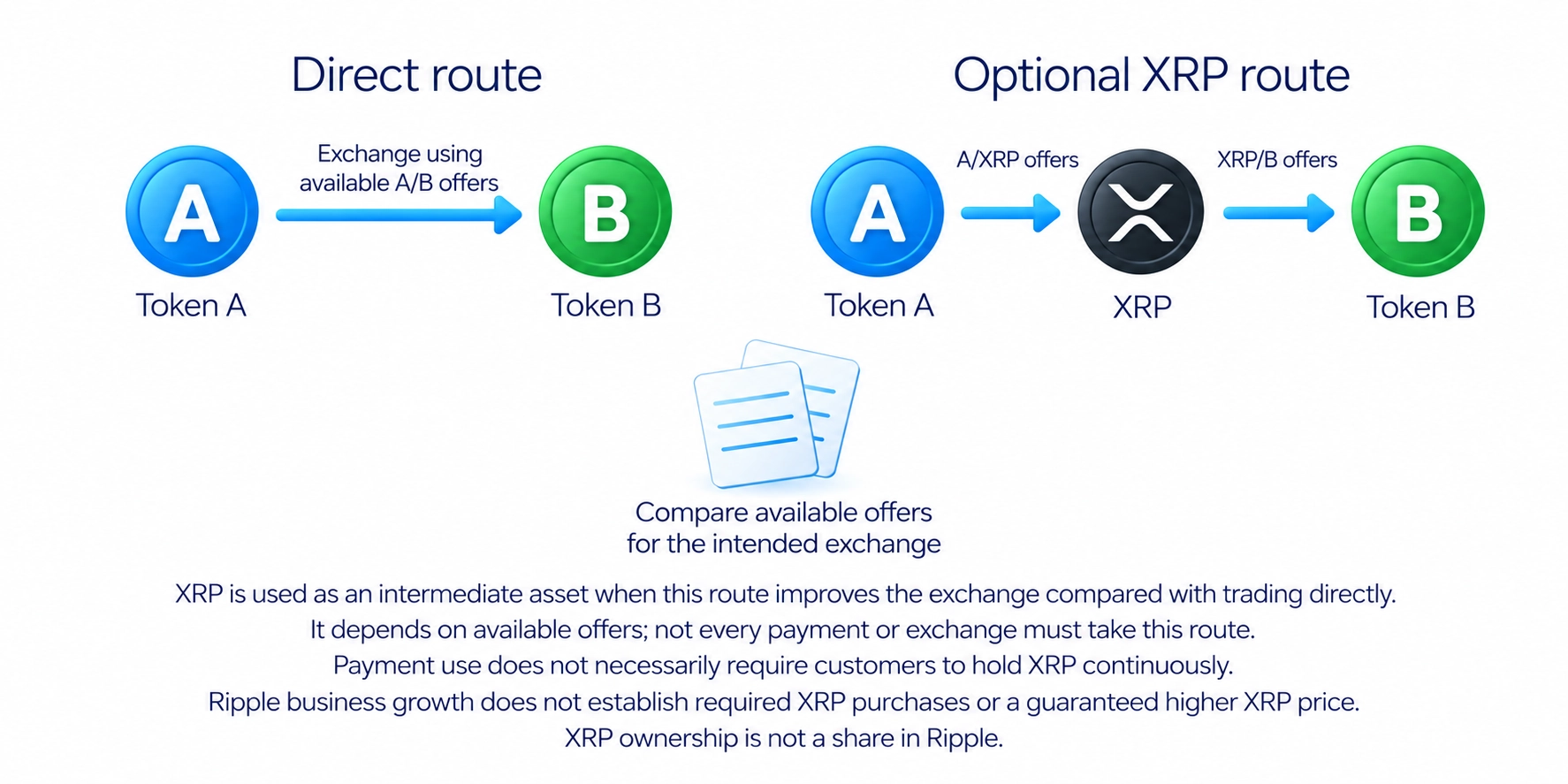
XRP can transfer value between XRPL accounts. It can also act as an intermediate asset when exchanging two other tokens: one is exchanged for XRP, then XRP for the other. This route depends on available offers and is used when it improves the exchange compared with trading directly. Not every payment or exchange has to use this route.
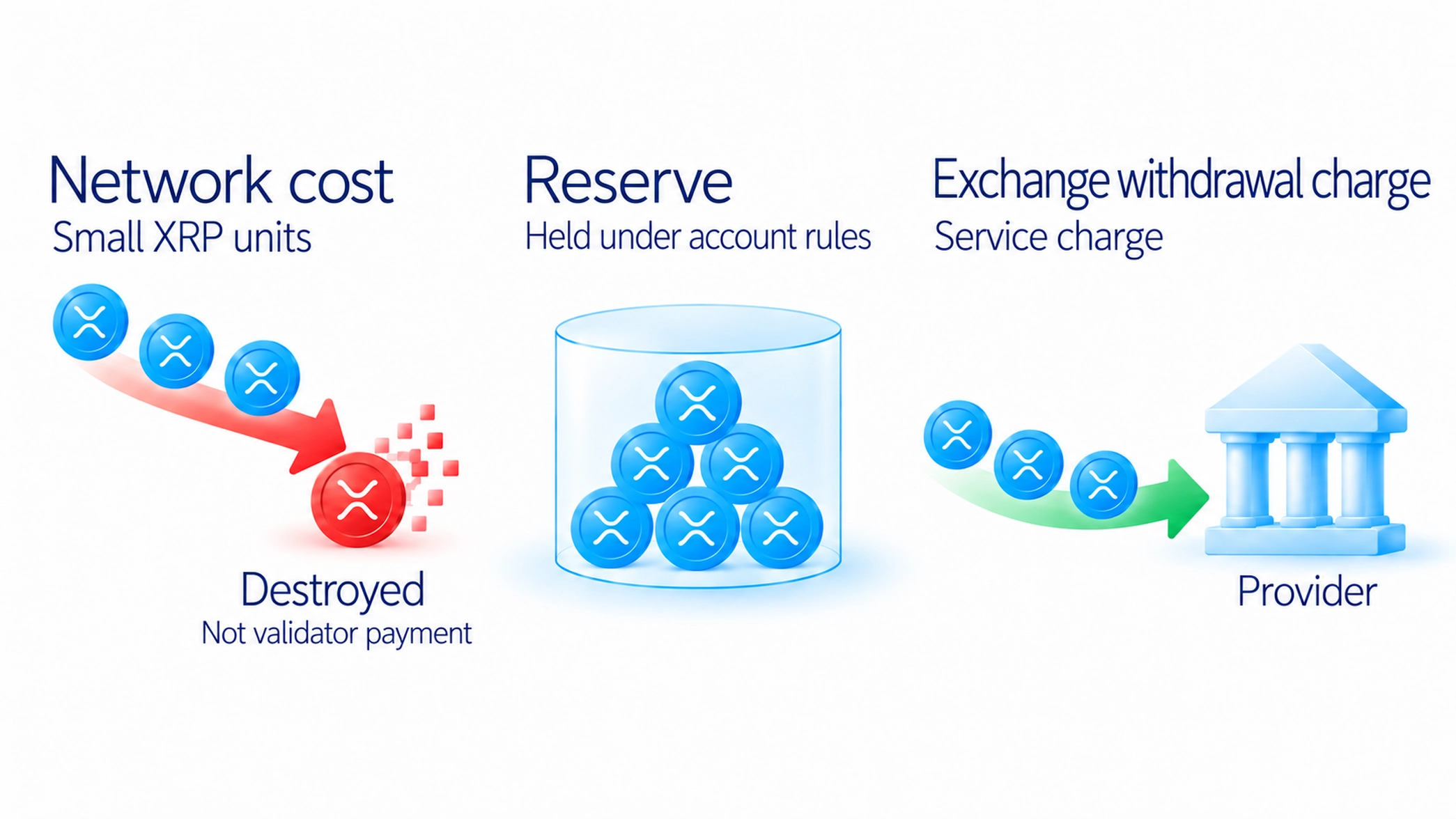
The sender specifies a transaction cost in XRP. This amount is destroyed rather than paid to validators. The required cost can vary with the transaction and network load. An exchange’s withdrawal charge is a separate service charge and need not equal the network cost.
An XRPL account also has a reserve requirement: a quantity of XRP that helps limit the resources used by accounts and their stored objects. Adding certain objects can increase that requirement. A reserve is not a burned transaction fee, and rules for using or releasing it differ. Before creating an account, check current network and wallet requirements rather than copying an old fixed amount.
A growing Ripple business does not establish growing purchases of XRP. A payment product may use ordinary currencies or stablecoins, tokens designed to track a reference such as the US dollar, while a route using XRP does not necessarily require a customer to hold it continuously. Check the product, the exact use of XRP and whether the operation requires buying the coin. A partnership headline alone does not answer those questions.
Even genuine payment use does not produce a simple formula for XRP’s market price. Coins can pass repeatedly between participants; payment volume is not the amount of fresh money invested in the asset. Buyers’ and sellers’ available orders determine the prices at which trades can take place. A useful payment technology and a profitable coin purchase are different outcomes.
XRP supply and locked coins
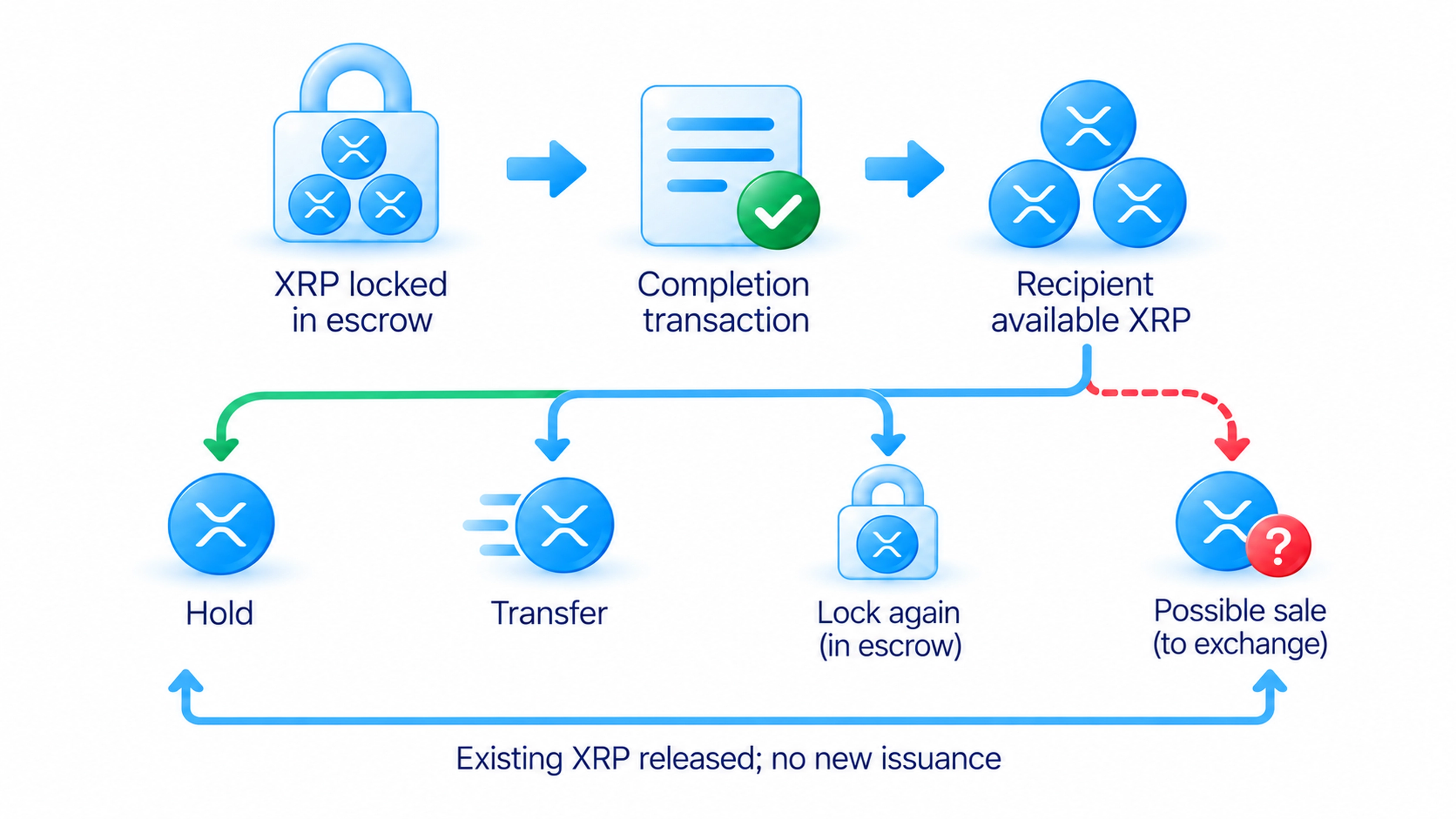
The original issue is different from the quantity available to trade. Some coins belong to large holders or sit in escrow, a mechanism that locks funds until specified conditions are met. The ledger entry sets the recipient and conditions for release. Releasing existing XRP does not create new XRP.
A release date does not mean every unlocked coin is automatically sold on an exchange. Completing an escrow requires a separate transaction. Its recipient can then hold, transfer or lock the funds again. Distinguish available coins, transfers and actual sales when evaluating supply. Tokenomics explains these distribution and release questions more broadly.
For a provider’s circulating-supply figure, check which accounts and locked funds it excludes and when its data was collected. Providers can treat large holders differently. A change in the displayed figure should not automatically be described as new issuance or a cash inflow.
Reading XRP price
Choose the pair and venue first, such as XRP/USD or XRP/USDT, where USDT is a token designed to track the US dollar. Check whether you are looking at the coin itself or a contract for trading its price changes. Different venues can display different prices and recorded trading quantities. Switching data sources can change a visible level or volume figure without any change to XRPL’s rules.
On the chart, identify the direction of movement, recent highs and lows and the reaction around a chosen area. A previous high is a reference to observe, not a compulsory destination. A round number is not a reliable level simply because it is easy to remember. The chart-reading guide explains how to mark and examine these areas.
My practical course’s priority-change-level chapter examines the movement’s structure and the price response around a marked area. It helps distinguish a structural change from a simple touch. This is a general chart-reading lesson, not a separate personal XRP strategy. A company announcement does not replace that price check.
Trading volume means the quantity traded in the selected venue or collection of sources. It need not include all XRP trading. A spike shows greater recorded activity, not who traded or what they intended. Compare it with price movement and check the data source; volume alone does not prove that banks bought XRP.
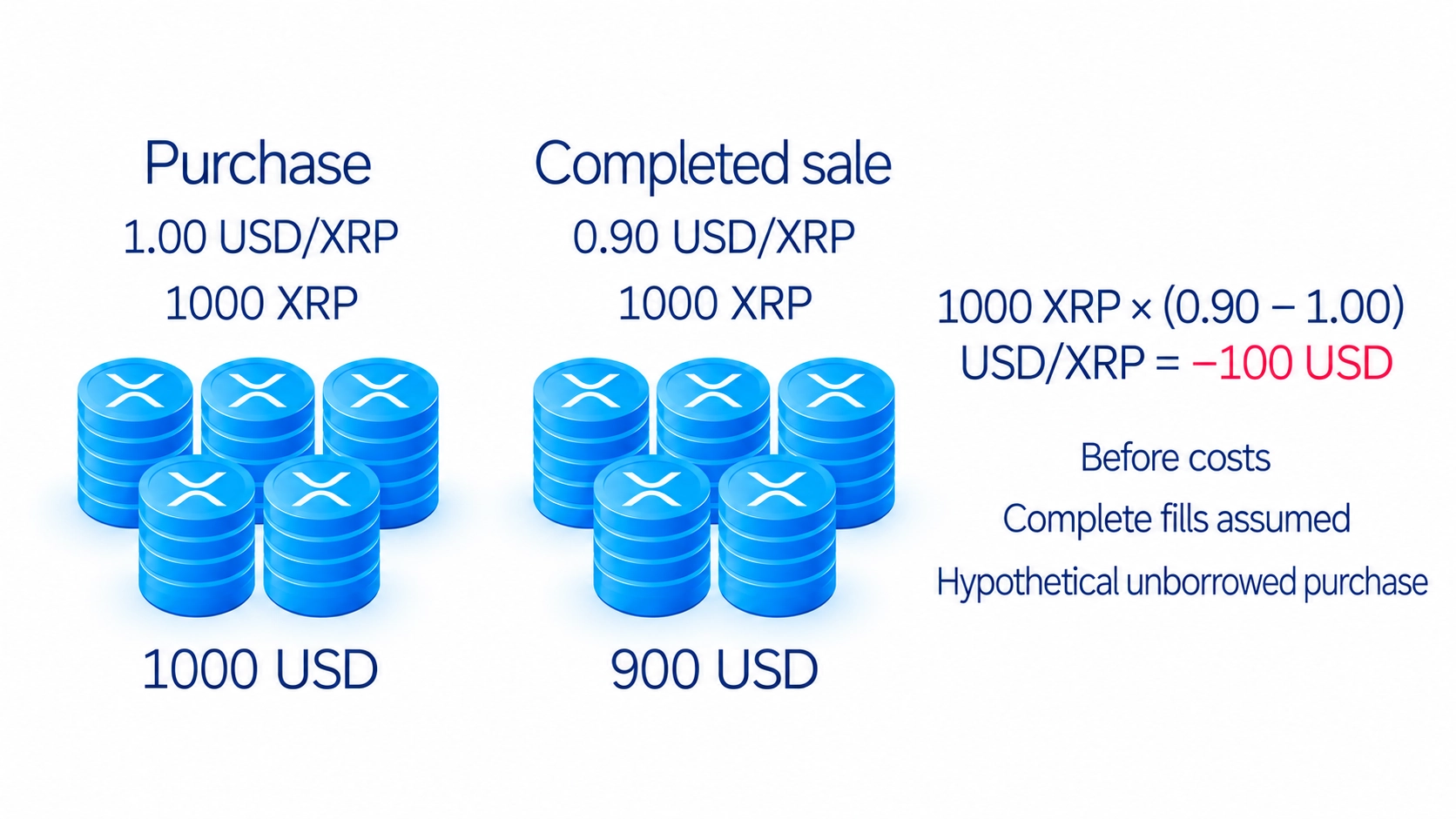
For one hypothetical unborrowed purchase, assume 1,000 XRP are bought at USD 1 each. Selling the entire quantity at USD 0.90 returns USD 900 and loses USD 100 before costs: 1,000 × (0.90 − 1) = −100 USD. Both trades are assumed to fill completely at those prices. The example does not prescribe an acceptable loss for every account.
Good news can already be reflected in participants’ expectations. After publication, buying at current prices may be insufficient to push price higher, or other events may change sellers’ decisions. No rise does not prove the news is useless, and a rise does not prove it had only one cause. Separate the announcement’s content from the market response you actually observe.
For legal news, check the document, jurisdiction, parties and type of transaction. A decision about particular sales or company obligations does not establish identical rules for every XRP holder in every country. Check whether it changes access to a venue, withdrawal rights or product terms. Fundamental analysis explains how to assess this wider context.
Before buying or transferring XRP
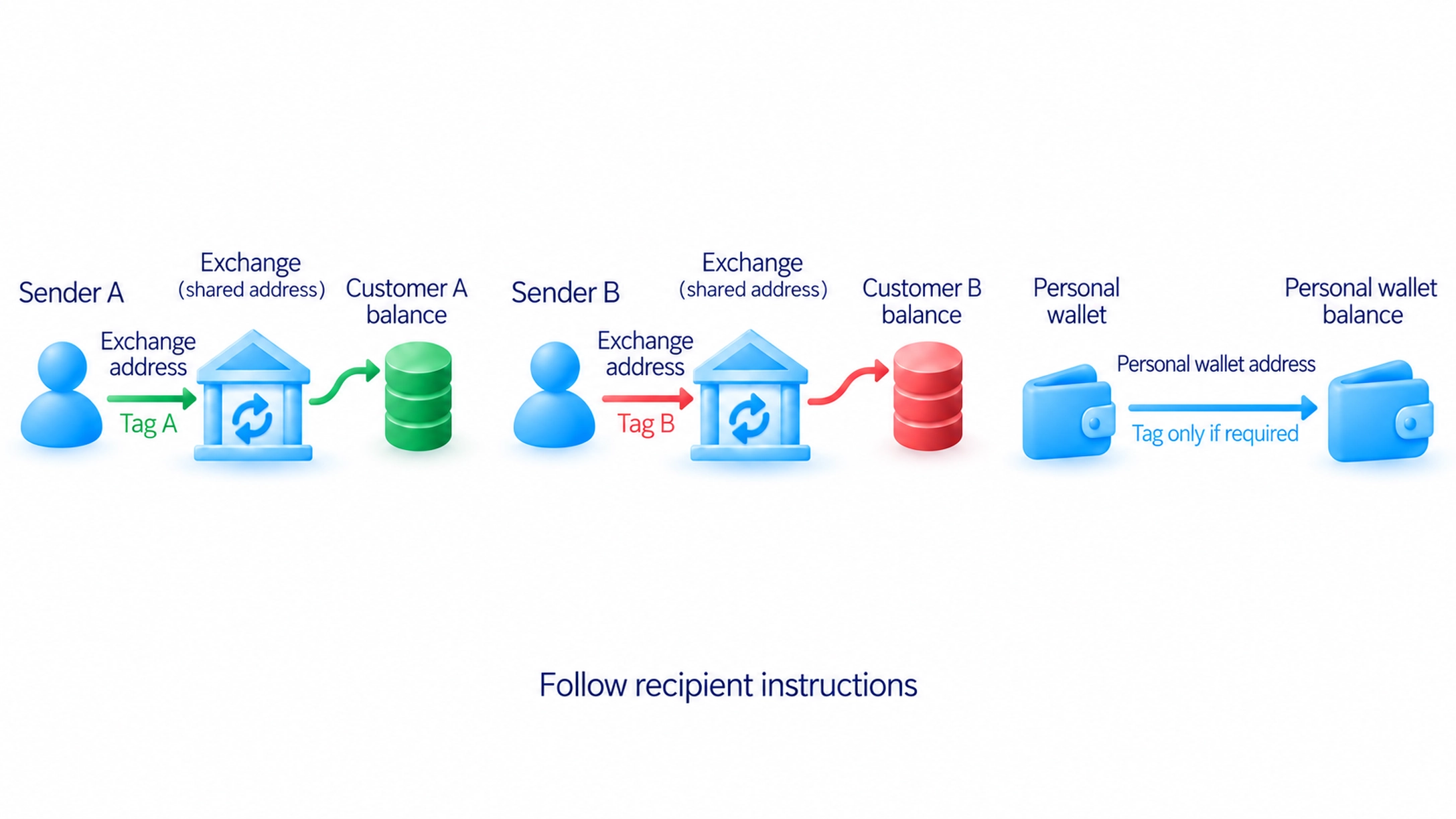
Before transferring XRP, match the network, recipient address and any required Destination Tag, an extra identifier for the payment’s intended recipient. An exchange may use one address for many customers and use the tag to credit the right balance. Not every personal wallet needs a tag; follow the recipient’s instructions. A missing required tag can cause rejection or require manual investigation before crediting.
Before buying, record the asset or contract you will receive, who controls the balance and how withdrawals work. Separately check supply, the news source and chart data. If the argument is simply that a Ripple deal must make XRP rise, it leaves out the link between that deal, coin purchases and market pricing. Establish that link before making a decision.
Frequently asked questions
XRP is the native coin of the XRP Ledger. Ripple is a company developing payment products. Owning XRP gives you neither a share in Ripple nor a claim on its profits.
No. The original 100 billion XRP were created at launch. XRPL does not use Bitcoin-style mining to confirm its records, and network transaction costs destroy small amounts of the existing coins.
No. Escrow locks funds under specified conditions, and completion requires a separate transaction. The recipient can hold or transfer the released coins; availability is different from an exchange sale.
A product need not require purchases of XRP, and using the coin for a payment need not mean holding it continuously. A price assessment needs the actual product terms, coin supply and market conditions, not only the company’s success.
Choose the pair, venue and product. Examine price direction and the reaction around a marked area. A past high is not a promised future price, and recorded volume belongs to the selected data source.
A Destination Tag tells a recipient how to identify the payment, for example which customer to credit at a shared exchange address. Use it when the recipient requires it; not every personal wallet needs one.
About the author
Igor Arapov, practising trader since 2013 and author of the ArapovTrade educational library. ORCID: 0009-0003-0430-778X.




