Ethereum is a network for transferring assets and running programs. Ether, usually written ETH, is its native coin: it pays for network operations and supports participation in securing the network. Understanding what Ethereum can do helps you identify an asset and its risks. It does not establish a profitable buying price.
Before reading a chart, identify the product. ETH priced in dollars, ETH priced in Bitcoin and a contract linked to ETH describe different trades. Buying an application’s token is also different from buying ETH itself.
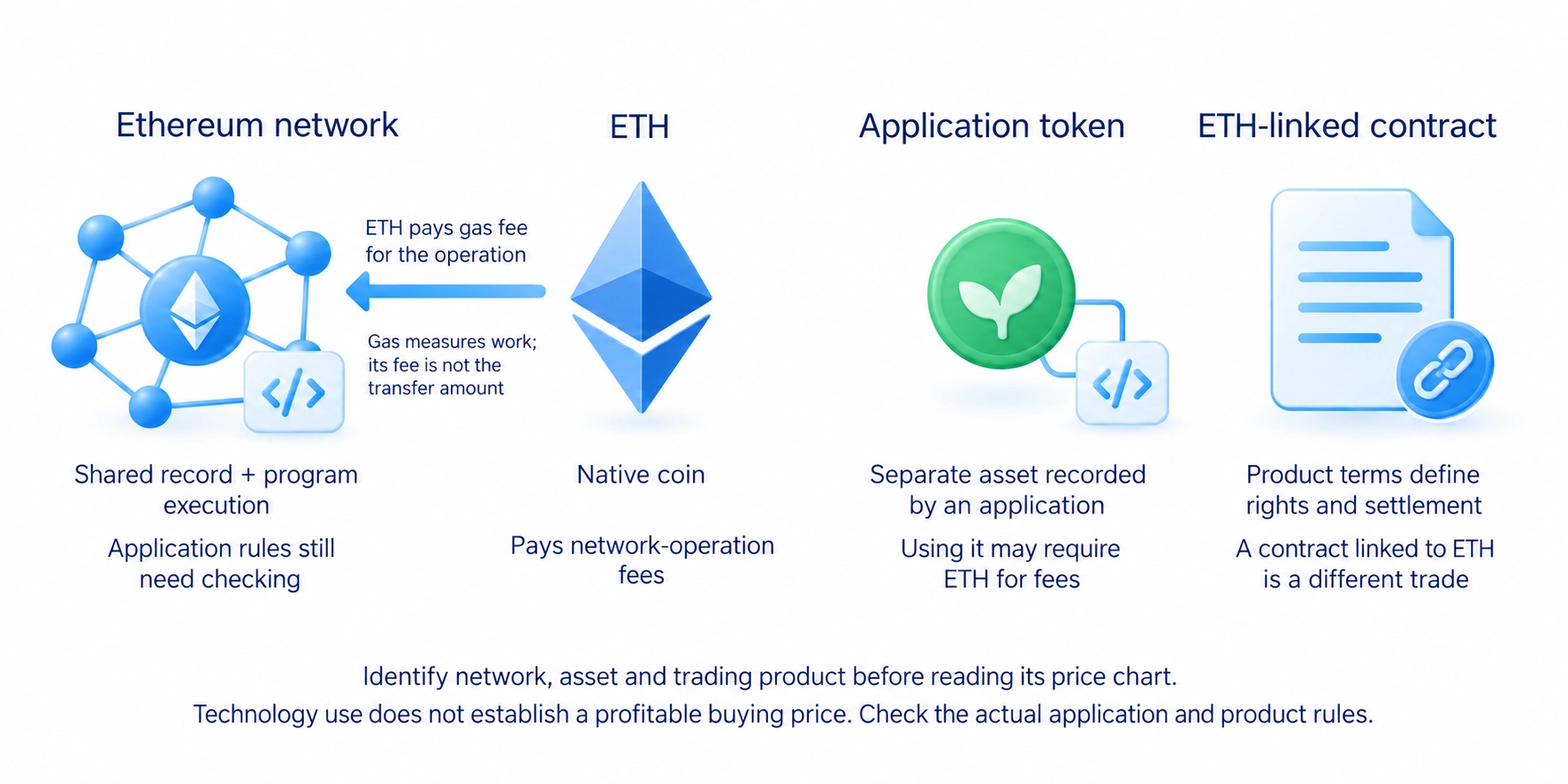
Ethereum, ETH and application tokens
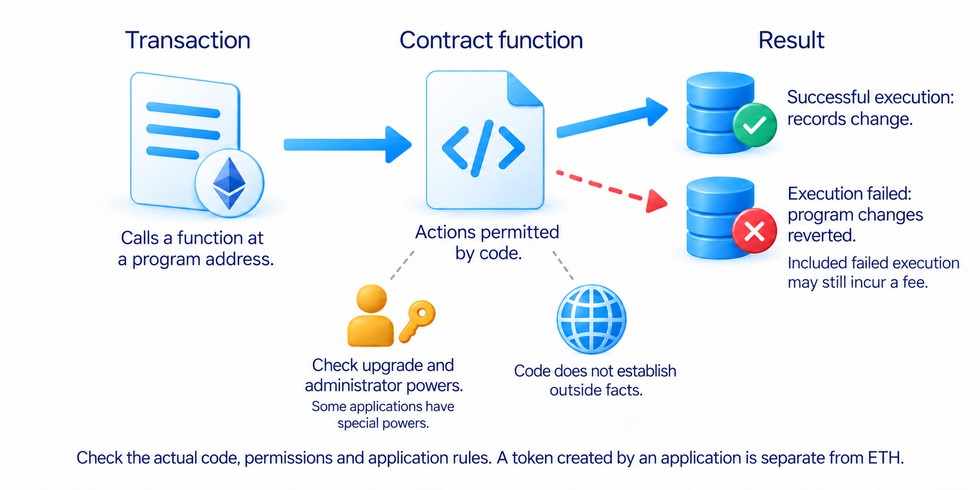
Ethereum records activity in a blockchain, a shared record organised into linked blocks. It also runs smart contracts, programs stored at particular addresses. A transaction can call one of a program’s functions to perform the actions its code permits.
A program can record tokens, arrange an exchange or enforce an application’s conditions. It does not automatically establish that outside information is true or correct an error in its own code. Some applications can be upgraded or have special administrator powers. Check the application’s rules instead of assuming that deployment on Ethereum makes it safe.
Bitcoin and Ethereum have different protocol rules and uses. Bitcoin’s issuance rules set a limit of about 21 million BTC. ETH has no equivalent fixed supply ceiling: new coins are issued and some existing ETH is destroyed. This does not let an individual create arbitrary amounts; network participants still check the protocol’s rules.
Tokens created by Ethereum applications are separate assets from ETH. Using a token can require ETH to pay for the operation even though the token has a different purpose and price. A wallet is an interface for accessing accounts and authorising actions, not a file containing the coins. Cryptocurrency for beginners explains these network and ownership distinctions.
Gas fees, staking and ETH supply
Gas measures the computational work used by an operation. The gas fee is the amount paid for that work, not the amount of ETH being transferred. A gas price is often quoted in gwei, where one gwei is one-billionth of an ETH. A simple ETH transfer and a call to a complex program need not use the same amount of work.
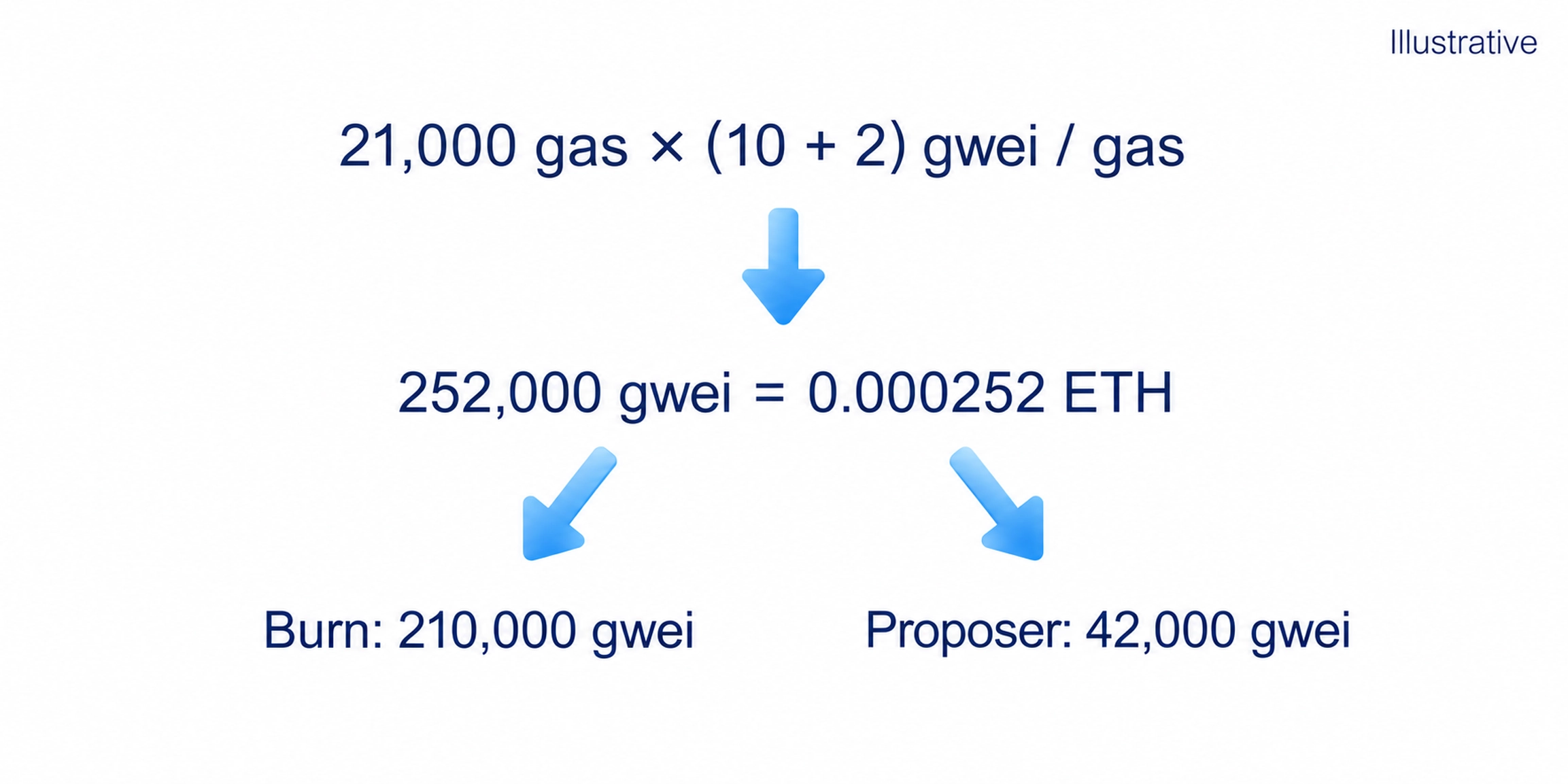
For an ordinary main-network transaction, the fee includes a base fee and a priority fee for each unit of gas used. The protocol determines the base fee and destroys that portion of ETH. The priority portion goes to the block proposer. Your total cost depends on the work actually used and the applicable fee conditions.
Consider a teaching example: a simple transfer uses 21,000 gas units, the base fee is 10 gwei and the actual priority fee is 2 gwei. Its fee is 21,000 × (10 + 2) = 252,000 gwei, or 0.000252 ETH, in addition to the amount sent. These are example inputs, not a current standard tariff. Token transfers and program calls may use different resources.
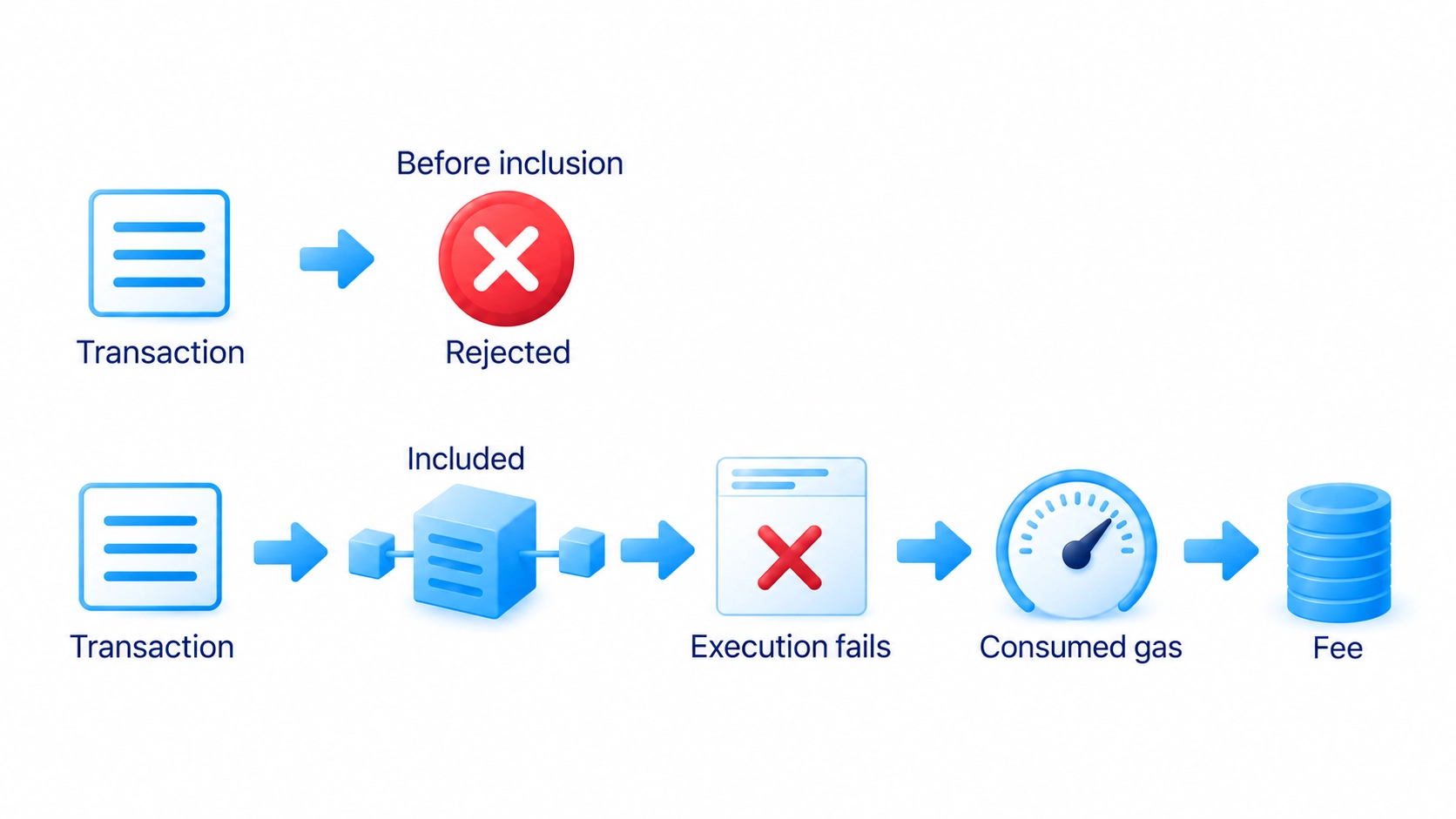
A transaction included in a block can use work and incur a fee even when its execution fails. That is different from a request rejected before inclusion. Before approving an operation, check the intended action and estimated cost. Afterwards, check its network status rather than treating an app’s message as proof of success.
The Merge was Ethereum’s transition to Proof of Stake in September 2022. Validators, participants that check and propose blocks, commit ETH to participate under the network’s rules. Mining is no longer the main network’s method of producing blocks. Staking describes this participation arrangement, not a promise of a fixed investment return.
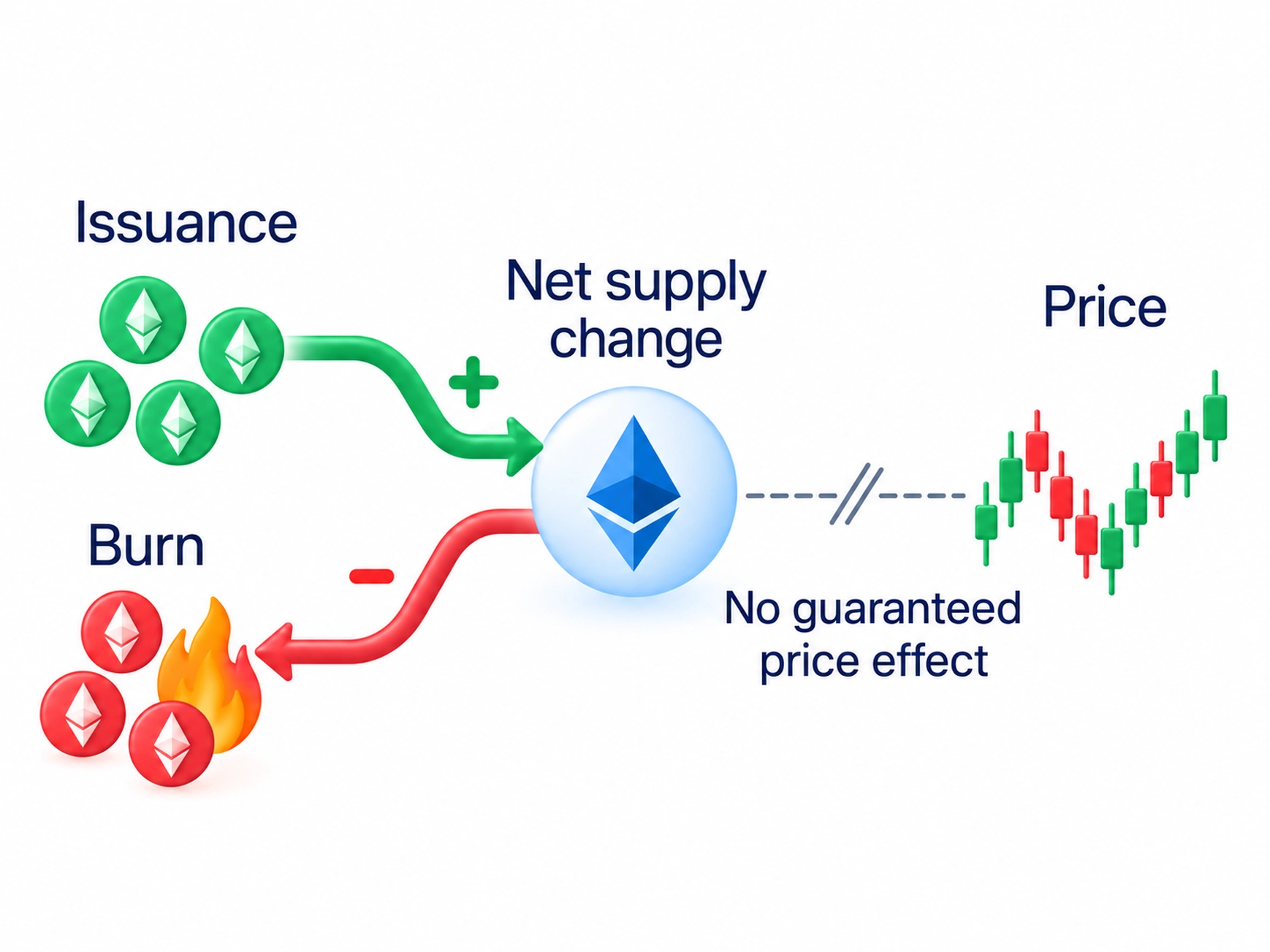
The protocol issues ETH as validator rewards and destroys part of the transaction fees. Net supply can rise or fall depending on the balance of issuance and destruction over a period. It is therefore inaccurate to call ETH permanently deflationary, meaning that its quantity must always shrink. Even a shrinking supply does not determine the market price.
Staked ETH participates in securing the network, but withdrawal depends on the method and service used. A reward in ETH is not necessarily a profit measured in dollars. Some services also provide tokens representing staking-related rights that can trade separately. Do not treat all staked ETH as permanently unavailable; the staking guide explains participation and withdrawal conditions.
What Ethereum Layer 2 means
Layer 2 describes solutions that perform work separately while using Ethereum for specified verification or data publication. Rollups batch transactions and submit data or results under their particular rules. They can increase capacity, but different solutions do not have identical confirmation, withdrawal or security arrangements.
The cost of an operation depends on the network, workload, action and data-publication costs. Check the wallet’s actual estimate rather than assuming every second-layer transaction is always cheaper. Also check who can upgrade or interrupt the application and what steps make a withdrawal final.
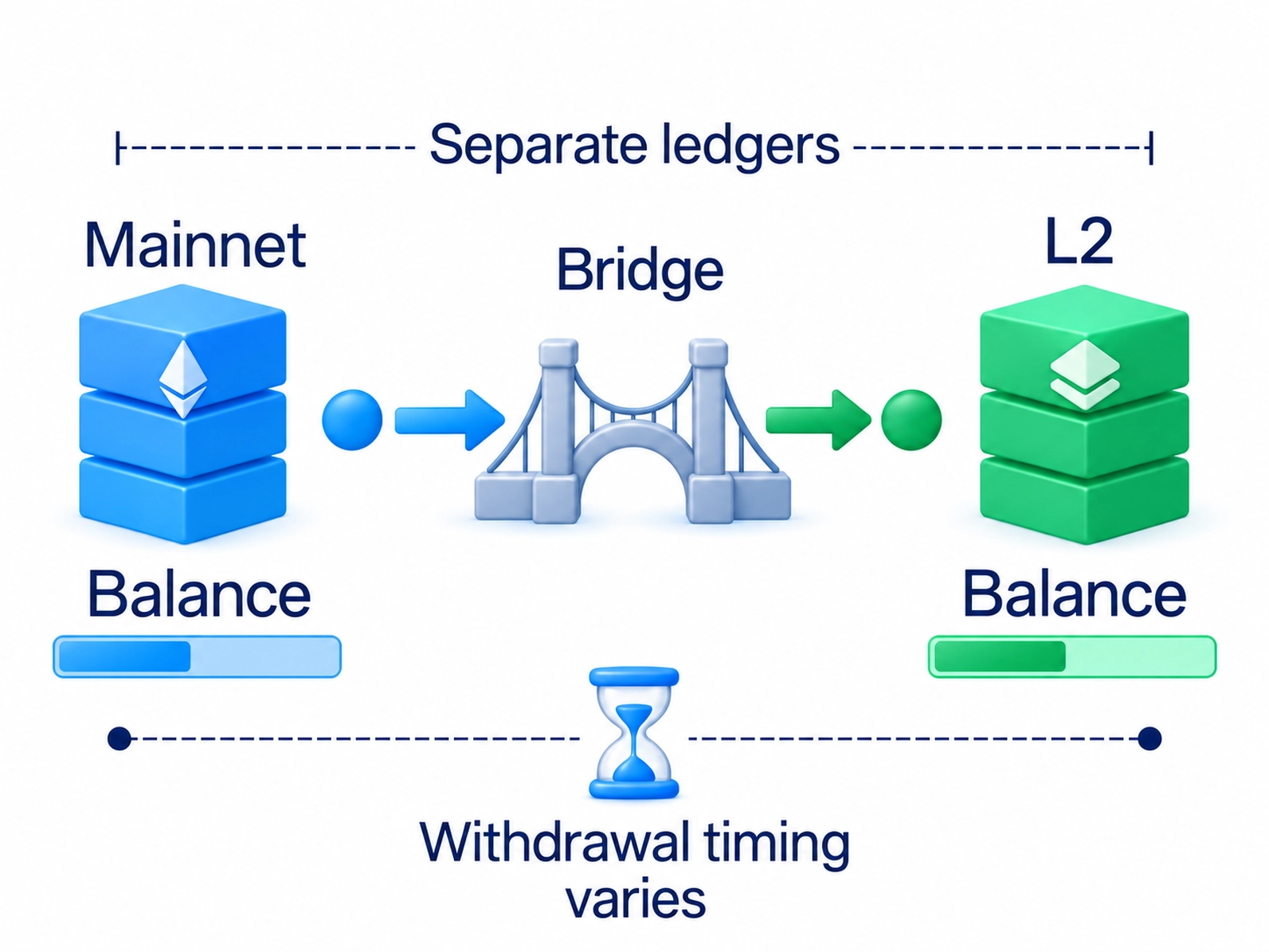
The same address format does not mean your balance is shared across networks. Moving assets between networks can require a bridge, an arrangement with its own transfer and verification rules, or a service supporting the intended withdrawal. Check the recipient’s network and asset support. Sending on the main network does not automatically deliver funds to a second-layer balance.
Label activity data with the network and period it describes. Application activity on a second layer is not the same measure as main-network transaction count or main-network fees. More application use can indicate technology adoption without proving a proportional increase in the market demand for ETH.
Reading ETH prices and the ETH/BTC ratio
Separate demand for network operations, new issuance, purchases of ETH and sales by holders. Higher transaction fees describe the cost of using a particular network, not a ready-made buying signal. Expectations, financing conditions and the trading products available to buyers can also affect the market price.
For a fund linked to ETH, read what it holds, its costs and its permitted operations. Do not assume every product participates in staking or passes staking rewards to shareholders. A fund share and ETH at your own address give different rights. The documents of the actual product matter more than a general announcement about its launch.
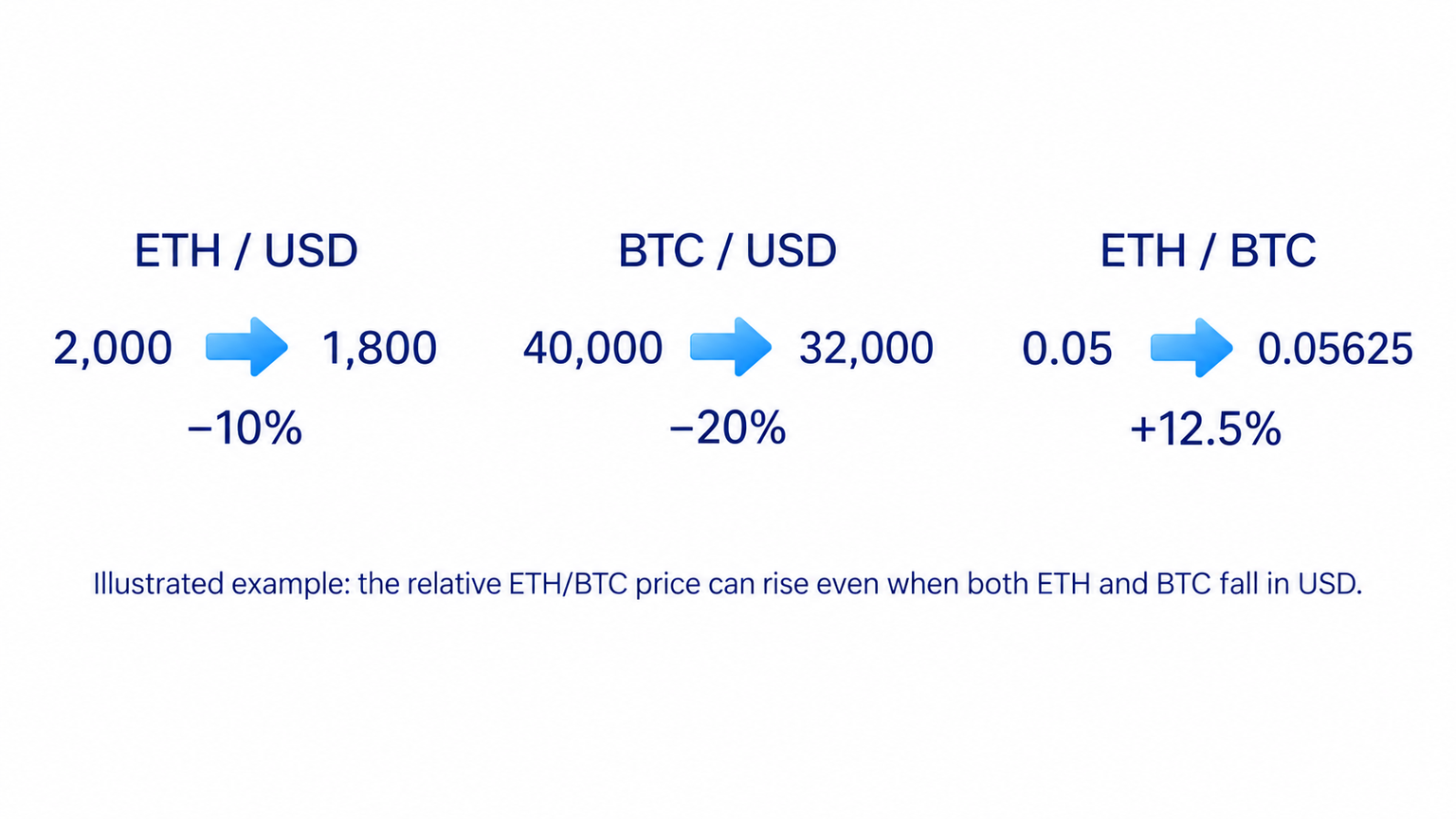
ETH/BTC is the price of ETH expressed in Bitcoin. A rising ratio means ETH has strengthened relative to BTC; ETH can still be falling in dollars if BTC is falling faster. This ratio is not a correlation coefficient, a measure of how returns move together, and does not show money being transferred directly between the two assets.
ETH and BTC can move in the same direction, but their relationship depends on the period and method of comparison. ETH does not have to follow every Bitcoin movement. When comparing Ethereum with Solana, keep the network’s technical properties separate from the financial result of holding its coin.
Preparing a trade on the selected ETH market
Choose the venue, pair, product and chart intervals you intend to use. Mark significant highs, lows and areas where price previously stopped. Their sequence helps distinguish a rise, a fall or a range. A technology announcement does not erase that observed price structure.
Trading volume records the quantity traded in the selected market during a period. A source may report ETH quantity, futures contracts or the money value traded. One venue does not record every worldwide transaction, and a large figure does not identify a trader’s intentions. Compare the recorded activity with price movement around the area you have marked.
The price-level demonstration shows how to mark areas on another market. It adds practice after the written explanation; it does not verify an ETH trade’s result. When price crosses an area, check its next reaction rather than immediately declaring that someone manipulated the market.
In my course, quantity starts with the permitted money loss and the instrument’s parameters. The next step is to calculate how much can be traded for the distance to the planned protective exit. For ETH, that means checking coin quantities or contract specifications instead of copying another market’s example quantity. Practise the sequence on a demo account using virtual money first.
Before entering, check the spread, the gap between the best buying and selling prices, and whether available orders can accommodate your quantity. A protective stop requests an exit when its trigger condition is met; its execution price can differ from the plan. If the product lets you control more value than the money committed, also check its forced-closure rules. Those rules do not replace a protective plan.
Record the reason for entry, the condition that would invalidate it and the data source used. After the trade, compare the plan with the actual execution. Believing that the network will develop does not by itself explain why a trade should begin at this particular place on the chart.
Frequently asked questions
Ethereum is a network for transfers and programs. ETH is its native coin, used to pay for operations and support participation in securing the network. An application token is a separate asset.
Gas measures the work used by an operation. Its fee pays for that work at the applicable price. The fee is separate from the amount being transferred and may differ between actions.
Mining is no longer the main Ethereum network’s block-production method. Since The Merge, it uses Proof of Stake, with validators committing ETH to check and propose blocks under the network’s rules.
No. New ETH is issued as rewards and some fees are destroyed. The change in supply depends on both over the selected period. A reduction does not guarantee a higher market price.
It is a solution that performs some work separately while using Ethereum for specified verification or data publication. Costs, confirmation and withdrawals depend on the particular solution. Check the exact network before transferring funds.
It is ETH’s price in Bitcoin. A rising ratio means ETH is stronger relative to BTC, but ETH may still be falling in dollars. It is not a measurement of how closely the two assets’ returns move together.
Choose the venue and product, mark the price structure and define the area for your decision. Before entry, set the permitted money loss, the distance to the planned protective exit and the matching quantity. Account for execution and any forced-closure rules rather than copying a quantity from another market.
About the author
Igor Arapov, a practicing trader since 2013 and author of the ArapovTrade library. ORCID: 0009-0003-0430-778X.




