Solana is a network for transfers and applications, while SOL is its native coin. SOL pays for network operations and can be used to support network security. Buying the coin makes your holding depend on its market price; it does not give you a guaranteed share of every application's earnings.
Separate the network from the product you choose. SOL controlled through your own wallet, an application token and a contract for trading price changes have different rights and risks. Establish which one you are buying before judging its prospects.
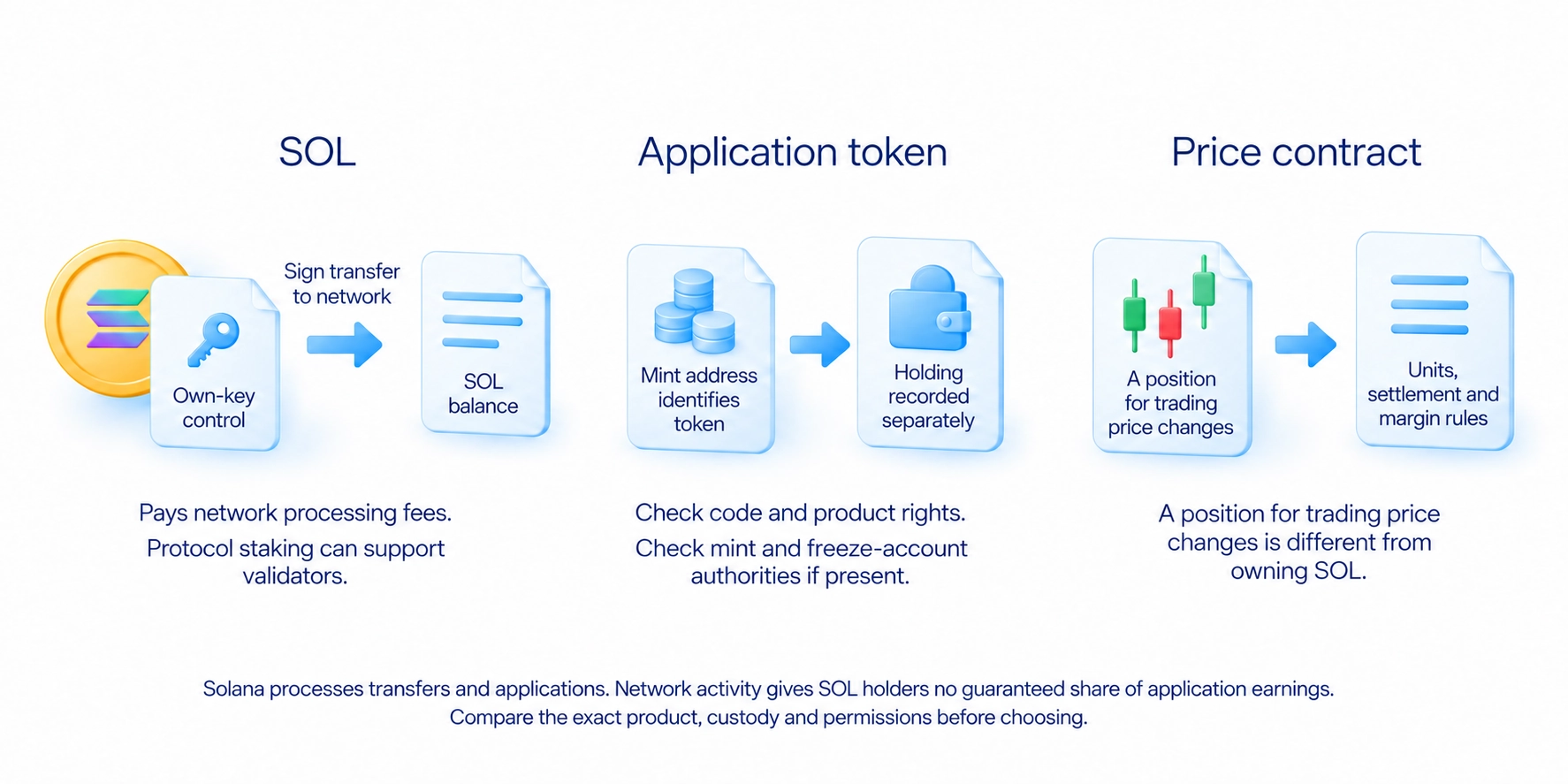
SOL and application tokens on Solana
Solana records operations on a blockchain, a shared record built from linked blocks. Programs process users' requests and update data under their rules. An application might exchange assets, for example. Its code, upgrade powers and terms must be assessed separately from the network on which it runs.
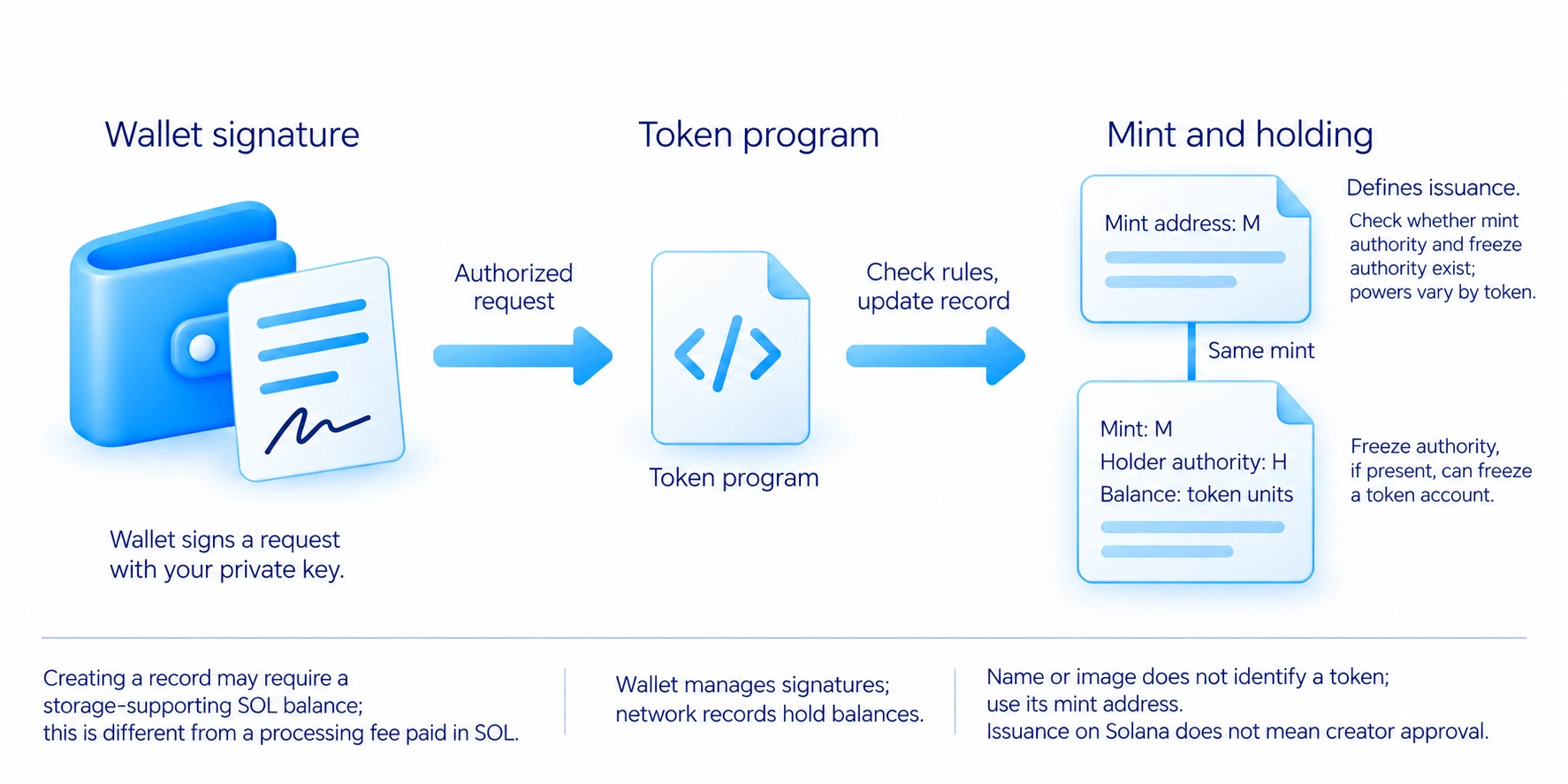
SOL differs from tokens created through Solana's token programs. These are commonly called SPL tokens, named after the Solana Program Library. Identify a token by its mint address, the address of its specific issuance record, rather than its name or image alone. Different tokens can give different powers to create units or freeze transfers. Being issued on Solana does not mean the network has approved the creator.
A wallet manages signatures and access to records. Individual tokens are recorded in token accounts, separate network records associated with the token and its holder. Creating a record may require a minimum SOL balance to support its storage. That balance is different from a transaction-processing fee. Cryptocurrency for beginners explains the underlying asset, network and access concepts.
Solana and Ethereum organise application data differently. Solana keeps executable programs and their changing data in separate accounts, network records with their own addresses. An Ethereum smart contract, a program with its own address, has storage associated with that contract account. Implementing the same application idea therefore involves different arrangements for its instructions and data.
For a user, compare the particular action, required confirmation and total cost rather than an advertised speed alone. A low-fee claim does not replace checking the wallet's actual estimate. Technical capabilities do not by themselves determine the coin's market price.
How transactions are confirmed and what Proof of History does
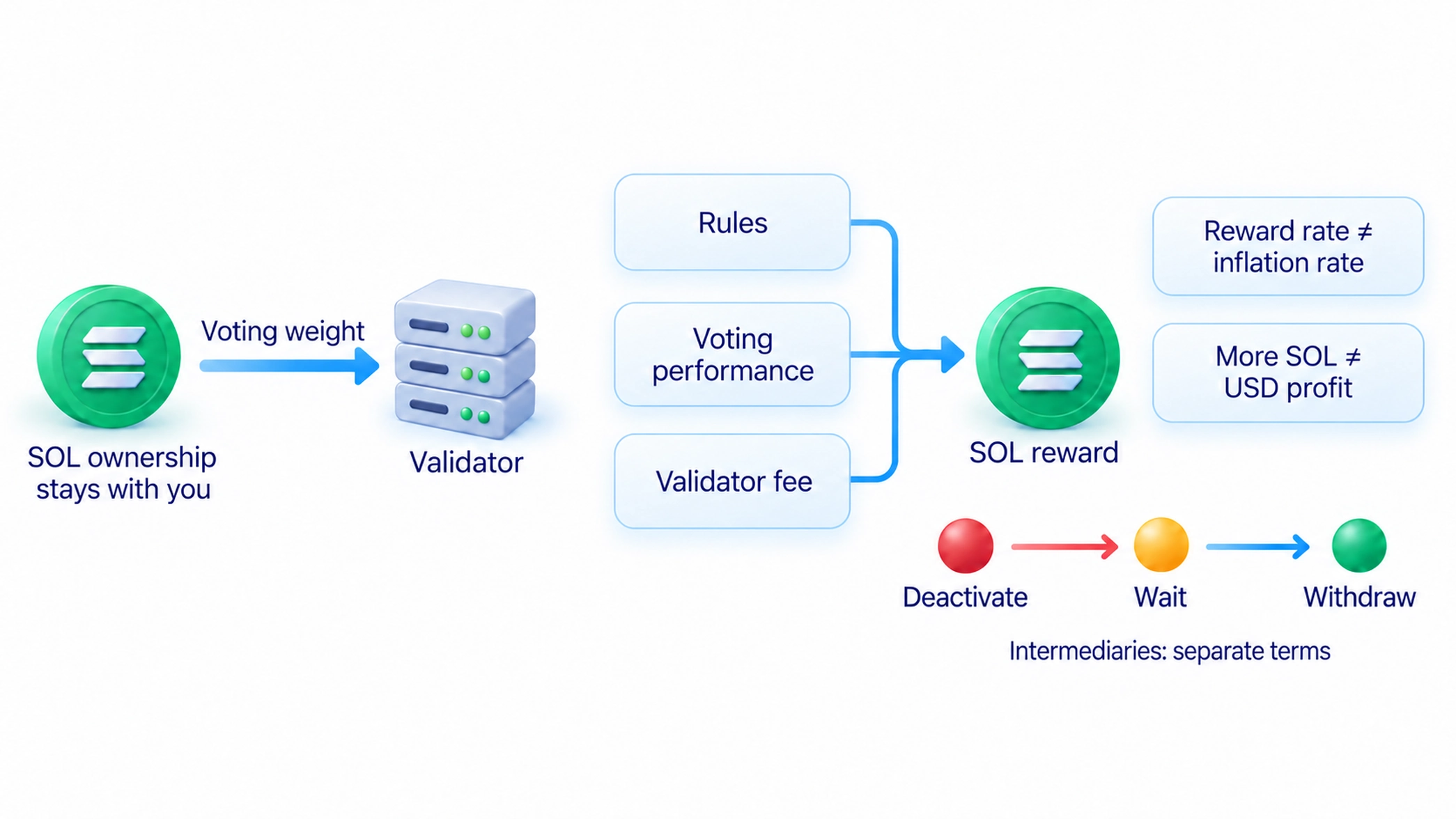
Validators process transactions and participate in agreeing which blocks belong to the network's record. In Proof of Stake, their voting weight depends on delegated SOL. Delegating in ordinary protocol staking adds weight to a selected validator without handing that validator ownership of your tokens. A company offering a staking service can have different custody terms.
Proof of History, or PoH, produces a verifiable sequence of calculations that helps establish the order of events. It organises time and recorded data rather than replacing the network's agreement on valid operations. PoH alone does not establish that a payment is correct or ready to withdraw.
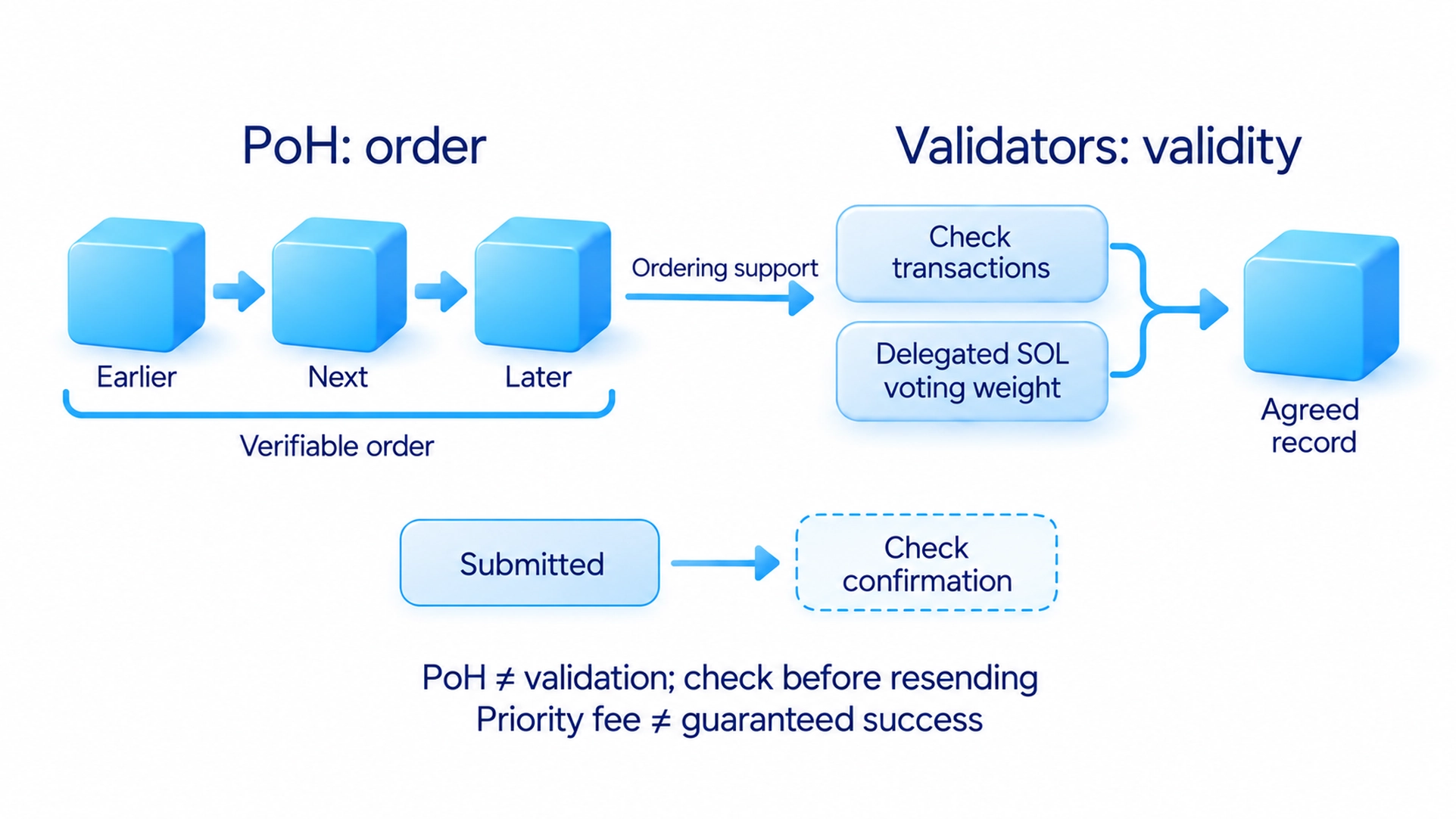
High throughput does not mean every request finishes instantly. An application can show a submitted request before the confirmation you need. Network demand, the selected fee, program execution and access to network services can affect processing. If an action appears to fail, check its status before sending it again.
TPS means transactions per second, but check what the statistic counts. A total can include validators' voting transactions; a non-vote measure excludes them. Compare the same period and counting method rather than a theoretical maximum. Many transactions also do not necessarily mean many different people buying SOL.
Fees, SOL issuance and staking
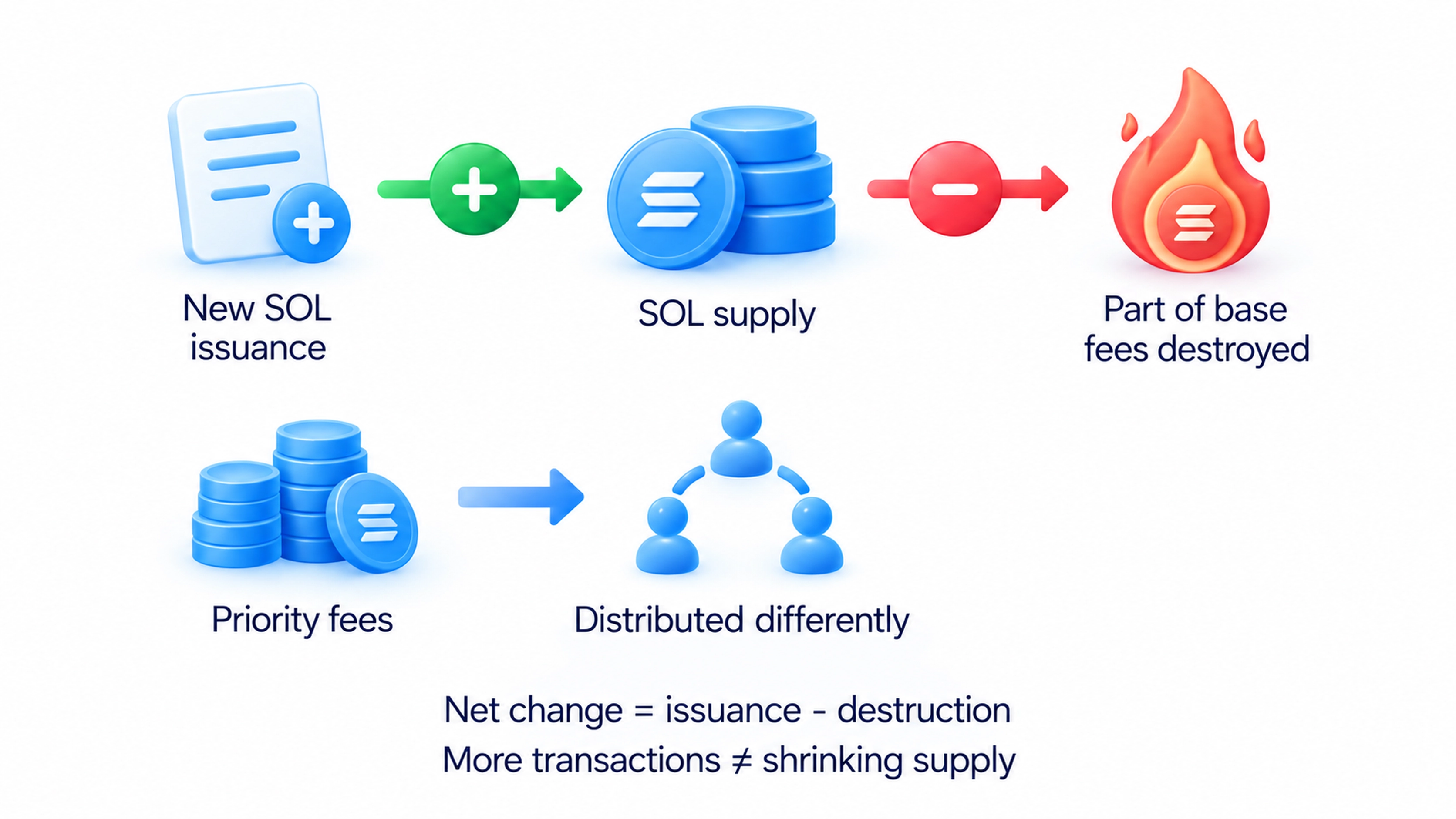
Network processing fees are paid in SOL. They include a base fee and may include a priority fee. The additional fee improves scheduling priority rather than guaranteeing success or a better exchange price. A processed transaction that fails can still incur a fee.
Separate that network fee from the token's purchase price and an application's charges. A swap service may charge its own fee, and creating an account can require a separate balance for data storage. Review the total expected cost before signing, rather than reading only the field labelled network fee.
The protocol issues SOL for rewards and destroys part of the base fees, often called burning. Priority fees are distributed differently, so not every fee paid is fully burned. The net change in supply depends on issuance and destruction over the period. A high transaction count alone does not establish a shrinking supply.
Staking means committing or delegating SOL to support validators in checking network operations. Ordinary delegation does not transfer ownership of the SOL to the validator. Staking rewards depend on issuance rules, the share of SOL participating, the validator's voting performance and its fee.
The inflation rate is not each participant's reward rate. Rewards paid in SOL do not guarantee a dollar profit. With ordinary protocol staking, deactivation takes time before assets become withdrawable.
Check separately the terms of an intermediary or a token representing a staking holding.
Assessing Solana activity and news
Name the activity you are measuring: user transactions, active addresses, fees or exchange volume. One person can use several addresses, and automated programs can generate many actions. Examine the composition and repeated use of applications rather than treating one record-breaking day as evidence of lasting demand.
Applications offering exchanges and loans need transaction processing, but have their own risks. A higher valuation of the assets in them can reflect price changes rather than new deposits. Decentralised finance explains those operations. Their total asset value is not the profit of someone holding SOL.
When reading an upgrade announcement, distinguish a proposal, a test and a change actually enabled on the network. Then identify what changes for the user: confirmation, permitted operations, fees or participation requirements. Naming a new technology does not establish that every application already uses it.
A wallet problem, a problem reaching a network service and a blockchain problem can look similar to a user, despite having different causes. Check the transaction's status, the network's status and the exchange's deposit or withdrawal restrictions. An exchange can pause transfers even when the network is operating normally.
When comparing Solana with XRP and the XRP Ledger, compare the same tasks and conditions. News about an investment product also requires checking its rights, charges and holdings. Buying an investment-fund share or an exchange contract is different from transferring SOL to your own address.
Reading the SOL chart and calculating quantity
Choose the venue, pair and product before reading the chart. Mark visible highs, lows and areas where price stopped. Their sequence helps distinguish rising prices, falling prices and a range. A round price may attract attention, but does not by itself confirm a reversal.
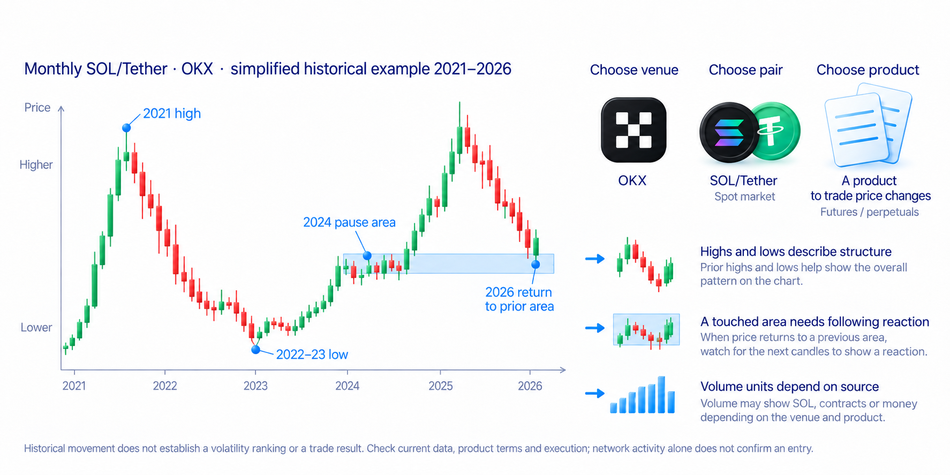
Trading volume belongs to the selected market and period. Check whether the source counts SOL units, contracts or the money value traded. A large reading does not identify a participant. Compare activity with how price crosses the selected area and whether it remains beyond it.
In my course, calculating quantity starts with the instrument's parameters and the acceptable money loss. For a SOL trade, identify the planned protective exit before calculating the quantity. A one-dollar movement in the coin and in a contract can have different money effects. Check the specifications rather than transferring a calculation between products unchanged.
Consider a hypothetical unborrowed purchase with a planned loss budget of USD 60 and USD 3 per SOL between entry and the planned exit. Before costs, the quantity is 60 ÷ 3 = 20 SOL. A wider distance with the same quantity increases the planned loss. To preserve the same budget, recalculate the quantity before entry. Allow separately for fees and a difference between planned and actual execution prices.
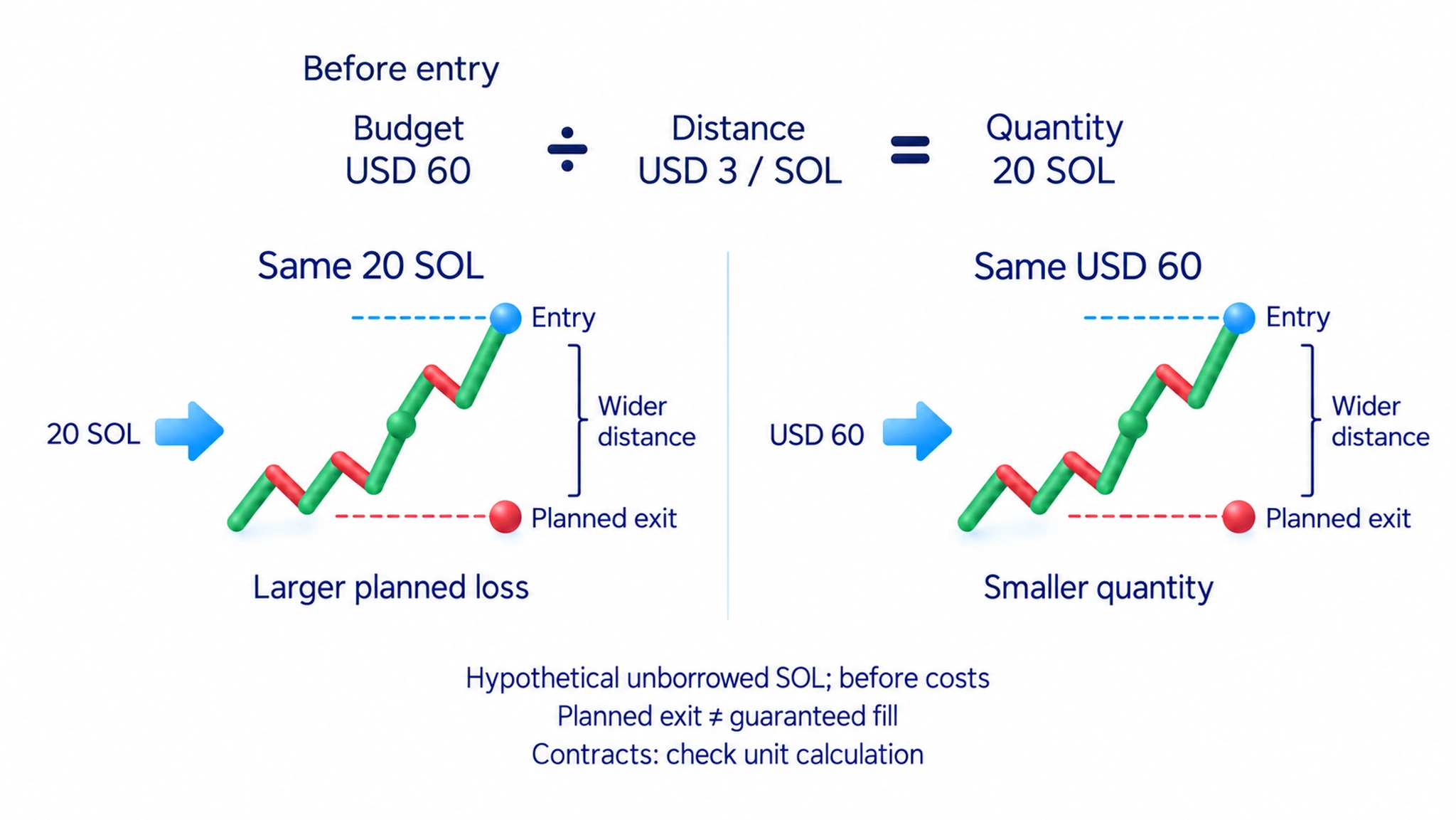
Before entering, check the spread, the difference between the best available buying and selling prices, the available orders and the protective order's conditions. A stop is an instruction intended to close a trade when its price condition is reached; it does not promise a fill at that exact price. Forced closure of a leveraged trade has separate rules. Save the entry reason, the condition that invalidates it and the quantity calculation, then compare the plan with execution. A news story about network speed does not explain a chart entry on its own.
Frequently asked questions
Solana is a network for transfers and applications. SOL is its native coin, used for processing fees and participation in network security. Tokens created by applications are different assets from SOL.
Proof of History is a verifiable sequence of calculations that helps establish the order of events. It works alongside the network's agreement on valid operations, rather than replacing that validation.
No. The cost depends on the operation, application and selected priority fee. Processing also depends on demand and confirmation. A submitted request is not necessarily a completed transfer.
A count can include voting transactions and repeated automated actions. Network activity is not the same as the number of people buying SOL or the profit earned by holders.
Distinguish a proposal and testing from a change actually enabled. Identify what changes for the user and whether the application you need uses the new rules.
Before entry, choose the acceptable money loss and the distance to the planned protective exit. For an unborrowed coin purchase, divide that loss by the price distance in money per SOL. Allow separately for costs and execution. For a contract, check what its units represent before using the formula.
About the author
Igor Arapov has traded since 2013 and writes the ArapovTrade learning library. ORCID: 0009-0003-0430-778X.




