DeFi, short for decentralised finance, covers financial operations carried out through programs on a blockchain, a shared record of network transactions. These include exchanging tokens, borrowing and supplying assets for other participants to use. Instead of using a conventional bank account, you sign actions with a crypto wallet. Before committing funds, establish where the assets go, what pays the return and what conditions govern getting them back.
How a DeFi operation works
DeFi services include token exchanges, lending and borrowing, liquidity pools that hold assets for swaps, stablecoins intended to track a reference value, and price oracles, services that supply external prices to programs. Users can swap tokens, supply assets for lending, borrow against committed assets or provide liquidity for other users’ swaps. A quoted return does not establish profit: losses can arise from changing asset prices, borrowing costs, pool rules or program failures.
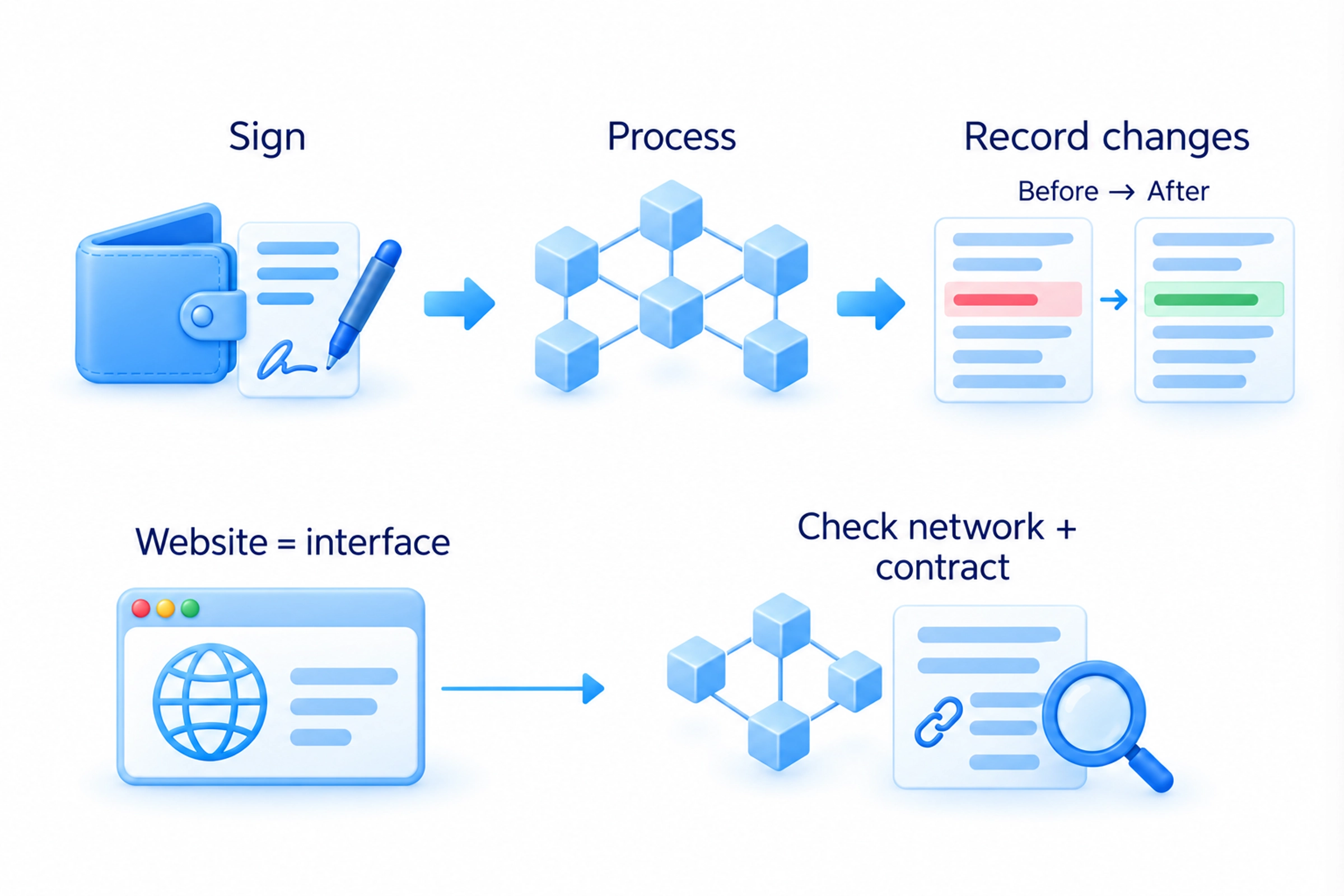
These services can depend on one another, so a problem with a stablecoin or price feed can affect a connected loan or pool. A smart contract is a program on a blockchain that carries out defined actions when its conditions are met. You sign a request with your wallet, the network processes it and the program updates the asset records.
The website is usually an interface to that program. Check the network and contract address; a familiar name or logo does not establish that you are using the intended service.
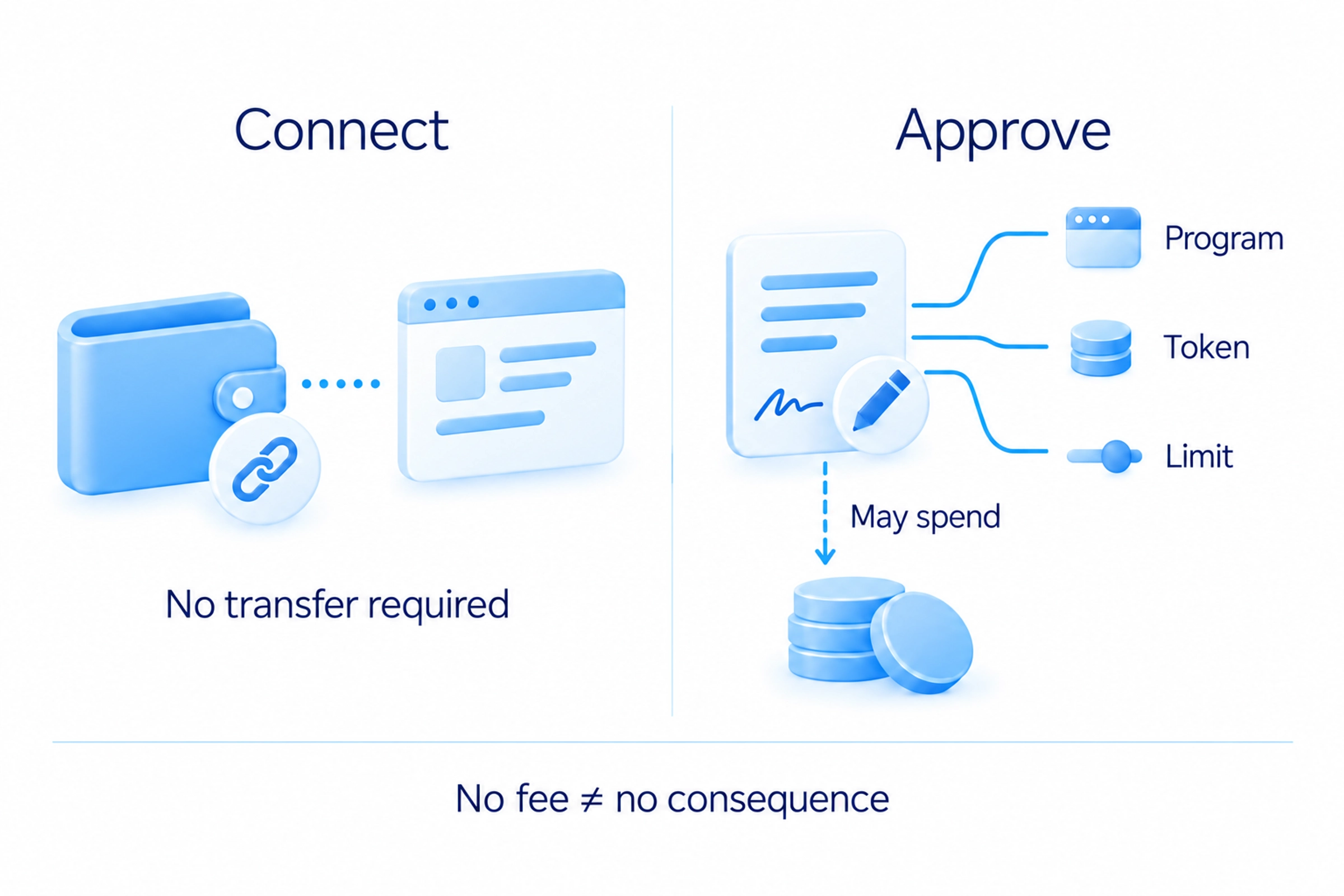
Connecting a wallet does not necessarily move funds. A later signature, however, may authorise spending or make a transfer. A token approval lets the specified program spend tokens up to the permitted amount. Check the recipient of that permission, the token and the limit. Signing a message can also have financial consequences even when it does not require a network fee.
A company-run financial service can control account access and hold assets for customers. DeFi moves specified operations into programs, but removing a bank does not remove dependencies. A protocol may use external price data, give certain participants management powers and depend on the underlying network. Some systems allow program upgrades or pauses. Check those powers before accepting a claim that nobody can change the rules. Cryptocurrency for beginners explains the underlying network and wallet concepts.
Token swaps and liquidity pools
A decentralised exchange, or DEX, lets users exchange assets through a blockchain. One design uses a liquidity pool: tokens participants have deposited into a program. An automated market maker, or AMM, calculates exchange terms under the pool's rules. Other exchanges can use different formulas or order books, lists of waiting buy and sell orders.
A swap removes one token from a pool and adds another, changing the available quantities. A trade that is large relative to those quantities can worsen its own average exchange price. This is price impact. Conditions can also change while the request waits to be processed. A slippage tolerance sets an acceptable execution limit; it does not remove the trade's own effect on price.
For a swap of a fixed amount, the interface may specify a minimum quantity to receive. If execution cannot satisfy it, the transaction fails under the program's rules. A network fee may still be charged for processing that failed transaction. Before signing, compare the estimated output with the minimum output, the exchange fee and the network fee.
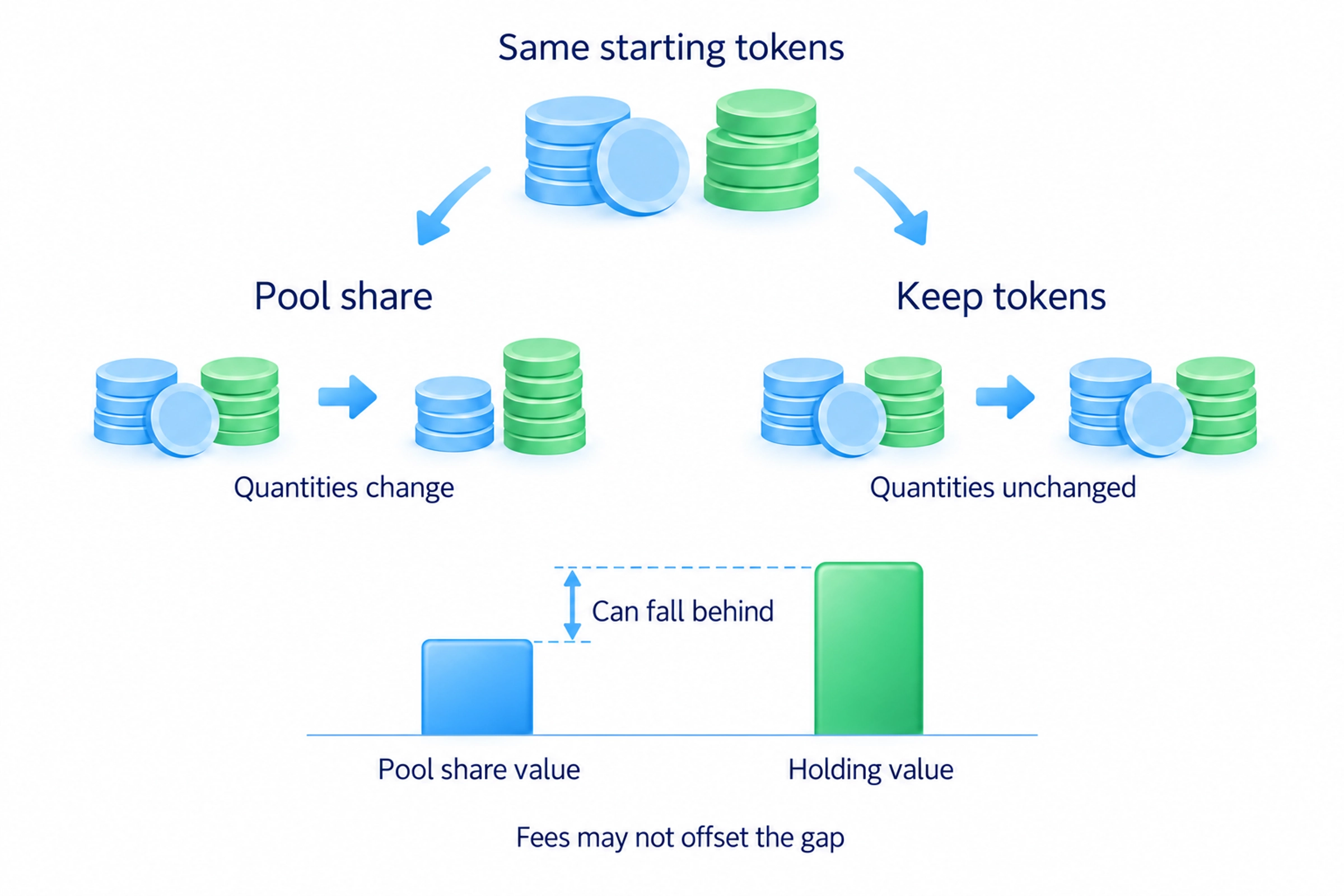
A liquidity provider receives a claim on the corresponding share of pool assets and the fees allowed by its rules. In a simple two-token pool, that share contains changing quantities of each token. In designs with a selected price range, earning fees and the composition of the holding also depend on whether the price is within that range. A pool share does not promise the return of the original quantity of both tokens.
Impermanent loss means the value of a liquidity provider's holding can fall behind the value of simply keeping the same original tokens. As their relative price changes, the pool changes their quantities. This compares two alternatives; it does not necessarily mean the holding is worth less than the amount originally invested. Fees may offset the difference, but need not. The word impermanent does not promise that the difference will disappear.
Collateral-backed loans and liquidation
In a lending protocol, some participants supply tokens and others borrow against collateral, assets committed to support the debt. For example, a user can supply ETH and borrow stablecoins while keeping the collateral dependent on the ETH price. The loan must be repaid in the specified asset with accrued interest. Falling collateral value and growing debt can both weaken the borrower's position.
The maximum permitted initial loan and the liquidation threshold are different settings. Liquidation allows other participants to repay eligible debt and receive collateral with an incentive under the protocol's rules. Valuation commonly uses a price oracle, a service that supplies prices to the program. Incorrect price data can therefore affect the collateral assessment too.
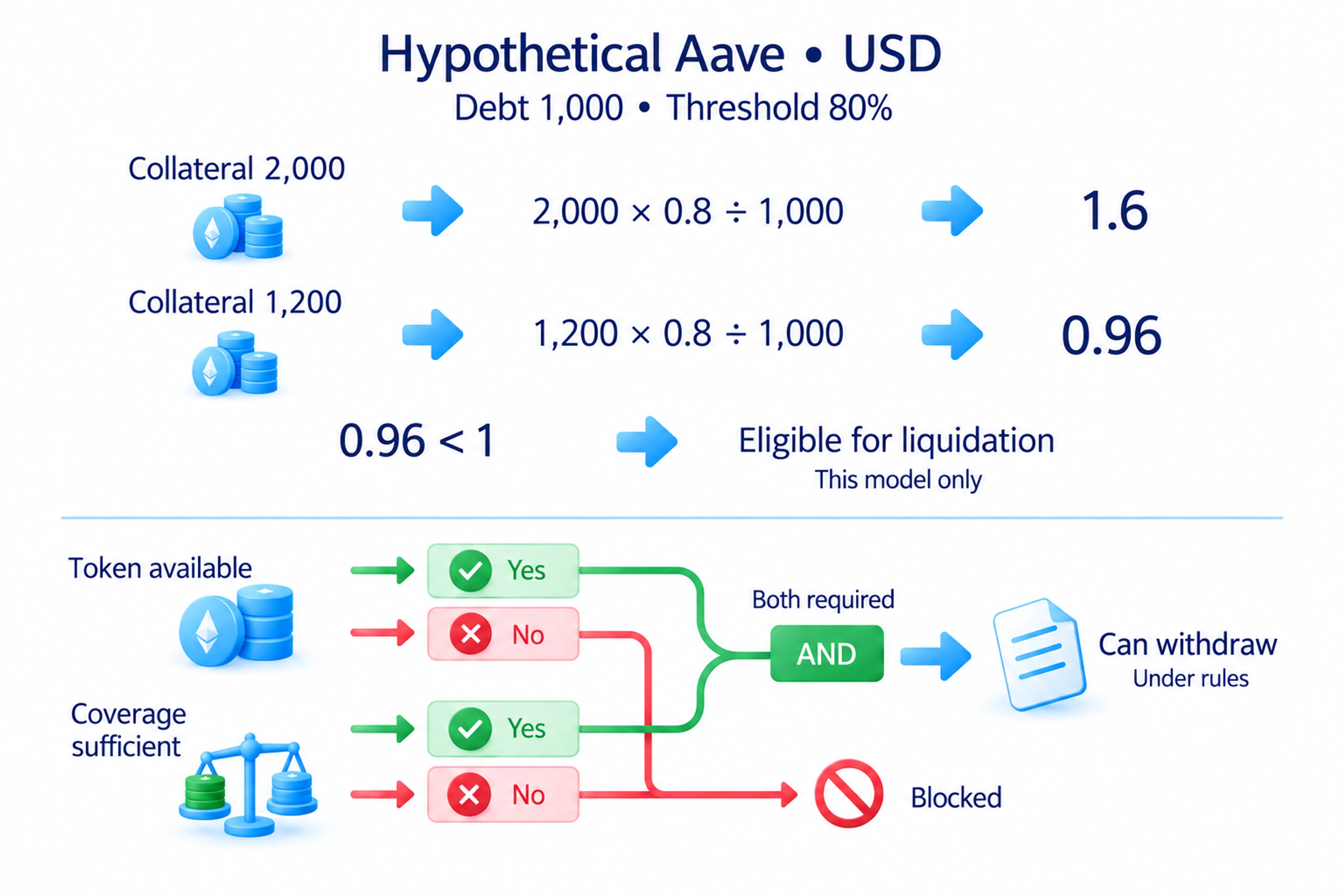
Aave uses a health factor to assess debt coverage after applying the liquidation threshold. Consider one hypothetical collateral asset worth USD 2,000, a threshold of 80% and debt worth USD 1,000. The health factor is 2,000 × 0.8 ÷ 1,000 = 1.6.
If the collateral falls to USD 1,200 while the debt and threshold stay unchanged, it becomes 1,200 × 0.8 ÷ 1,000 = 0.96. A value below one makes the position eligible for liquidation in this model. The example does not establish a universal rule for every DeFi protocol or promise a particular liquidation price.
Supplied assets are not a bank deposit with unconditional withdrawal. The pool must have enough of the relevant token available; some may be borrowed. If your supplied assets also support your own loan, withdrawing them must leave the required collateral coverage intact. Check both conditions before supplying assets, and remember that accrued interest changes the debt over time.
Where returns come from and what TVL measures
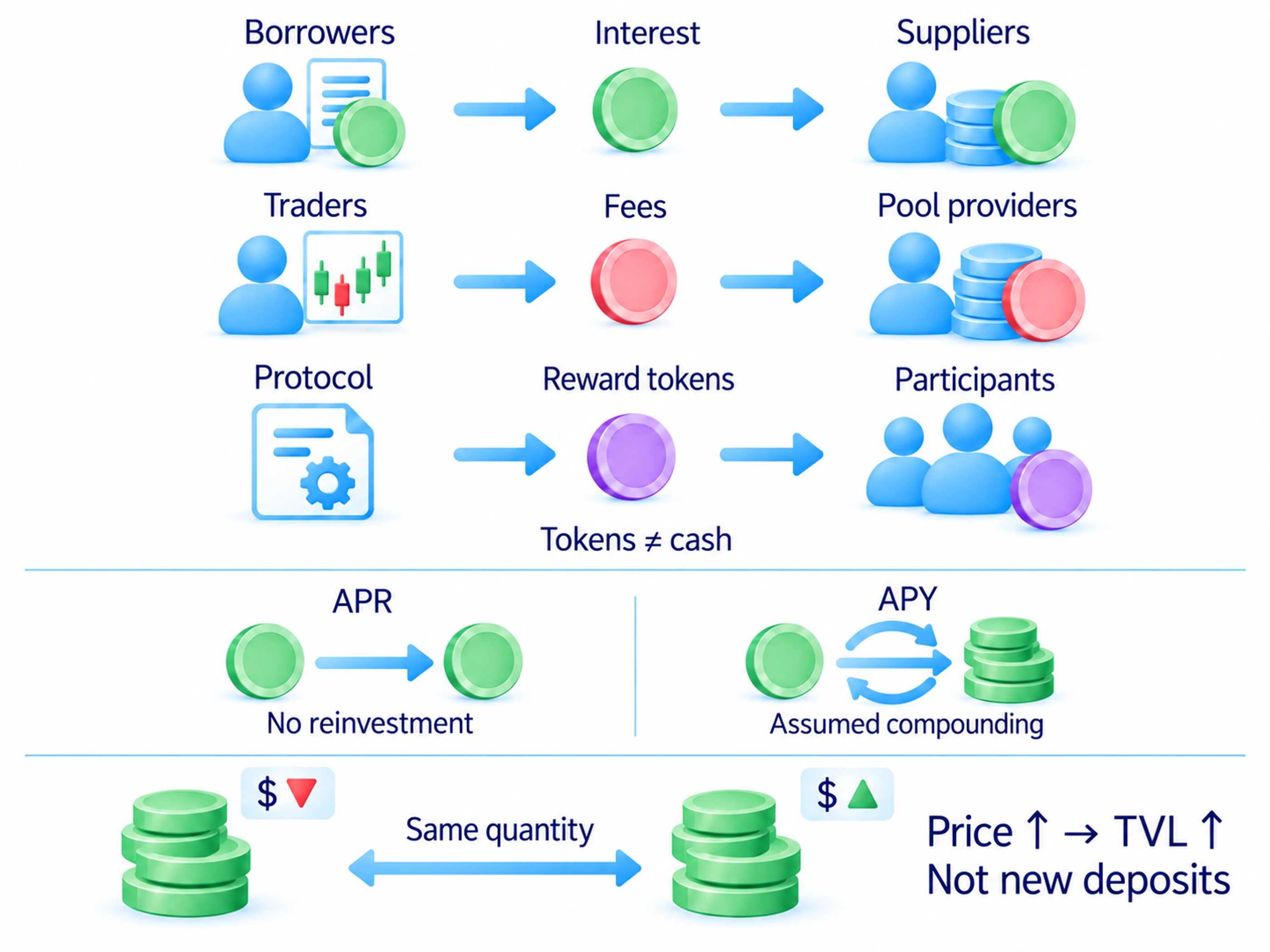
The source of a payment depends on the operation. Suppliers may receive borrowers' interest, while exchange-pool providers may receive part of traders' fees. A protocol may also distribute reward tokens. Receiving those tokens is not the same as receiving cash income: their price, saleability and distribution conditions affect the outcome.
An advertised annual rate often reflects current conditions rather than a rate locked in for the next year. Annual percentage rate, or APR, normally excludes reinvesting the return. Annual percentage yield, or APY, includes assumed compounding, earning a further return on reinvested rewards. Compare the payment asset, calculation method, reinvestment frequency and costs. A high number does not explain where the payment comes from, and does not by itself prove fraud.
Staking to support a network and depositing tokens into an exchange pool serve different purposes. Interfaces sometimes use staking for other reward programs too. Find out what actually happens to the assets before comparing percentages. The crypto staking guide explains the separate network-participation mechanism.
Total value locked, or TVL, estimates the value of assets counted in the contracts of a selected protocol or group. It depends on both token quantities and prices. A higher dollar valuation with unchanged quantities does not prove new deposits or more users. When comparing services, check which assets are included and how the method handles repeated claims on the same underlying assets.
TVL is not the quantity available for a particular swap or withdrawal. A large total can span different assets and operations. Check the availability of the token you need, actual costs and the source of rewards alongside that total. A long operating history and a large recorded value are information about a service, not substitutes for examining its rules and dependencies.
Checks before using DeFi
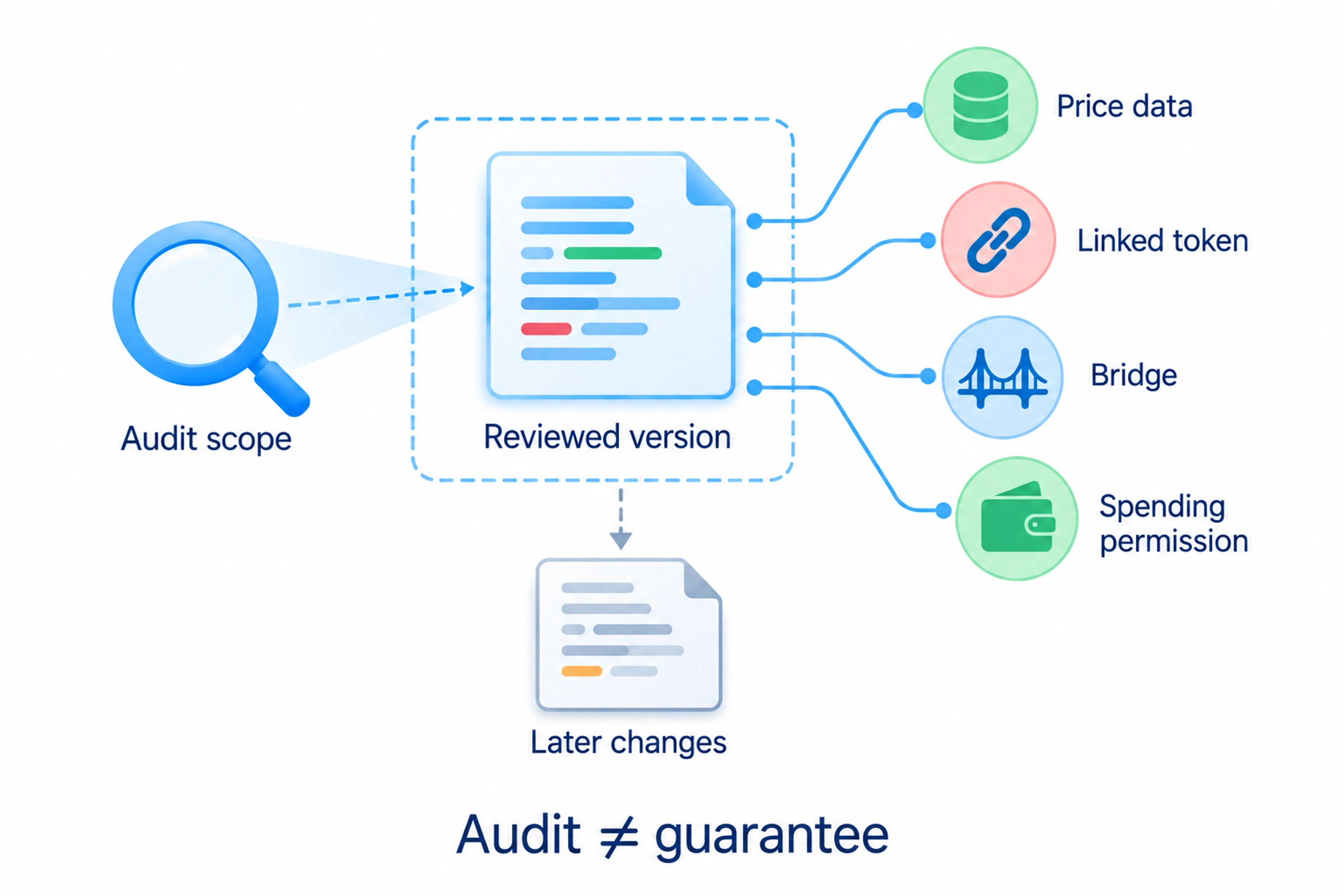
A code audit can identify weaknesses without guaranteeing their absence. Check which version and programs were examined, whether anything changed afterwards and who can make further changes. Losses can also arise through price data, a linked token, a bridge between networks or permission to spend assets, rather than a defect in the core program alone.
Record the network, program addresses, purpose of the operation, payment source and conditions for recovering funds. Read withdrawal restrictions, collateral rules and management powers. Check whether you can revoke an unwanted spending permission and which assets it covers. Crypto risks and scams explains common deception and wallet-protection problems.
In my course, the section on calculating quantity starts with the instrument's parameters and the money the trader is prepared to lose. That check has a limit here: a market-price stop cannot protect against a program defect or an authorised token transfer. The course does not provide a DeFi strategy. Separately assess what you could lose if a program or dependency fails, and practise the action in a learning environment when the protocol provides one.
A small test operation helps check the steps and costs, but does not establish future safety. If you cannot explain the payment source or the conditions for getting funds back, a high advertised rate does not supply the missing information. Find those conditions in the documentation and identify which dependencies remain outside your control.
Frequently asked questions
DeFi covers financial operations through blockchain programs, such as token exchanges and loans backed by assets committed to support the debt. A wallet signs the actions. Removing a bank does not remove risks arising from programs, assets or external data.
TVL estimates the value of assets counted for a protocol or group. Prices and the counting method affect it, so it is not a measure of new cash deposits, user numbers or the availability of a specific token for withdrawal.
The token quantities in a pool share change under the pool's rules. As relative prices move, its value can fall behind simply keeping the original tokens. Fees need not offset that difference, and the tokens and program can introduce other losses.
Payments may come from a share of trading fees, borrowers' interest or reward tokens. Check the payment source, payment asset and costs. More tokens do not necessarily mean a greater money value.
No. An audit examines particular code and helps find defects, but does not guarantee their absence. It does not remove risks from external data, tokens, spending permissions or later program changes.
About the author
Igor Arapov has traded since 2013 and writes the ArapovTrade learning library. ORCID: 0009-0003-0430-778X.




