Cryptocurrency risks involve price changes, the ability to sell, the service holding the assets and control of the wallet. Fraud adds a different problem: someone misleads you to obtain your money or access. A falling price does not automatically prove fraud, and a familiar name does not rule out losses. Before transferring money, identify what you are buying, where it will be held and who can control it.
The different ways crypto users can lose money
Buying an asset and entrusting money to a service are different decisions. The purchase brings price risk. The service adds custody, withdrawal conditions and your rights if the company has problems. Cryptocurrency for beginners explains coins, tokens and the underlying blockchain, the network's shared transaction record.
An exchange commonly controls access to assets it holds for customers. A displayed balance does not by itself establish that withdrawals are available. With your own wallet, responsibility for the keys and signed actions rests with you. Crypto storage explains these arrangements. Neither eliminates every type of loss.
Token-program rules matter too. A smart contract, the program defining a token's operations, may restrict transfers, charge additional fees or give an administrator powers to change conditions. A working website and an attractive chart do not show those powers. Check the contract address on the intended network and the rights to change its rules.
Haste can combine several risks: buying after a sharp rise, skipping an address check or signing an action you do not understand. A claim that this is your last chance does not make an offer more credible. If you cannot explain who receives the money or what access you are granting, stop before signing or transferring.
Losses without fraud
A cryptocurrency price can change sharply without anyone committing fraud. A real, functioning project does not promise a profitable token purchase. Buying the asset without borrowing means a fall reduces the holding's market value. Waiting does not restore the amount spent if the price fails to recover.
Suppose you buy 100 coins for USD 10 each, spending USD 1,000. At USD 2 per coin, the holding is worth 100 × 2 = USD 200. Its value has fallen by USD 800, or 80% of the initial cost, before fees. This is a hypothetical valuation calculation, not a forecast for a named cryptocurrency.
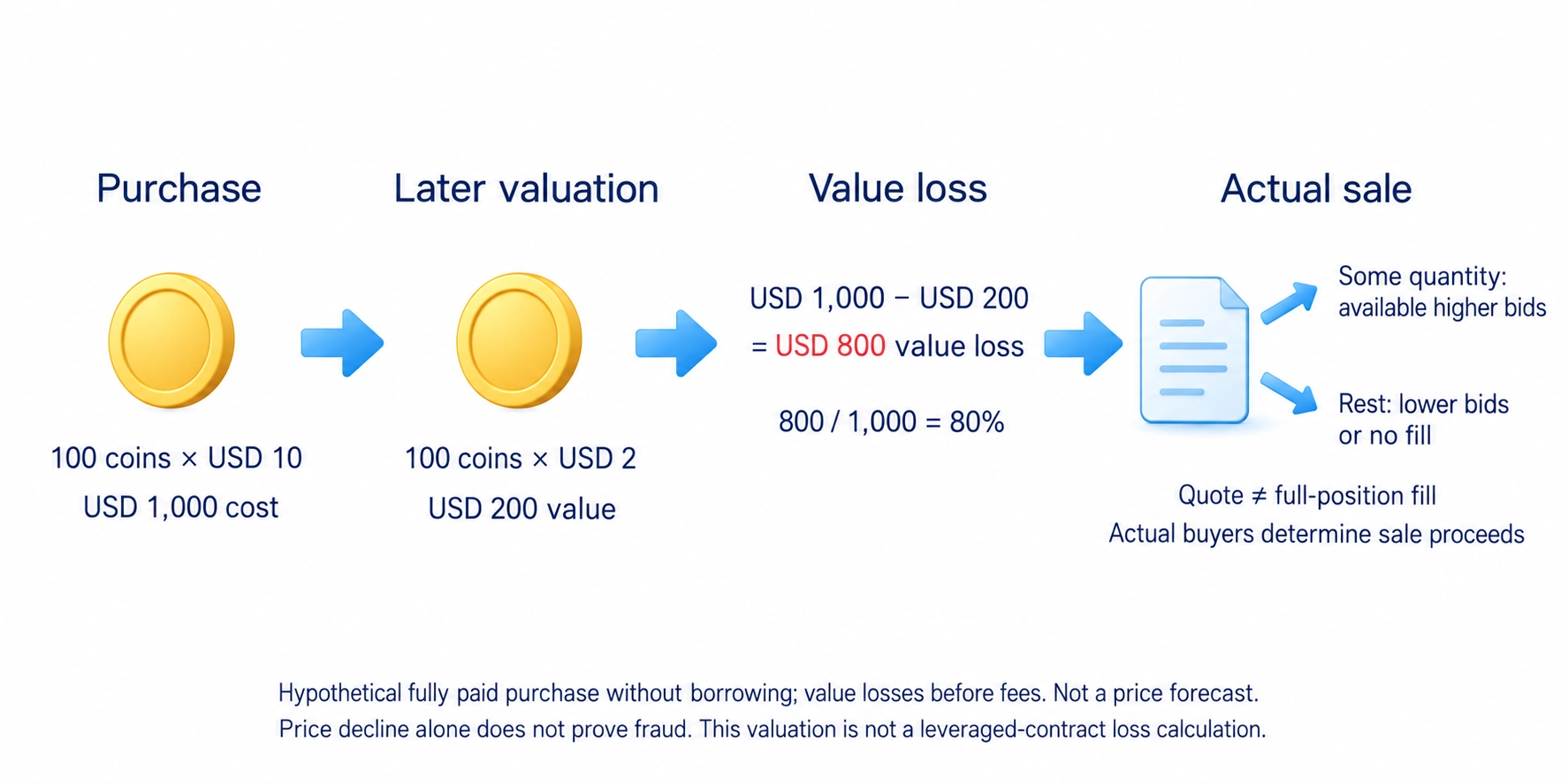
The ability to sell matters alongside the quoted price. Where few buying orders are available, a large sale may execute at several progressively lower prices. The last quote does not promise that your entire quantity can be sold at that price. A large price difference between venues can also reflect unavailable withdrawals or insufficient orders. Those conditions matter in crypto arbitrage.
Leverage, opening a trade worth more than the funds committed to it, creates another loss mechanism. The service may forcibly close the trade before the asset price reaches zero. Crypto perpetuals and margin explains that process. Do not apply the unborrowed-purchase calculation to a leveraged contract.
Delisting means a venue stops trading a particular market. It may remove a trading pair or the asset more broadly. That does not by itself prove fraud or require the asset's price to become zero, but it can make selling and withdrawing harder. Read the notice for the affected markets, withdrawal deadline and supported networks. Do not transfer to an address that no longer accepts the asset on your selected network.
Common crypto scams
A crypto scam uses deception to obtain money or control of assets. A project that fails commercially is not automatically a scam. Assess verifiable actions and terms, rather than treating a falling chart or an accusation as proof.
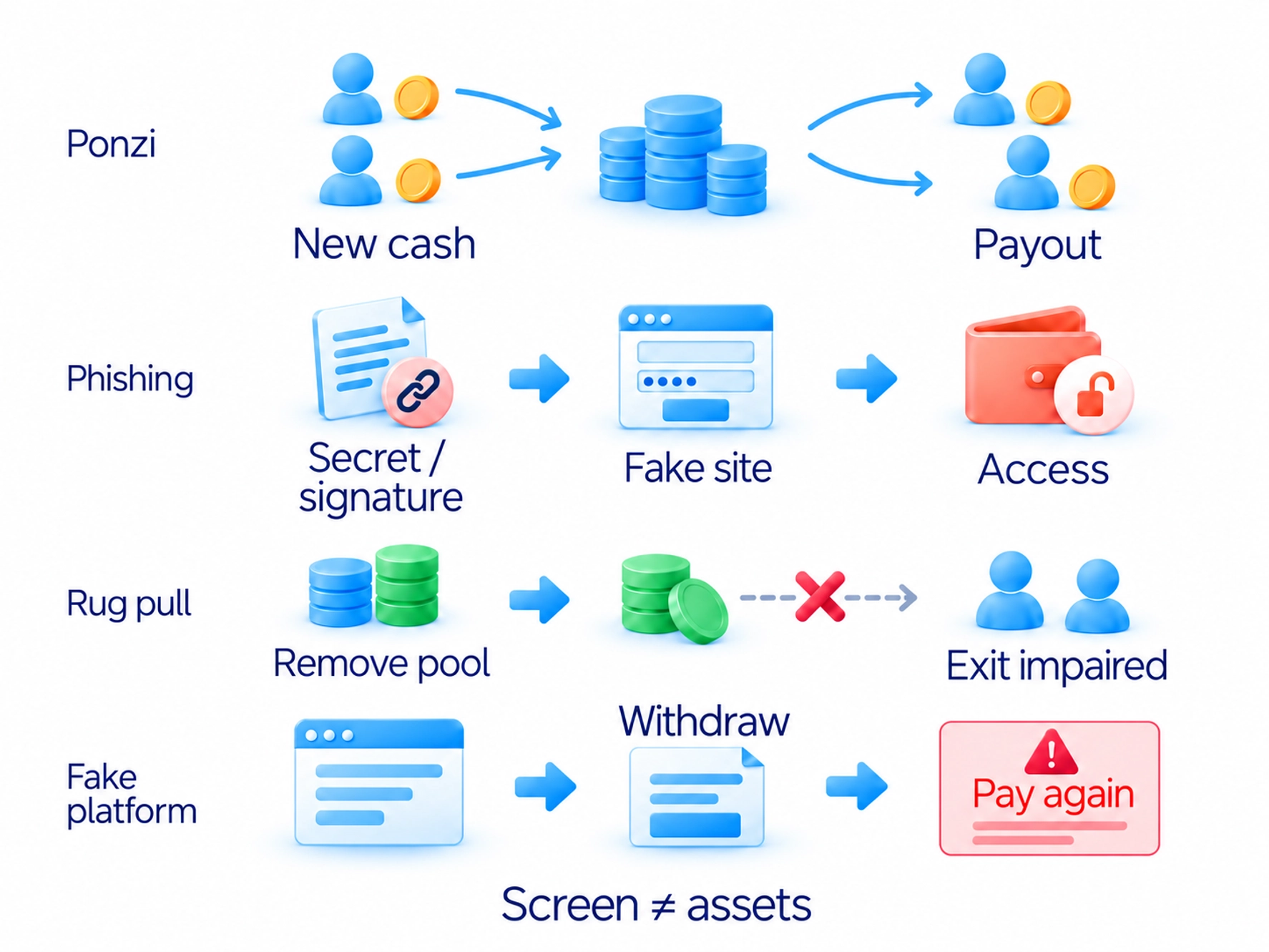
A fake investment platform may display a growing balance without making the represented purchases or holding withdrawable assets. When you ask to withdraw, it may demand another payment for tax, insurance or account unlocking. An account-screen figure does not prove that assets exist. Sending more money to an unverified recipient is not a reliable way to recover earlier payments.
In a Ponzi scheme, payments to existing participants come from new participants' money rather than the promised investment activity. Recruitment-based pyramid schemes also depend on new participants to pay earlier ones. High, supposedly stable returns and rewards for recruitment call for checking the actual payment source. These clues alone are not proof of a crime; saying that community growth pays the returns still does not explain independent earnings.
Phishing uses a fake page, message or support contact to obtain access. The attacker may ask for a recovery phrase, words that can restore a wallet, or request a harmful signature. Someone who obtains that phrase can restore its associated accounts and control their assets. An ordinary support request does not require you to disclose it.
A rug pull describes creators taking funds or removing liquidity, the assets available for trading, so buyers cannot exit as expected. Another harmful token program may allow buying while restricting ordinary holders' sales. An audit or a lock on some pool assets does not rule out other powers or routes for extracting funds.
How a pump and dump works
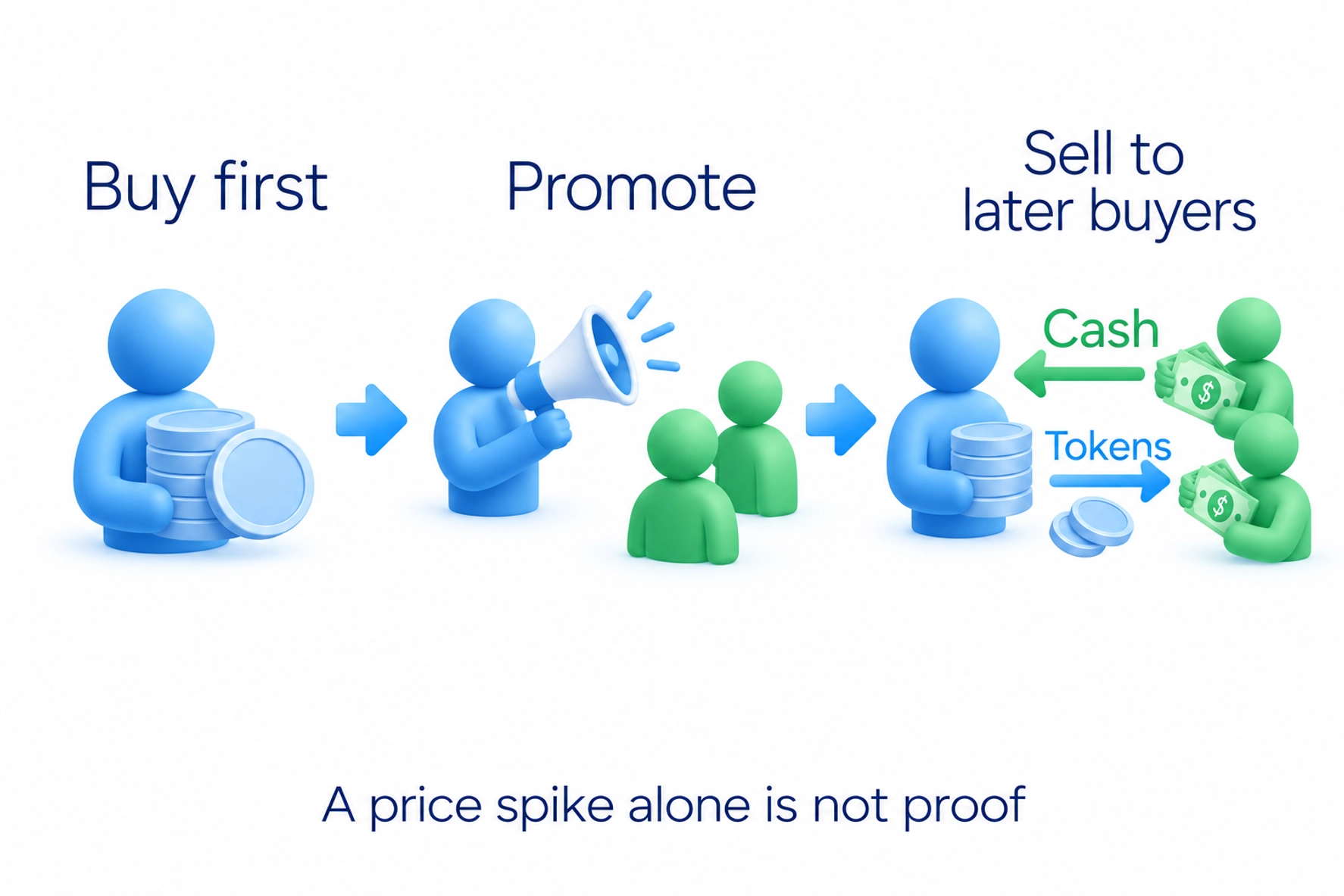
A pump and dump promotes an asset to draw in buyers before the organisers sell their holdings. They may buy first, spread false claims and urge others to act immediately. As later buyers chase the rise, earlier sellers use that demand to exit.
Where few orders are available, additional buying can raise the price sharply. Buying after that rise does not establish that buyers will be available for your own sale. The price can fall abruptly when promotion stops and selling begins. A sharp rise alone is not proof of a pump and dump; establishing the scheme requires evidence of the organisers' actions.
A private group announcing an exact buying time does not put everyone on equal terms. You do not know who already owns the coin and plans to sell when the signal appears. Profit screenshots and promises of shared gains do not establish your execution price. Investigate the reason for interest independently of people who benefit from your purchase.
Checks before transferring money
Find the genuine website through an independent source and compare its address carefully. Identify the company, service terms and withdrawal conditions for your country. Where the service requires authorisation, check the relevant regulator's register and match the legal entity. Company registration or permission for one service does not guarantee each token's safety or compensate market losses.
Connecting a wallet to a website and allowing a program to spend tokens are different actions. Read which program receives access, to which token and for what amount. An unlimited permission can remain after you close the site. Disconnecting the website from your wallet does not itself revoke an earlier spending permission.
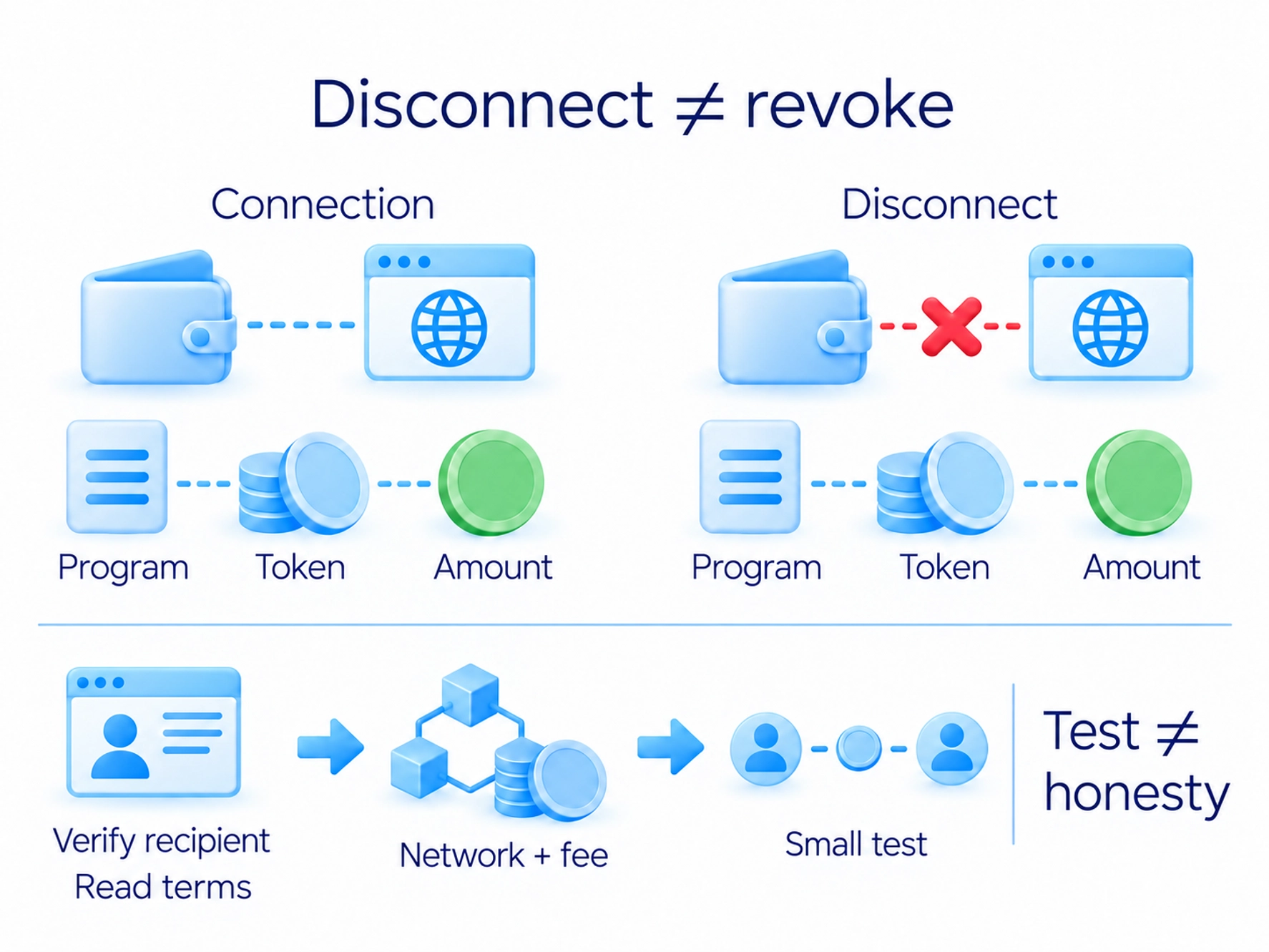
Before sending, check the network, destination, payment purpose, fee and recovery or withdrawal terms. A small test transfer can reveal some address or network mistakes, but does not prove a service is honest: scammers may allow an initial small withdrawal. Also establish what happens to customers' assets if the service stops operating.
In my course, calculating quantity connects the acceptable money loss with the conditions of a trade. A trading-loss limit, however, does not protect against giving away a recovery phrase or a service blocking withdrawals. Check custody and the recipient first, then decide how much to commit.
The optional account-drawdown discussion examines losing control of a trade. It illustrates trading risk rather than teaching a separate crypto-fraud method. Its relevance here is the difference between a plan for price changes and hoping that every loss must eventually disappear.
What to do if you suspect fraud
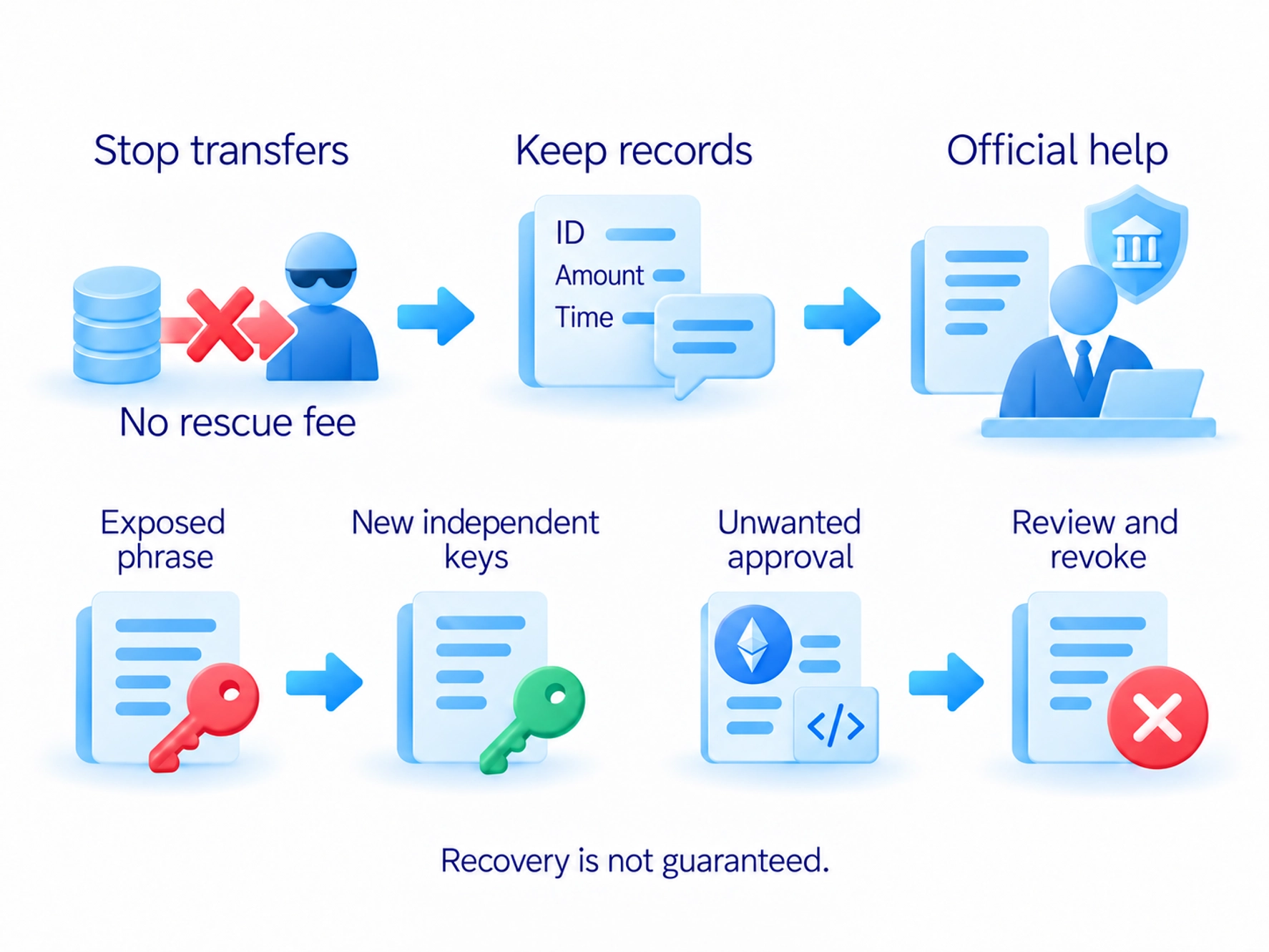
If you suspect fraud, stop further transfers and do not pay a stranger who promises to recover the money. Keep messages, website and wallet addresses, transaction identifiers, amounts and times. Contact the official support of the service used and the relevant authorities in your country. Recovery depends on the circumstances; a message promising success does not establish that it is possible.
If you disclosed a recovery phrase, treat the associated wallet access as compromised. Changing the application's password does not prevent someone restoring the wallet elsewhere with that phrase. Revoking an unwanted spending permission addresses a different problem from replacing compromised wallet access. Do not sign a stranger's proposed rescue action without understanding what it permits.
Frequently asked questions
Price changes, too few buyers for your sale, service failure, loss of wallet access and fraud can all cause losses. They require different checks: limiting a trade's quantity does not replace checking the recipient or wallet permissions.
Yes. Demand and available orders affect the price. A functioning project does not guarantee a profitable token purchase, and a fall alone does not prove deception.
Check the recipient, the source of the promised earnings, actual withdrawal terms and the access requested. Guaranteed returns, pressure to act and new payments to unlock funds are reasons to stop and verify independently, rather than proof that a superficial checklist can detect every scam.
It promotes an asset to attract buyers before the organisers sell. A later buyer can be left holding a falling token. A price rise alone does not establish that this scheme took place.
Check the network, destination, genuine website, recipient, withdrawal conditions, fees and permissions. A test transfer may reveal a technical mistake, but does not establish that the project is honest.
About the author
Igor Arapov has traded since 2013 and writes the ArapovTrade learning library. ORCID: 0009-0003-0430-778X.




