Trading psychology concerns how emotions and thinking habits affect decisions to enter, hold or close a trade. Fear can prompt an early exit from a profit or a refusal to accept a loss. Excitement can encourage a larger trade quantity without a new reason. The practical task is to notice these changes before they replace your trading rules.
Feeling calm does not guarantee a good trade. Feeling nervous does not automatically make a trade wrong. What matters is whether you understand the conditions, keep the planned risk and act on the rules you chose before opening the position.
Is Psychology More Important Than a Trading Strategy?
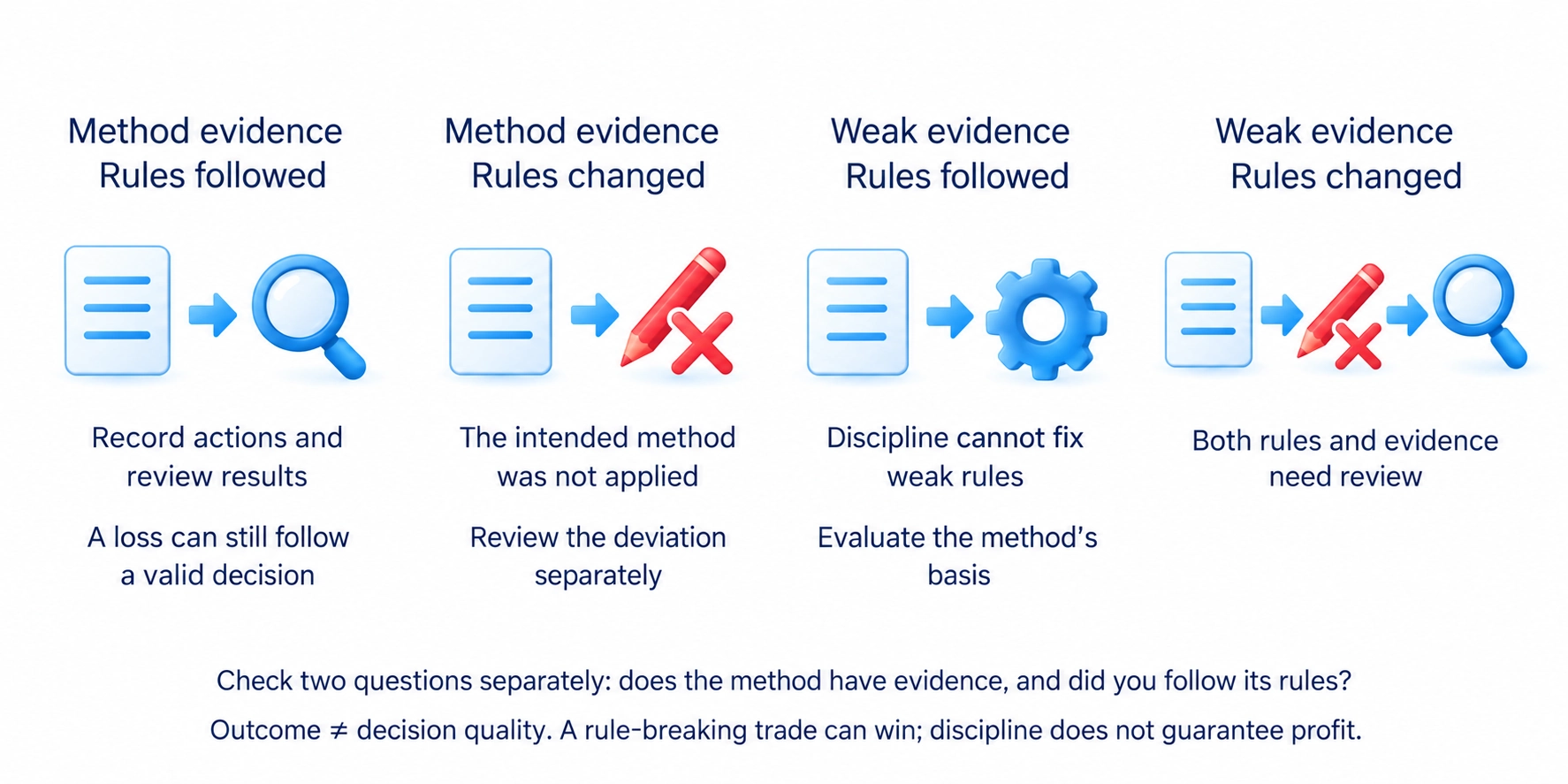
Discipline helps you follow a method; it cannot make every method profitable. You can execute weak rules consistently and still lose money. You can also break sensible rules because you want to avoid a loss or repeat a recent win.
Separate two questions: does the method have a sound basis, and did you follow it? The trading-system guide explains the method and its assessment. This article addresses behaviour: what you change under pressure and how to identify the change. There is no universal percentage of results attributable to psychology.
In the fear and greed lesson in my course, I distinguish trading for excitement from working through stated conditions. Before submitting an order, you should be able to explain why the trade meets your rules. “I want yesterday's money back” describes a wish, not an entry condition.
How Fear Changes Trading Decisions
Fear can pull decisions in opposite directions. Loss aversion means that avoiding a loss can weigh heavily in the decision. A trader may take a small profit early because losing it feels uncomfortable, yet keep a losing position open because closing it would make the loss final.
Researchers call the tendency to sell winners readily and retain losers the disposition effect. Terrance Odean documented it in a study of 10,000 brokerage accounts. That is a finding about a group of investors, not a diagnosis of every trader or proof that any profitable exit is premature.
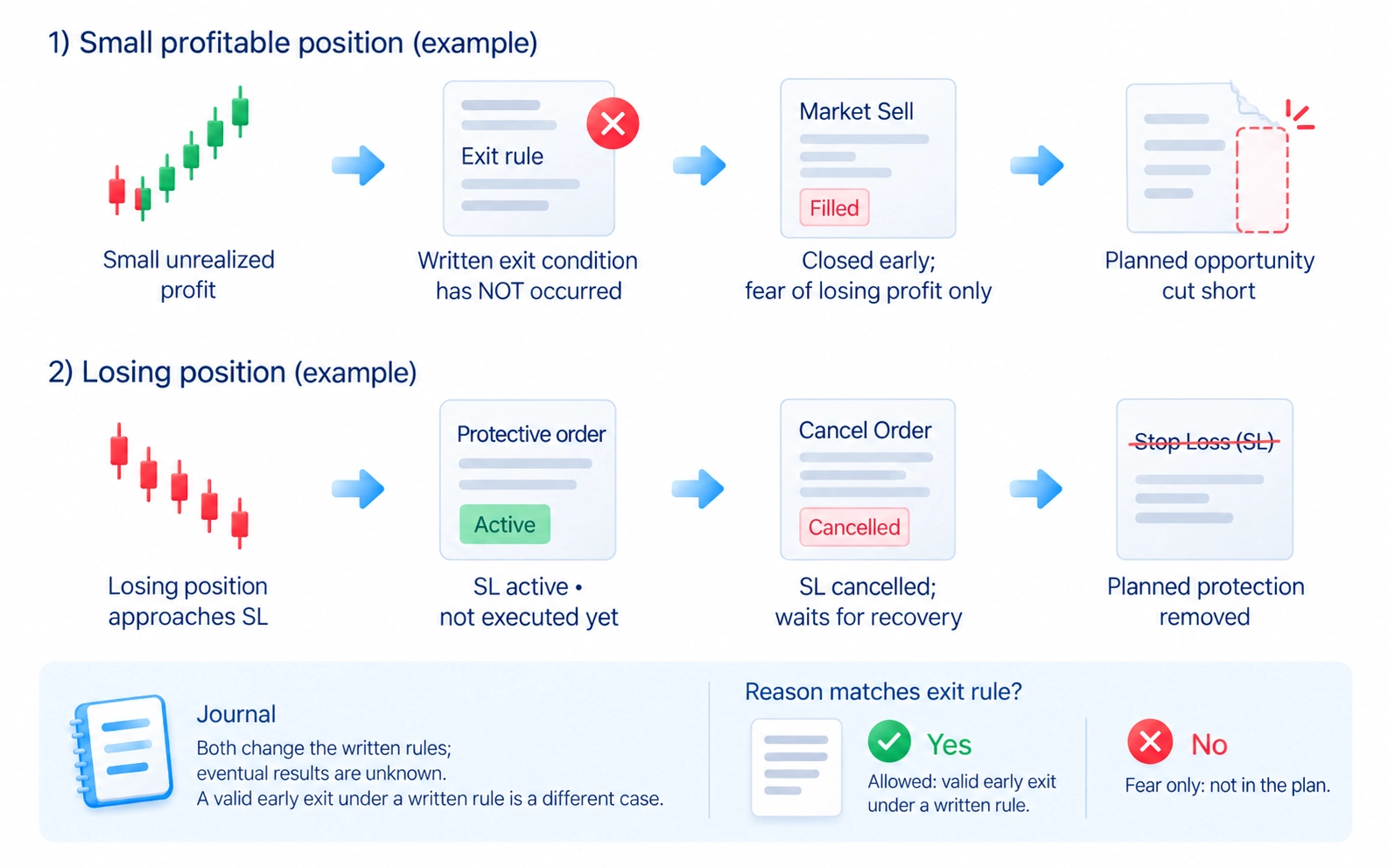
Consider a hypothetical trader who writes down an entry condition, a stop-loss and a target before buying. A stop-loss is an order intended to close the position if a specified trigger is reached. The trader closes the first trade at a small profit solely because the price might fall, although the planned exit condition has not occurred.
On the next trade, the price approaches the stop. Before the order executes, the trader cancels it and waits for recovery. The first action cuts the planned opportunity short; the second removes the planned protection. These are changes to the rules, whether or not either trade eventually makes money. A valid early exit under a written rule is a different case.
In my approach, the possible loss must also fit your financial circumstances. If a planned loss would threaten essential expenses, the position is too much to carry. If it makes you want to hide the stop or watch every price update, check the quantity as well as the exit condition. Risk management explains the sizing calculation. Reducing the position may reduce pressure, but it does not replace knowing when to enter and exit.
Fear can reveal a knowledge gap: you cannot explain the signal, do not understand the order or have not practised the method. Return to practice instead of forcing a real trade. The beginner's trading guide covers the platform and a demo account, which uses simulated money. Demo practice helps you learn the actions; it does not reproduce all the feelings of risking your own money.
Greed and Overconfidence After Winning Trades
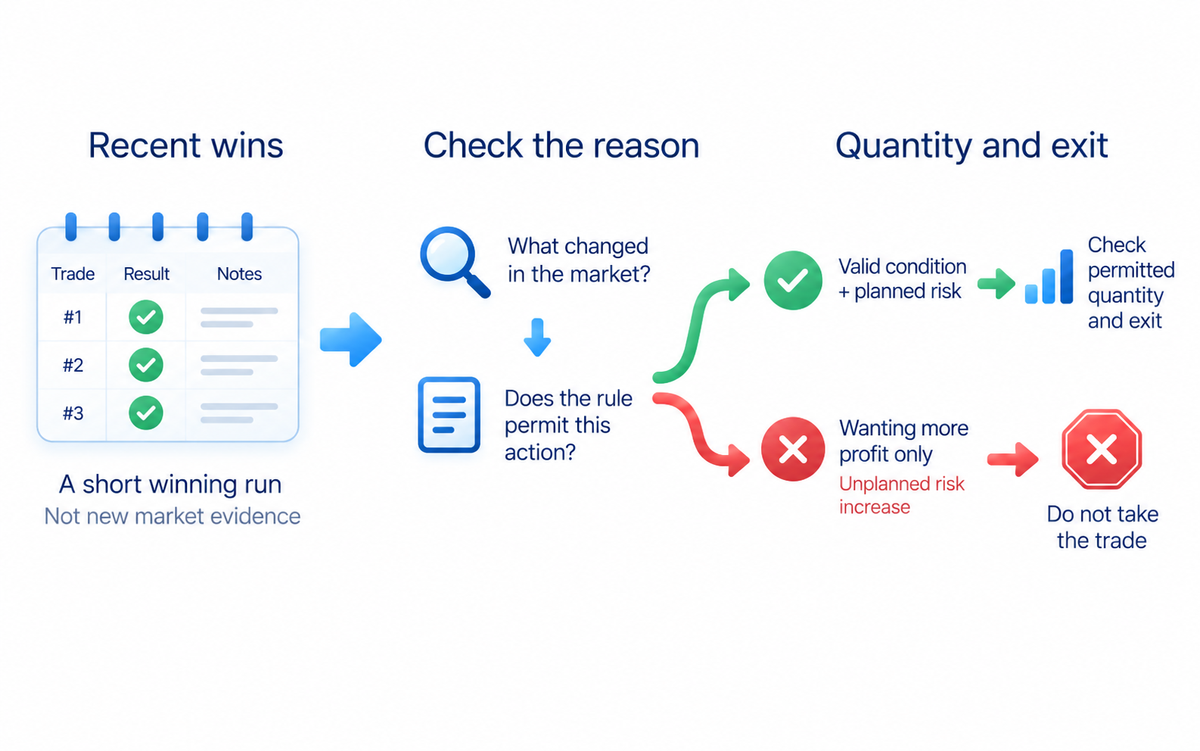
Greed becomes a trading problem when the amount you want to earn replaces the condition for acting. You increase quantity because the last few trades won, hold beyond the planned exit without a rule, or open another position because one win feels insufficient.
A short winning run does not establish that your method will keep working. It may increase confidence faster than the evidence supports. Compare the proposed change with the original plan: what changed in the market, and does your rule allow this action? Wanting a larger profit is not itself new market information.
The trade-management guide explains planned exits and changes to protective orders. Here the useful check is behavioural: are you applying one of those conditions, or changing the plan because the current profit feels too small?
Tilt and Revenge Trading After a Loss
Tilt means becoming so frustrated or agitated that you struggle to follow your rules. Revenge trading is trading to recover a loss immediately, rather than because a valid opportunity appeared. Not every trade after a loss is revenge trading; the reason and the risk distinguish them.
Watch for concrete changes: entering without the required condition, increasing quantity to win back money, moving the stop farther away, or ignoring your stopping rule. A wish to restore the account balance can lead to adding to a losing position or raising the stake after losses. Their mechanics belong in the averaging and martingale guide. The psychological question is whether you are looking for an entry condition or trying to erase an unpleasant result.
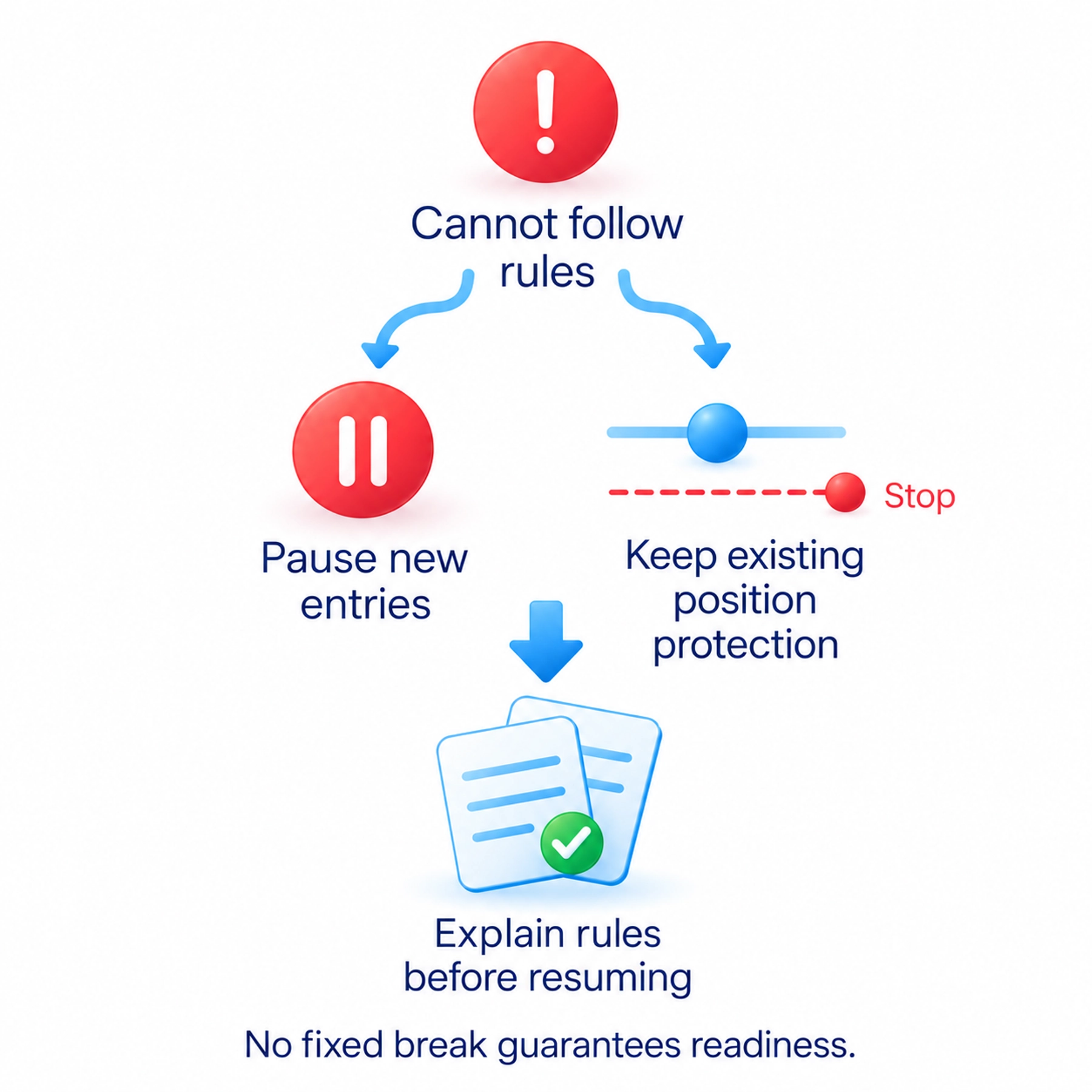
Choose your stopping conditions before trading. They can include a loss limit you have set or a clear rule violation. If you cannot follow the plan, stop opening new trades and review what happened. Pausing new entries does not mean cancelling protection on an existing position. No fixed break of ten minutes guarantees that you will be ready to resume; check whether you can again explain and follow the rules.
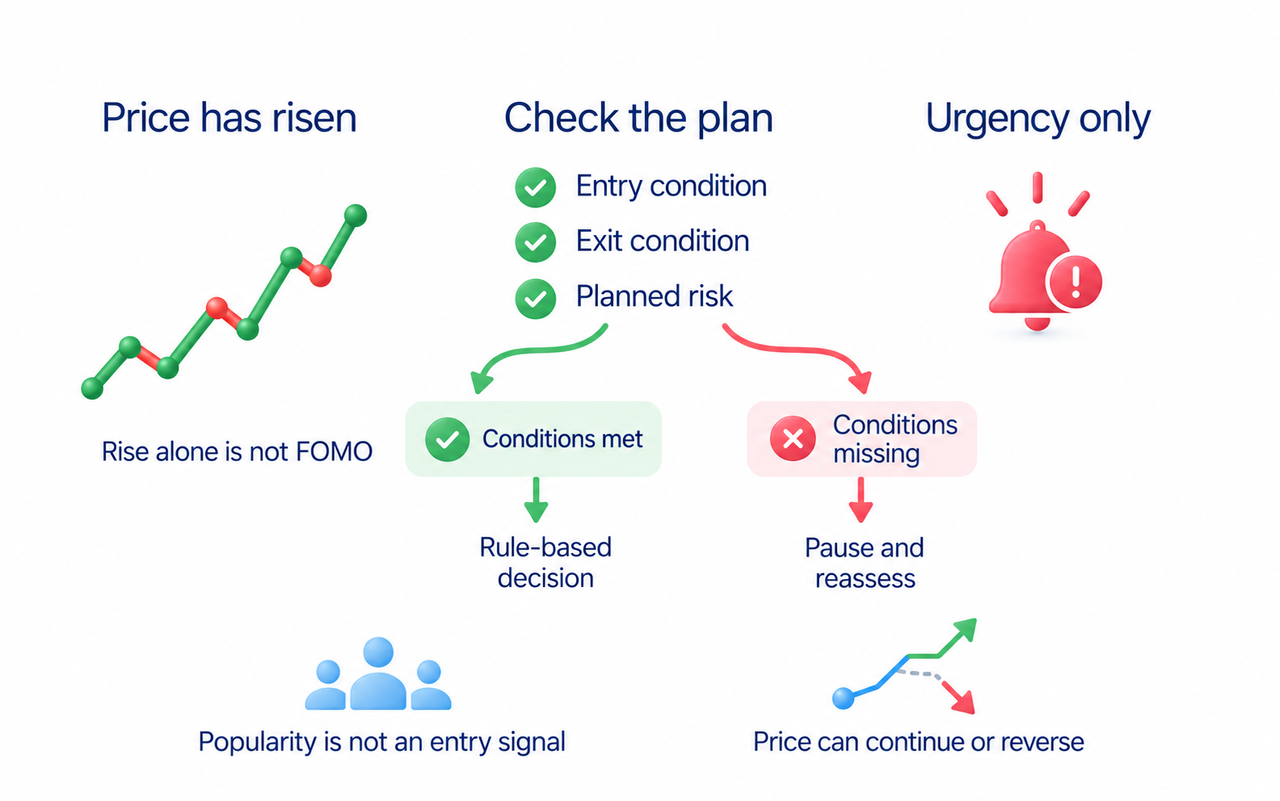
FOMO: Fear of Missing a Price Move
FOMO means fear of missing out on an opportunity. A fast rise, other people's profit screenshots or repeated notifications can create urgency: buy now, otherwise it will be too late. The price may continue rising or reverse. Buying after a rise does not automatically mean buying the top; the error is acting without the conditions and risk controls your method requires.
Before entering, answer two questions: what is my entry condition, and what would require me to exit? If you cannot answer, someone else's enthusiasm does not supply the missing rule. Limit notifications that push you to react immediately, and check the actual market evidence instead of counting people who agree.
In my explanations, emotional crowd behaviour is one way to interpret how large positions may be built or closed. This is a model of market behaviour, not proof of who placed an order. Its market reasoning is covered in Smart Money and volume analysis. The feeling that “everyone is buying” does not identify a large participant or create an entry signal.
Thinking Biases to Check Before a Trade
A thinking bias is a repeated error in how you judge information. It can affect a calm trader as well as an emotional one. Naming the bias is useful only if it changes what you check:
- Confirmation bias: you look mainly for evidence supporting your position. Write down the condition that would invalidate the trade too.
- Anchoring: your decision stays tied to the entry price. Check the present reason for holding; the market does not have to return to your purchase price.
- Sunk-cost thinking: money, time or effort already spent becomes a reason to continue. Those past costs do not by themselves improve the next decision.
- Herding: you treat an idea's popularity as proof. Check your own entry condition rather than the number of people recommending it.
- The gambler's fallacy: you assume several falls make the next rise due. A sequence of price moves alone does not establish the next move's probability.
Use these checks on actual decisions, not as labels for your personality. “I ignored the exit condition and searched for reassuring comments” is more useful than “I have bad psychology.” It names the action you can review.
How to Respond to Losing Trades
A loss is not automatically a mistake. A trade can meet the entry conditions, use the planned quantity and close according to the exit rule, yet lose money. An unplanned trade can make a profit. Keep the result and the quality of the decision separate.
A losing run also does not prove either that the method is broken or that it remains sound. Review execution and the method's evidence separately. Do not increase risk simply because you think a win must come next. Apply the stopping conditions chosen in advance instead of inventing exceptions while you want to recover.
In the trader-development discussion, I describe how early carelessness can turn into excessive fear after losses. This is a pattern I discuss, not a compulsory sequence everyone must experience. You do not need to lose an account to learn risk limits. The written rules and checks here are usable without watching the video.
How to Reduce the Influence of Emotions
Before entering, record the reason for the trade, the exit condition, the quantity and planned loss, and the condition for stopping new entries. If a decision changes during the trade, record the reason for that change. “I increased quantity after a loss without a new signal” is a concrete observation; “I felt bad” alone does not explain what happened.
Review these records when you are not deciding what to do with an open position. Choose one repeated violation and one practical constraint to address it. For example, if you repeatedly raise quantity to recover losses, calculate and check the permitted quantity before submitting the next order. This changes the action rather than asking you to become fearless.
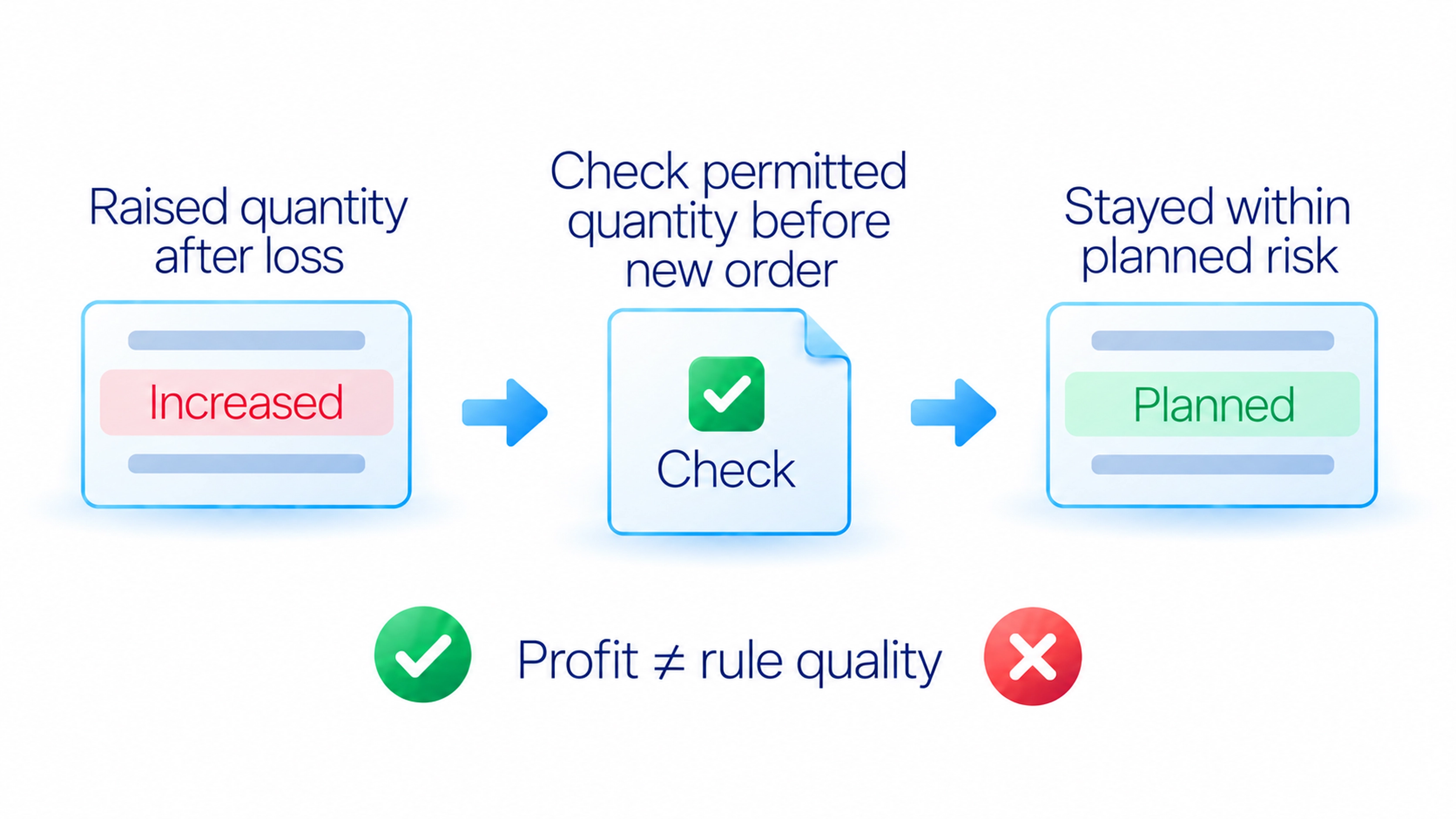
Assess progress through behaviour: fewer entries without conditions, fewer unplanned risk increases, and consistent use of your stopping rule. These improvements do not guarantee profit or remove the need to assess the method. The aim is to make decisions that you can explain and review even while feeling uncertainty.
Frequently asked questions
There is no universal ranking or percentage. A method needs a sound basis, while discipline helps you apply it. Following weak rules consistently does not make them profitable; ignoring rules also changes the method you intended to use.
Fear can cause an early exit or a refusal to close a loss. Greed can prompt extra quantity or holding beyond a planned exit. Compare the action with your written rule, not just the eventual profit or loss.
No. A rise can be part of a valid entry condition. Fear of missing out (FOMO) occurs when urgency about missing an opportunity replaces your entry, exit and risk rules. It does not establish that the price has reached a top.
Tilt is frustration or agitation that makes following your rules difficult. It may show up as entries without the required condition, larger stakes after losses or ignored stopping conditions. Stop new entries when you cannot follow the plan, while keeping existing open trades managed under their rules.
You cannot rely on having no emotions. Use written conditions, an affordable planned loss and records of actual actions to reduce their influence. Feeling nervous is not itself a rule violation, and feeling calm does not prove a trade is sound.
Check whether you understand the entry and exit conditions, the order and the possible loss. If knowledge or practice is missing, return to demo practice using virtual money. If the planned loss is too much to carry, reduce quantity or skip the trade rather than forcing yourself to enter.
About the author
Igor Arapov, a practising trader since 2013 and author of the ArapovTrade library. ORCID: 0009-0003-0430-778X.




