What is proprietary trading?
Proprietary trading means a firm trading for its own account. A professional firm may provide its traders with capital and infrastructure. The same label also appears on retail programmes selling an evaluation and simulated trading. Identify which arrangement you are considering before comparing advertised account sizes.
In a professional firm, a trader may be an employee, partner or contractor. The agreement determines compensation and responsibility. A paid online challenge is not a defining feature of every proprietary trading business. Neither an entry exam nor a large advertised account establishes that a company is reliable.
A retail programme may remain simulated even after the evaluation. Prices can resemble market prices without the participant’s orders reaching an exchange. The company may separately use trading data for its own trades or pay a contractual reward based on simulated results. That is different from giving the participant control of a live brokerage account.
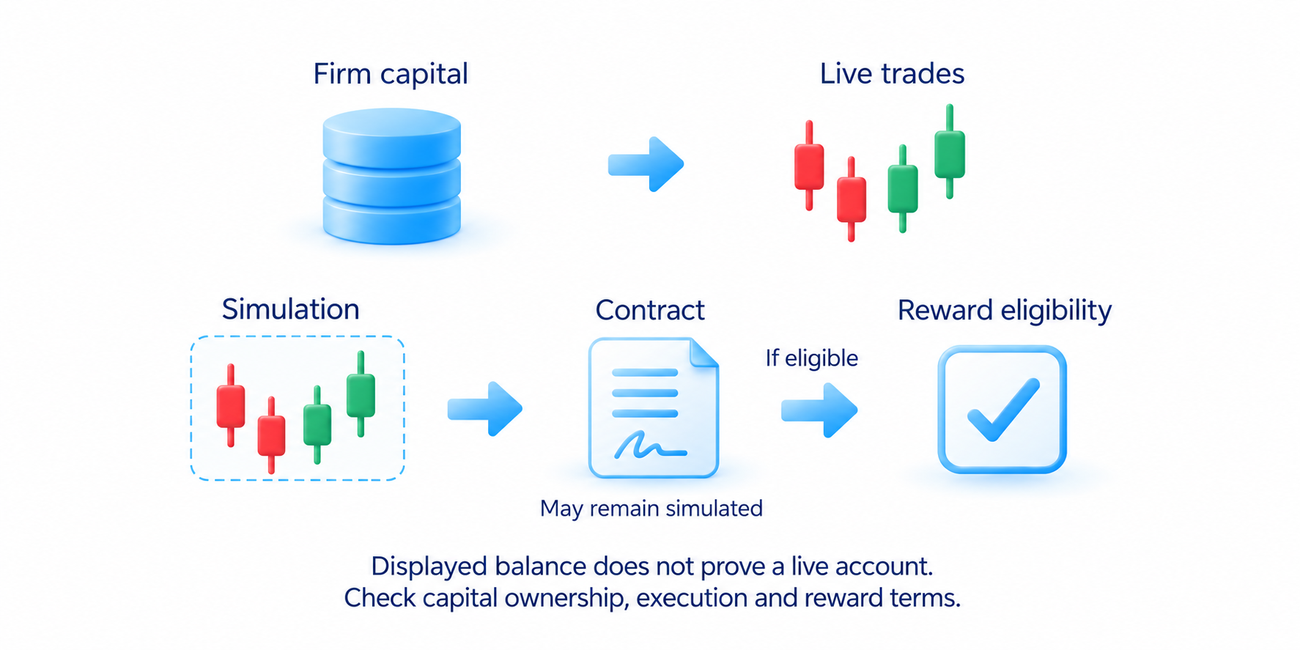
FTMO’s programme for contracts for difference, products based on price changes rather than ownership of the underlying asset, uses simulated accounts. Topstep distinguishes its simulated Express Funded Account from a Live Funded Account using the firm’s capital. These examples illustrate different models; they are not recommendations. The word funded alone does not tell you where trades occur, who owns the money or what creates a right to payment.
How a prop challenge works
A prop challenge is an evaluation under a programme’s rules. It typically combines a profit objective with limits on losses and trading behaviour. Stages, completion conditions and time requirements differ. Paying for an attempt does not mean the advertised capital has been transferred to you.
The fee may be a one-off purchase or a recurring subscription. Activation, resets, data and platform access can create further charges. Establish what the payment buys, when billing stops and what a refund requires. A free practice account may let you rehearse the rules without qualifying you for funding or rewards.
Check all evaluation conditions together. A provider may require positions to be closed before counting the profit target, a minimum number of trading days or a limit on the contribution of the best day. Exceeding a consistency measure may delay completion rather than close the account. The current programme rules determine the consequence.
Drawdown is a fall from a specified reference account value. There is no universal daily-loss limit, drawdown percentage or trader profit share. Products from the same company can calculate them differently. Before paying, save the exact product rules, formulas, time zone and reward terms. Those records help you distinguish your own rule breach from a later change in the service.
Loss limits, equity and trailing drawdown
Balance records closed results and applied charges. Equity also includes the current result of open positions. A programme monitoring equity can register a breach while a trade is still open. A recovery after the breach does not necessarily restore eligibility, even if the final closing balance is above the boundary.
The daily-loss calculation may include closed trades, open profit or loss, trade fees and charges for holding overnight. Check the provider’s daily reset time rather than assuming it uses your local midnight. An open position held through the reset can have less room before a breach than yesterday’s closing result suggests. Apply the actual formula to the open position.
An overall loss boundary can be fixed or trailing. A fixed boundary refers to a specified starting value. A trailing boundary moves upward after a defined high point is reached. The programme may measure that high during the day or at the close, using balance or equity. Identical advertised percentages can therefore impose different constraints.
In a hypothetical evaluation, current equity is $10,000. The daily lower boundary is $9,700 and the overall lower boundary is $9,600; both remain fixed until the next recalculation in this example. The respective gaps are $300 and $400. The nearer boundary leaves only $300 of room, not the entire displayed $10,000.
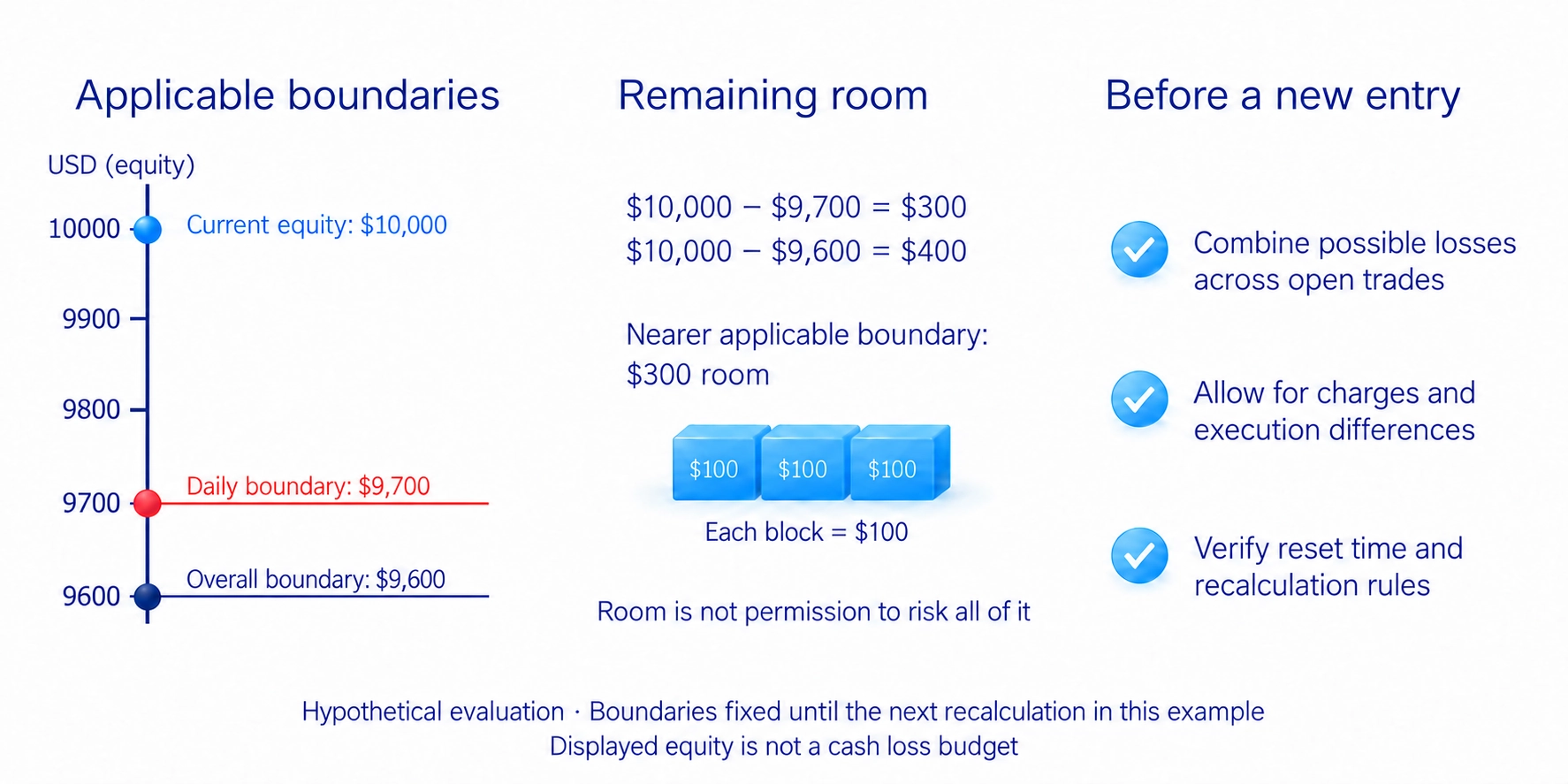
That $300 is not permission to risk all the remaining room. Charges and execution can increase the realised loss, while other open positions can consume room at the same time. Check the possible losses across all open trades and leave space for execution differences before a new entry. Risk management explains how to turn a cash loss budget and instrument parameters into position size.
Funded accounts and payouts
A funded account is a programme stage with specified trading and reward conditions. It can still be simulated. A headline capital figure does not mean you own that amount, can withdraw it or may lose all of it. Read what the number actually represents.
In a simulated programme, a cash reward is a payment owed under the company’s agreement, subject to its conditions. It is not a withdrawal of your own money from the displayed trading balance. Identify what makes a result eligible, which conduct disqualifies it and how claims are reviewed. Payments received by other participants do not guarantee yours.
The profit split describes the participant’s share of an eligible result. Check the share, minimum claim, waiting period, payout cap and required trading days. An evaluation-fee refund may depend on the first approved reward or another event. A promise of a refund without that event does not establish an unconditional repayment after any attempt.
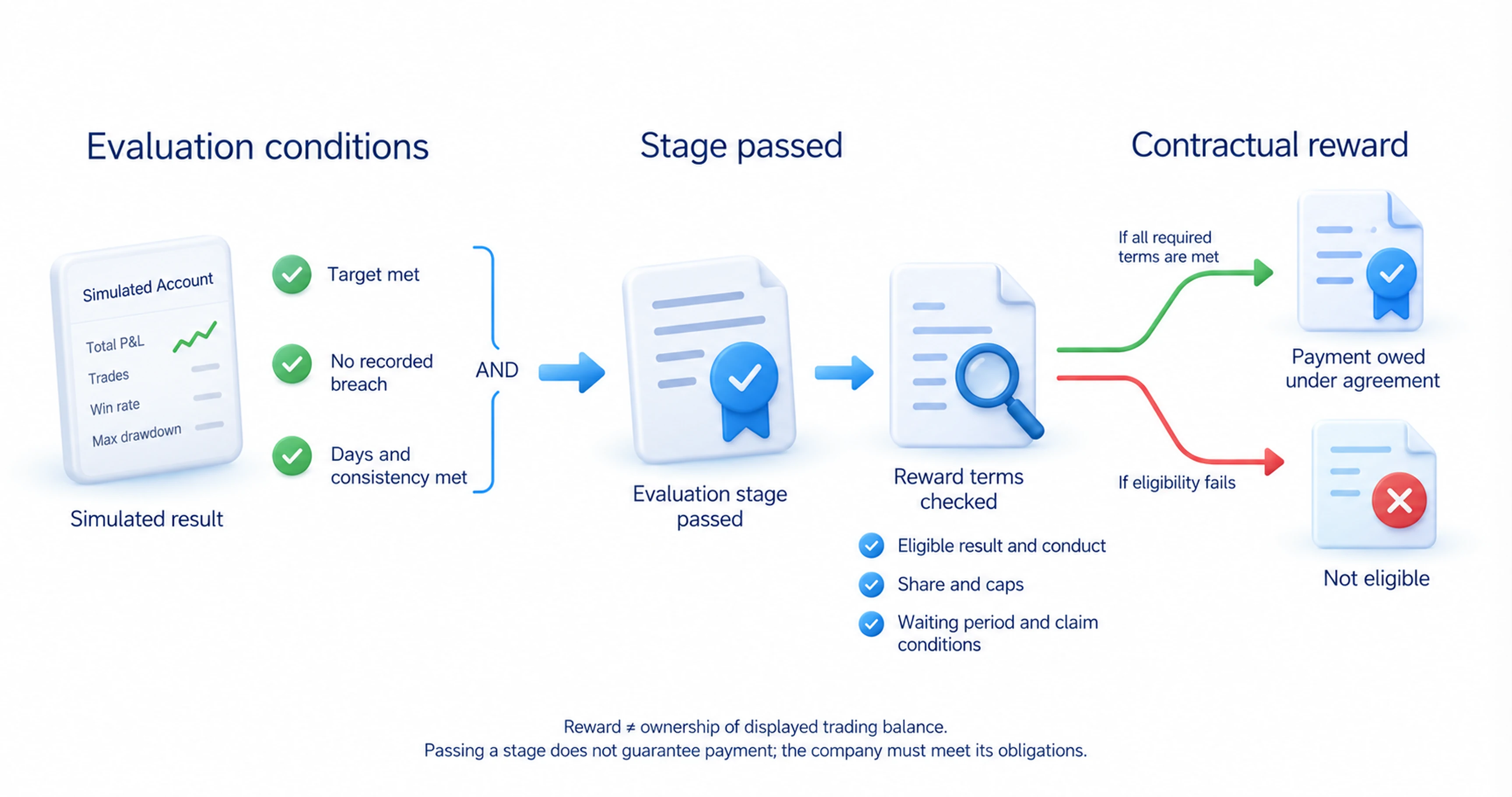
Taking a payout can reduce the trading balance and the room above a loss boundary. Find out whether limits reset, a reserve remains and trading can continue after a full withdrawal. Real-market stages also have the company’s rules. Moving from simulation to live trading does not remove position limits or loss constraints.
Restrictions can cover news, overnight or weekend positions, automated strategies, copying, position quantity and exploitation of simulator errors. Check the selected product rather than relying on another firm’s rules or an older plan. A platform accepting an order does not establish that the agreement permits the action.
Check the firm before paying
Identify the legal entity, agreement, contact address and dispute process. Establish the registration jurisdiction and the service actually offered: simulation, education, live trading or another activity. Company registration is not permission to provide every investment service. Applicable requirements depend on the service and jurisdiction.
Belgium’s Financial Services and Markets Authority has warned about paid simulated prop programmes and unclear reward entitlement. That warning is a reason to examine the business model and terms; it does not establish that every professional prop firm is unlawful everywhere. Pay particular attention to repeated attempt fees when the conditions for receiving a reward remain vague.
Ask for a written explanation of any condition you cannot apply. If you cannot reproduce the loss-limit calculation, identify the contracting entity or understand grounds for refusing a payout, you do not yet have enough information to decide. A guaranteed-income promise does not resolve those gaps.
Prop programmes versus your own account
On your own account, you use your funds and follow the broker’s and market’s rules. A retail prop programme adds evaluation and reward conditions to the trading method. Personal expense can include repeated attempts and subscriptions, not just the first fee. Responsibility when trading actual firm capital is determined separately by the agreement.
Additional constraints can change how a method performs. A strategy allowing a long open drawdown may conflict with a programme monitoring equity every day. A larger nominal account does not simply multiply earlier returns. Reapply the proposed programme’s rules to your recorded trades and locate the points that would have breached them.
In my course’s position-sizing section, the sequence is to set the acceptable cash loss, check the stop distance and the value of a price point, then calculate quantity. A prop evaluation adds another check: room above the company’s nearest applicable loss boundary. The course teaches position sizing; it does not promise to pass a particular challenge.
The video on drawdown explains how keeping a losing position can turn a manageable exit into a prolonged loss. It is a practical addition to the written explanation, not a review of prop firms. Trying to recover losses to reach a target can add pressure; trading psychology explains the decisions involved.
If you do not yet have written trading rules, begin with the beginner learning route and demo practice. Before paying for an evaluation, save your limit calculations, verify reward conditions and set a total budget for attempts. This lets you assess the offer before payment. Trading outcomes and the company’s ability to meet its obligations remain separate risks.
Frequently asked questions
In its original meaning, proprietary trading is a firm trading for its own account. Retail programmes using the label can instead sell evaluation and simulated trading. Check the agreement for the capital, execution and reward model.
Check the profit objective, daily and overall loss formulas, open positions, charges, reset time and prohibited actions. Conditions apply together. Reaching the target does not erase an earlier recorded breach.
It is a programme stage with defined trading and reward conditions. It can remain simulated. The label does not mean the entire displayed amount belongs to the trader or is available to withdraw.
Balance includes closed results and applied charges. Equity also includes current open-position results. A rule monitoring equity can be breached before a position closes.
Terms differ. A free practice mode may not provide reward eligibility. A professional proprietary trading firm does not have to recruit through a paid online challenge.
Your own account uses your money under the broker’s terms. A prop programme adds rules governing access, results and rewards. Personal costs and responsibility depend on the agreement.
No. You must meet the next stage’s conditions and payout requirements. In a simulated programme, payment depends on the company’s contractual obligations, not ownership of the displayed balance.
About the author
Igor Arapov, a practising trader since 2013 and author of the ArapovTrade library. ORCID: 0009-0003-0430-778X.




