All topics: trading questions and answers
Understand trade quantities, loss limits, protective exits and decisions made under emotional pressure. Each short answer links to its written explanation.
1. Limiting trading losses
Risk vs money management
How are risk management and money management different?
Risk management sets limits on planned losses. Position sizing, often called money management, decides how much to trade while respecting those limits. The labels can overlap; neither makes the trade safe.
Trading losses
Why can good entries still lose money overall?
Risk may be too large, losses too big or trades taken without rules. A good entry cannot save an account if losses are not controlled.
Losing streaks
Why are several losses in a row dangerous?
Each loss reduces account value, including gains or losses on open trades. A fixed percentage produces a smaller dollar risk after a loss; keeping or increasing the old dollar risk raises its share of the remaining account. Set a limit before the series and recalculate quantity from current account value.
Risk per trade
How much should I risk on one trade?
The often-used 1% or 2% account-risk guideline is a choice, not a safety guarantee. Choose a limit that reflects an account decline you can tolerate, possible losing streaks and your other open trades.
Position sizing
How do I calculate my trade size?
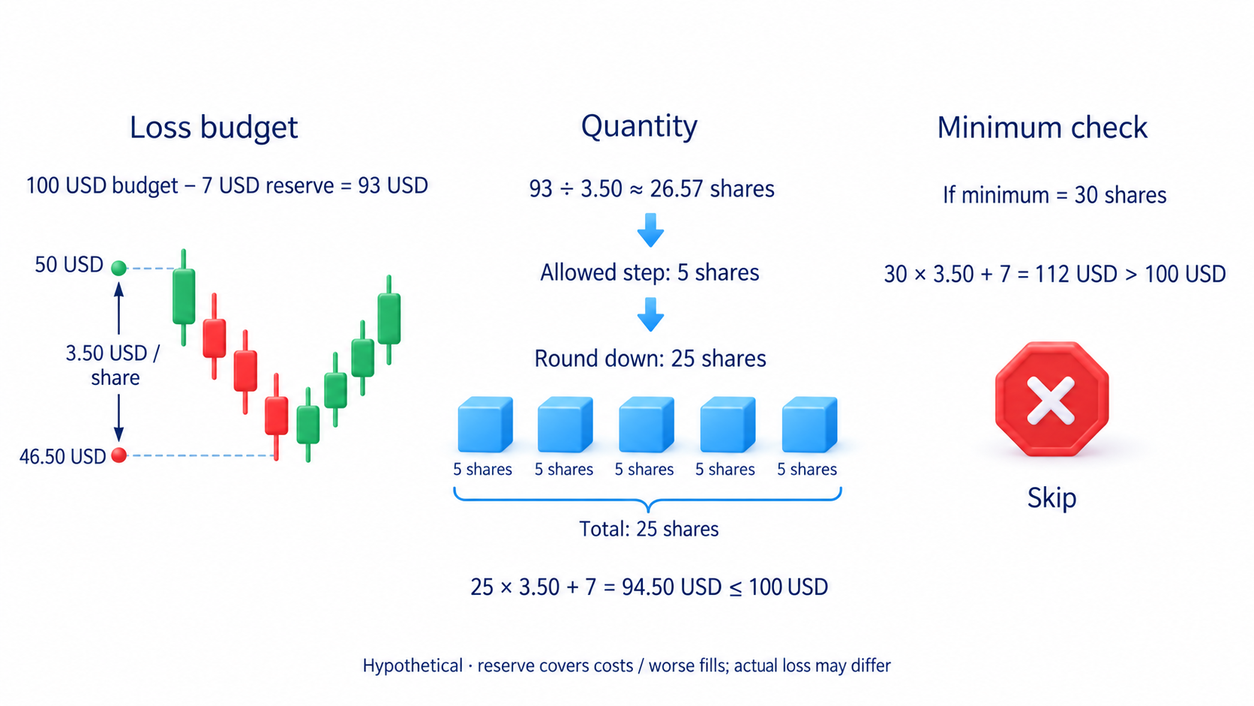
Choose the planned exit and the amount you can afford to lose, then allow for costs and possible worse execution. Divide the remaining loss budget by the price loss per unit to calculate quantity. Round down to an allowed size; skip the trade if even the minimum is too large.
Stop-loss order
Why set a stop-loss before entering?
A stop-loss instructs the platform to exit when a specified price condition occurs. Choosing the exit before entering ties it to the reason for the trade instead of hope that a loss will recover. The order does not guarantee an exact exit price.
Risk-reward and win rate
How does risk-reward affect the win rate I need?
The winning percentage is only part of the result: average gains, average losses and costs also matter. Gains three times the losses can produce a positive series with fewer than half winning trades, under those actual outcome assumptions. Compare the full result after costs, not just the number of wins.
Trading expectancy
What is trading expectancy?
Expectancy is the average money result per trade, combining how often gains and losses occur with their sizes and costs. Compare rule-following trades separately from the result of every trade in the account.
Compounding profits
What does compounding mean in trading?
Compounding in trading means retaining realised profits so they can help fund later trades. A fixed risk percentage then applies to the changing account base. Further losses reduce that base too; retaining profits does not promise interest or future growth.
Forex lot sizes
What are standard, mini and micro lots?
For ordinary Forex trade sizing, a standard lot normally represents 100,000 units of the base currency, a mini lot 10,000 and a micro lot 1,000. The base currency is the first currency in the pair. Check the actual product’s contract size and permitted quantity step.
Combined position risk
Can different currency trades share the same risk?
Yes. Several pairs can depend on the same US dollar move. A change in the dollar can therefore cause losses across multiple positions at once.
2. After you open a trade
Managing an open trade
What should I do after opening a trade?
Follow your planned exit, stop and profit-taking rules. Avoid changing the plan simply because you feel frightened or want a larger gain.
Take-profit order
What is a take-profit order?
A take-profit instruction aims to close a trade at a chosen profit target. Its order type and available prices determine whether and how it executes; naming the target does not guarantee that the market reaches it.
Profit target
Where should I place a take-profit?
Arapov looks at areas that may block price, such as resistance above a buying trade or support below a trade opened for a fall. The target should reflect the chart rather than a desired cash profit.
Risk-reward ratio
How do I compare a trade's possible gain and loss?
Compare the planned money gain at the target with the planned money loss at the protective exit. Actual fills, partial exits and charges can change the result.
Break-even stop
What does moving a stop to break-even mean?
It means moving the stop to the entry price. The trade may then close near its starting price, although fees and slippage can still leave a small loss.
Moving stops too early
Why can an early break-even stop hurt results?
An ordinary pullback can revisit the entry, close the trade and then continue toward the target. Move the protective exit only under conditions written before entry, such as a confirmed change in chart highs or lows that supports the new level. The order still does not guarantee its fill price.
Trailing stop
How far away should a trailing stop be?
A trailing stop follows price to protect some profit. Too close, it may trigger on normal fluctuations; too far away, it allows more profit to be given back.
Hedging a position
What is hedging?
Hedging uses another trade or contract to reduce an existing risk. For example, a producer may use a contract to protect the price of a future sale. The hedge has its own terms and costs; it does not guarantee a profit or remove every risk.
3. Adding money to a position
Average purchase price
How does buying more change my average price?
Buying at a different price changes the average cost of the whole position. It also increases the amount you own and the money exposed to price moves.
Averaging down
Why can buying more of a falling asset be risky?
If the price keeps falling, the larger position loses more money. A lower average purchase price does not protect the account by itself.
Adding to a losing trade
Why do traders want to add to a losing position?
It can be difficult to admit a mistake and take the loss. Buying more in the hope of getting even can replace a planned decision with an emotional one.
Martingale strategy
Why is martingale risky?
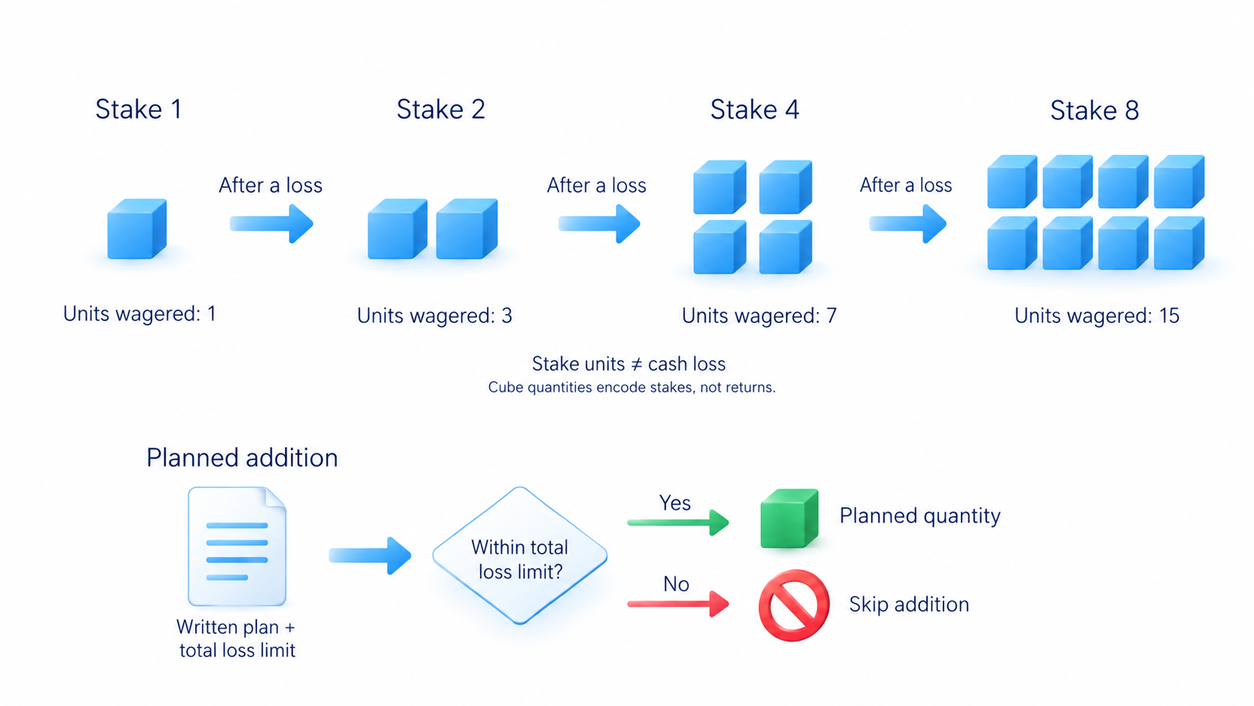
Martingale increases the stake after a loss. With doubling, sizes grow as 1, 2, 4, 8 and so on, so a long losing streak can quickly exhaust an account.
Planned position additions
How is a planned addition different from rescuing a losing trade?
A planned addition is decided in advance with a limit on the total loss. Trying to rescue a trade often starts after losses and may lack that limit.
4. Behaviour and trading decisions
Trading emotions
How can emotions interfere with a trading plan?
Emotions can replace the stated reason for a trade with excitement or a wish to recover a loss. Explain the conditions before placing an order; discipline does not make every method profitable.
Trading vs gambling
How is systematic trading different from gambling?
Systematic trading uses stated conditions rather than excitement or hope. You should be able to explain the reason before placing the order, and the method still needs sound evidence; following weak rules consistently does not make them profitable.
Fear, greed and tilt
What is trading tilt?
Tilt is frustration or agitation that makes following your rules difficult. It can lead to entries without a signal, increased quantity after losses or ignored stopping conditions. Stop new entries when you cannot follow the plan.
FOMO trading
What is FOMO in trading?
FOMO is fear of missing out on a profitable move. It can push you to buy after a sharp rise without a plan instead of waiting for a suitable trade.
Crowd behaviour
How does Arapov connect crowd emotions with large traders?
He uses emotional crowd behavior as one way to interpret how large positions may be built or closed. This is a model, not proof of who placed an order; a popular idea alone is not an entry signal.
Trading biases
What thinking mistakes can affect a trader?
You may look only for evidence that supports your idea, fixate on the entry price or follow the crowd. These habits make a trade harder to assess calmly.
Loss vs mistake
Is every losing trade a mistake?
No. A trade that follows the rules can still lose. To identify a mistake, compare your actions with the plan rather than judging by the result alone.
Emotional control
How can I reduce emotional trading?
Write down entry conditions, risk and reasons to take a break before trading. Review results later, when the immediate emotions have eased.
Learning to accept losses
Does a trader's attitude to risk change with experience?
Losses can turn early carelessness into excessive fear. Arapov discusses this pattern, but it is not a compulsory path. Check your rules rather than assuming everyone develops in the same stages.
Sunk cost bias
Why is it hard to close a trade I have already put money into?
You may want to justify earlier spending or recover losses. Money already spent does not make the remaining trade better; assess its current conditions.
Winning streaks
Why can several wins lead to excessive risk?
A winning streak can make you expect more success and increase trade size. A few recent wins are not enough to evaluate a whole system.
Gambler's fallacy
Does price have to rise after falling several times?
No. The number of previous falls does not determine the next move. Expecting a reversal just because of a streak is called the gambler's fallacy.
About these learning materials
This section draws on the ArapovTrade library and Igor Arapov’s educational videos. It offers definitions, instrument comparisons, explanations of market mechanics and the author’s trading approach.
The library’s author is Igor Arapov, a practising trader since 2013. The detailed lessons explain each subject in context; these short answers provide a starting point.




